Walter de Maria
Walter de Maria, Measuring the Infinite World
Artist Spotlight · The Collection Editorial
“The land is not the setting for the work but a part of the work.”
Walter de Maria
There are artists who make objects, and there are artists who remake the way we understand space, time, and our own smallness within the cosmos. Walter de Maria belongs firmly to the second category. When the Dia Art Foundation opened the doors of its New York home to ongoing presentations of his 1977 masterwork The New York Earth Room, a room filled with 280,000 pounds of rich dark soil sitting serenely in a SoHo loft, audiences encountered something that defied every convention of what a gallery visit could be. That work has remained open and tended by a caretaker ever since, becoming one of the most quietly radical acts of sustained artistic commitment in the history of contemporary art.
Walter de Maria
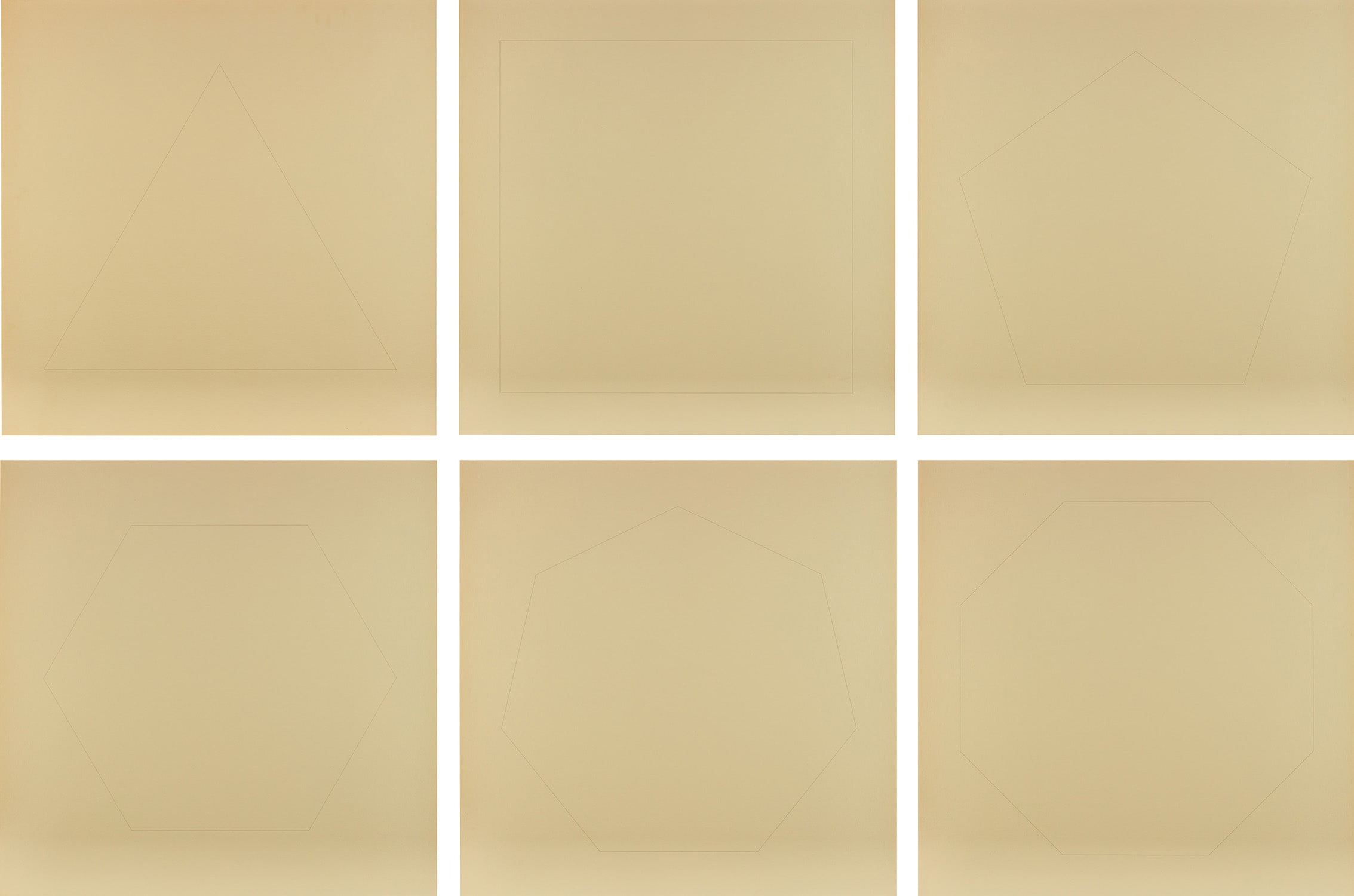
The Pure Polygon Series: six plates
It is a fitting emblem for an artist whose entire practice was devoted to confronting the viewer with something vast, patient, and genuinely outside the usual rhythms of commerce and spectacle. Walter Joseph de Maria was born on October 1, 1935, in Albany, California. He grew up on the western edge of American ambition, in a landscape that already carried the scale and drama that would come to define his mature work. He studied history and then art at the University of California, Berkeley, receiving his BA in 1957 and his MFA in 1959.
Berkeley in the late 1950s was a place of extraordinary intellectual ferment, and de Maria arrived there at exactly the right moment. He absorbed the lessons of the New York School and the emerging discourse around Happenings and Fluxus, developing a deep and lasting friendship with La Monte Young and becoming peripherally involved in the early Fluxus movement. These relationships connected him to a generation of artists who believed that art could be an event, a duration, or a measurement rather than simply a thing. De Maria moved to New York in the early 1960s and quickly became a central figure in the downtown avant garde.
He performed as a drummer, playing with the band that would eventually become The Velvet Underground, and ran in circles that included Richard Serra, Carl Andre, and Robert Smithson. This community of artists was collectively reimagining what sculpture could mean, pushing against the preciousness of the art object and towards something more durational, conceptual, and often physically extreme. De Maria absorbed all of this energy while maintaining a distinctive voice that was his alone: more mathematical, more elemental, and in some ways more spiritually ambitious than nearly anyone around him. He was drawn to systems, to repetition, and to the peculiar beauty that emerges when human measurement is held up against natural scale.
His breakthrough works of the late 1960s established the poles of his practice. The Mile Long Drawing, executed in the Mojave Desert in 1968 using two parallel chalk lines drawn one mile in length and twelve feet apart, announced his commitment to land as both medium and subject. Then came Lightning Field in 1977, installed in a remote area of New Mexico and consisting of 400 polished stainless steel poles arranged in a precise grid covering one mile by one kilometer. Visitors stay overnight in a small cabin and witness over hours and days the way light, weather, and the occasional lightning strike interact with the poles.
The experience is not dramatic in any conventional sense. It is slow, accumulated, and transformative in a way that changes how one sees the open sky thereafter. Lightning Field is widely regarded as one of the defining achievements of Land Art and indeed of postwar art as a whole. What distinguishes de Maria from many of his peers in the Land Art and Minimalist movements is his insistence on exactitude as a form of poetry.
His works are not rough or accidental. They are governed by mathematical systems and geometric precision, yet the effect is never cold. There is something almost devotional in the care with which he measured, counted, and placed. The Broken Kilometer, installed in a cast iron building at 393 West Broadway in New York and also maintained by Dia, consists of 500 solid brass rods each two meters in length, laid in five parallel rows on the wooden floor.
The spacing between the rods increases as they recede from the viewer, creating an optical effect of extraordinary subtlety. Standing before it, one feels the weight of all that metal and all that calculation, and something releases in the mind. For collectors approaching de Maria's work on paper and through his drawings, the Pure Polygon Series represents an especially compelling entry point into his thinking. These graphite template drawings on American Etching paper, presented in their original pine and maple wood portfolio with canvas slipcase, carry the full geometry of his conceptual universe in a form that can be held and studied.
The portfolio format itself is significant: de Maria understood that the object housing a work of art is part of its meaning. The precision of the templates, the quality of the paper and the craftsmanship of the case all speak to a practice where attention to material conditions was never incidental. Works on paper by de Maria offer collectors a rare intimacy with a mind more often encountered at monumental scale, and they occupy an important place in any collection oriented around Conceptual Art or Minimalism. In market terms, de Maria's works appear relatively rarely, which reflects both the nature of his practice and the care with which his estate and the Dia Foundation have stewarded his legacy.
When drawings and editions do appear at auction or through private sale, they attract serious collectors who understand their historical importance. His position within the canon places him in close conversation with Richard Serra, Donald Judd, Robert Smithson, Nancy Holt, and Michael Heizer. Any collector interested in the Land Art generation, or in the broader Minimalist and Conceptual traditions of the 1960s and 1970s, will find de Maria to be an indispensable point of orientation. His work holds its significance not because of market speculation but because of its genuine, enduring strangeness and beauty.
De Maria passed away on July 25, 2013, leaving behind a body of work that feels, if anything, more necessary with each passing year. At a moment when the relationship between human civilization and the natural world has become the defining question of our time, his lifelong devotion to measuring that relationship with honesty, precision, and wonder reads as something close to prophecy. His works do not offer comfort or easy resolution. They offer something better: the experience of genuine scale, the humility that comes from standing in the presence of the unmeasurable, and the strange consolation of knowing that someone tried anyway to take its measure.
For collectors and for culture, that is a gift that does not diminish.
Explore books about Walter de Maria
Walter De Maria
Dia Art Foundation
The Lightning Field
Walter De Maria
Walter De Maria: Sculpture and Drawings
Museum of Modern Art
Walter De Maria: Word and Thing
Dia Art Foundation
The New York Earth Room
Dia Art Foundation
Walter De Maria: Minimal Art and Land Art
Phaidon Press