Walasse Ting
Walasse Ting: Joy Rendered in Pure Color
Artist Spotlight · The Collection Editorial
There is a particular kind of painting that stops you mid step, not because it demands intellectual labor but because it simply delights. Walasse Ting was a master of that arrest. His canvases and papers crowded with luminous women, imperious cats, and flowers so vivid they seem to hum carry a frequency that bypasses argument and goes straight to pleasure. As institutions across Asia and North America continue to reassess the mid century diaspora artists who wove Eastern and Western traditions together into something genuinely new, Ting's work has emerged as one of the most joyful and least easily categorized achievements of that extraordinary generation.
Walasse Ting
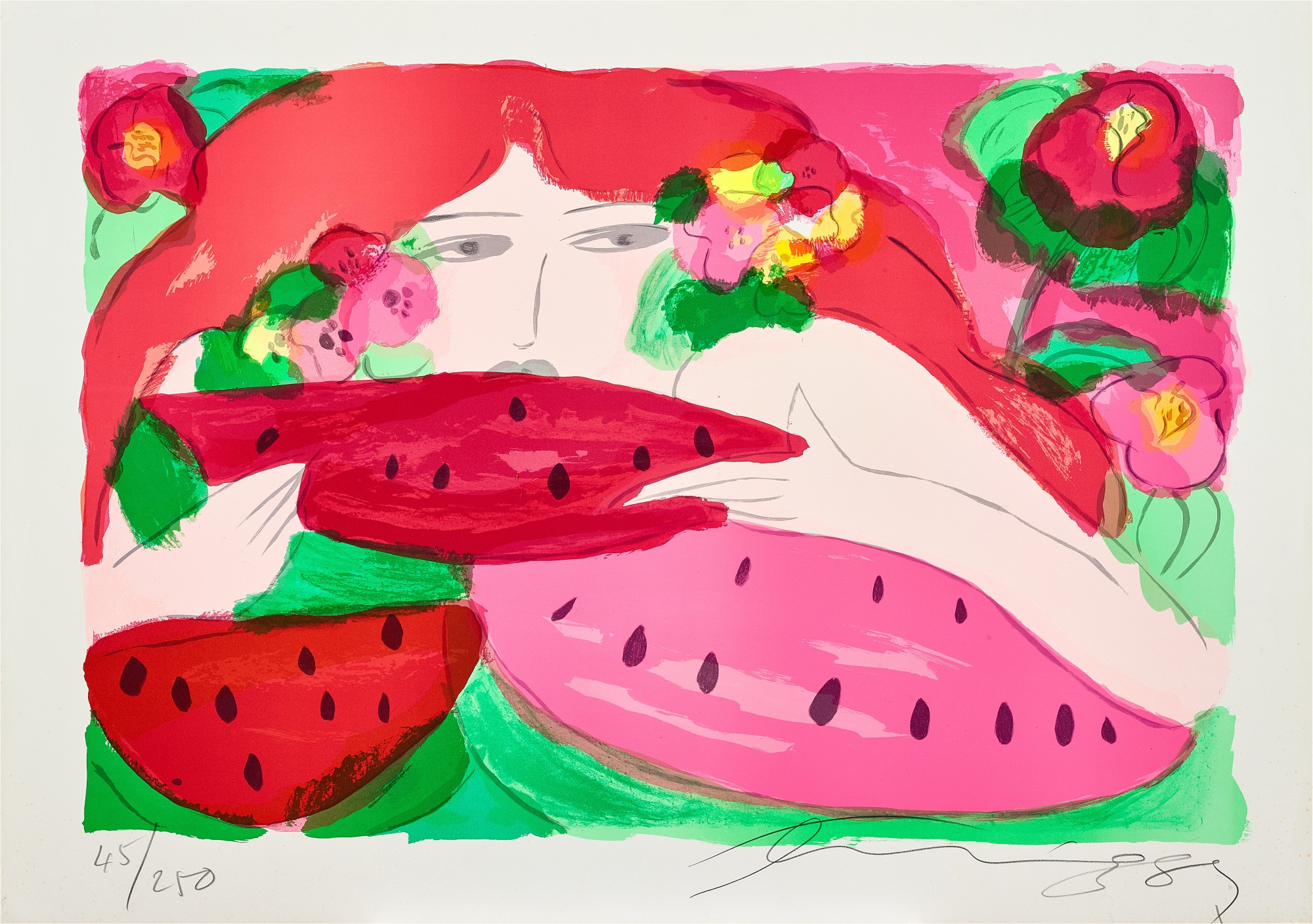
Lady with watermelons 西瓜女人
Collectors who encountered him decades ago tend to speak about their first Ting with the particular warmth reserved for things that changed their eye. Ting was born in Shanghai in 1929, a city then electric with cosmopolitan ambition and cultural collision. He studied at the Shanghai Art Academy before the upheavals of midcentury China set him, like so many artists of his generation, on a path outward. He arrived in Paris in the late 1940s, joining that storied congregation of painters, poets, and dreamers gathered in the cafés and cold studios of the Left Bank.
It was in Paris that his formation truly began, where the deep grammar of Chinese ink painting its respect for the brushstroke as a thing complete in itself, its comfort with empty space, its understanding that gesture carries meaning met the raw energy of postwar European modernism. He was absorbing everything, and he was doing so with the discipline of someone who had grown up understanding that a single brushstroke could contain an entire philosophy. In Paris, Ting found kinship with the CoBrA movement, the loosely affiliated group of artists from Copenhagen, Brussels, and Amsterdam who rejected the cerebral detachment of much postwar abstraction in favor of spontaneity, raw color, and a kind of liberated primitivism. His friendships with Karel Appel and Asger Jorn were formative.
Walasse Ting
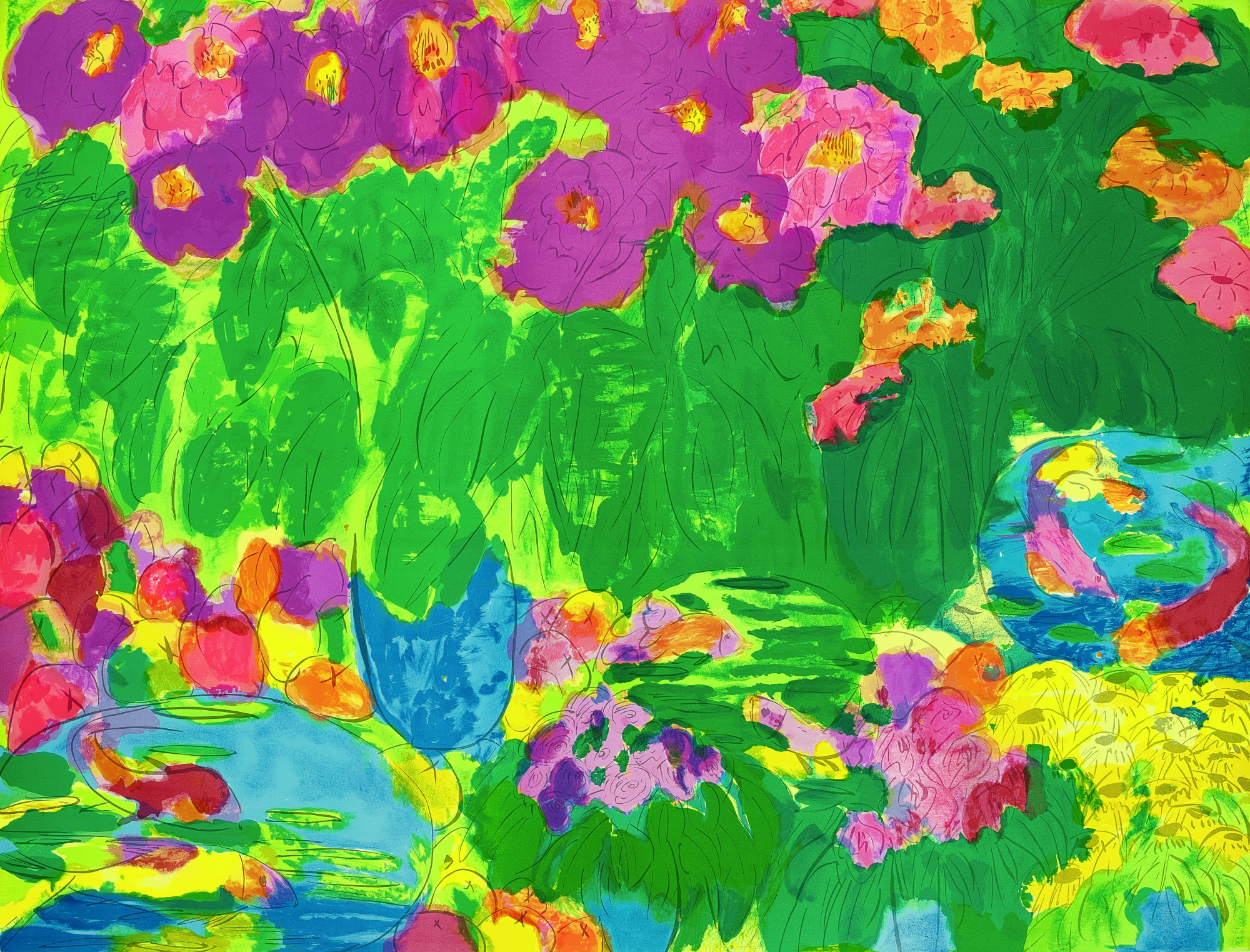
Peaches and flowers 桃和鮮花, 1990
These were painters who believed that feeling was the primary material of art, and Ting, shaped by a calligraphic tradition in which the mark was inseparable from the emotional state of the person making it, recognized in CoBrA something that rhymed with his own deepest instincts. The movement validated what he already knew: that urgency and pleasure were not aesthetic compromises but legitimate ambitions. The pivotal chapter of Ting's career arguably arrived when he relocated to New York in the 1950s and 1960s, entering a scene crackling with Abstract Expressionism and the first stirrings of Pop Art. He found a particular ally in Sam Francis, the California born painter whose own practice floated between lyrical abstraction and something approaching pure color field luminosity.
Their friendship would produce one of the most celebrated artist collaborations of the era. In 1964, Ting and Francis together produced the landmark artist's book "1¢ Life," an extraordinary publication featuring lithographs by Ting alongside contributions from a constellation of artists including Robert Rauschenberg, Andy Warhol, Roy Lichtenstein, and Joan Miró. The book, printed in a limited edition and distributed with characteristic bohemian generosity, is now a prized collector's object and stands as a document of a singular creative moment when downtown New York was genuinely the center of the world's artistic ambition. What distinguishes Ting's mature practice is the particular alchemy he achieved between his two formative inheritances.
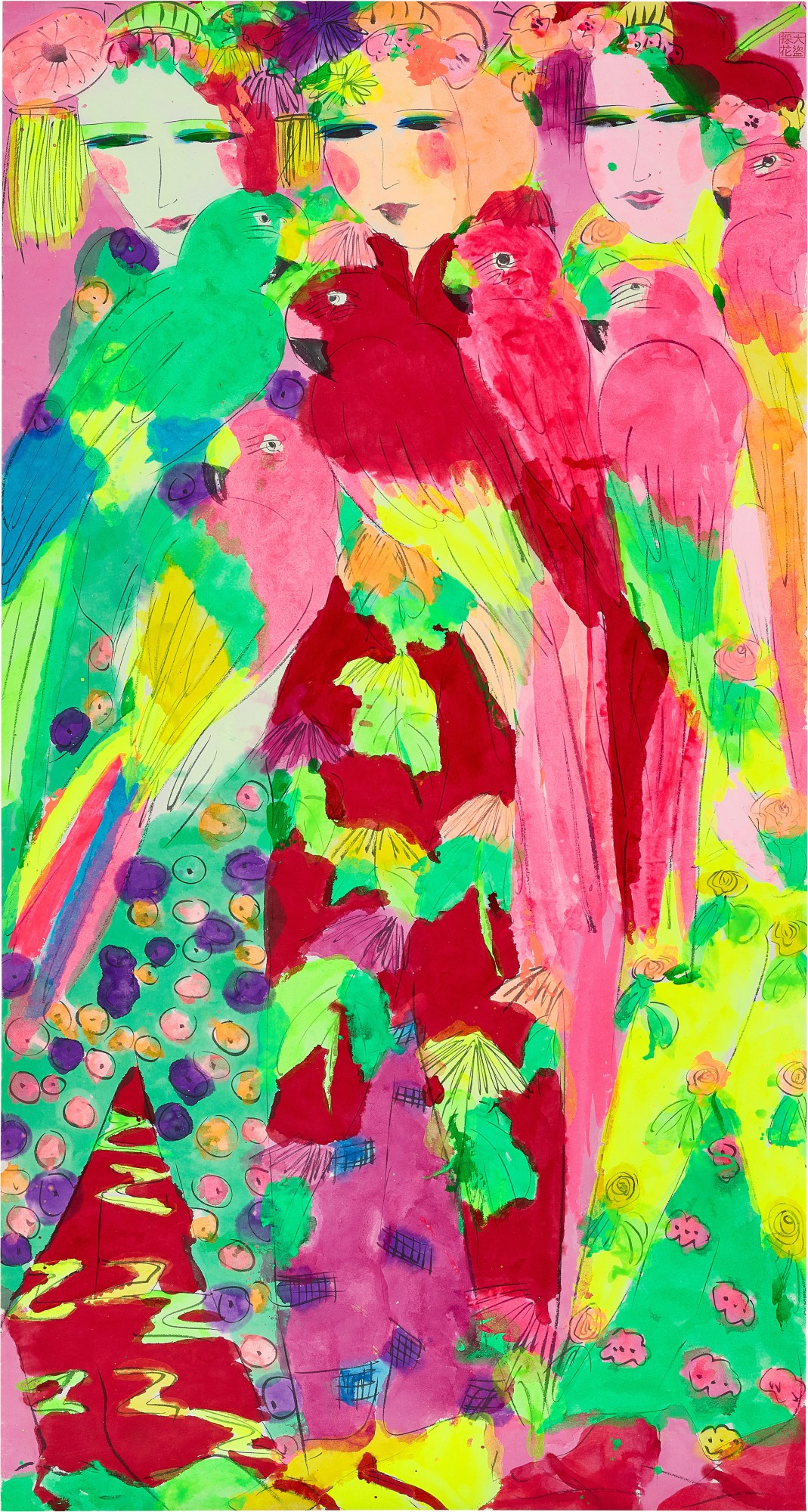
Walasse Ting
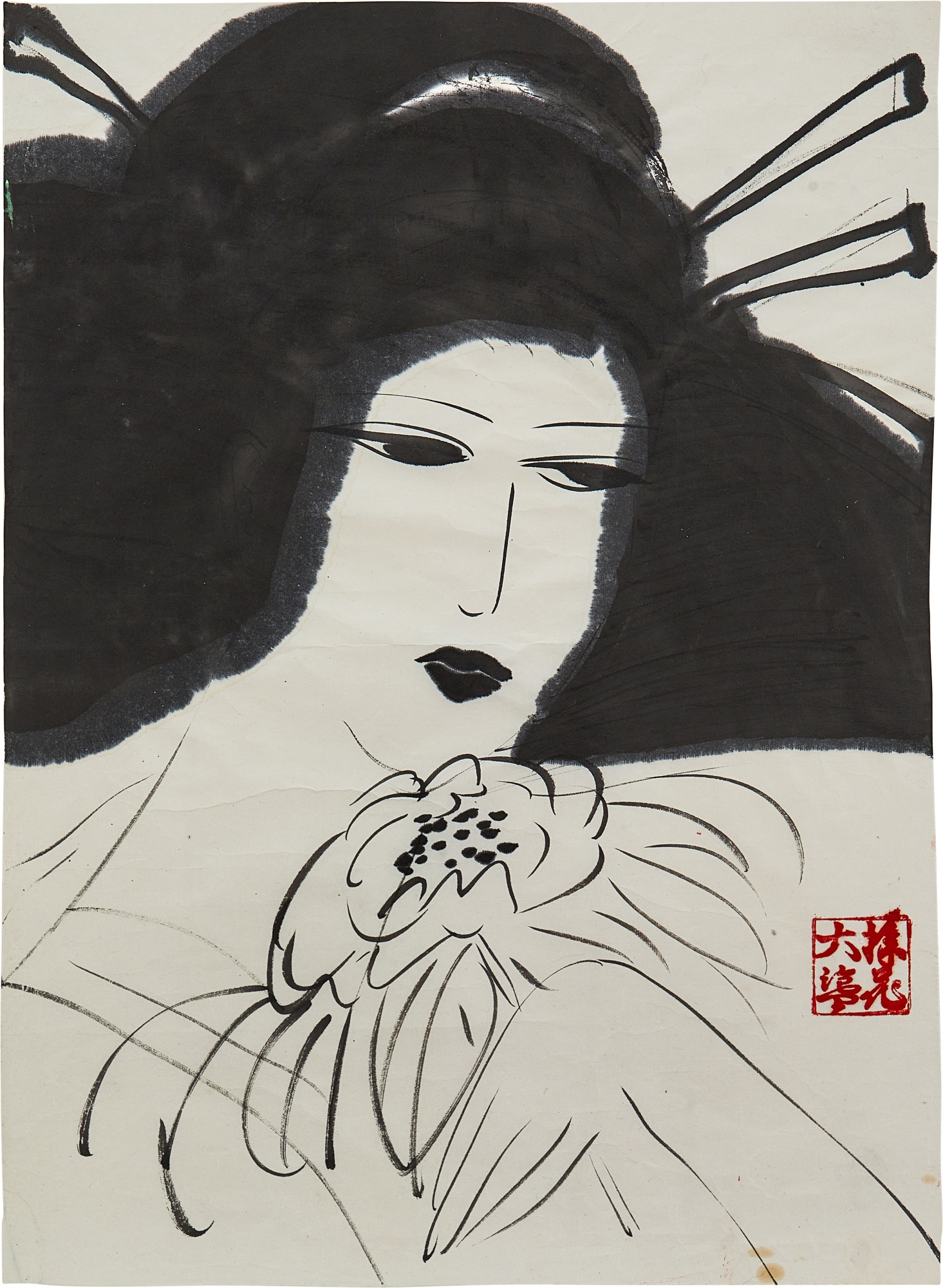
Lady 仕女
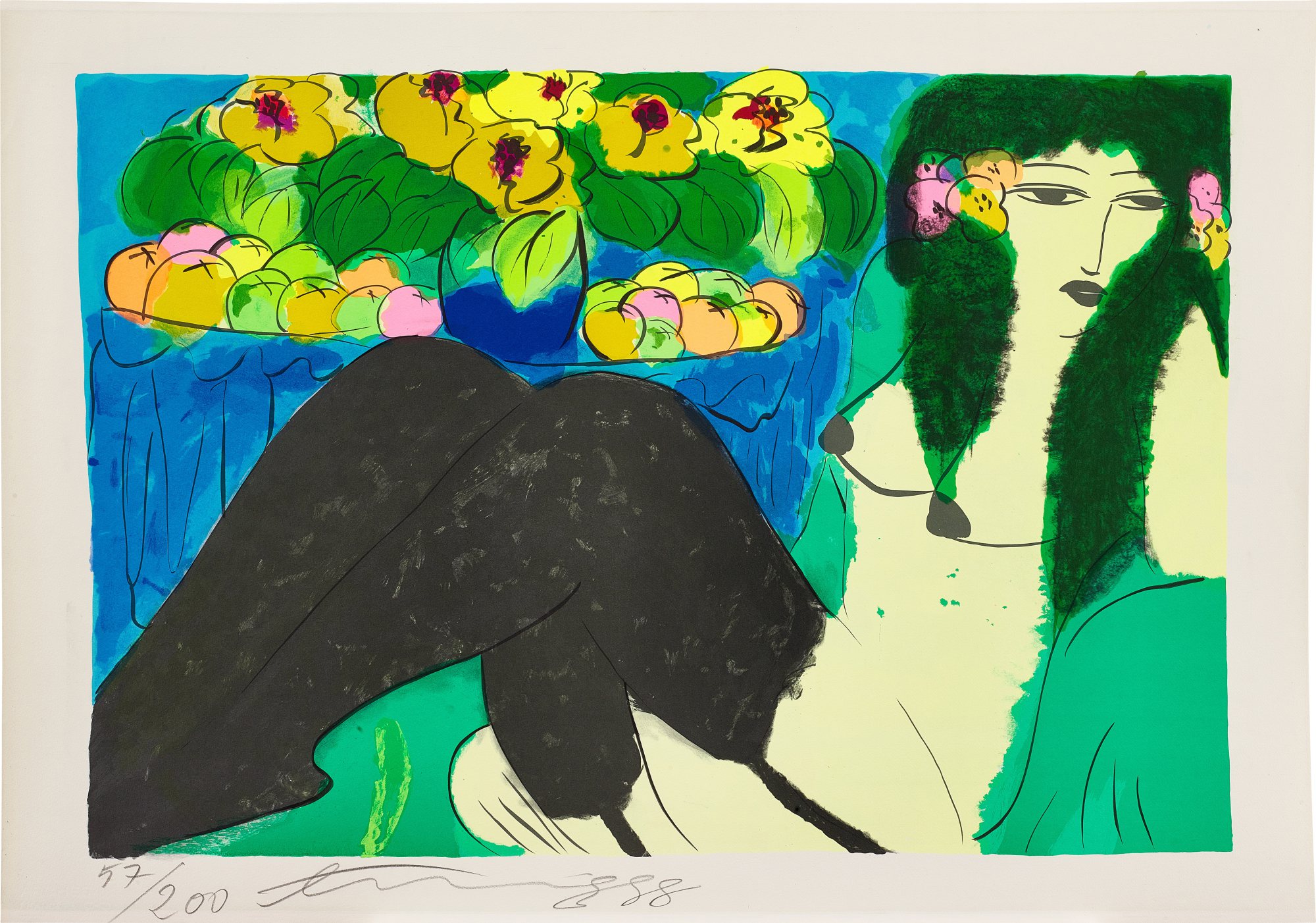
His brushwork is always recognizably Chinese in its speed, its confidence, and its acceptance of the accident as information. A single stroke delineating a woman's shoulder or a cat's arching back has the quality of calligraphy: it was made once, decisively, and it carries the energy of that singularity. Yet the palette is pure Western Pop, even psychedelic: hot pinks, electric greens, sunflower yellows, and deep cobalt blues jostling together with the cheerful excess of a painting that has given itself permission to be gorgeous. His lithographs, of which he produced a significant and celebrated body of work, carry these qualities into the medium with striking fidelity.
Works like "Lady with Watermelons" and "Peaches and Flowers" demonstrate how completely he understood the lithographic process as an extension of his hand, rather than a mechanical reproduction of his ideas. His ink works on paper, including his luminous "Lady" compositions, strip everything back to the essentials of mark and ground, and they are perhaps where his mastery is most purely visible. For collectors, Ting represents a genuinely rewarding area of engagement. His work spans a range of media and scales, from intimate ink drawings to large and commanding acrylics, and his lithographs in particular offer an accessible point of entry into a practice of real historical significance.
Walasse Ting
Lady with flowers 女人與花, 1988
Auction results across Hong Kong, New York, and London have reflected growing institutional and private appetite for his work, with strong demand from collectors in Asia who rightly recognize him as a crucial figure in the story of modern Chinese art and its encounter with the West. What to look for: the vibrancy and clarity of color, the assurance of the linework, and that quality of arrested motion that the best Tings possess. A painting or work on paper by Ting that stops you is a painting that will continue stopping you for decades. Ting occupies a genuinely unusual position in art history, one that grows more rather than less interesting with time.
He is not quite an Abstract Expressionist, not quite a Pop artist, not quite a traditional Chinese painter, and entirely himself. His nearest companions in spirit might include Henri Matisse, whose late works share Ting's conviction that joy is a serious subject, and perhaps the great Japanese Gutai artists who were similarly interrogating what happened when Eastern mark making met Western avant garde energy. Among his direct contemporaries, Sam Francis and Karel Appel remain the most illuminating points of comparison, though Ting ultimately arrived somewhere neither of them could have reached alone. The deepest reason Walasse Ting matters today is simple and has nothing to do with art market dynamics or institutional rehabilitation, though both are real and ongoing.
He painted a world in which beauty was not a consolation or an apology but a form of honesty. His women are not idealized in the Western academic sense; they are presences, vivid and self possessed, rendered with the affection of an artist who found the human figure genuinely inexhaustible as a subject. His cats are portraits of dignity. His flowers are not decorations but arguments.
Taken together, his body of work asserts that pleasure and seriousness are not opposites, that a painting can delight and endure, and that a brushstroke made with full commitment is a form of truth. That is a legacy worthy of sustained and devoted attention.
Explore books about Walasse Ting