Vladimir Dubossarsky
Vladimir Dubossarsky, Painting the World Gloriously Large
Artist Spotlight · The Collection Editorial
When the State Tretyakov Gallery in Moscow devoted serious institutional attention to the generation of Russian artists who came of age after the Soviet collapse, one name surfaced repeatedly in critical conversation: Vladimir Dubossarsky. His canvases, enormous and unapologetically theatrical, had spent decades doing something quietly radical. They held the contradictions of Russian life, the kitsch and the heroic, the borrowed and the deeply local, in a single luscious, technically accomplished image. For collectors and curators navigating the landscape of post Soviet contemporary art, Dubossarsky has long represented something rare: an artist with genuine wit, genuine craft, and a genuine argument to make.
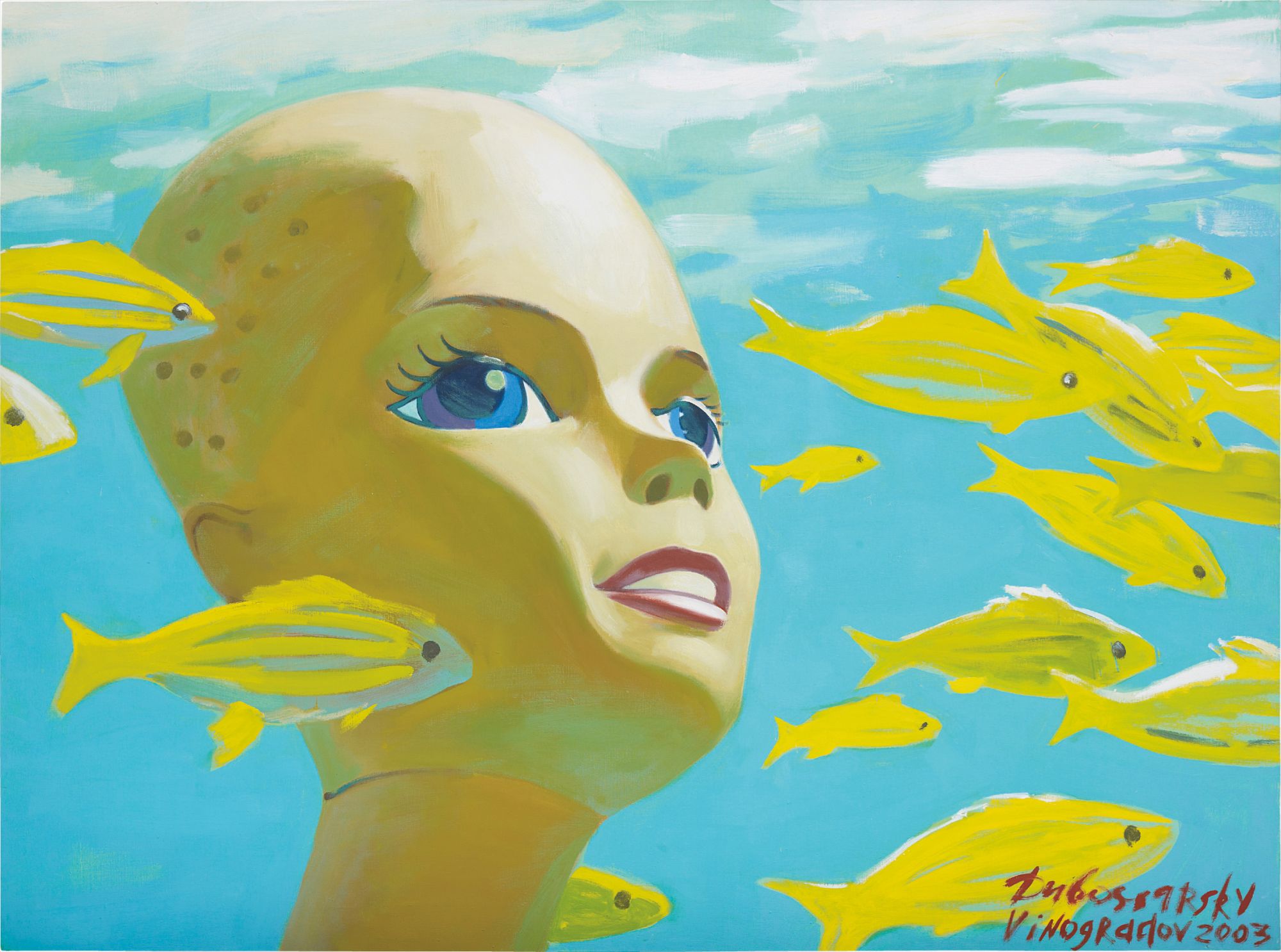
Vladimir Dubossarsky
Barbie
Vladimir Dubossarsky was born in Moscow in 1964, coming of age in a city shaped by the full weight of Soviet visual culture. The propaganda murals, the monumental sculptures, the heroic imagery that filled public space were not abstract historical references for him. They were the texture of daily life, the wallpaper of childhood. He studied at the Moscow State Academic Art Institute named after V.
I. Surikov, one of Russia's most rigorous and prestigious training grounds, where he absorbed the technical traditions of Russian academic painting. That foundation would prove decisive. When the Soviet Union fell and a new, chaotic, pop saturated Russia emerged, Dubossarsky had the skills to paint anything, and the cultural memory to know exactly why it mattered what he chose to paint.
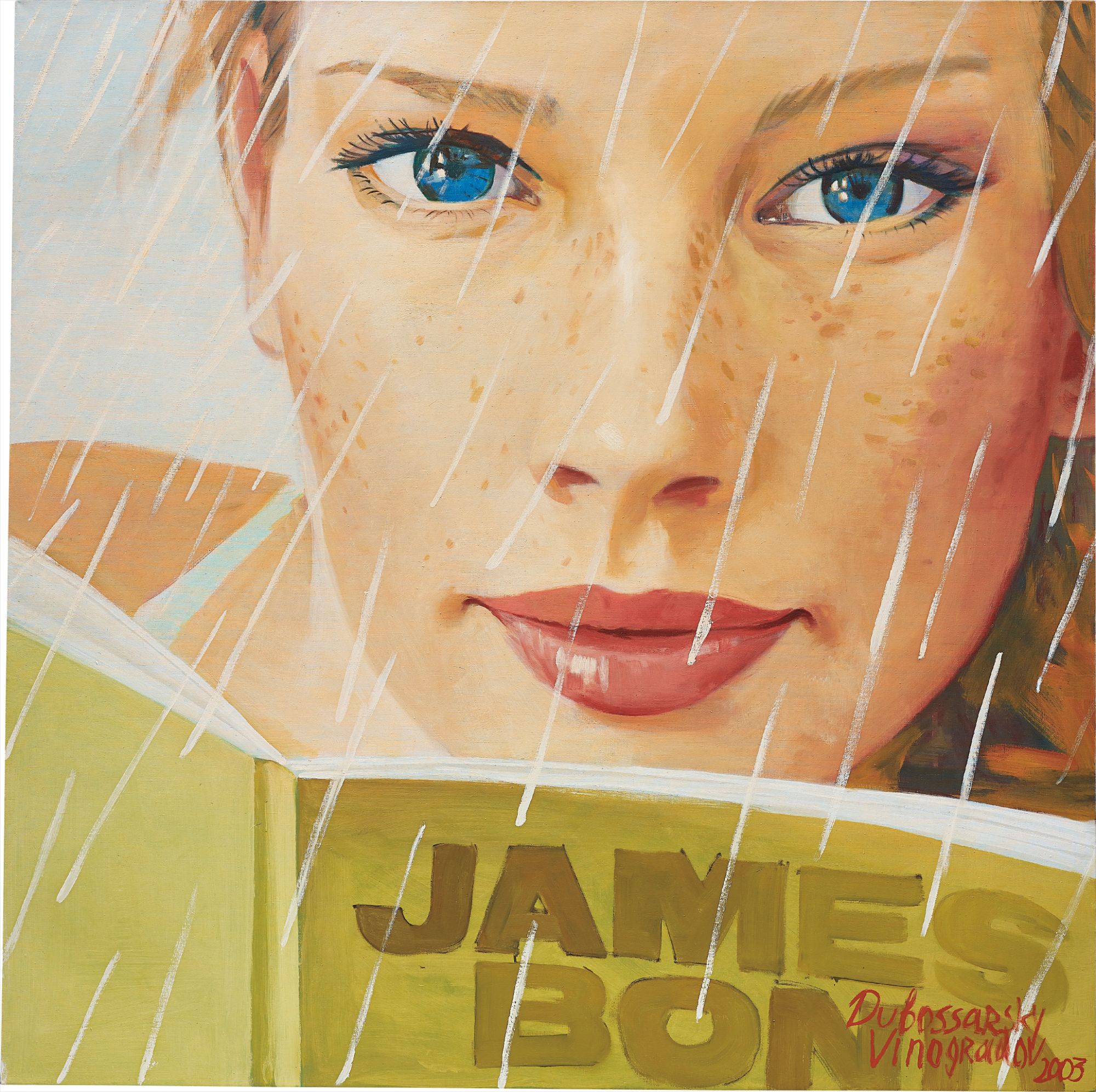
Vladimir Dubossarsky
James Bond, 2003
In the early 1990s, Dubossarsky formed his celebrated collaborative partnership with Alexander Vinogradov, and the duo Dubossarsky and Vinogradov quickly became one of the most talked about presences in Moscow's electrified post perestroika art scene. Working together, they developed a practice that fused the monumental ambitions of Soviet socialist realism with the flotsam of Western popular culture flooding into Russia after the collapse. Their large scale canvases placed Arnold Schwarzenegger and Barbie dolls alongside lush pastoral landscapes and heroic nudes in compositions that felt simultaneously satirical and sincere. The collaboration lasted for roughly two decades and was shown internationally, bringing Russian contemporary art to audiences in Europe and the United States who were hungry to understand what the post Soviet imagination looked like from the inside.
Dubossarsky's paintings from the 1990s and early 2000s represent some of the most electrically charged work produced anywhere in that period. A canvas such as "Arny 3" from 1998 places the unmistakable silhouette of Schwarzenegger as action hero into a pictorial space that owes as much to Russian academic figure painting as it does to Hollywood movie posters. The result is not parody, or not only parody. It is a genuine inquiry into how images acquire power, how bodies become symbols, and how a culture metabolizes foreign iconography.

Vladimir Dubossarsky
Arny - 3, 1998
"James Bond" from 2003 operates in a similar register, taking one of the most globally recognizable fictional identities of the twentieth century and submitting it to the formal logic of Russian monumental painting. The scale of these works is not incidental. Scale is itself an argument about importance, and Dubossarsky understood that from the beginning. The diptychs in his body of work deserve particular attention from collectors.
"La Ronde de Nuit: dans l'atelier de l'artiste" from 2007 is a two panel composition that plays knowingly with the tradition of the artist's studio as subject, a lineage running from Vermeer through Courbet and into the twentieth century. "Summer" from 2002 and "Under Water Orange" from 2005 both use the diptych format to introduce a rhythmic, almost cinematic quality to the image, as though the painting is unfolding in time rather than simply occupying space. This structural intelligence is characteristic of Dubossarsky at his most ambitious. He understands painting as a language with a long history, and he speaks it fluently while choosing to say something entirely his own.

Vladimir Dubossarsky
La Volpina
Works such as "Smoke on the Snow" from 2004 and "After Klazma" from the same year reveal a more lyrical, reflective dimension of his practice. These canvases draw on the Russian landscape tradition, evoking the spiritual weight that Russians have long attached to their natural environment, while introducing the ambiguity and irony that marks his generation's relationship to inherited sentiment. There is genuine feeling in these paintings, but it is feeling that has passed through self awareness and come out the other side more honest, not less. "Japanese Beauties" and "La Volpina" demonstrate his continuing fascination with feminine archetypes and the way popular culture constructs desire, subjects he approaches with curiosity rather than condescension.
For collectors, Dubossarsky offers a remarkably coherent body of work that rewards both individual acquisition and considered collection building. His paintings have appeared at major international fairs and have been held by significant European and Russian collections. The large scale oil and acrylic works on canvas and linen that define his practice are technically assured and have demonstrated strong market presence among collectors focused on post Soviet contemporary art. Works from the peak collaborative period with Vinogradov, roughly 1994 through the early 2010s, are especially sought after, representing a singular cultural moment that cannot be recreated.
As his solo practice has continued to develop, collectors have found in it the same sharp intelligence and formal ambition, now expressed in a more singular voice. Dubossarsky belongs to a generation that includes figures such as Oleg Kulik, AES and F, and Blue Noses Group, artists who used the tools of Western contemporary art, performance, installation, large scale painting, to work through specifically Russian questions about identity, history, and transition. He is perhaps most usefully understood alongside Erik Bulatov, whose text based canvases interrogate the language of Soviet visual culture with similar seriousness, and Ilya Kabakov, whose installations create total environments from the debris of Soviet daily life. Internationally, his use of popular iconography in monumental format invites comparison with the Pictures Generation in the United States, with artists such as Jeff Koons and Richard Prince who asked similar questions about the images that surround us and the desires they encode.
Dubossarsky arrives at related territory through a very different route, and the Russian specificity of his work gives it a character that is entirely irreducible to any Western counterpart. What makes Vladimir Dubossarsky matter today is precisely what made him matter in the 1990s: the insistence that painting, even large, gorgeous, technically accomplished painting full of recognizable faces and popular symbols, is a serious form of thinking. His canvases do not ask you to choose between pleasure and intelligence, between beauty and critique. They insist that these are not in conflict.
In a contemporary art world that has sometimes grown suspicious of painting's capacity for ambiguity, his work stands as a luminous counter argument. To live with a Dubossarsky is to live with a painting that knows exactly what it is doing and invites you, warmly, to figure that out alongside it.