Vija Celmins
Vija Celmins, Keeper of Infinite Skies
Artist Spotlight · The Collection Editorial
“I wanted to rebuild the world, a small piece of it, in my studio.”
Vija Celmins, interview with Dave Hickey
In the autumn of 2019, the Metropolitan Museum of Art in New York opened a landmark retrospective devoted to Vija Celmins, a rare institutional embrace that confirmed what devoted collectors and museum curators had long understood: that this quietly revolutionary artist had spent five decades producing some of the most visually arresting and philosophically resonant work of her generation. The exhibition gathered paintings, drawings, and prints spanning her entire career, and critics responded with the kind of reverence usually reserved for the canonical giants of postwar art. Standing before her vast graphite surfaces, visitors found themselves pulled into a state of concentrated stillness, as though the act of looking had been transformed into something closer to meditation. Celmins was born in Riga, Latvia, in 1938, and her early years were shaped by upheaval that would leave permanent marks on her sensibility.
Vija Celmins
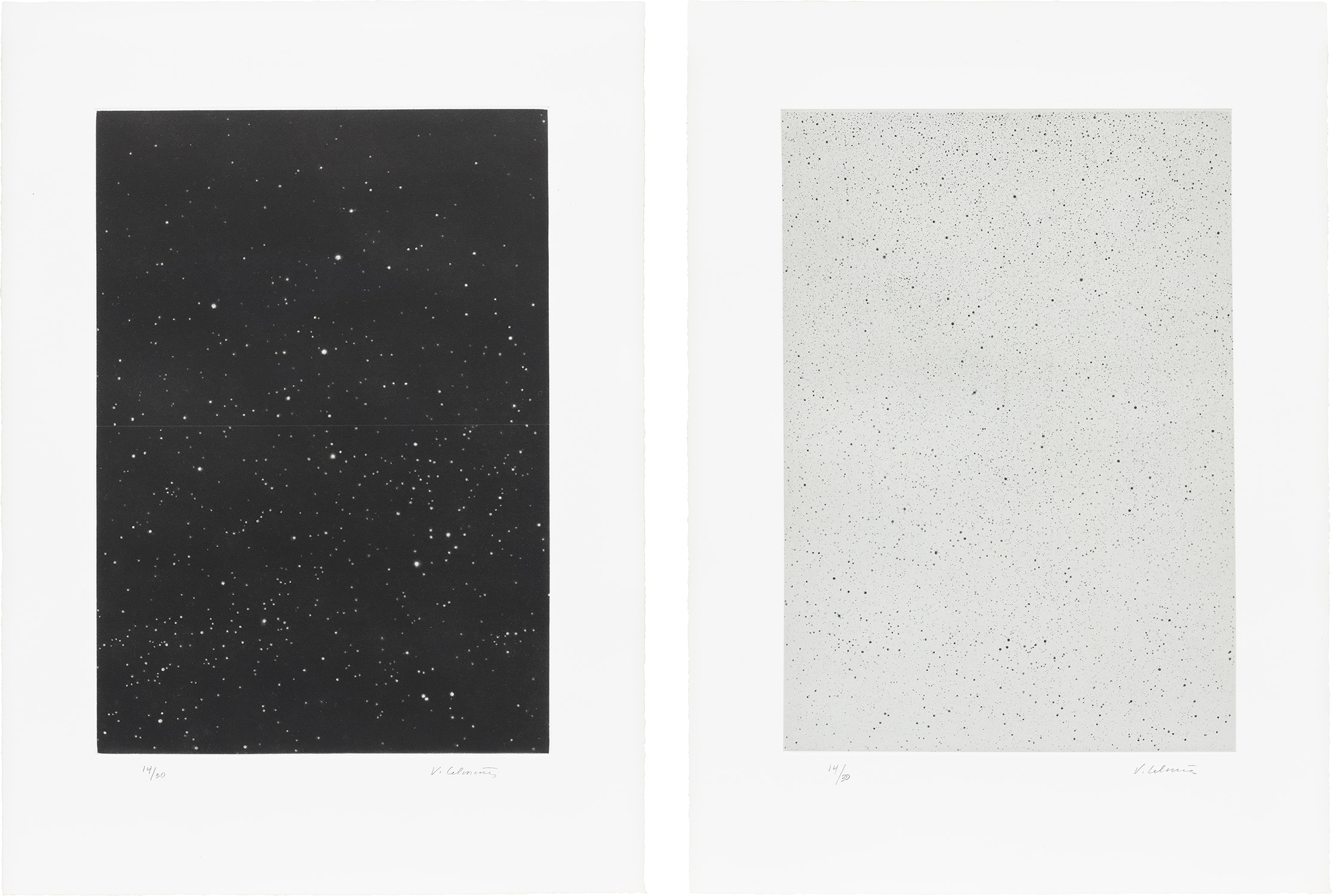
Divided Night Sky; and Reverse Galaxy
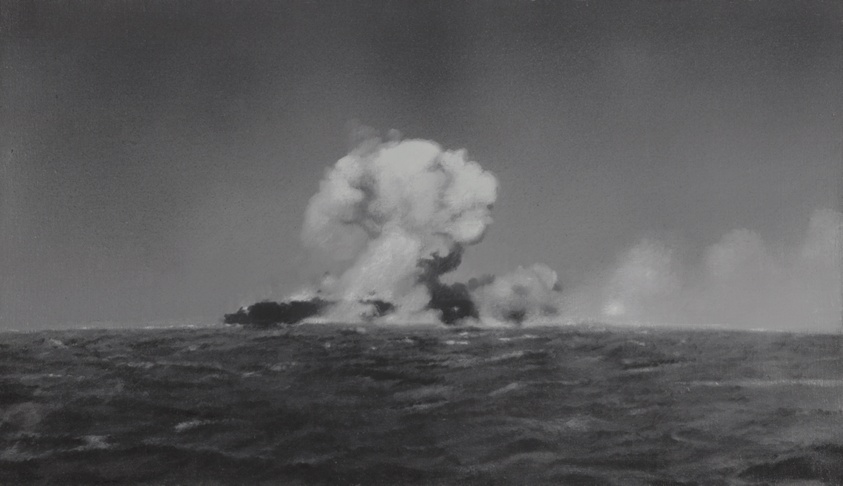
During the Second World War, her family fled Soviet occupation and eventually made their way through Germany before emigrating to the United States in 1949. They settled in Indianapolis, Indiana, where the young Celmins encountered a new world with the heightened attention of someone who understood, at a cellular level, that stability is never guaranteed. She studied at the John Herron Art Institute in Indianapolis before moving to Los Angeles in 1962 to pursue graduate studies at UCLA, arriving just as that city was becoming one of the most energized centers of contemporary art in America. In Los Angeles during the 1960s, Celmins developed her earliest mature work, a series of paintings depicting ordinary domestic objects and, memorably, images sourced from newspaper photographs: aircraft, warships, and exploding planes rendered in muted, almost monochromatic tones.
These works engaged with the concerns of Pop Art without surrendering to its ironic detachment. Where Warhol and Lichtenstein were cool and conceptual in their appropriations, Celmins was intensely physical, building images through an accumulation of marks that expressed a deeply personal relationship to the act of looking. By the late 1960s, she had moved to New York and shifted her focus toward the natural world, beginning her long engagement with the surfaces of oceans, deserts, and night skies that would define her reputation. The works for which Celmins is best known are exercises in almost unimaginable patience and precision.
Vija Celmins
Strata (G. 1056, R. 15)
Her graphite drawings of ocean surfaces, begun in the late 1960s and returned to across subsequent decades, present the viewer with a field of water that appears simultaneously infinite and utterly flat. The desert floor works, based on photographs of the Mojave, transform arid terrain into complex geometric compositions that hover between representation and pure abstraction. And then there are the night skies, perhaps her most iconic subject: fields of darkness scattered with stars, rendered in graphite or executed as prints, that achieve a paradox peculiar to great art, the sense that a fixed image can contain the feeling of endlessness. These are not illustrations of nature.
“The work is really about looking. Intense looking. Building something through looking.”
Vija Celmins, The Metropolitan Museum of Art, 2019
They are propositions about perception itself. Celmins has worked extensively in printmaking, and this dimension of her practice is particularly rewarding for collectors. Her collaborations with Gemini G.E.
Vija Celmins
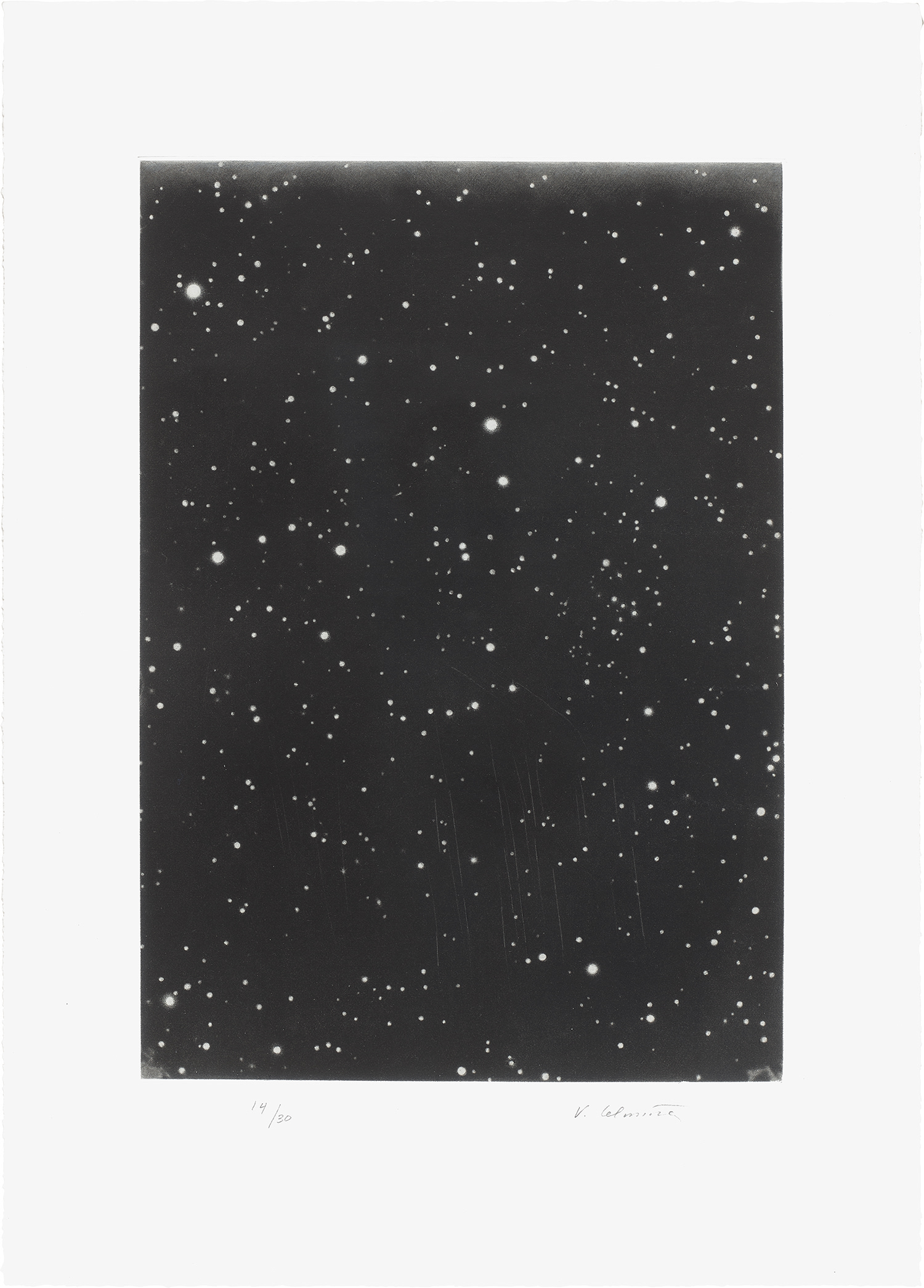
Dark Galaxy
L. in Los Angeles produced prints of exceptional technical ambition, including the mezzotint and aquatint works in the Strata series. Her night sky prints, made using photogravure, aquatint, and drypoint, achieve tonal subtlety that rivals her drawings on paper. Works such as Night Sky I (Reversed) and Night Sky 2 (Reversed), produced on Hahnemühle Copperplate paper, and the dazzling Divided Night Sky and Reverse Galaxy, a pairing of mezzotint and etching with drypoint on Magnani Pescia Satinato paper, demonstrate how inventively she has translated her obsessions into the printmaking medium.
The Concentric Bearings series, published with Gemini G.E.L., combines mezzotint, aquatint, drypoint, and photogravure in works of formidable beauty and rarity.
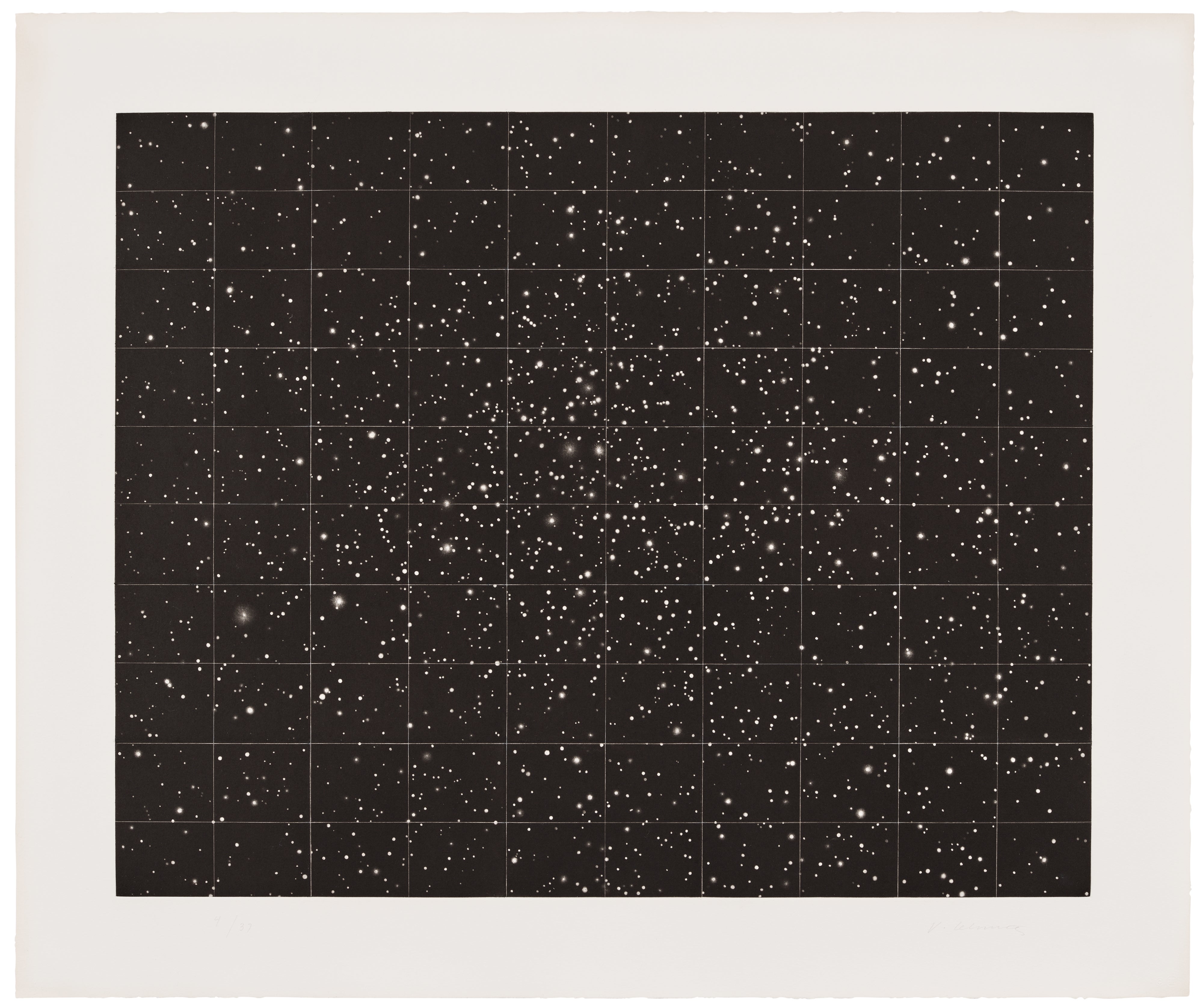
Vija Celmins
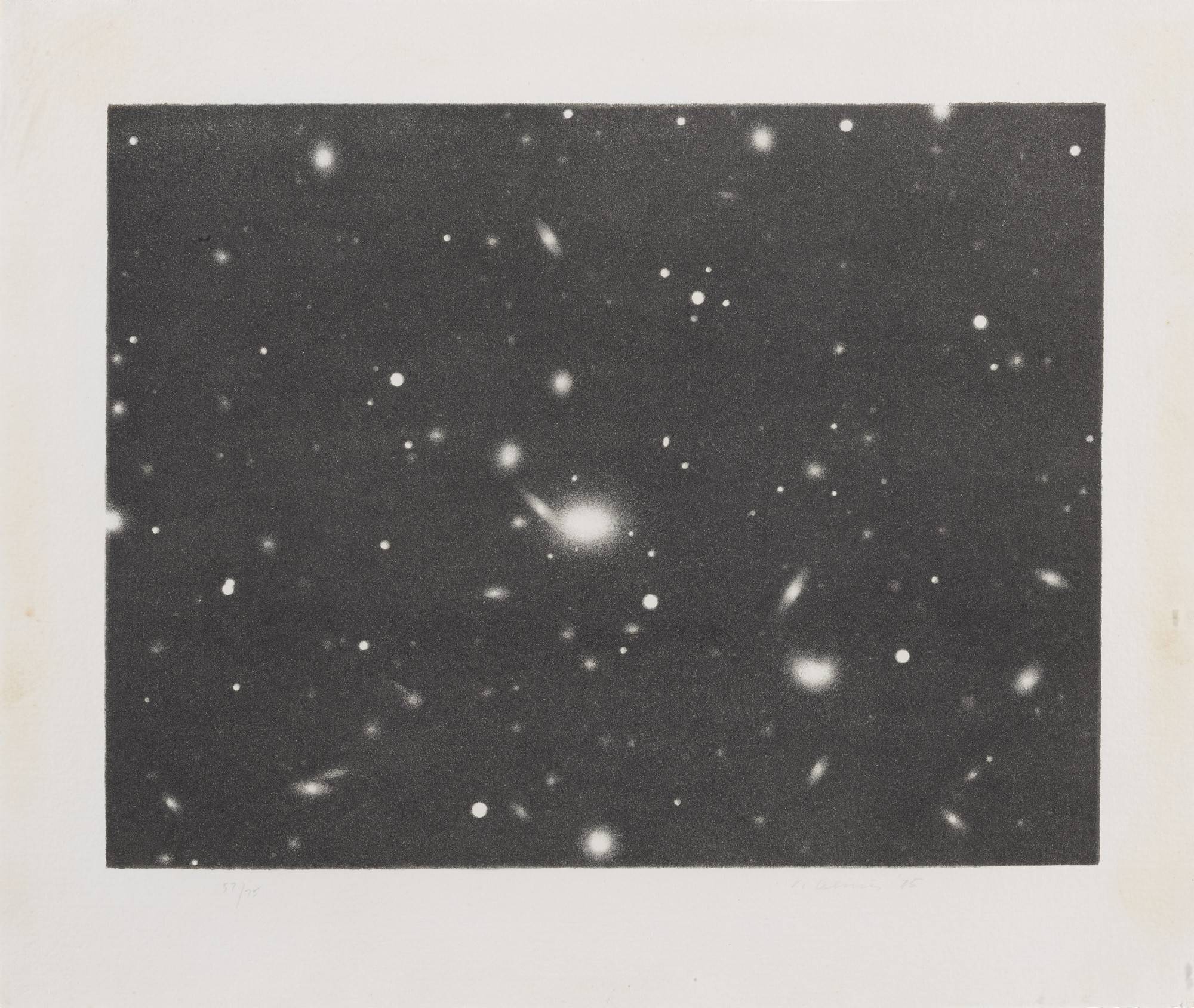
Galaxy
Each print rewards the kind of sustained looking that Celmins herself brings to the making of them. From a collecting perspective, Celmins occupies a position that is both accessible and genuinely significant. Her prints and multiples, while not inexpensive, allow collectors to engage with her practice at a range of price points. Her unique drawings and paintings command serious prices at auction and appear in the holdings of the world's most important institutions: the Museum of Modern Art, the Whitney Museum of American Art, and Tate in London all hold significant examples of her work.
The appeal to collectors is not merely aesthetic. There is a conceptual coherence to her practice, a sense that every work she has made belongs to a sustained inquiry, that makes a single piece feel like an entry point into an entire world of thought. Works published through Simmelink and Sukimoto Editions, such as Dark Galaxy and Galaxy, are particularly sought after for their combination of rarity and visual power. In the context of art history, Celmins invites comparison with a constellation of artists who share her commitment to slowness, surface, and the phenomenology of looking.
Agnes Martin, whose grids were also meditations on infinity and repetition, is a natural reference. The German painter Gerhard Richter, who has similarly explored the relationship between photography and painting, occupies adjacent intellectual territory. And there are connections to the Photorealist movement, though Celmins has always resisted that label, insisting that her work is less about reproducing appearances than about exploring what it means to construct an image mark by mark over time. Her practice is also deeply sculptural: her bronze casts of stones, paired with their real counterparts in her celebrated To Fix the Image in Memory series, are among the most quietly astonishing objects in contemporary art.
Vija Celmins matters today not simply because her work is beautiful, though it is, with a gravity and precision that rewards every encounter. She matters because she offers a model of artistic integrity that feels increasingly vital. In an era of accelerating images and shortening attention spans, her work demands a different kind of engagement, slow, patient, and completely present. She has spent her career making art that insists on the value of careful looking, and in doing so she has produced a body of work that seems more urgent with each passing year.
For collectors who value depth over novelty and lasting resonance over seasonal trend, Celmins is not simply an excellent choice. She is an essential one.
Explore books about Vija Celmins