Victor Vasarely
Victor Vasarely, The Master Who Made Vision Dance
Artist Spotlight · The Collection Editorial
“Pure form and pure color can signify the world.”
Victor Vasarely
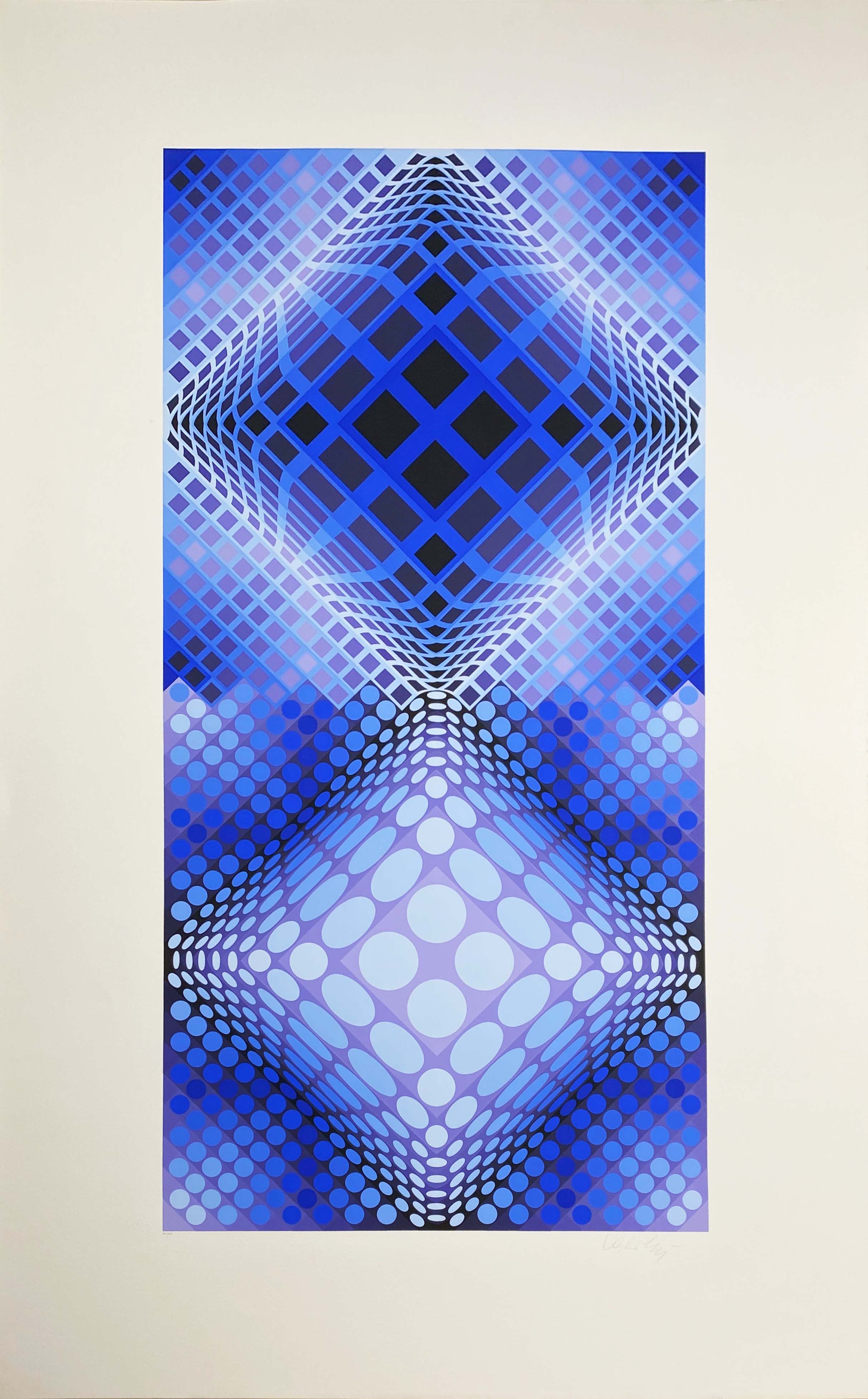
Stand before a Vasarely and something remarkable happens. The canvas breathes. Squares ripple outward like sound waves. Spheres swell and recede without moving an inch.
Victor Vasarely
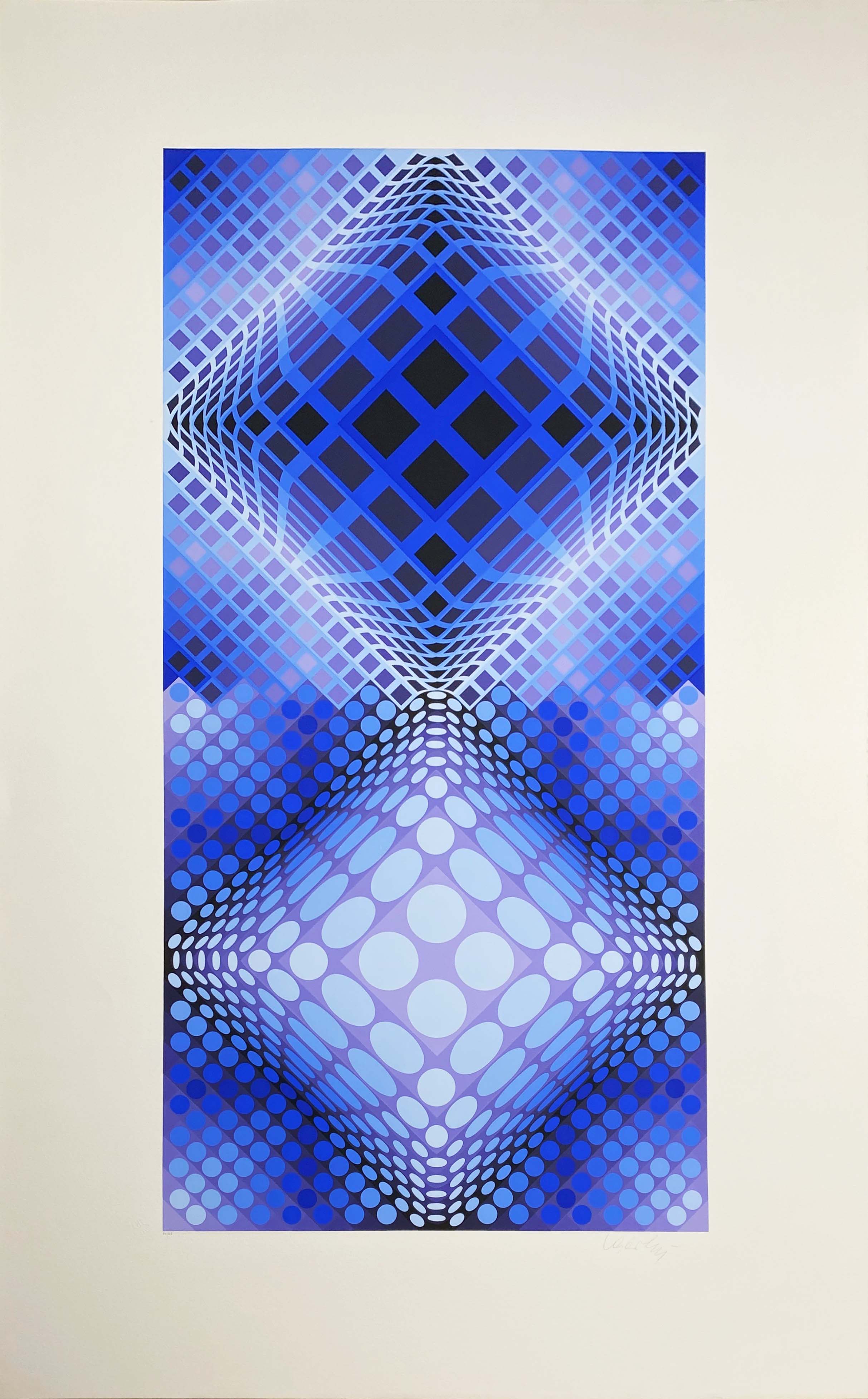
Album Meta: Seven Plates 2, 1976
It is a phenomenon that has captivated gallery visitors and serious collectors for seven decades, and in recent years the appetite for his work has only intensified. Major retrospectives at the Fondation Vasarely in Aix en Provence and renewed scholarly attention across Europe have repositioned him not merely as a pioneer of Op Art but as a genuinely radical thinker whose ideas about perception, democracy in art, and the integration of visual experience into everyday life feel startlingly prescient in our image saturated present. Victor Vasarely was born Viktor Vásárhelyi in Pécs, Hungary, in 1906, in a country then still part of the Austro Hungarian Empire. The city of Pécs had a lively artistic and intellectual culture, and the young Vasarely showed an early aptitude for drawing that his family encouraged.
He enrolled at the Budapest Academy of Medicine before abandoning that path entirely to pursue art, a decision that would prove transformative. In 1927 he entered the Mühely, the Budapest school founded by Sándor Bortnyik that was explicitly modeled on the Bauhaus in Weimar. There, under the influence of Bauhaus pedagogy and its belief that art, craft, and industrial design could and should speak the same language, Vasarely absorbed principles of formal rigor, geometric structure, and the social purpose of visual communication that would underpin everything he made for the rest of his life. He arrived in Paris in 1930, a young man carrying Bauhaus ideals into a city still dazzled by Surrealism and the last embers of the avant garde movements that had exploded before the war.
Victor Vasarely
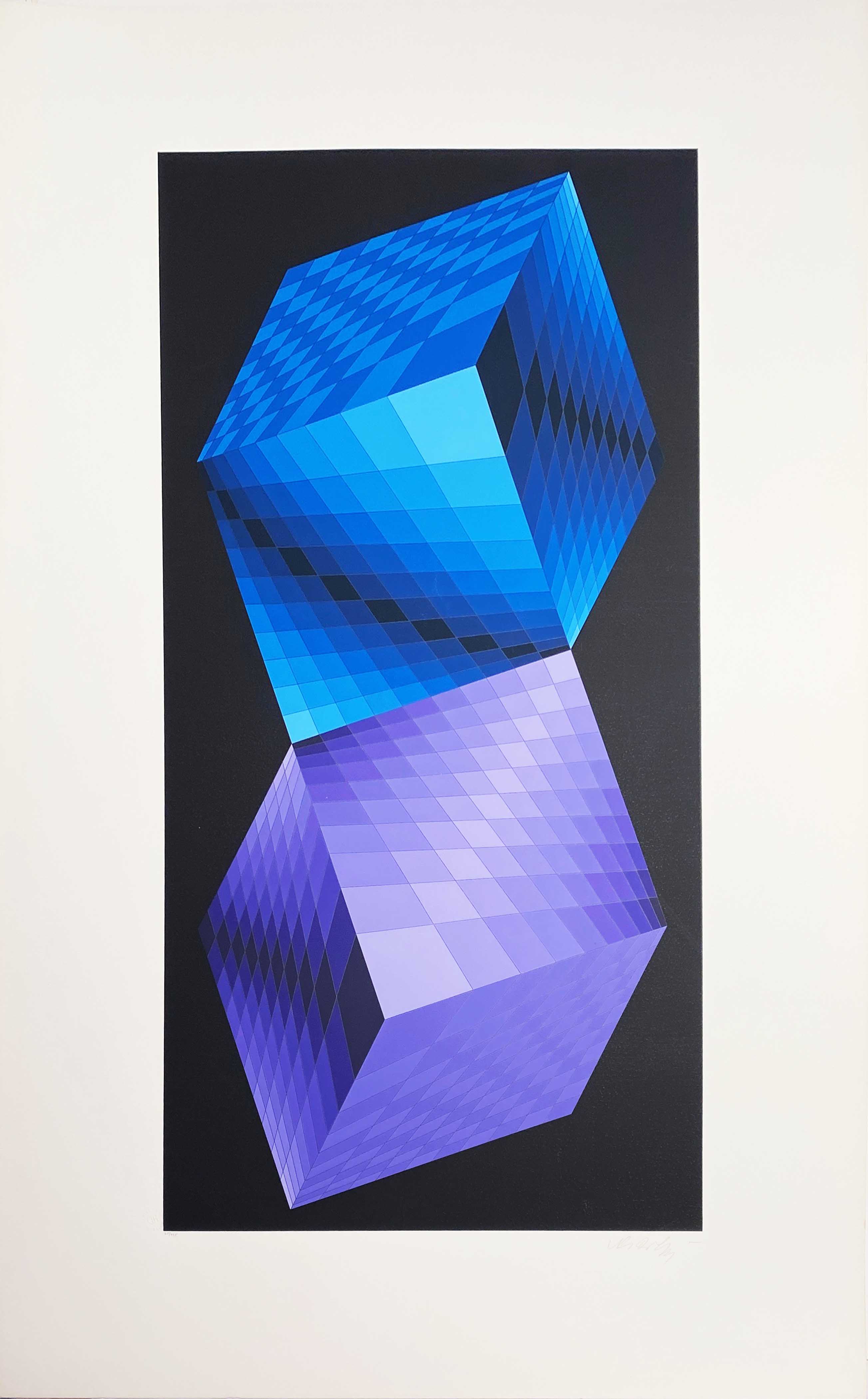
Album Meta: Seven Plates 7, 1976
For much of the 1930s and into the 1940s he worked in graphic design and advertising, a period he later described as formative rather than secondary. The commercial work demanded clarity, precision, and an understanding of how the eye moves across a surface, skills that would become the very substance of his mature painting. By the late 1940s he had begun making works on paper and canvas that explored the optical consequences of geometric pattern, works that announced a completely original sensibility. The 1950s were the decade of breakthrough.
“The art of tomorrow will be a collective treasure or it will not be at all.”
Victor Vasarely
Works such as Grilles II, from 1952, show Vasarely arriving at the formal vocabulary he would develop with extraordinary consistency and ambition across the following four decades. The grid becomes a field of possibility. Lines thicken and thin, shift and cluster, creating the illusion of curvature on a flat surface. He called this systematic approach his Alphabet, a set of elemental units including squares, rhombuses, hexagons, and circles that could be combined in infinite permutations to generate visual movement.
Victor Vasarely
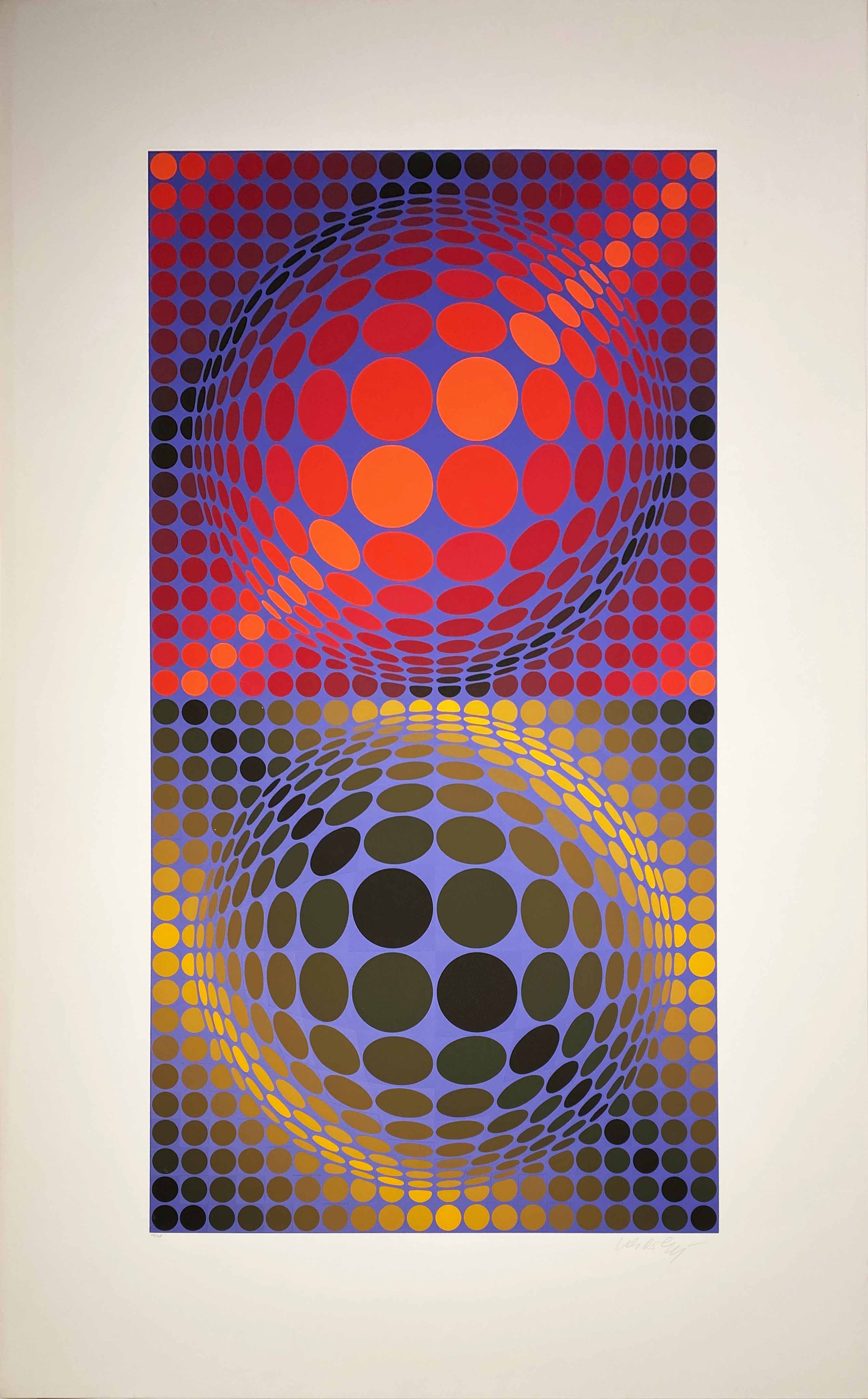
Album Meta: Seven Plates 4, 1976
It was an idea with philosophical implications as much as aesthetic ones. If art could be reduced to a reproducible visual code, then it could be multiplied, distributed, democratized. Vasarely believed passionately that art should not be the exclusive property of the wealthy few. He wanted his images to live on posters, in public spaces, in the homes of ordinary people.
By the 1960s the world had caught up with him. The Op Art movement, named by a Time magazine critic in 1964, brought Vasarely to international prominence, and his inclusion in the landmark exhibition The Responsive Eye at the Museum of Modern Art in New York in 1965 introduced his shimmering geometries to an enormous American audience. He became one of the most discussed artists of the decade, a figure whose work seemed to capture something essential about modernity, about the way perception itself could be a subject for art. Works from this period, including the Vonal series and his explorations of spherical and cubic forms, pushed his visual language into three dimensions, creating forms that appear to inflate and rotate on the picture plane.
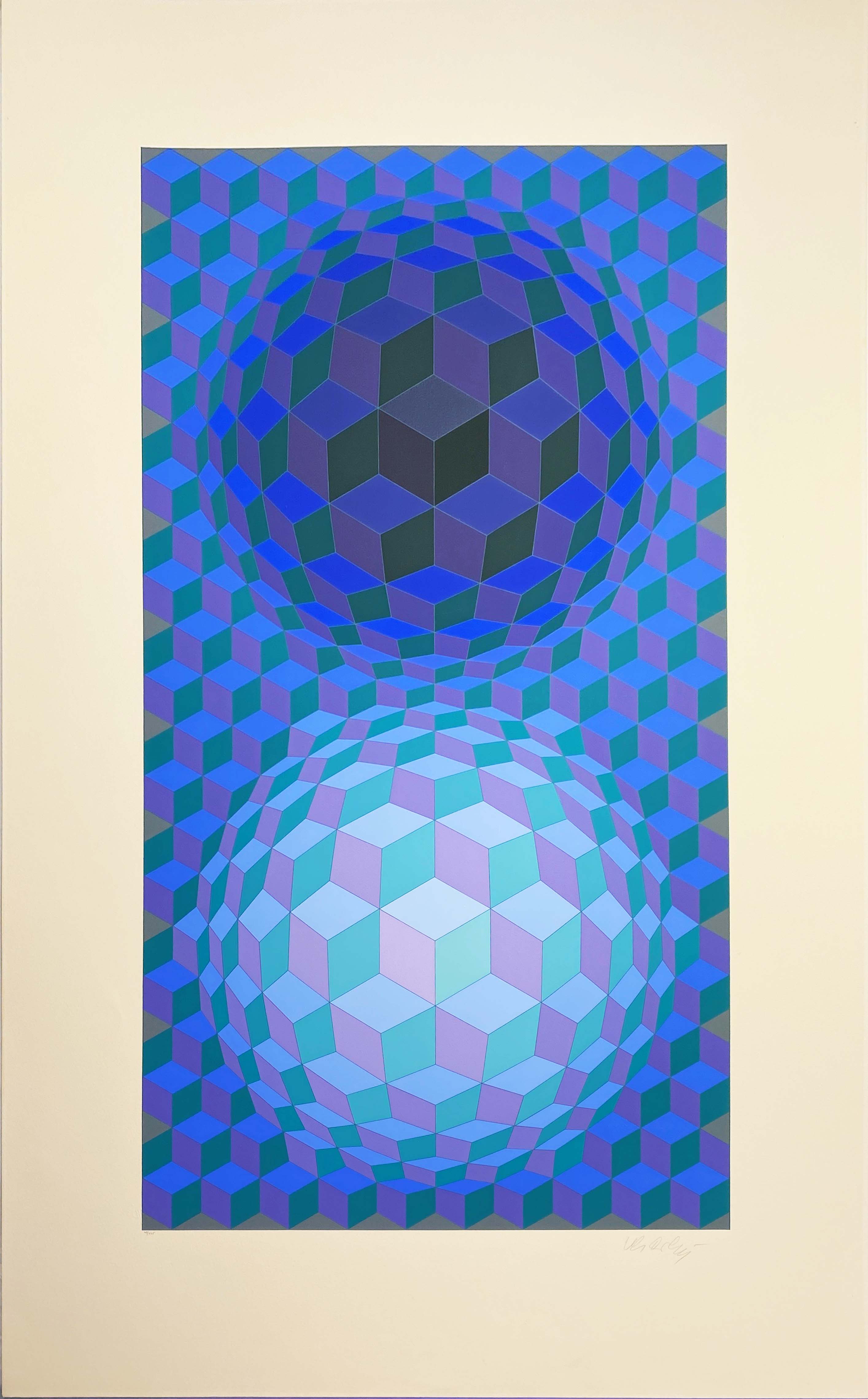
Victor Vasarely
Album Meta: Seven Plates 5, 1976
Vonal Prim, from 1975, exemplifies this mastery, its precisely calibrated acrylic surface generating a sense of depth and movement that seems to exceed what paint and canvas should be able to achieve. The screenprint became an essential medium for Vasarely, and works such as the Album Meta series from 1976 demonstrate why. Printmaking aligned perfectly with his democratic philosophy. An edition of screenprints could reach hundreds of collectors, carrying the same optical charge as a unique canvas at a fraction of the cost.
The Album Meta plates, with their layered fields of color and geometry, show a printmaker operating at the absolute height of his craft, each sheet a complete and self sufficient visual argument. Sphere and Cube, another celebrated screenprint, brings together the two forms that obsessed him most, setting them in dynamic tension across a field of shifting color. These works remain among the most accessible entry points to his practice and are sought by collectors at every level of the market. For those looking to build a collection, Vasarely offers a richly varied landscape.
His unique canvases in acrylic, particularly works from the late 1960s through the 1970s such as Hazay a from 1968 and Alum I, represent his practice at its most ambitious and command strong prices at auction, with major works having appeared at Christie's, Sotheby's, and Bonhams in London and Paris. Signed and numbered screenprints from well documented editions, including the Réponses à Vasarely portfolio, offer a compelling combination of authenticity and relative accessibility. Collectors should look for works with clear provenance, legible edition numbers, and consistent color registration, signs of quality control that Vasarely took seriously. His work sits comfortably alongside that of contemporaries including Bridget Riley, whose kinetic line work shares his preoccupation with retinal experience, and Josef Albers, whose Homage to the Square series pursued a related investigation into color and perception through geometric form.
Ellsworth Kelly and Richard Anuszkiewicz also belong to the broader constellation of artists working the territory between abstraction and opticality that Vasarely helped define. Vasarely spent his later decades at the Fondation Vasarely in Aix en Provence, a building he designed in collaboration with the architect Jean Sonnier and which opened in 1976 as a monument to his vision of art as environment. He died in Paris in 1997 at the age of ninety, leaving behind an extraordinary body of work and an institution dedicated to its continuation. His legacy is not a nostalgic one.
The questions he asked about perception, reproducibility, and the social life of images are questions that artists, designers, and thinkers are still grappling with today. In a visual culture defined by screens, algorithms, and the infinite reproducibility of the digital image, Vasarely looks less like a historical figure and more like a prophet who simply arrived a few decades early.
Explore books about Victor Vasarely
Victor Vasarely
Marcel Joray
Vasarely
François Marquet
Victor Vasarely: A Retrospective
Pierre Restany
Vasarely: Catalogue Raisonné
Gabrielle Esperabé de Lafontan

Victor Vasarely
Jean Luc Chalumeau
Vasarely: The Complete Works
Michelle Knopp
Victor Vasarely: Paintings and Prints
Ann Temkin