Vanessa Beecroft

Vanessa Beecroft: The Body as Living Canvas
Artist Spotlight · The Collection Editorial
“I wanted to show the body as a form, like a still life, something to be observed.”
Vanessa Beecroft, interview
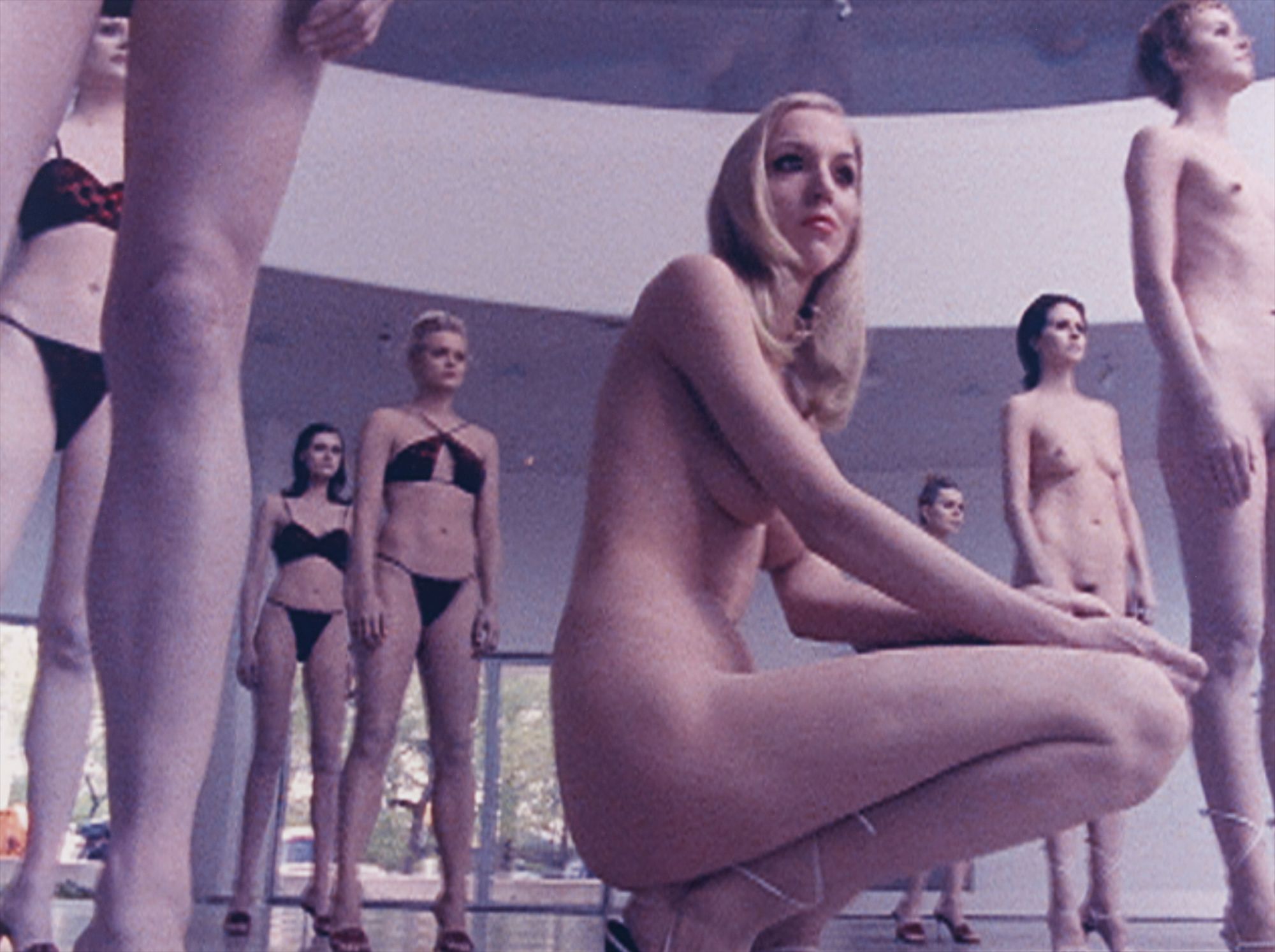
There are moments in contemporary art that feel genuinely unrepeatable, and Vanessa Beecroft has made a career of engineering them. When the Solomon R. Guggenheim Museum in New York opened its rotunda to one of her performances, audiences encountered something that defied easy categorization: rows of women, meticulously dressed or undressed, standing in near silence as visitors circled them across Frank Lloyd Wright's iconic spiral. The work, catalogued as VB35, became one of the defining images of late 1990s performance art, a photograph of which now circulates as both document and artwork in its own right.
Vanessa Beecroft
Untitled, 2014
That chromogenic print, rich in color and compositional tension, captures what Beecroft does better than almost anyone: she transforms the human body into a medium as rigorously controlled as oil paint or bronze. Vanessa Beecroft was born in Genoa, Italy, in 1969, and her early formation was shaped by the particular intensity of Italian aesthetics, the weight of classical tradition pressing against the restlessness of postwar European culture. She studied at the Accademia Ligustica di Belle Arti in Genoa before continuing her education at the Accademia di Brera in Milan, one of Italy's most storied art institutions. Milan in the late 1980s and early 1990s was a city alive with fashion, design, and a ferociously competitive creative scene, and Beecroft absorbed its visual language deeply.
Her earliest works were rooted in painting and drawing, and a personal diary she kept during her student years, obsessively cataloguing her daily food intake, later became source material for her first performance in 1993. That first performance, staged in Milan, was called VB01, and it established the numerical naming convention she would carry through her entire career. The work involved a group of women, invited to stand in a gallery space while Beecroft read aloud from her diary. From the beginning, her practice was about exposure in multiple senses: the exposure of the body, of private psychological material, and of the social structures that govern how we look at women.
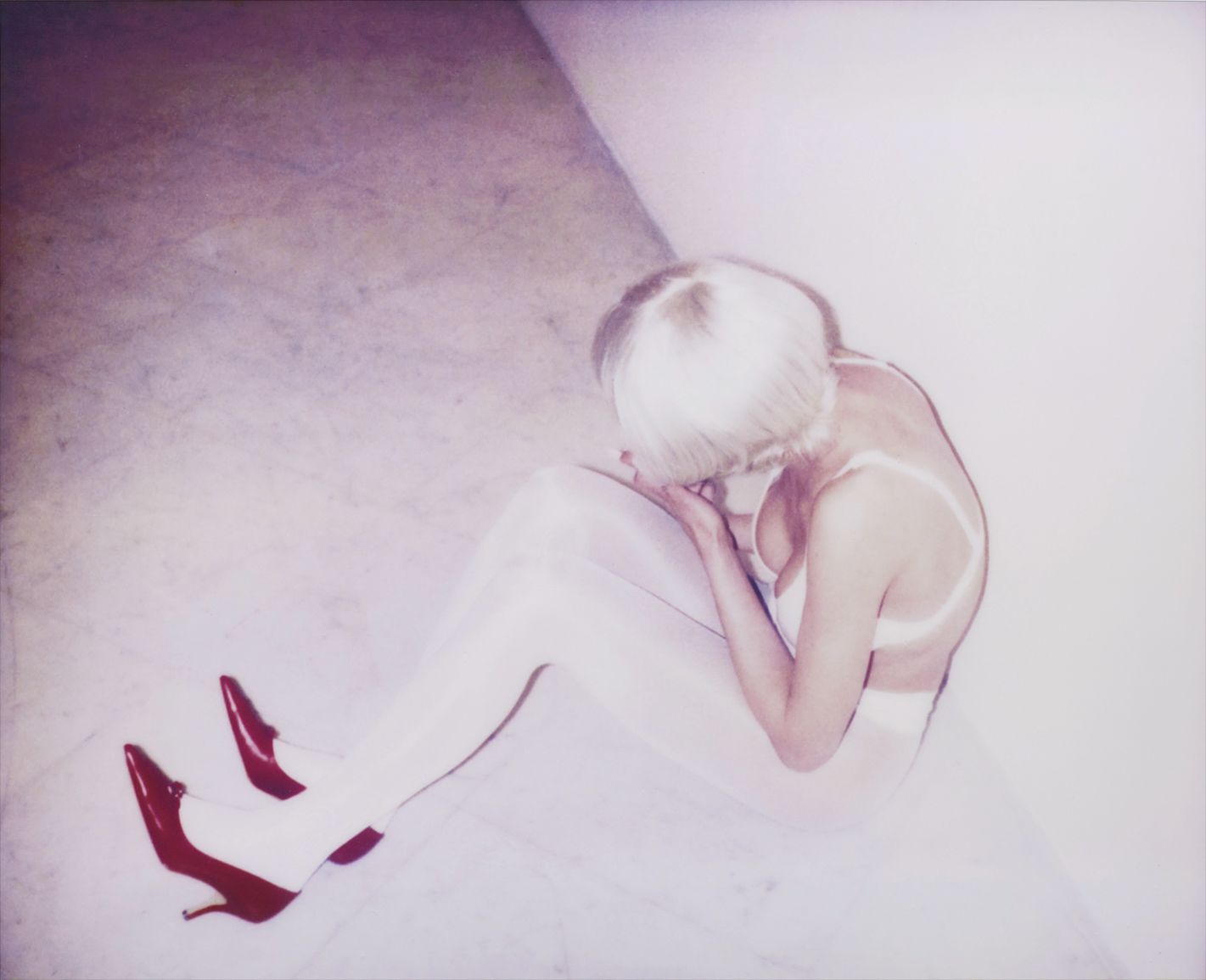
Vanessa Beecroft
VB26.038, Galleria Lia Rumma, Naples
She moved to New York in the mid 1990s, and the city's art world embraced her with unusual speed. Galleries like Deitch Projects helped bring her work to a wider American audience, and her performances began to attract the kind of attention that crosses from the art world into broader cultural conversation. Through the late 1990s and into the 2000s, Beecroft refined and expanded her visual language with remarkable consistency. Her performances, always designated with the VB prefix followed by a number, took place in museums, galleries, and institutional spaces around the world, from the Castello di Rivoli in Turin to the Gagosian Gallery in Los Angeles.
The VB52 performance at Castello di Rivoli, documented in a stunning chromogenic print face mounted to Plexiglas, exemplifies her mature approach: groups of women arranged with choreographic precision, their stillness creating a tension between sculpture and living presence. Her work at Galleria Lia Rumma in Naples, documented in VB26.038, similarly demonstrates her sensitivity to architectural context, allowing the specific weight and light of each venue to inflect the work's meaning. The photographs that emerge from these events are not mere documentation; Beecroft considers them artworks in their own right, and their status in the market reflects that position.
Vanessa Beecroft
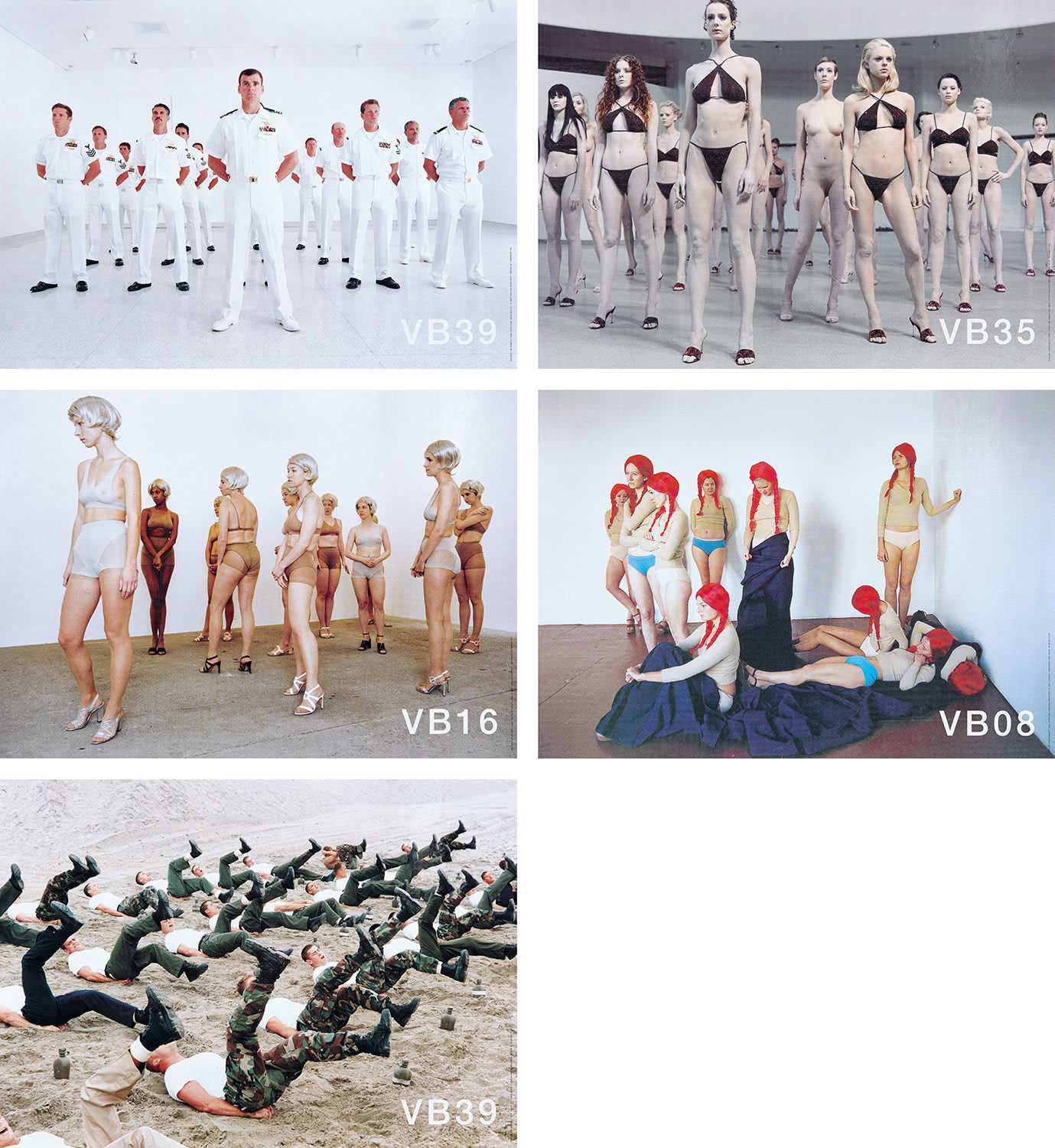
VB08; VB35; VB16; VB39; and VB39 (P. 56)
Among the most compelling aspects of her practice is how it holds multiple art historical conversations simultaneously. She draws from the tradition of Minimalism, particularly the serial, systemic thinking of artists like Carl Andre and Donald Judd, but she replaces geometric abstraction with the irreducible specificity of human bodies. She is in dialogue with feminist performance artists including Marina Abramovic and Yoko Ono, yet her aesthetic is shaped as much by couture fashion and classical painting as by radical body art. Her collaborations with fashion have been frequent and genuinely integrated into her practice rather than peripheral to it.
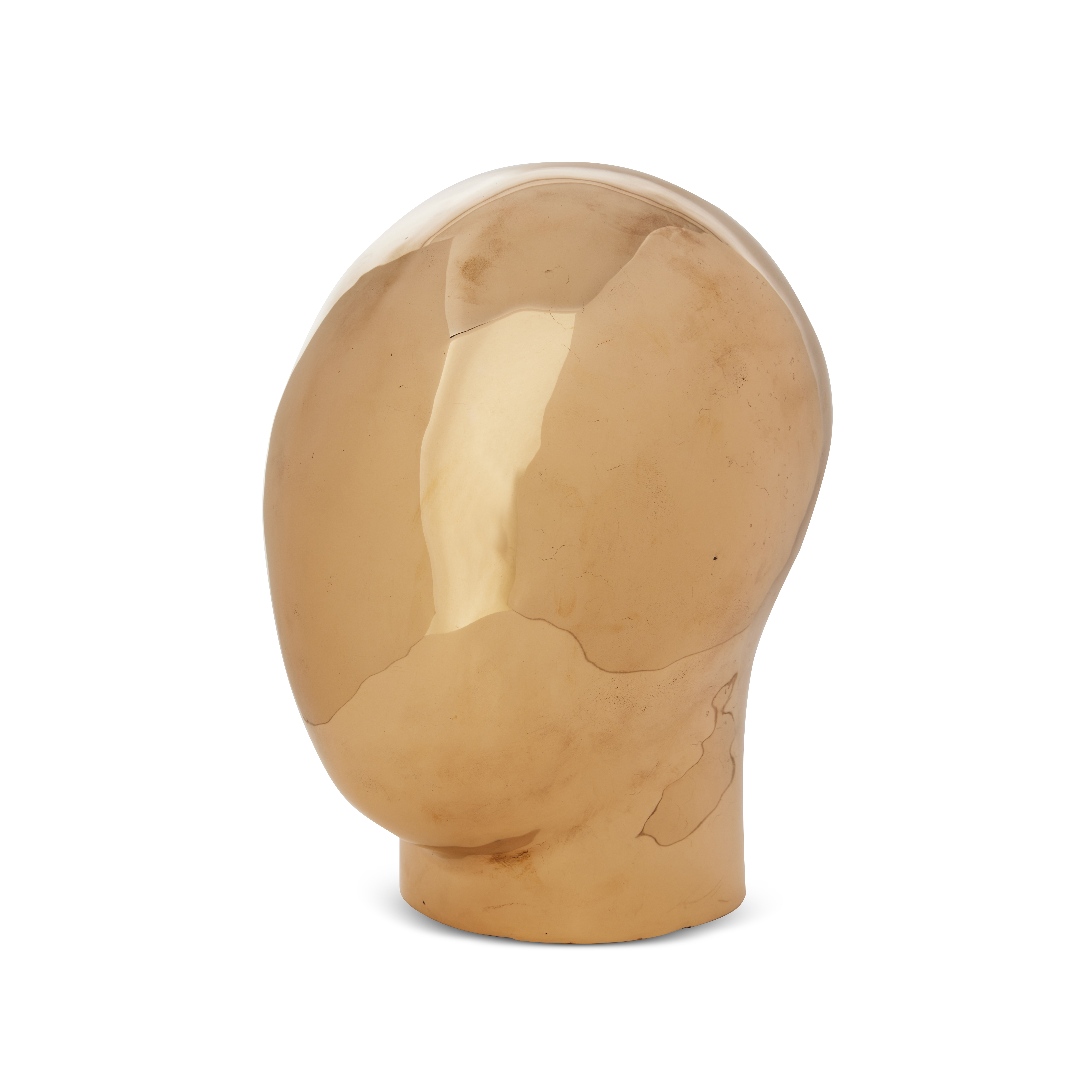
A work like Vogue Hommes, presented as a complete set of two digital pigment prints in colors on Hahnemühle photo rag paper, shows how comfortably she moves between the registers of fine art and image culture without compromising either. Her bronze sculpture titled Untitled from 2014 adds yet another dimension to this already rich practice, demonstrating a commitment to material permanence alongside the temporal ephemerality of performance. For collectors, Beecroft's work offers both intellectual depth and extraordinary visual presence. The chromogenic prints and C prints that document her performances are available in carefully controlled editions, often signed and numbered with certificates of authenticity, making their provenance and status clear.
Vanessa Beecroft
c-print
Works published through Parkett, the celebrated Zurich and New York based arts publication, including editions such as VB08, VB35, VB16, and VB39, represent particularly strong collecting opportunities because they combine the credibility of Beecroft's practice with the imprimatur of one of contemporary art's most respected editorial platforms. These editions were produced in limited runs and signed by the artist, and they sit comfortably in collections alongside work by artists who shaped the same era, including Cindy Sherman, Wolfgang Tillmans, and Andreas Gursky. Site Santa Fe works, such as Top 20 from the New Mexico festival, document her engagement with institutional contexts beyond the traditional gallery circuit and add geographic and institutional breadth to any collection focused on her output. The question of legacy is one Beecroft's work raises with particular urgency right now, as conversations about the representation of women's bodies in art history have deepened and become more nuanced.
Her practice has always been entangled with these questions in complex ways, drawing both celebration and critique, which is precisely what ambitious art does. To look at a work like Jesse, one of her more intimate figurative pieces, is to understand that behind the orchestrated grandeur of the large scale performances is an artist of genuine sensitivity and psychological acuity. Beecroft has never been content to repeat a successful formula, and her willingness to move between performance, photography, painting, and sculpture over more than three decades marks her as one of the most restlessly intelligent artists of her generation. Her work belongs in serious collections not simply because it documents a significant moment in contemporary art history, but because it continues to ask difficult and beautiful questions about seeing, being seen, and what it means to be present in the world.
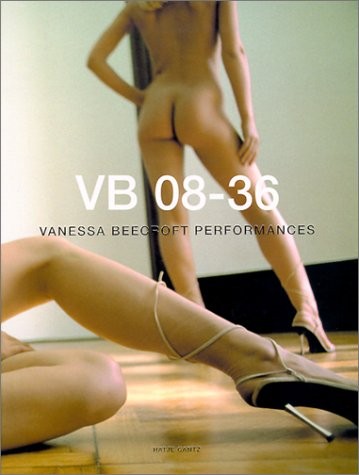
Explore books about Vanessa Beecroft
Vanessa Beecroft: VB
Vanessa Beecroft, Bruce Ferguson
Vanessa Beecroft
Robert Sansi
Vanessa Beecroft: Performances 1993-2003
Vanessa Beecroft, Various curators
Vanessa Beecroft: VB Drawing
Vanessa Beecroft
Vanessa Beecroft: VB Drawings, Paintings, Installations 2006-2010
Vanessa Beecroft