Valerio Adami
Valerio Adami, The Poet of Sharp Lines
Artist Spotlight · The Collection Editorial
There are moments in art history when a single canvas stops a room. At the Centre Georges Pompidou in Paris, where Valerio Adami's work has been celebrated and studied for decades, visitors encounter something immediately arresting: a world rendered in bold, unbroken outlines, filled with flat planes of saturated color, where the familiar becomes strange and the strange becomes luminous. Adami has spent the better part of seven decades building one of the most singular visual languages in postwar European painting, and yet his work remains one of the great pleasures awaiting discovery for a new generation of collectors and enthusiasts. Born in Bologna in 1935 and raised in Milan, Adami came of age in an Italy still rebuilding itself from the rubble of the Second World War.
Valerio Adami
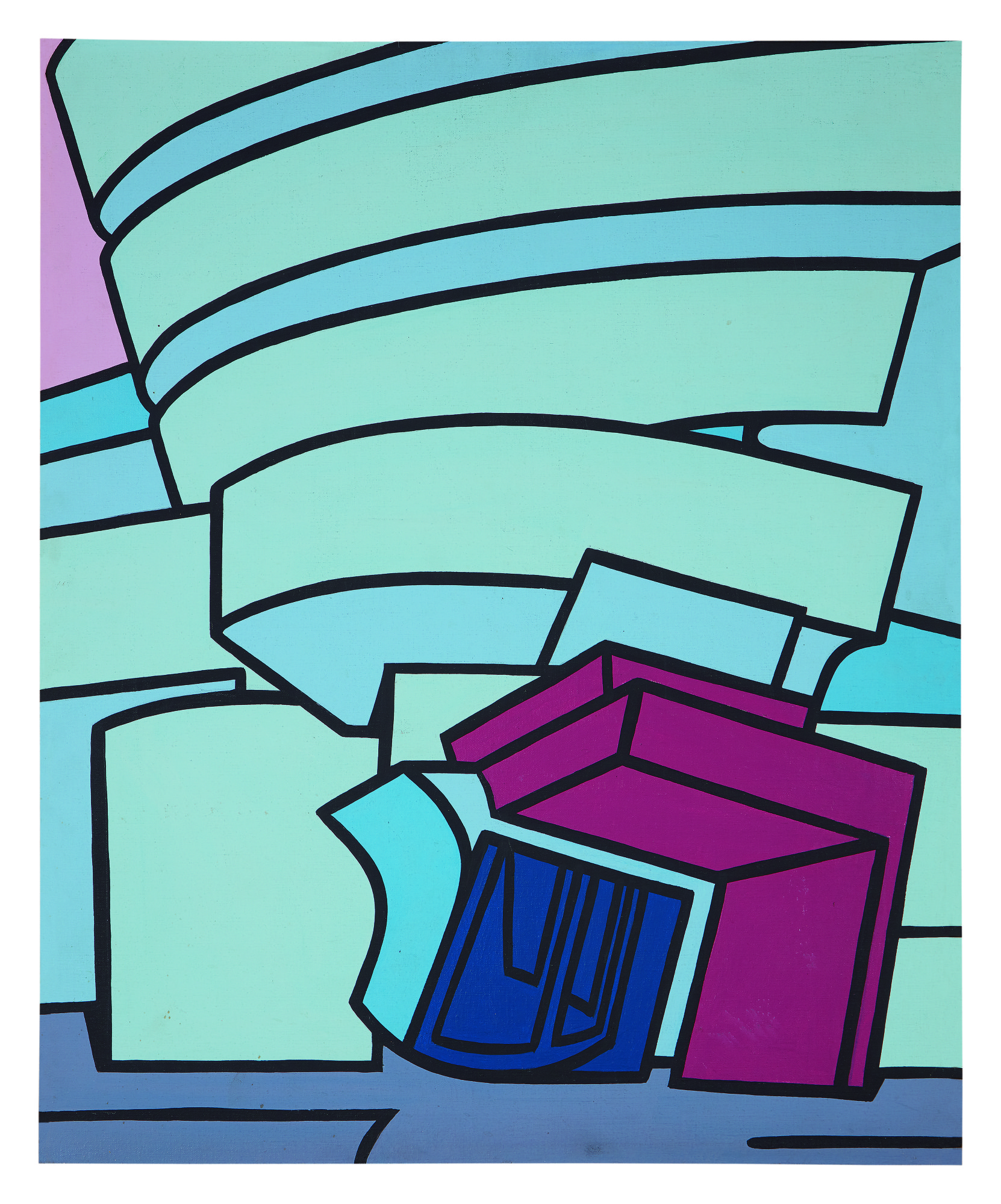
The Guggenheim
The cultural energy of postwar Milan was electric, and Adami absorbed it with a young artist's hunger. He studied at the Brera Academy of Fine Arts under the painter Achille Funi, a training that gave him rigorous draftsmanship as a foundation. But the real education came from travel: extended periods in London, Paris, and New York throughout the late 1950s and 1960s brought him into direct contact with the most vital currents of contemporary art. He befriended avant garde intellectuals and artists, and the philosopher Jacques Derrida would later become both a friend and an interlocutor whose ideas about signs, language, and representation found a profound echo in Adami's visual thinking.
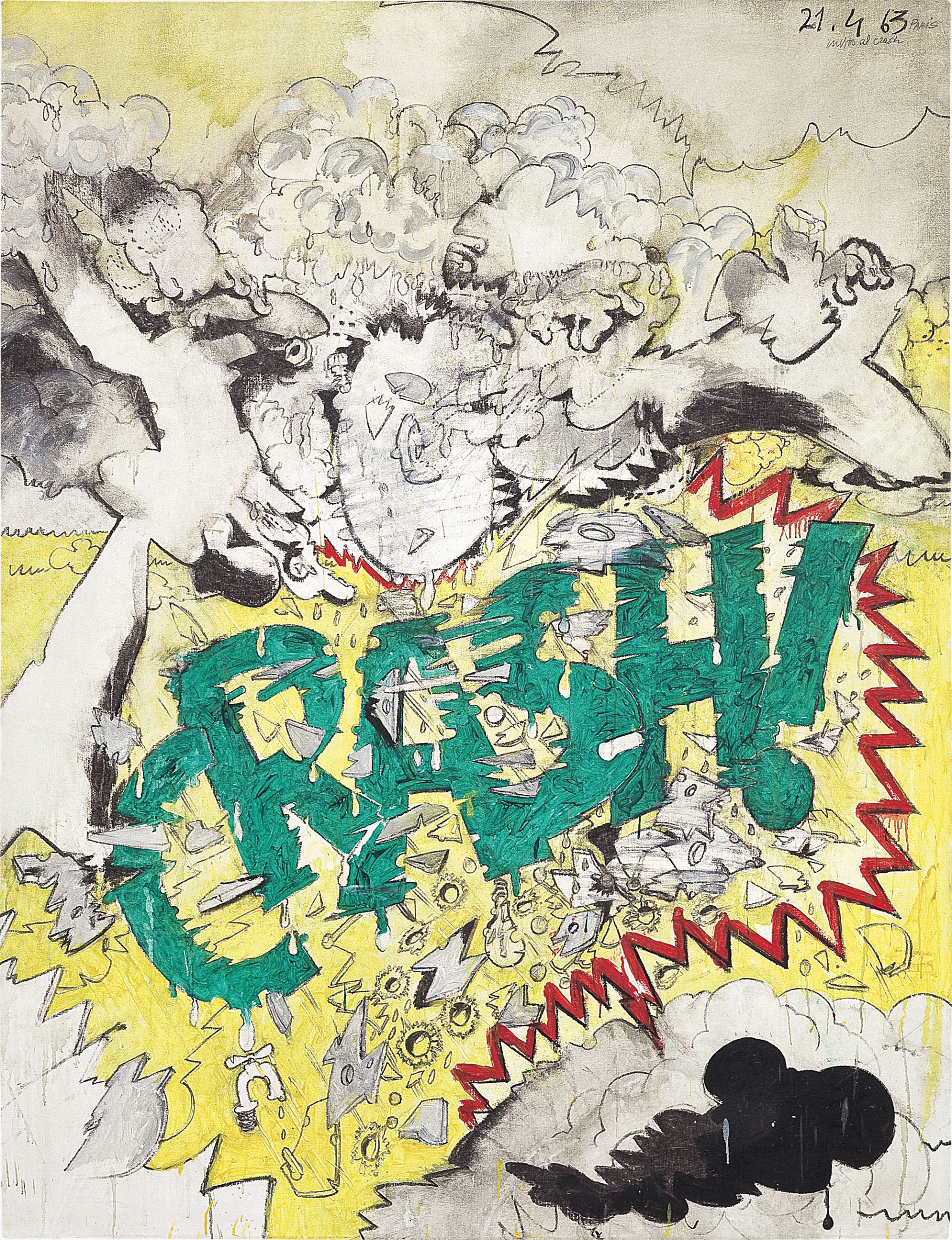
Adami's early work, visible in pieces such as the oil on canvas "Invito al Crash!" from 1963, already announces the approach that would define his career. The thick, graphic outlines that contain and demarcate his forms recall both the tradition of stained glass and the visual grammar of comic strips and commercial illustration. But Adami was never a Pop artist in any straightforward sense, even as his work shared certain coordinates with artists like Roy Lichtenstein or Eduardo Paolozzi.
Valerio Adami
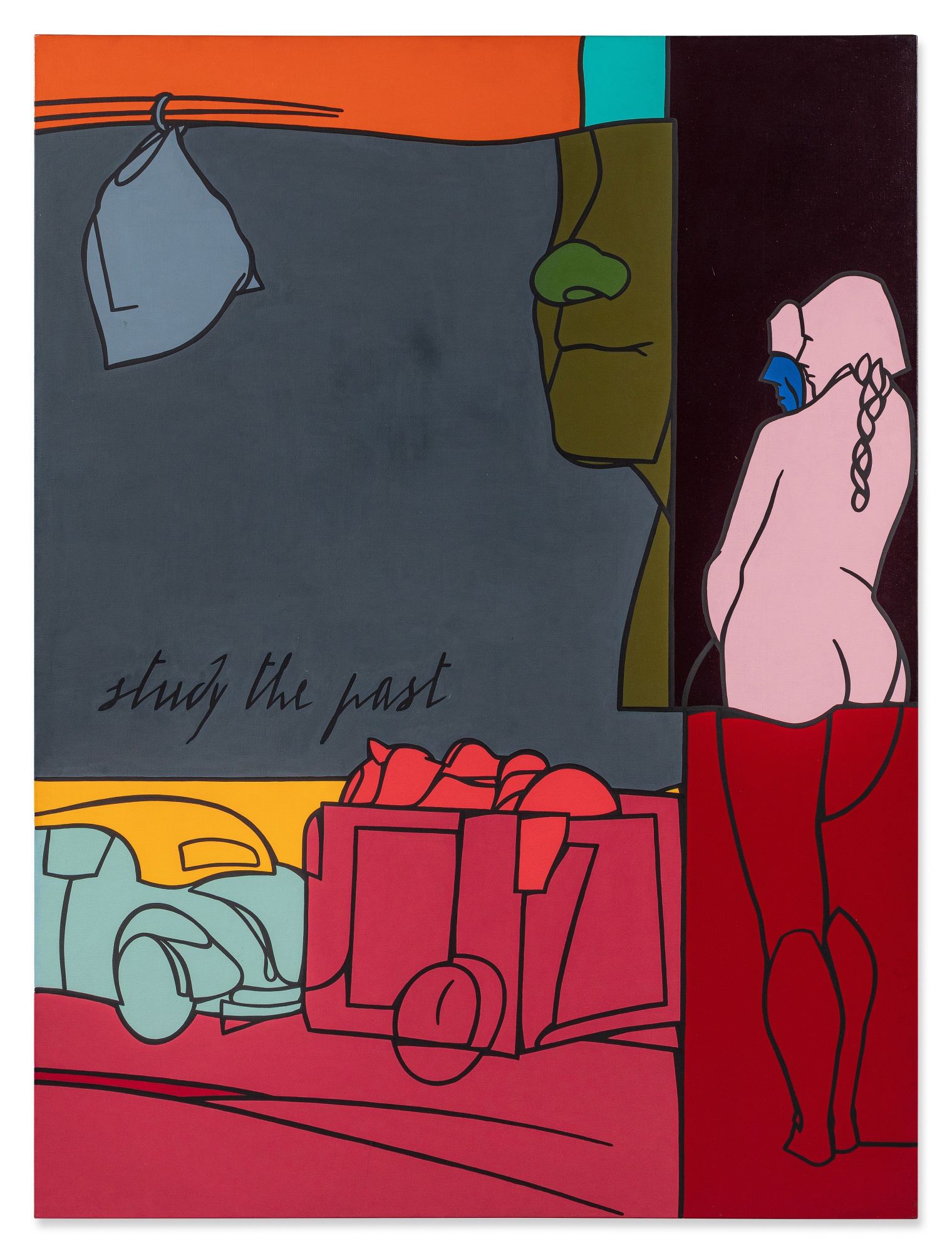
Study the Past, 1976
Where Pop often embraced consumer culture with ironic distance, Adami brought a more literary, psychologically layered sensibility. His figures and spaces carry weight, as though each scene is the aftermath of a narrative we have just missed or are about to witness. The period running from the late 1960s through the 1980s represents the fullest flowering of his mature practice. Works from this era demonstrate his remarkable gift for compression: a single painting might invoke Walter Benjamin, Sigmund Freud, or the landscapes of the American West while remaining entirely coherent as a formal composition.
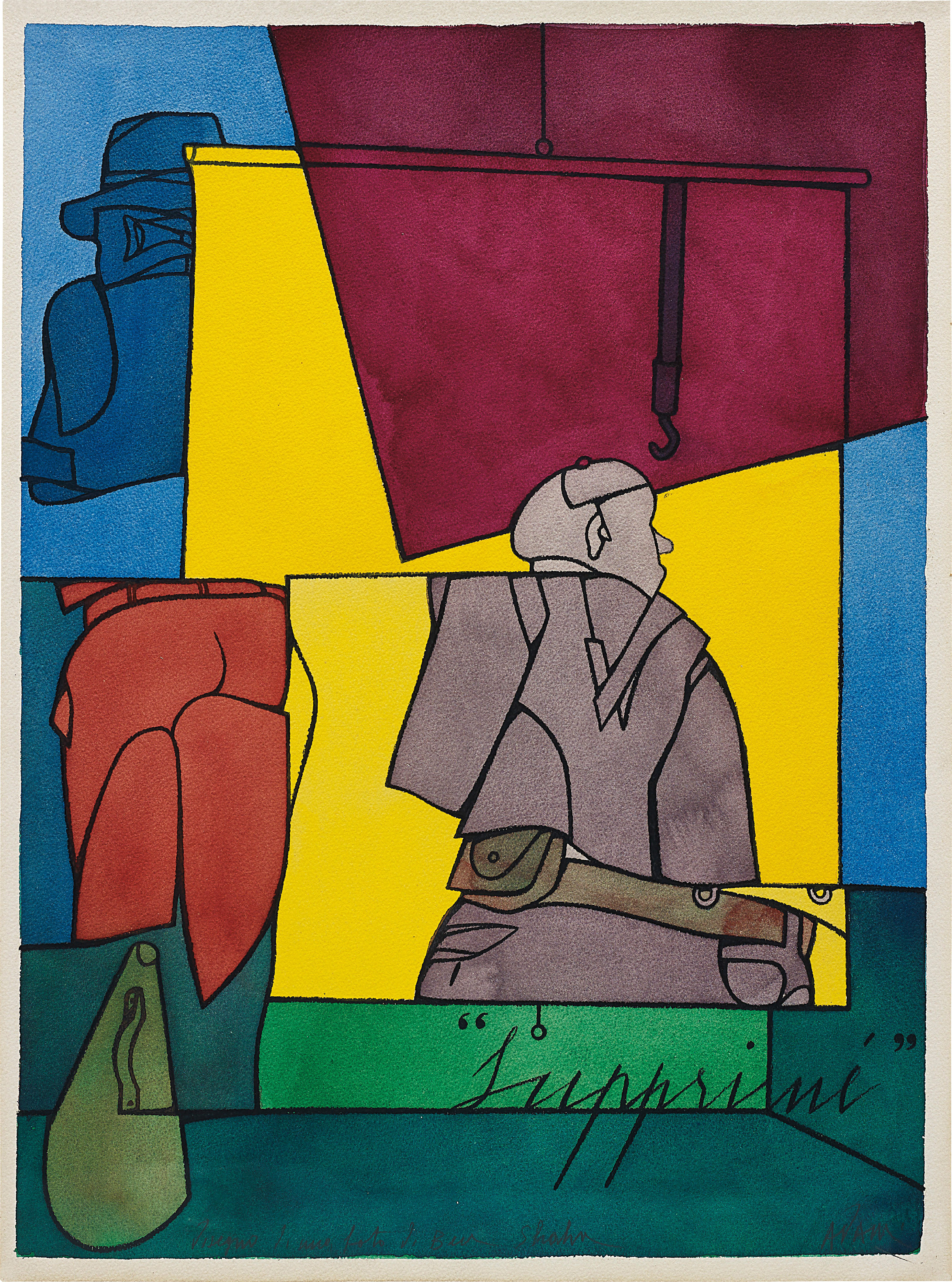
"Study the Past" from 1976 is exemplary in this regard, its title alone signaling the depth of Adami's engagement with history and memory. The 1971 acrylic "Paesaggio 'Buffalo Bill' Statue" shows his fascination with America, its mythologies, and the way those mythologies circulate as images in the global imagination. His 1979 work "Foto di Ben Shahn," executed in ink and watercolor, reveals an artist in dialogue with the social realist tradition, paying homage to the great American documentary photographer and painter through a formal language entirely his own. Few works illustrate Adami's range and ambition more vividly than "The Guggenheim," his acrylic meditation on Frank Lloyd Wright's iconic New York museum.
Valerio Adami
Foto di Ben Shahn, 1979
In this canvas, Adami transforms architecture into something close to pure sign: the spiraling rotunda becomes a series of interlocking shapes, a diagram of cultural aspiration rendered in the artist's characteristic bold palette. It is a painting about painting, about how we frame and contain art, and it rewards sustained looking. The choice of subject is characteristically loaded. Adami has always been drawn to places and objects that are themselves already images, already mediated, already part of a shared visual vocabulary.
For collectors, Adami offers something genuinely rare: a body of work that is intellectually demanding and visually pleasurable in equal measure. His prints and works on paper, including ink and watercolor pieces such as "Foto di Ben Shahn," represent an accessible point of entry and demonstrate the same precision and invention that characterize his large canvases. The market for Adami has been steady and appreciative rather than speculative, attracting collectors who value depth of meaning alongside decorative and formal strength. His works appear regularly at the major European auction houses, and his prints have long been treasured by those who collected alongside figures such as Derrida and the literary theorist Jacques Lacan, both of whom owned works by him.
Valerio Adami
Invito al Crash!, 1963
To understand Adami fully, it helps to place him in a broader constellation. He shares with Francis Bacon an interest in the distorted figure and with R.B. Kitaj a commitment to using visual art as a vehicle for literary and intellectual reference.
The Swiss artist Peter Klasen and the French figurative painters of the narrative figuration movement in Paris, including Hervé Télémaque and Gilles Aillaud, occupied similar territory during the 1960s and 1970s. But Adami's voice is unmistakable within this company: more lyrical than Bacon, more formally austere than Kitaj, more personally mythological than the narrative figuration group at its most political. He is an artist who synthesized an enormous range of influences into something entirely his own. What makes Adami matter today, in a moment when painting is once again the subject of widespread critical attention and collector enthusiasm, is precisely his refusal to be easily categorized.
He is neither a pure formalist nor a literary illustrator; neither a Pop artist nor a traditional figurative painter. He is something harder to name and therefore more lastingly interesting: a thinker who paints, a storyteller who works in outline and color rather than in prose. His long career, extending from postwar Milan to the present, represents a sustained act of faith in the capacity of painting to hold complexity, to carry memory, and to make visible what language alone cannot reach. To discover Adami is to gain access to one of the richest and most rewarding bodies of work in twentieth and twenty first century European art.
Explore books about Valerio Adami