Utagawa Toyokuni I
The Master Who Gave Kabuki Its Face
Artist Spotlight · The Collection Editorial
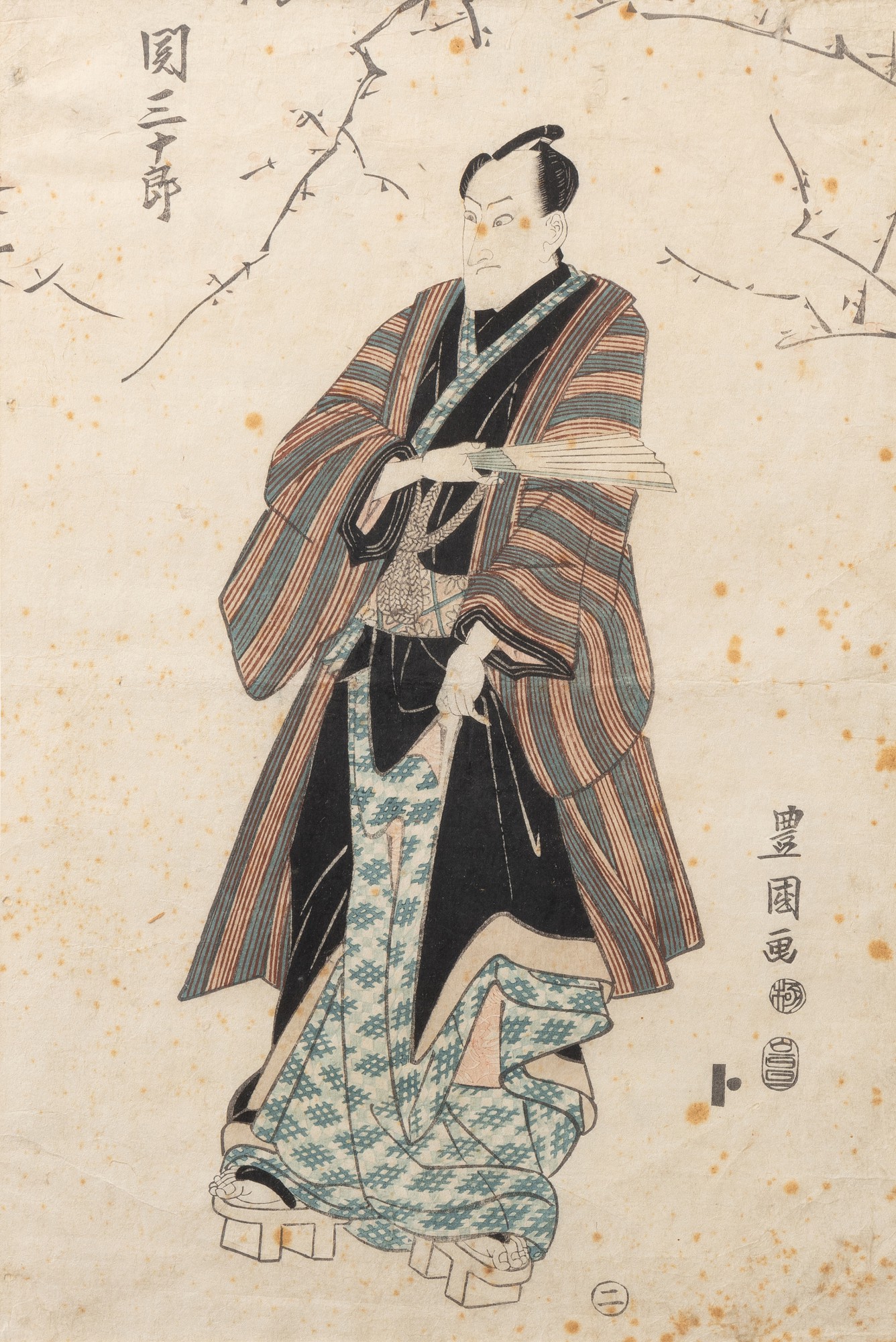
Few moments in the history of Japanese art feel as electrically alive as standing before a Utagawa Toyokuni I actor print and meeting the gaze of a kabuki performer frozen at the height of his dramatic power. The actor's eyes are wide, his posture coiled, his robes a cascade of pattern and color that seems to vibrate even after two centuries. This is the gift Toyokuni left the world: a visual language for theatrical intensity so precise and so inventive that it defined how Japan saw its own popular culture for generations. Today, collectors and curators from Tokyo to London to New York are returning to his work with fresh eyes, recognizing in his compositions not merely historical document but genuine artistic genius.
Utagawa Toyokuni I
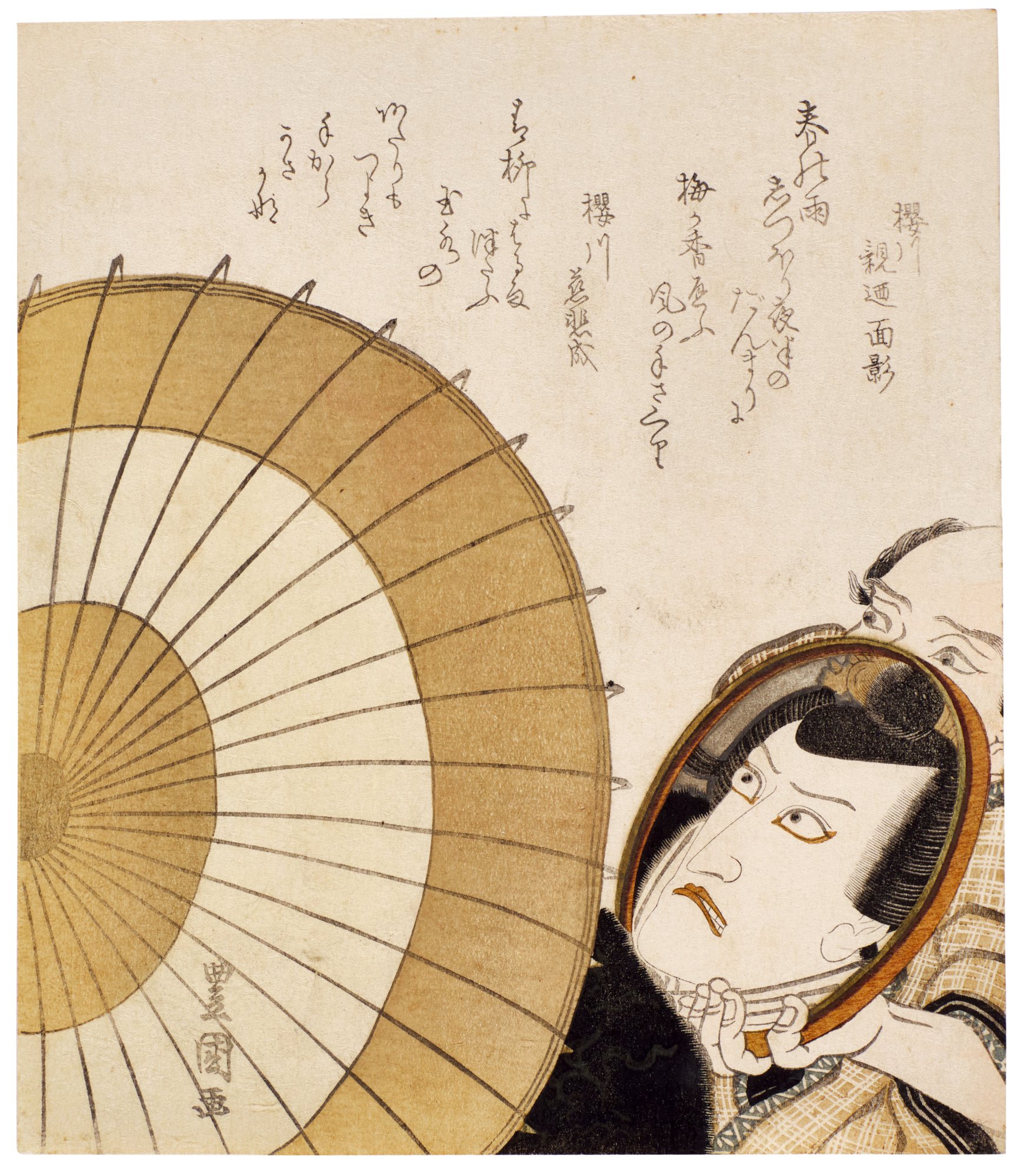
The face of the actor Ichikawa Ebizo VI reflected in a mirror from behind a parasol | Edo period, 19th century
Toyokuni was born in Edo, present day Tokyo, in 1769, the son of a doll maker and sculptor named Kurahashi Tatsuzo. From early childhood he was immersed in a world of craft and visual ingenuity, and his father's work instilling in him a sensitivity to form, gesture, and the expressive potential of the human figure. He entered the studio of Utagawa Toyoharu as a young student, taking instruction from one of the most technically accomplished printmakers of the era. Toyoharu was celebrated for his uki e, perspective prints that drew on European techniques of spatial recession, and this early exposure to questions of viewpoint and spatial illusion would echo throughout Toyokuni's career.
By the 1780s and into the 1790s, Toyokuni had begun to establish a voice distinctly his own. He absorbed the bold psychological intensity that Toshusai Sharaku had brought to actor portraiture during Sharaku's brief, blazing period of activity in 1794 and 1795, yet where Sharaku favored grotesque distortion and psychological extremity, Toyokuni pursued something more nuanced: a celebration of the actor's magnetism rather than a dissection of it. He studied the work of Katsukawa Shunsho, who had pioneered the close cropped bust portrait, the okubi e format, and brought it to a new level of emotional legibility. From these influences Toyokuni distilled a style that was dynamic, accessible, and deeply attuned to public taste.
Utagawa Toyokuni I
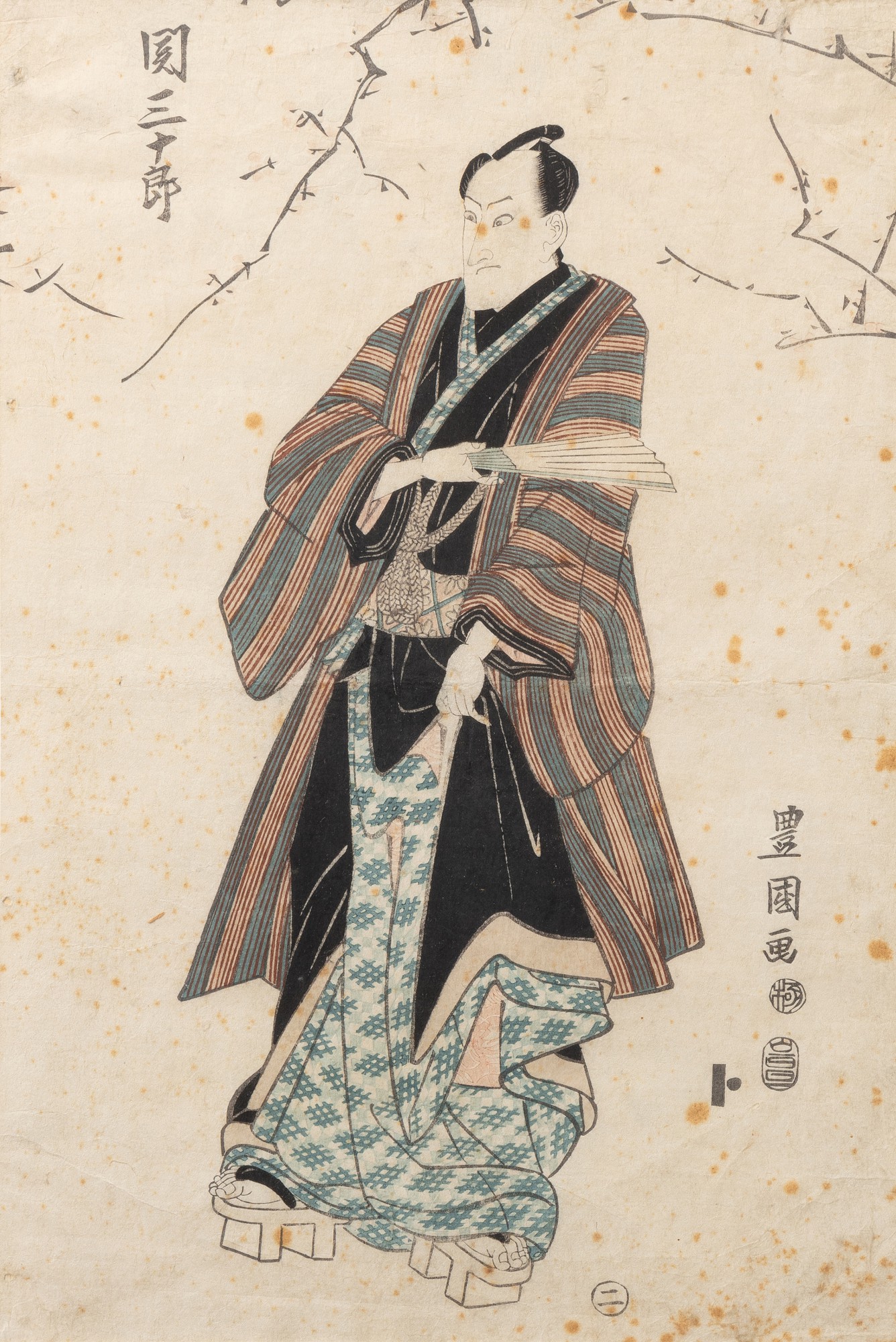
日本 江戶時代 十八世紀 木刻版畫一組三幀
His breakthrough came with the publication of his series Yakusha Butai no Sugata e, or Portraits of Actors on Stage, which appeared from around 1794 onward. These prints captured kabuki performers in full theatrical dress during actual stage productions, rendering the mie, the dramatic frozen pose that punctuated kabuki performance, with extraordinary vividness. The series was enormously popular and established Toyokuni as the preeminent chronicler of Edo's theatrical world. He brought the same compositional ambition to bijin e, beautiful woman pictures, producing images of courtesans and fashionable women that combined elegance with a liveliness rare in the genre.
His women move, tilt their heads, glance sideways; they feel present rather than decorative. Among the works now available on The Collection, several illuminate the full range of his achievement. The print depicting the face of actor Ichikawa Ebizo VI reflected in a mirror from behind a parasol is a masterly exercise in visual wit and conceptual sophistication. Rather than showing the actor frontally, Toyokuni uses the reflective surface as a device to suggest multiple viewpoints at once, a choice that feels strikingly modern and speaks to his restless formal intelligence.
Utagawa Toyokuni I
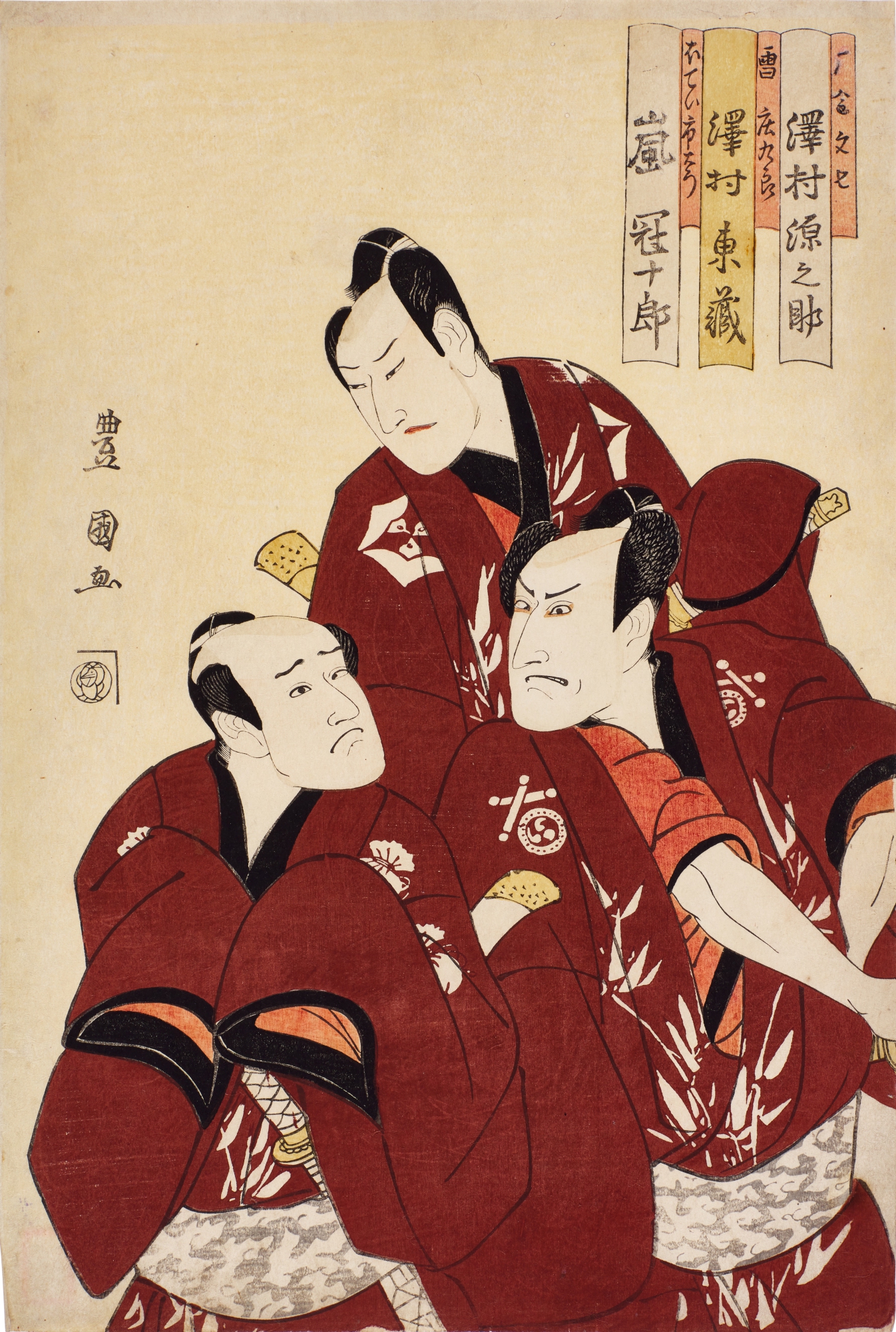
The actors Sawamura Gennosuke, Sawamura Tozo and Arashi Kanjuro | Edo period, late 18th - early 19th century
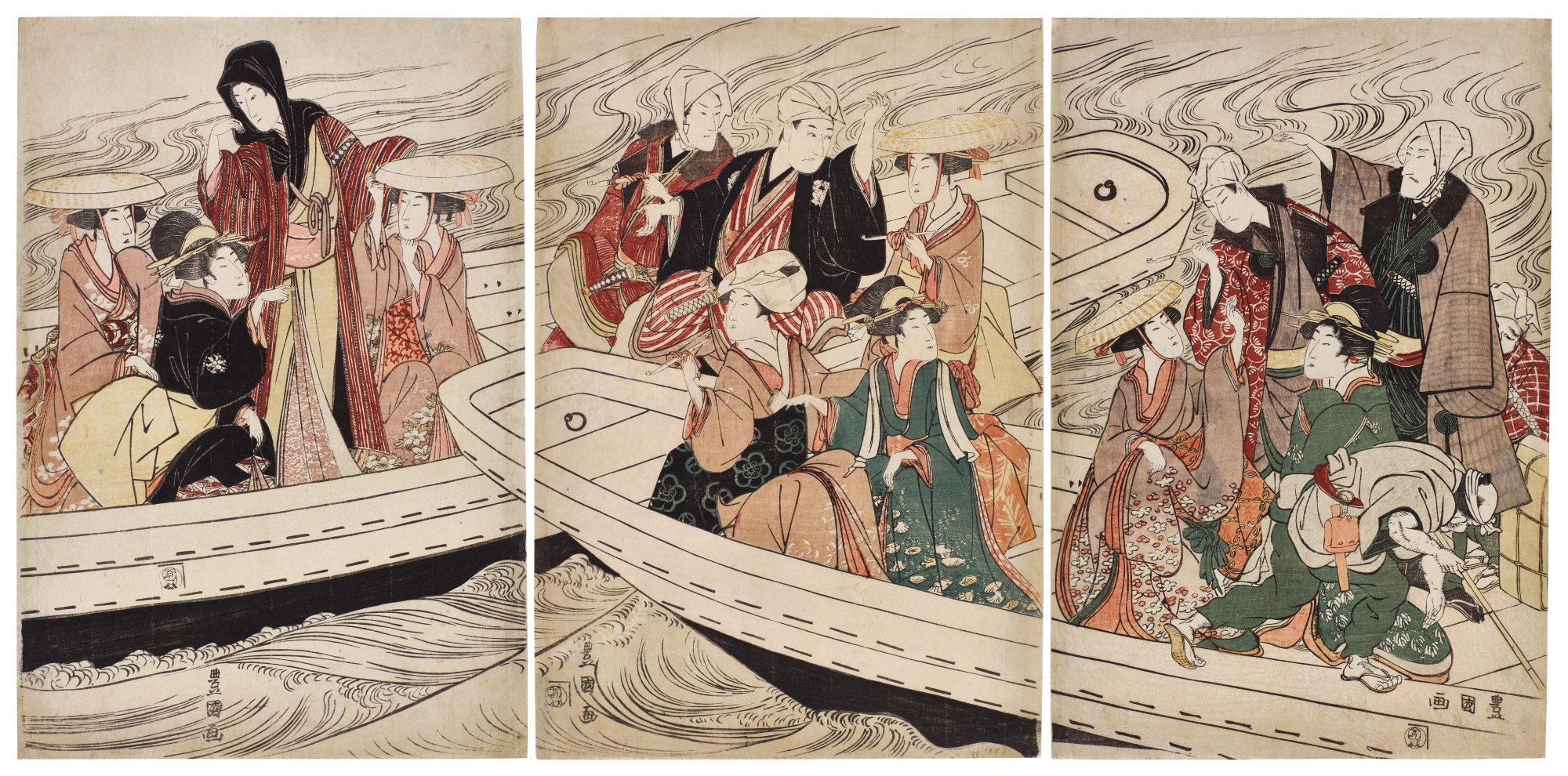
His triptych print showing the actors Sawamura Gennosuke, Sawamura Tozo, and Arashi Kanjuro from the late eighteenth to early nineteenth century demonstrates his command of the multi sheet format, orchestrating three figures across an expanded horizontal field with the confidence of a stage director. River Crossing, also of the nineteenth century, reveals a gentler register of his talent, its figures moving through landscape with a lyrical ease that shows he was never merely a specialist but a complete artist. From a collecting perspective, Toyokuni occupies a particularly compelling position in the ukiyo e market. His work is both historically significant and visually immediate, meaning it rewards the uninitiated viewer at first glance while yielding deeper pleasures to the scholar.
Major auction houses including Christie's, Sotheby's, and Bonhams have offered his prints with consistent results, and fine impression examples with strong color and clear detail continue to attract serious competition. Collectors are advised to attend carefully to impression quality, since later printings from worn blocks can lose the crispness that makes his line work so electrifying. Early impressions retain the full depth of color that Toyokuni intended, and these command a meaningful premium. Works depicting the most celebrated actors of his era, particularly Ichikawa Danjuro and members of the Nakamura line, tend to generate the strongest interest.
Utagawa Toyokuni I
River Crossing | Edo period, 19th century
To understand Toyokuni fully is to understand the broader constellation of ukiyo e masters among whom he worked and competed. His contemporary Kitagawa Utamaro was redefining bijin e with his intimate close ups of women's faces and his profound sensitivity to feminine psychology. Katsushika Hokusai, only nine years younger, would go on to reshape the landscape print entirely. Toyokuni's own school, the Utagawa school, became the most influential artistic lineage in nineteenth century Japan, with students including Utagawa Hiroshige, whose landscape series would achieve worldwide recognition, and Utagawa Kuniyoshi, whose warrior prints brought ferocious invention to the genre.
Toyokuni trained them, shaped them, and gave the school its foundational identity. His legacy extends far beyond the studio. The Utagawa school's dominance through the nineteenth century meant that Toyokuni's formal vocabulary, his approach to composition, his treatment of gesture and color, became the common inheritance of Japanese printmaking. When Western artists encountered ukiyo e in the latter half of the nineteenth century and the Japonisme movement swept through the studios of Paris and beyond, influencing figures from Monet to Toulouse Lautrec to Mary Cassatt, it was partly Toyokuni's visual sensibility, transmitted through his students and their students, that was reshaping Western art.
He died in 1825, having spent more than four decades transforming how a culture saw itself. To collect his work today is to hold something genuinely foundational: a piece of the visual DNA from which so much of the art we love was made.
Explore books about Utagawa Toyokuni I
Utagawa Toyokuni: His Life and Works
Laurence P. Roberts
Japanese Prints During the Edo Period
Matthi Forrer
The Art of Utagawa Toyokuni
John T. Carpenter
Hokusai and His School
Roger Keyes
The Prints of the Utagawa School
Andrew Gerstle
Kabuki Prints and Paintings
Gian Carlo Calza
The Japanese Print: History and Technique
Andreas Marks