Turi Simeti
Turi Simeti, Where Form Finds Its Freedom
Artist Spotlight · The Collection Editorial
In the winter galleries of European museums and at the auction houses that have watched Italian postwar abstraction ascend to sustained critical and market prominence, one name surfaces again and again among collectors who prize rigorous, meditative beauty: Turi Simeti. Born in Alcamo, Sicily in 1929 and gone from us in 2021, Simeti spent nearly six decades pursuing one of the most focused and quietly radical investigations in postwar art. His passing has only sharpened the attention paid to his legacy, and the sustained appetite for his shaped canvases and works on paper confirms what a devoted circle of collectors and curators understood for decades: here was an artist of genuine and lasting consequence. Simeti grew up in Sicily at a time when the island felt geographically and culturally distant from the continental centers of modernist experiment.
Turi Simeti
Ovali Rossi
That distance proved formative rather than limiting. When he arrived in Rome in the 1950s, he brought with him the clarity of an outsider, someone unburdened by the weight of established school allegiances and eager to find his own footing. Rome in those years was alive with artistic conversation, and Simeti moved through its studios and galleries with an open curiosity. It was his eventual relocation to Milan, however, that placed him at the center of the movements that would define his life's work, embedding him in a community of artists rethinking the very surfaces and boundaries of painting.
In Milan during the early 1960s, Simeti encountered the ideas circulating around Arte Programmata, the movement championed by artists such as Bruno Munari and Getulio Alviani, who were interested in perception, seriality, and the systematic properties of visual form. He also drew close to the spirit of the Shaped Canvas movement, which in Italy found its most rigorous practitioners among artists willing to treat the physical support of the painting not as a neutral container but as an active participant in meaning. Simeti studied the work of Agostino Bonalumi and Enrico Castellani, two figures whose exploration of the shaped and extended canvas offered essential precedents. Yet Simeti's response to those precedents was distinctly his own: where others multiplied protrusions or varied their rhythms dramatically, Simeti pared everything back to the ellipse, the oval, and the monochrome.
Turi Simeti
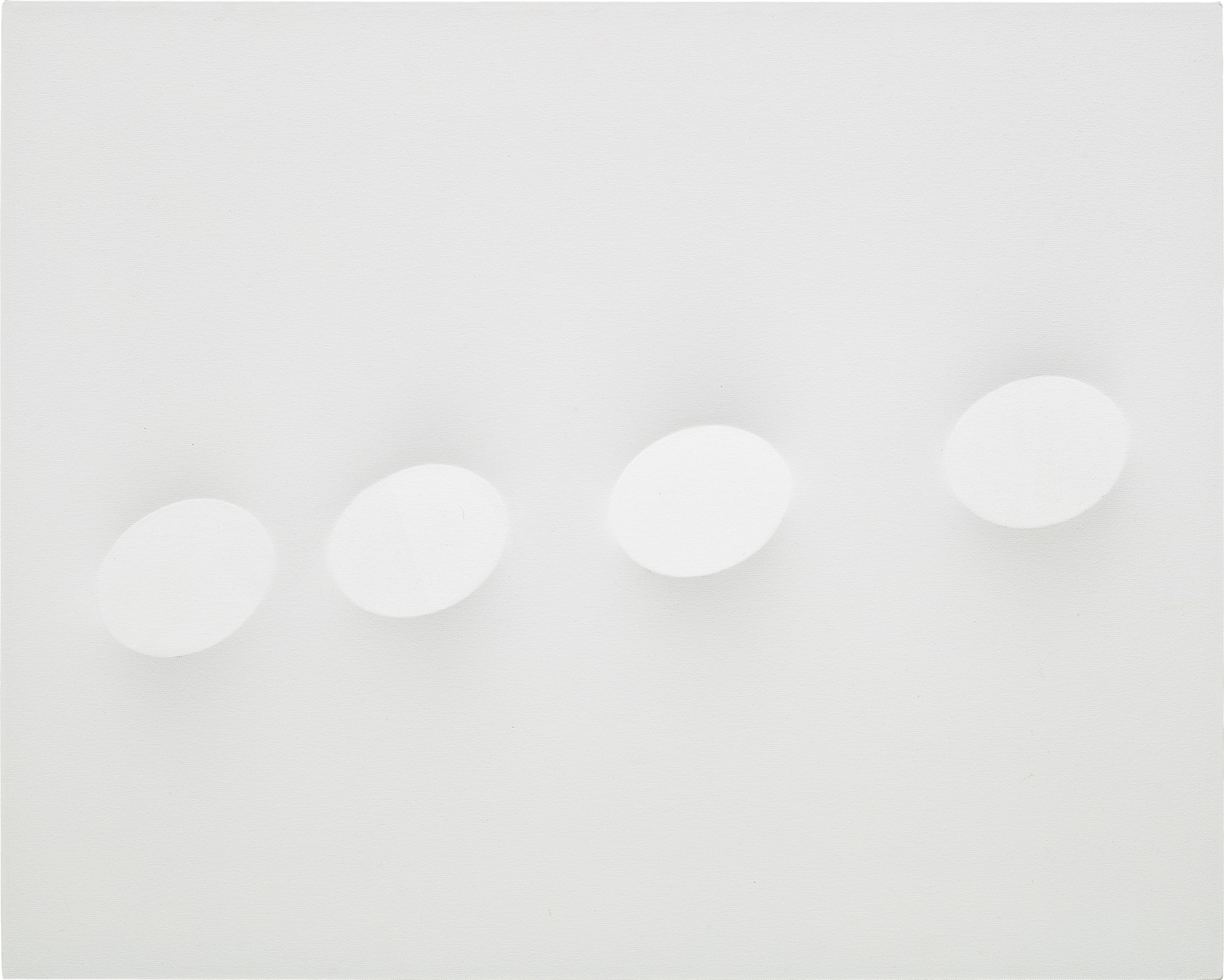
4 ovali bianchi, 2013
The oval became Simeti's signature with the force of a philosophical commitment rather than a stylistic choice. Beginning in the 1960s and continuing without interruption until the final years of his life, he devoted himself to canvases in which one or more elliptical forms press outward from behind the picture plane, straining against edges that have themselves been shaped to echo and contain those pressures. The surface is invariably monochromatic, the color applied with care and consistency so that the light raking across the shallow relief becomes the primary event. The works do not illustrate tension; they embody it.
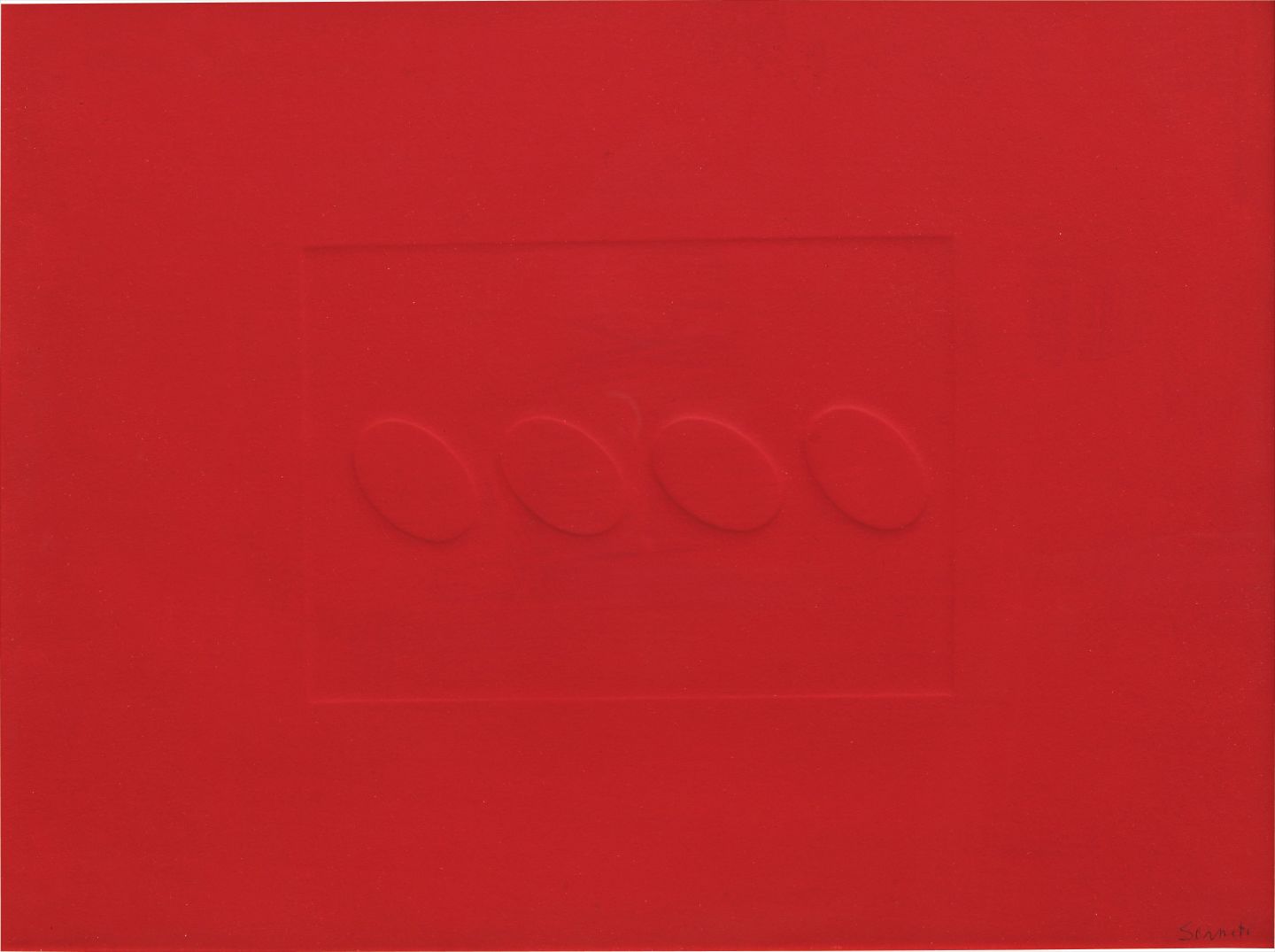
A single oval pushing against the boundary of a shaped canvas is simultaneously a form seeking escape and a form perfectly held, and that duality gives the best of Simeti's paintings a quality of dynamic stillness that is genuinely difficult to achieve. Among the works that best demonstrate his command of this vocabulary, pieces such as "Tre Ovali Neri" from 1980 and "Trittico bianco blu azzuro," also from 1980 and composed across three shaped canvases, show Simeti at a moment of full maturity. The triptych format allowed him to spread his quiet rhythms across space, inviting the eye to travel and rest and travel again. Works on Fabriano paper, including the strikingly refined "Ovali Rossi" and "Ovali Gialli," reveal that his formal intelligence translated seamlessly from canvas to paper, the oval retaining its compressed energy even in a more intimate scale.
Turi Simeti
Ovali Gialli
Later works such as "4 ovali bianchi" from 2013 and "Quatre Ovali Rossi" from 2014 demonstrate that his touch remained assured and his commitment to the premise undiminished well into his eighties. For collectors, Simeti offers something rare in the market for postwar Italian abstraction: a body of work that is conceptually coherent, visually immediate, and rewarding to live with. The monochromatic palette means his canvases adapt to a wide range of interior contexts without imposing or competing, while the subtle three dimensionality of the shaped surface ensures they are never static. Works change as the light changes, as the viewer shifts position, as the hours pass.
That responsiveness to environment and perception connects Simeti directly to the perceptual concerns of Arte Programmata and aligns him with the tradition of artists who understood painting as an experience unfolding in real space and real time. Collectors drawn to Lucio Fontana, to Castellani, or to the cerebral refinement of Bonalumi will find in Simeti a kindred sensibility and a practice that rewards close looking over many years. Simeti's position within art history has been solidified through exhibitions at Italian institutions and through the sustained advocacy of galleries committed to postwar European abstraction. His work has been shown in contexts that place him alongside Fontana and the Spazialismo movement as well as within broader surveys of international minimalism, where his Italian particularity stands out as a contribution rather than a footnote.
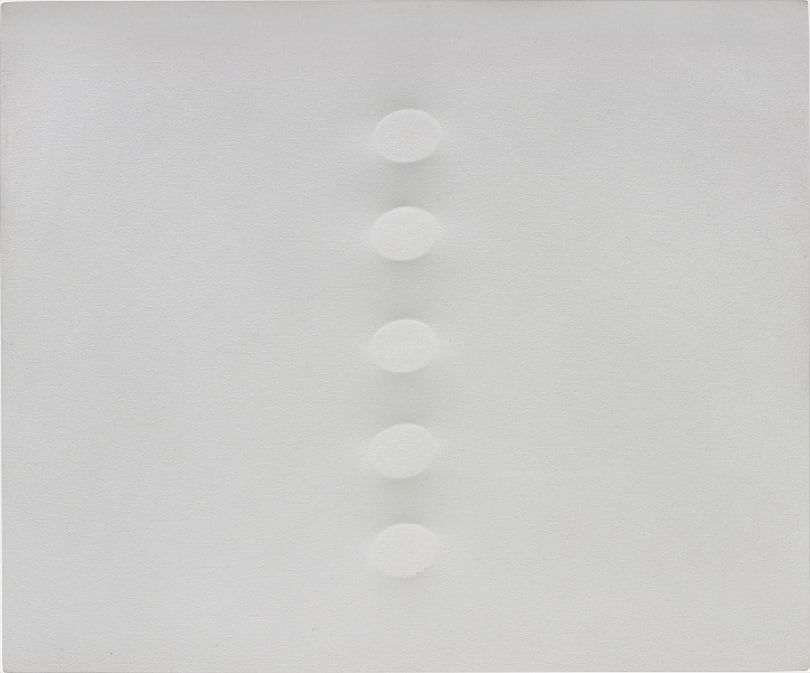
Turi Simeti
Cinque Ovali Bianchi, 2006
The comparison to American Shaped Canvas painters of the 1960s is instructive: where Frank Stella approached the shaped canvas as a problem of pictorial logic, Simeti approached it as a problem of felt experience, of pressure and release, of the body's intuitive response to form at the edge of containment. What endures in Simeti's work, and what makes it so affecting to encounter whether in a museum survey or in the focused setting of a private collection, is its commitment to a single question asked with endless patience and care. What happens when form presses against its own limit? The answer, in canvas after canvas, in red and white and black and yellow, in single ovals and in groupings of four or five, is that something quietly extraordinary occurs.
The surface becomes a field of potential, the boundary becomes a site of dialogue, and the viewer is drawn into a contemplation that feels both ancient and entirely modern. Turi Simeti gave his life to that question, and the art world is immeasurably richer for the constancy and beauty of his reply.