Tsukioka Yoshitoshi
Yoshitoshi: The Master Who Reimagined Everything
Artist Spotlight · The Collection Editorial
There is a moment in the British Museum's permanent collection when visitors stop moving. They have rounded a corner into the Japanese galleries and found themselves face to face with a sheet of handmade paper carrying an image of such psychological intensity and chromatic daring that the twenty first century seems to dissolve around them. The print is by Tsukioka Yoshitoshi, and the effect it produces is not nostalgia but something far more alive: the recognition that here was an artist operating at the absolute outer limits of his medium, pushing a centuries old tradition into territory that feels, even now, startlingly modern. Yoshitoshi's work has enjoyed a sustained and deepening appreciation among collectors and curators globally, with major holdings at the Library of Congress, the Art Institute of Chicago, and the Museum of Fine Arts Boston confirming his status as an artist of genuine world historical importance.
Tsukioka Yoshitoshi
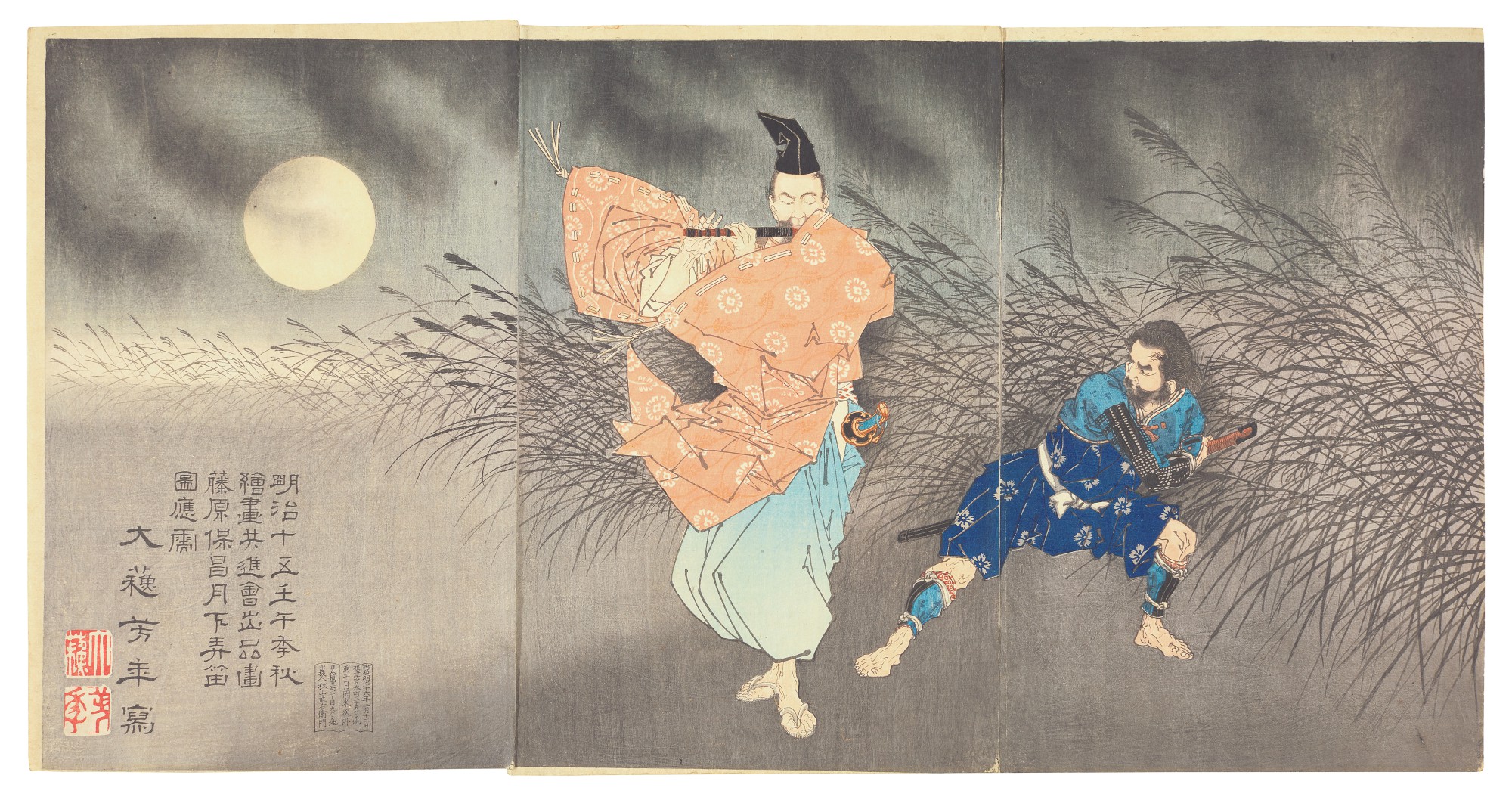
Fujiwara Yasumasa Plays the Flute by Moonlight (Fujiwara Yasumasa gekka roteki) | Meiji period, late 19th century
Yoshitoshi was born in Edo, the city we now call Tokyo, in 1839, and the circumstances of his early life gave him an unusual vantage point on the social transformations that would define his era. Raised by his uncle, a merchant of means, he was apprenticed at the age of eleven to the great ukiyo e master Utagawa Kuniyoshi, one of the most dynamic and inventive printmakers of the nineteenth century. Kuniyoshi's studio was a place of tremendous creative energy, producing warrior prints of theatrical ferocity, landscapes of mythic grandeur, and figure studies of remarkable psychological depth. The young Yoshitoshi absorbed all of it.
He received his first professional name at fourteen, a mark of real accomplishment, and began producing work for commercial publishers while still a teenager in a city that was, even then, beginning to shake under the pressures of Western contact and political instability. The Japan in which Yoshitoshi came of age was undergoing one of the most dramatic transformations any society has ever experienced in so compressed a period of time. The fall of the Tokugawa shogunate in 1868 and the restoration of imperial rule ushered in the Meiji era, a period of forced modernization in which Western dress, Western technology, and Western cultural values were adopted with sometimes bewildering speed. Photography arrived and threatened to make printmaking obsolete.
Tsukioka Yoshitoshi
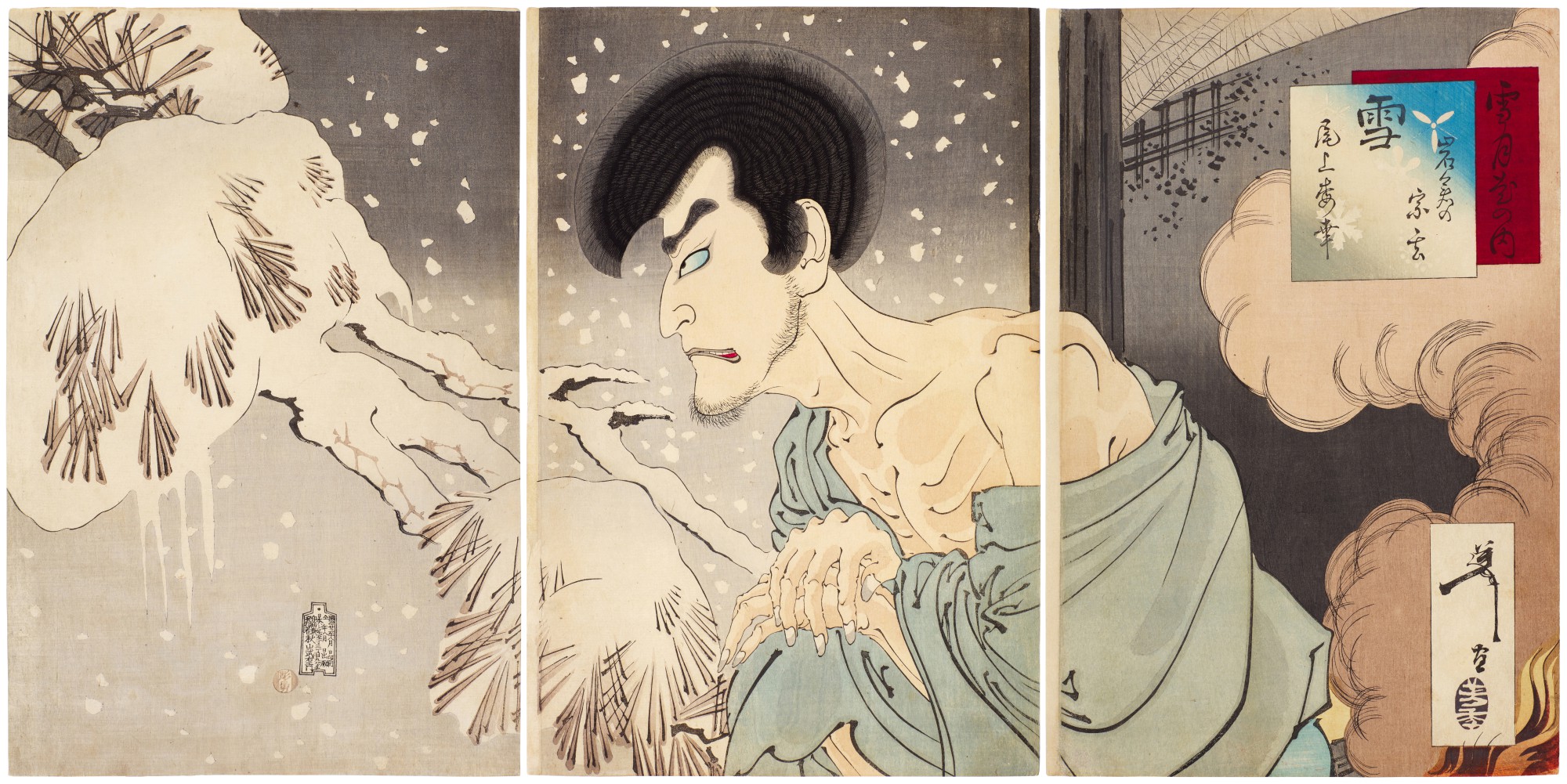
Tsukioka Yoshitoshi (1839-1892) Snow: The actor Onoe Baiko V in the role of Iwakura Sogen (Yuki: Iwakura no Sogen, Onoe Baiko), Meiji period, late 19th century
Newspaper illustration opened new commercial channels. Traditional patronage structures collapsed and reformed. Yoshitoshi navigated all of this with extraordinary adaptability, contributing to newspapers and illustrated journals while simultaneously producing work of a seriousness and ambition that no commercial assignment could contain. His career is inseparable from this moment of rupture, and it is precisely because he lived through so much upheaval that his art carries such emotional charge.
His mature work spans an astonishing range of subject matter and emotional register, but it is unified by a set of qualities that are immediately recognizable once you have learned to look for them. Yoshitoshi had a gift for isolating a single human figure against a ground of almost abstract atmospheric beauty, creating compositions that feel simultaneously theatrical and intimate. His series One Hundred Aspects of the Moon, produced between 1885 and 1892, is widely considered his supreme achievement, a sequence of prints in which the moon becomes not a subject but a lens through which the full complexity of Japanese historical and literary culture is refracted. The print known in English as Fujiwara Yasumasa Plays the Flute by Moonlight is among its most celebrated images: a courtier in brilliant robes moves through a nocturnal landscape with the ease of a man who knows himself entirely, and the blue of the night sky behind him is a colour that no photograph can adequately reproduce.
Tsukioka Yoshitoshi
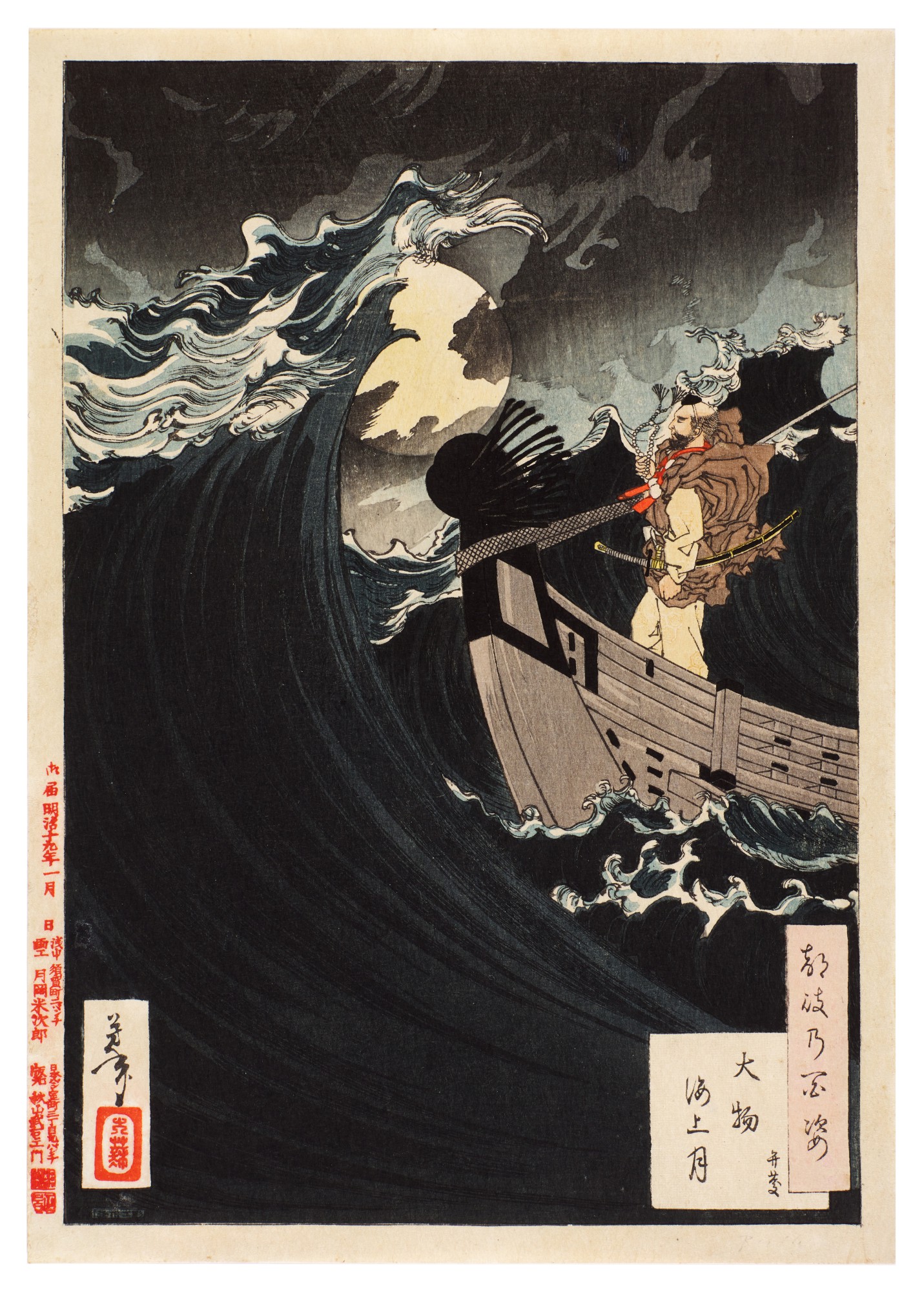
Moon on the sea at Daimotsu – Benkei (Daimotsu kaijo no tsuki) | Meiji period, late 19th century
It must be seen in person, on paper, to be believed. Other works in his body of work demonstrate the breadth of his imaginative reach. His depiction of the warrior monk Benkei at Daimotsu Bay captures a figure of legend at a moment of desperate loyalty, the sea behind him charged with the energy of a storm that is as much psychological as meteorological. His actor prints, including his portrait of Onoe Baiko V in the role of Iwakura Sogen in the Snow series, demonstrate a sensitivity to theatrical performance and the specific physicality of the Kabuki tradition that reflects his deep engagement with popular culture in all its forms.
He also produced remarkable work drawing on Chinese literary sources, including prints illustrating the great novel Journey to the West, a tradition that connected Japanese printmakers to a wider East Asian literary world. Across all of these subjects, the quality of Yoshitoshi's line and his command of colour are simply extraordinary, the product of a technical mastery built over four decades of continuous practice. For collectors, Yoshitoshi's work occupies a particularly interesting position in the market. His prints are available at a range of price points, from individual sheets in specialist auction sales to complete series that command significant sums at the major houses including Christie's and Sotheby's.
Tsukioka Yoshitoshi
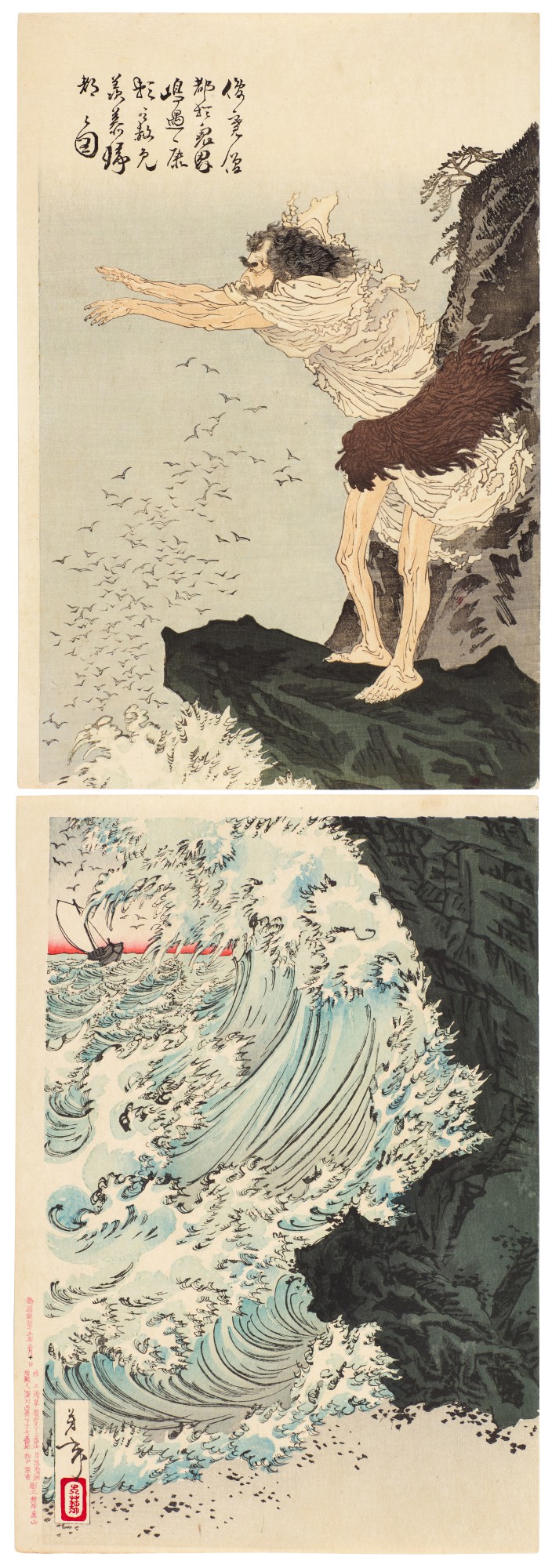
Tsukioka Yoshitoshi (1839-1892) Shunkan Watches Enviously from Kikai Island as Yasuyori is Pardoned and Returns to the Capital (Shunkan sozu Kikaigashima ni oite tamatama Yasuyori no shamen senbo kito no zu), Meiji period, late 19th century
Condition is paramount: the colours in Yoshitoshi's best prints are fugitive, meaning that exposure to light degrades them, and a well preserved impression can be dramatically more beautiful than a faded one. Collectors who have had the experience of seeing a fresh impression of One Hundred Aspects of the Moon rarely forget it. Complete series are significantly rarer than individual sheets and represent the work as its creator intended it to be experienced, as a sustained meditation rather than a series of isolated images. The market for Meiji period woodblock prints has grown steadily over the past two decades, supported by serious scholarship and institutional collecting, and Yoshitoshi consistently anchors the top of that market.
Yoshitoshi belongs to a lineage of ukiyo e masters that includes Katsushika Hokusai and Utagawa Hiroshige, artists whose work shaped the visual imagination of the Western avant garde from the 1860s onward. The influence of Japanese printmaking on Impressionist and Post Impressionist painting has been extensively documented, and the bold outlines, flattened perspectives, and chromatic intensity that characterised ukiyo e were among the catalysts that pushed European art toward modernism. Yoshitoshi represents the culmination of that tradition, the point at which it achieved its greatest psychological complexity and expressive range just as it was being superseded by new technologies and new modes of image making. In this sense he is a figure of poignant historical importance, but the work itself transcends any melancholy that narrative might suggest.
It is simply too alive, too confident, too full of the pleasure of making, to feel like an ending. Yoshitoshi died in 1892, leaving behind a body of work that was, for much of the twentieth century, known primarily to specialists. The rehabilitation of his reputation in the West, accelerated by major publications and exhibitions from the 1970s onward, has been one of the more gratifying stories in recent art historical scholarship, a recognition that a great artist had been waiting, with characteristic patience, for the world to catch up. Today his prints hang in the finest private collections alongside Rembrandt etchings and Goya aquatints, and they hold their own in that company without the slightest difficulty.
To encounter Yoshitoshi seriously is to understand that the boundaries we have drawn between Eastern and Western art history, between high art and popular culture, between tradition and innovation, are administrative fictions. He simply ignored them, and made something enduring.
Explore books about Tsukioka Yoshitoshi
Tsukioka Yoshitoshi: The Bloody Prints
John Stevenson
The Muzan-e Prints of Tsukioka Yoshitoshi
Matthi Forrer
Yoshitoshi: Master of the Macabre
Sebastian Izzard
New Forms: 36 Ghosts
Tsukioka Yoshitoshi
The Japanese Print: A Historical Guide
Andrew W. Mellon