Tomokazu Matsuyama
Between Two Worlds, Beautifully Whole
Artist Spotlight · The Collection Editorial
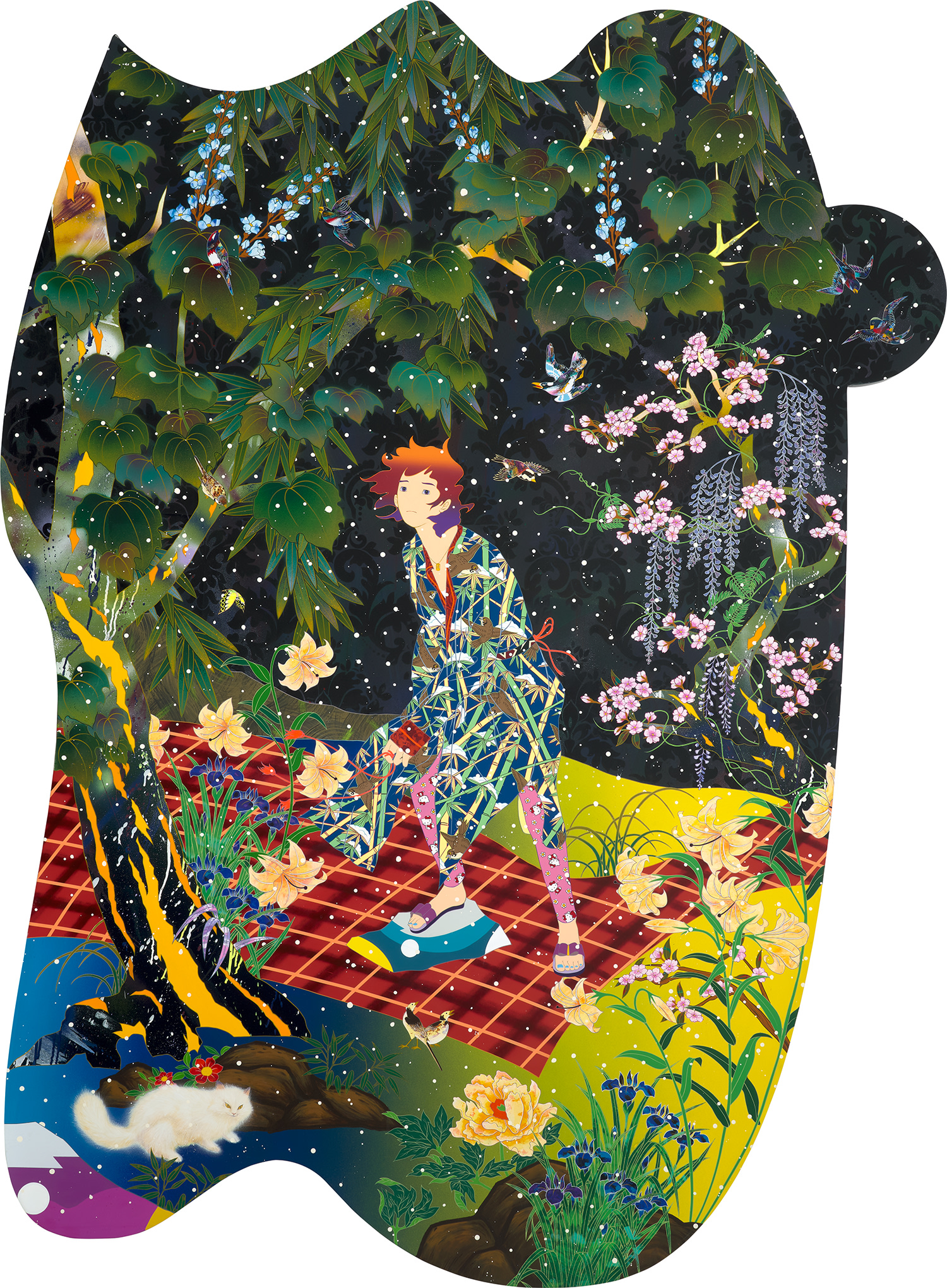
In the spring of 2023, Tomokazu Matsuyama's work appeared across gallery walls in New York, Hong Kong, and Tokyo almost simultaneously, a kind of cultural simultaneity that felt less like coincidence and more like inevitability. His paintings, monumental in scale and layered with the visual grammar of at least two civilizations, had been building toward this kind of global presence for years. Collectors who had been watching closely since the early 2010s found themselves in the company of a much larger audience, one that had caught up to what they already understood: that Matsuyama is among the most important painters working today at the intersection of cultural identity and contemporary visual language. Born in 1976 in Japan, Matsuyama grew up navigating a world shaped by the aesthetic intensity of Japanese visual culture, from the formal elegance of classical painting traditions to the kinetic energy of manga and the saturated commercial imagery of postwar consumer society.
Tomokazu Matsuyama
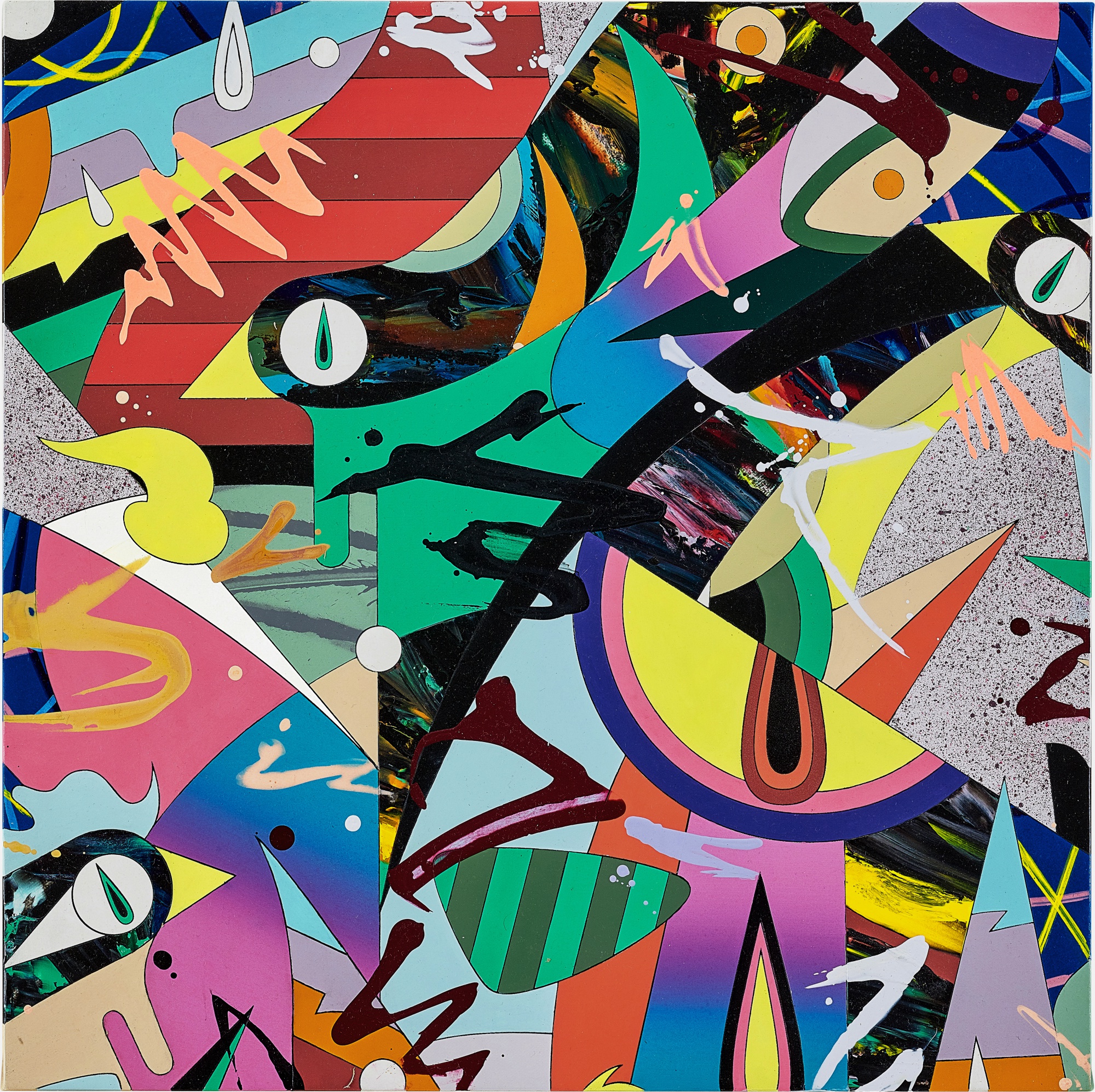
解放獵人
He later relocated to the United States, settling in New York, and that physical and psychic journey between East and West became the animating subject of his entire practice. He did not simply blend two traditions for stylistic effect. He interrogated what it means to carry two visual inheritances simultaneously, to see the world through a doubled lens without resolving the tension between them. His early work in New York showed an artist already fluent in multiple visual registers, someone who could move between classical figuration and graphic flatness with surprising ease.
Over time, his compositions grew more complex and more confident, the figures more fragmented, the layering more deliberate. He began incorporating screenprint techniques alongside oil and acrylic painting, allowing the mechanical and the handmade to coexist within a single surface. This hybrid approach, combining the intimacy of painting with the reproducibility of print, gave his work a quality that felt genuinely new rather than merely eclectic. The paintings that brought Matsuyama to wider international attention are remarkable for their density and their generosity.
Tomokazu Matsuyama
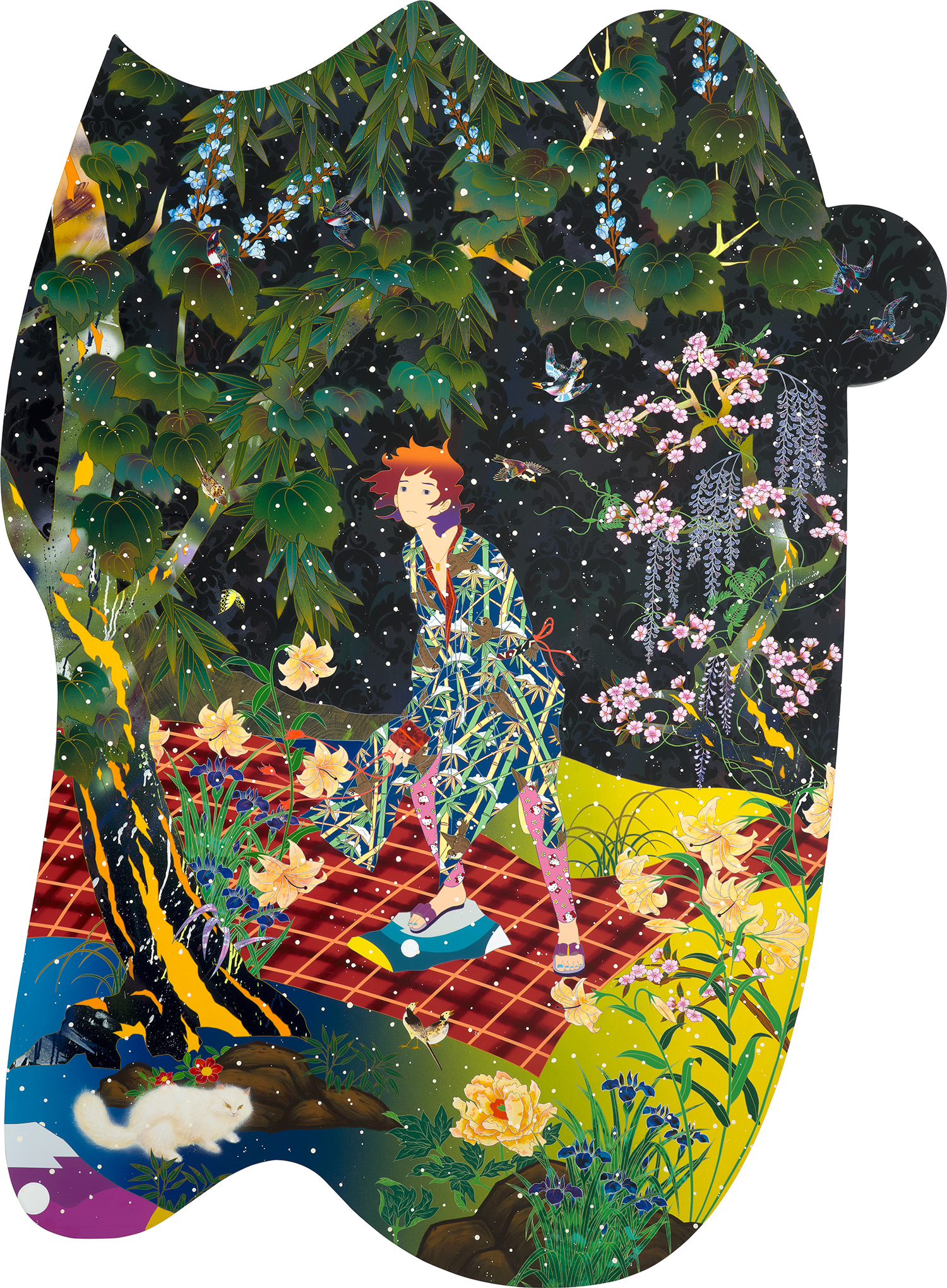
Daylight In My Place, 2019
Works like Frosti Aurora from 2020 and Daylight In My Place from 2019 present figures suspended in richly ornamented pictorial spaces where chrysanthemums and camouflage patterns, classical drapery and graphic color fields, coexist without apology. The figures themselves are often androgynous, their expressions serene or ambiguous, and they seem to float between cultural moments rather than being anchored in any single one. Nice Quiet Hot Tears, with its bilingual title carrying both English and Chinese characters, makes this duality explicit: language itself becomes part of the layered surface, a visual element as much as a semantic one. His works on paper and print editions, including pieces like Broken Train Pick Me, which combines digital printing and screenprint with glitter and high gloss on Somerset paper, demonstrate that Matsuyama's command of surface is not limited to canvas.
These works extend his visual ideas into formats that have brought his practice to a broader collecting audience, and they maintain the same rigorous layering and emotional intelligence as his larger paintings. His forays into three dimensional work, such as Natural Shell Pride from 2022, a wood and mixed media sculpture, reveal an artist increasingly willing to expand the boundaries of the painted surface into space itself. For collectors, Matsuyama's work presents a compelling proposition on several levels. His paintings occupy a position that feels historically grounded and urgently contemporary at the same time, which is a rare quality.

Tomokazu Matsuyama
Nice Quiet Hot Tears 寂靜的熱淚
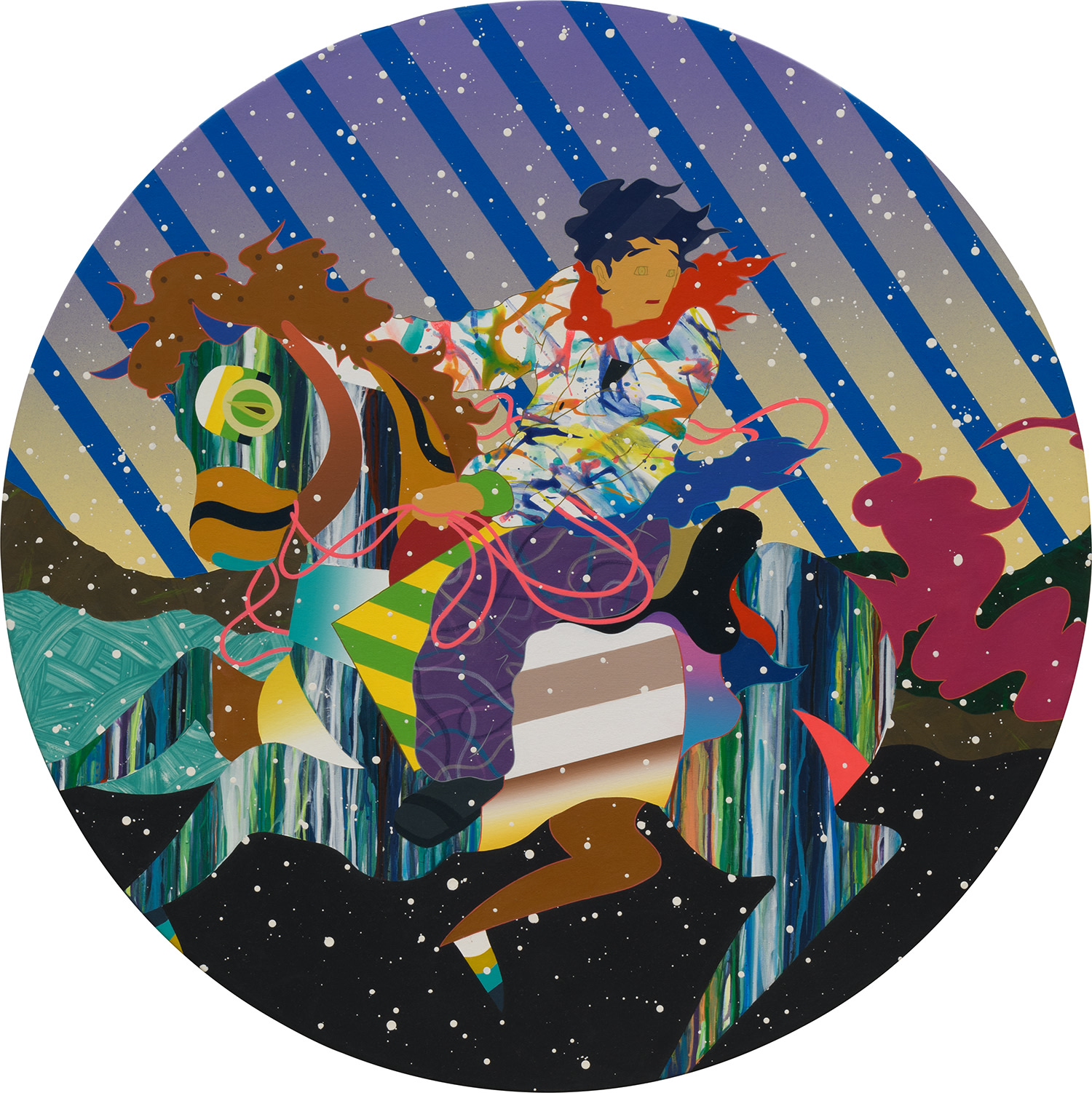
Works like the untitled acrylic on canvas from 2014 and the striking 解放獵人, which blends acrylic and screenprint in a composition of extraordinary visual power, demonstrate his range across scale, medium, and register. Collectors drawn to artists who engage seriously with questions of cultural identity and globalization will find in Matsuyama a painter who treats these themes not as political slogans but as lived experience rendered in form and color. His market has grown steadily and thoughtfully, supported by serious gallery relationships and genuine institutional interest rather than speculative heat. In the broader context of contemporary art history, Matsuyama's practice invites comparison with artists who have similarly navigated the space between cultural traditions.
His layered figuration recalls something of the complexity found in the work of Kehinde Wiley, who remixes art historical portraiture with contemporary Black identity, and there are resonances with the cultural code switching of artists like KAWS or Takashi Murakami, though Matsuyama's emotional register is distinctly his own, quieter and more introspective than either. He belongs to a generation of artists for whom globalization is not a backdrop but a biography, and who have made that biography into a sophisticated visual language. What Matsuyama ultimately offers, and what makes his work feel so necessary at this particular moment, is a model of cultural complexity that refuses simplification. His paintings do not ask viewers to choose between East and West, between the classical and the popular, between the handmade and the mechanical.
Tomokazu Matsuyama
diameter 106.5 cm (41 7/8 in.), 2014
They ask instead for a more expansive kind of attention, one that can hold contradiction and beauty in the same field of vision. In a world that increasingly demands that identities be declared and fixed, his work insists on the richness of living in between. That insistence, rendered in paint and ink and gold and glitter and silk and paper, is what will ensure that Matsuyama's work endures long after the cultural moment that produced it has passed.