Tom Wesselmann
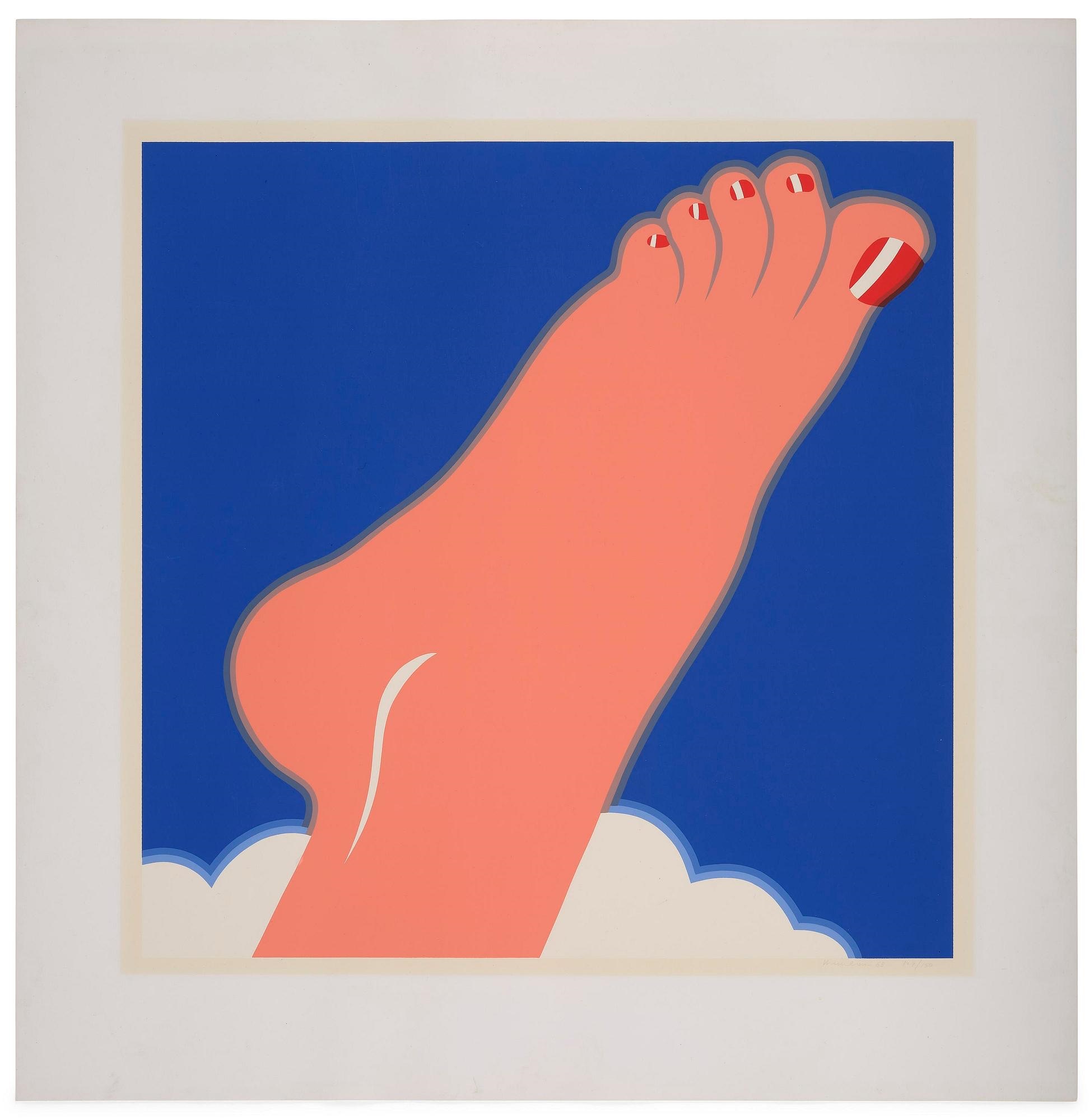
Tom Wesselmann, America's Most Sensuous Pop Visionary
Artist Spotlight · The Collection Editorial
“I wanted my paintings to have a sense of being here, in the world, among real things.”
Tom Wesselmann, interview with Slim Stealingworth, 1980
There is a moment in the Museum of Modern Art's permanent collection galleries when you round a corner and find yourself face to face with one of Tom Wesselmann's Great American Nudes, and everything you thought you knew about the boundaries between fine art and popular culture quietly dissolves. The canvas pulses with flat, confident color. A television set, a telephone, an American flag, and a reclining female figure coexist in the same pictorial space with absolute ease, as though they had always belonged together. That sensation, at once familiar and wholly invented, is Wesselmann's singular gift, and it continues to draw new generations of collectors, curators, and art lovers into his orbit decades after he first began reimagining the visual language of postwar America.
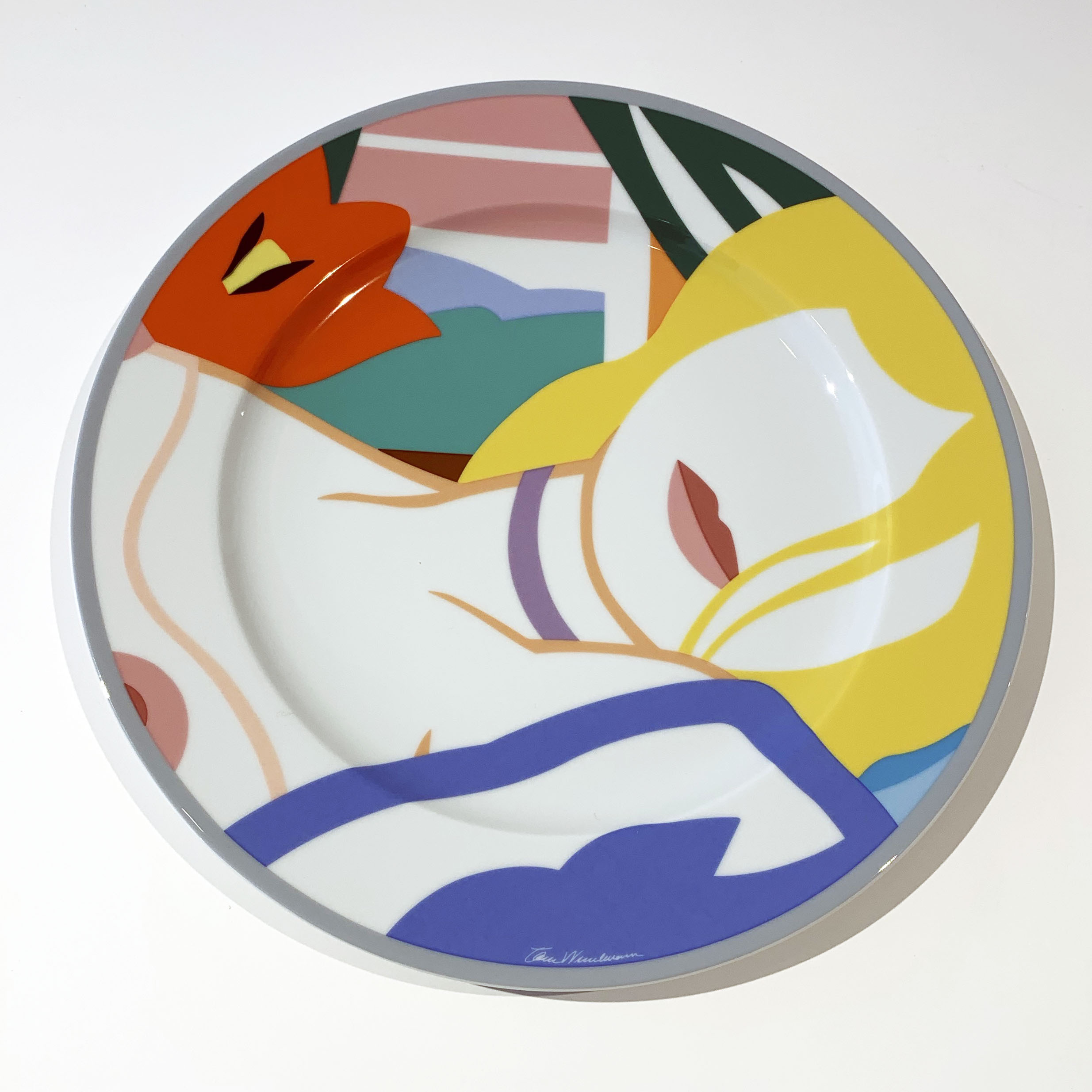
Tom Wesselmann
Rosenthal Künstler-Platzteller: Blonde Vivienne, 1990
Tom Wesselmann was born in Cincinnati, Ohio, in 1931, and his early years gave little obvious indication of the provocateur he would become. He studied psychology at Hiram College in Ohio before a chance encounter with a comic book he had drawn himself convinced him that art was his true calling. He enrolled at the Cincinnati Art Academy, then made the pivotal move to New York City in the late 1950s to attend Cooper Union, the rigorous design and fine arts school in Manhattan that had already shaped generations of American artists. New York in that era was electric with creative possibility, and Wesselmann absorbed everything around him, from the gestural ambition of Abstract Expressionism to the graphic directness of commercial advertising and the unapologetic vitality of American consumer culture.
His artistic breakthrough came in the early 1960s when he began developing the Great American Nude series, a body of work that would eventually run to over one hundred paintings and establish him as one of the definitive voices of Pop Art. Where contemporaries like Andy Warhol and Roy Lichtenstein drew on mass media imagery and mechanical reproduction, Wesselmann built collaged environments that incorporated actual objects, cut out magazine advertisements, working radios, and plastic flowers alongside painted figures. His nudes were deliberately faceless, reduced to simplified, sensuous outlines set against grounds of bold, unmodulated color. The effect was simultaneously abstract and explicit, cheerful and charged, and it announced a genuinely new approach to the figure in American painting.
Tom Wesselmann
Untitled
By the mid 1960s, Wesselmann was exhibiting regularly with the Green Gallery in New York, the pioneering space run by Richard Bellamy that also championed Donald Judd, Claes Oldenburg, and Dan Flavin. His Still Life series, developed in parallel with the Great American Nudes, brought the same formal intelligence to everyday objects, transforming refrigerators, bottles, bowls of fruit, and kitchen appliances into monumental compositions of breathtaking clarity. Later, he pushed further into three dimensions with his shaped canvases and cut out works, steel sculptures, and the intimate, intensely focused studies of mouths, lips, and cigarette smoke that became another of his signature contributions. The Smoker series, which he developed through the late 1960s and beyond, reduced the human presence to a single sensory detail rendered with exquisite economy, proving that Wesselmann's mastery of restraint was every bit as powerful as his command of abundance.
“I've always felt close to Matisse. He gave me permission to use color the way I do.”
Tom Wesselmann, artist statement
The works on paper and printmaking editions that Wesselmann produced throughout his career deserve particular attention from collectors, and they represent some of the most accessible points of entry into his practice. His screenprints, aquatints, and mixed media works on museum board carry all of the formal intelligence of his large scale canvases while offering an intimacy that suits the domestic spaces most collectors actually inhabit. Works such as Monica Nude with Purple Robe and Monica Nude with Yellow Curtain, both produced in the early 1990s, exemplify his ability to invest printmaking with the full weight of his painterly sensibility. The Monica series, featuring his partner and later wife Monica Wesselmann, represents a sustained meditation on the female figure that is as tender as it is formally rigorous.
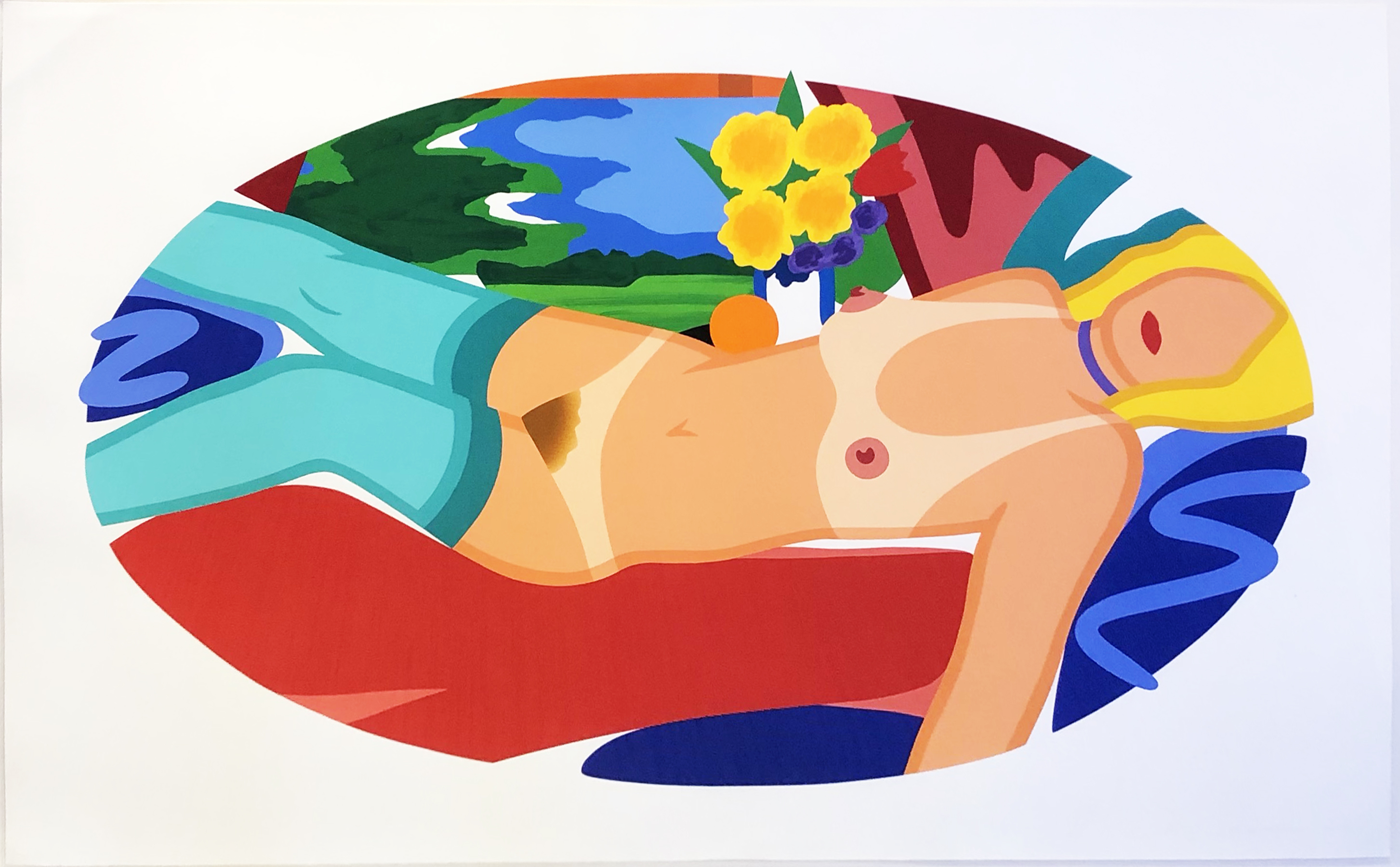
Tom Wesselmann
Beautiful Bedroom Kate, 1998
His later screenprints on museum board, including Mixed Bouquet with Leger from 1993 and Beautiful Bedroom Kate from 1998, show an artist still at the height of his powers, enriching his palette and deepening the dialogue between depicted space and the flatness of the picture plane. Within the broader context of Pop Art and postwar American painting, Wesselmann occupies a distinctive position. He shared with Warhol and Lichtenstein an appetite for the textures of consumer culture, and with Jasper Johns and Robert Rauschenberg a willingness to incorporate real world materials into the painted surface. Yet his preoccupation with the nude, and with the erotic charge of everyday domestic life, gives his work a warmth and a directness that sets it apart from the cooler irony of some of his peers.
He drew explicitly on the precedents of Matisse and Leger, particularly in his treatment of color and his approach to flattening pictorial space, and his work rewards viewers who come to it with an awareness of the European modernist tradition as much as those who approach it through the lens of American popular culture. For collectors, Wesselmann's market is well established and consistently supported by major auction houses and specialist dealers worldwide. His blue chip status reflects both the depth of his output across five decades and the enduring appeal of works that photograph beautifully, live generously in domestic and institutional settings, and carry genuine art historical significance. The range of media and scales in which he worked means that there are meaningful points of entry at various levels of the market, from studies and prints to major canvases and steel sculptures.
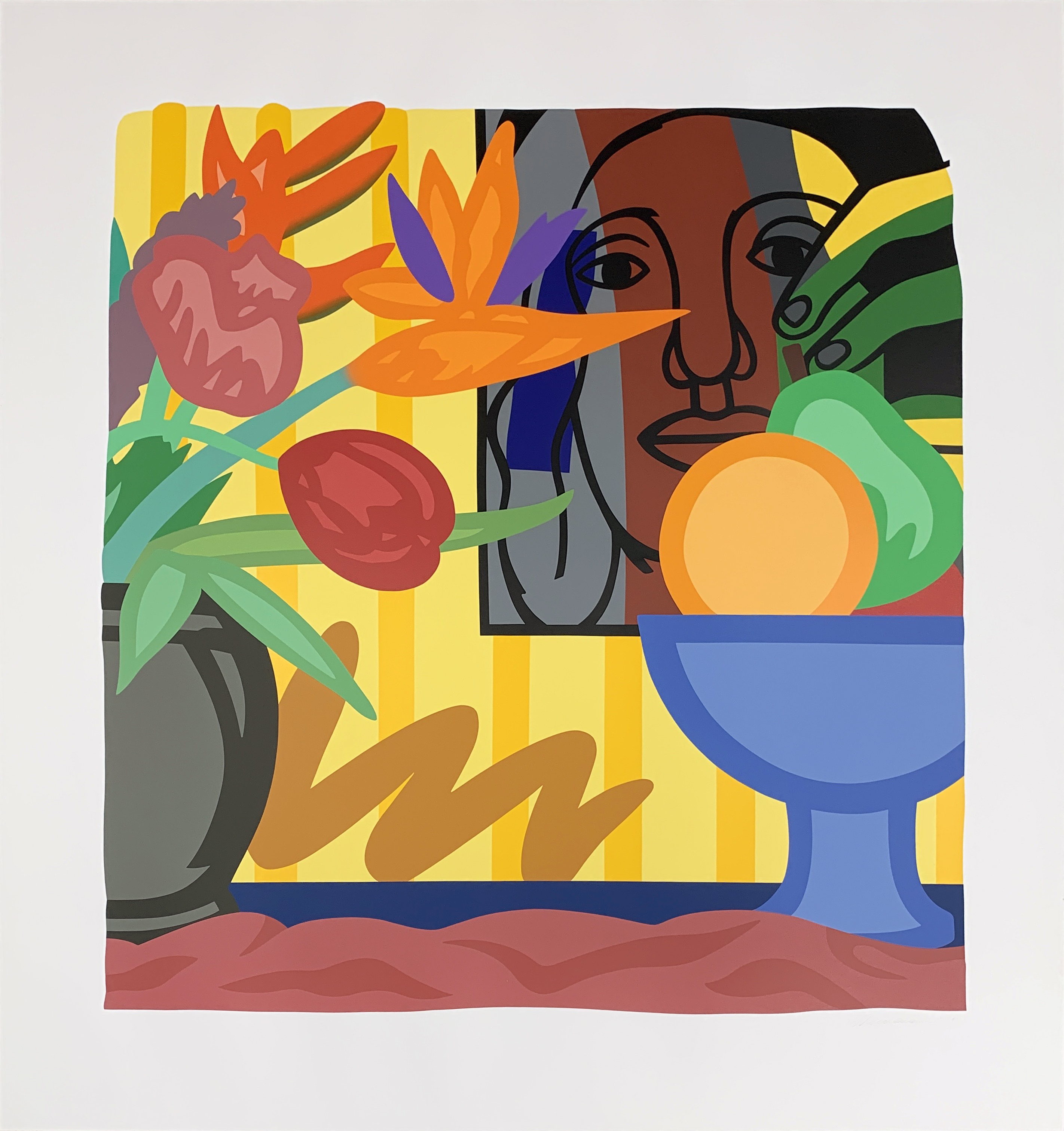
Tom Wesselmann
Mixed Bouquet with Leger, 1993
Collectors drawn to postwar American art, to the figure, to the intersection of abstraction and representation, or simply to works that bring genuine joy into a room will find Wesselmann to be a deeply rewarding artist to live with. Tom Wesselmann died in New York in 2004, having spent nearly five decades reshaping how Americans see themselves, their homes, their desires, and their culture. His legacy is secure not because it belongs to history but because it continues to feel alive, relevant, and genuinely pleasurable. In an art world that can sometimes take itself very seriously indeed, Wesselmann's reminder that sensuality, beauty, and everyday life are worthy subjects for the highest artistic ambition remains as valuable as ever.
Explore books about Tom Wesselmann