Titus Kaphar
Titus Kaphar Rewrites History With Paint
Artist Spotlight · The Collection Editorial
“I am not trying to destroy art history. I am trying to find the parts of it that have been left out.”
Titus Kaphar, TED Talk, 2017
In the spring of 2021, Titus Kaphar appeared on the cover of Time magazine, a distinction that marked not just a personal milestone but a cultural reckoning. The image, created in response to the murder of George Floyd and the grief tearing through Black communities across America, showed a Black mother cradling an infant while the space beside her remained conspicuously, heartbreakingly empty. It was titled "Shut In," and it announced to a global audience what the art world had understood for years: Kaphar is one of the most urgent and necessary painters working today. That moment crystallized his rare ability to speak across the boundary between the museum and the street, between art history and the present tense.
Titus Kaphar
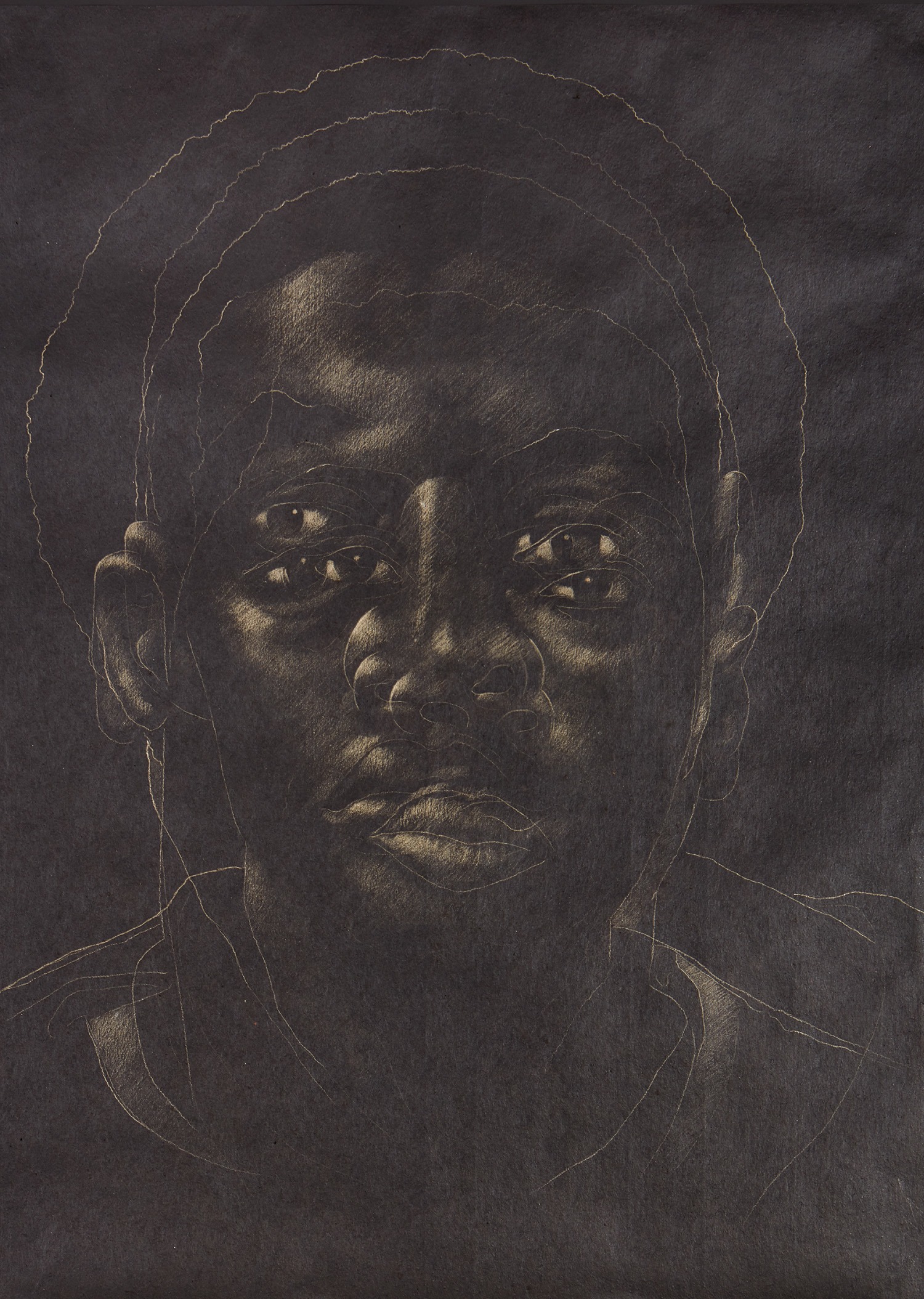
The Jerome Project (Asphalt and Chalk) XIV, 2015
Kaphar was born in 1976 in Kalamazoo, Michigan, and grew up in circumstances that gave him an intimate understanding of the ways institutions record some lives and erase others. His father struggled with addiction and was incarcerated, an experience that would later become the fuel for some of his most searching and emotionally complex bodies of work. Kaphar went on to study at the California College of the Arts, where he earned his MFA, and then pursued further study at Yale University. It was in those rigorous academic environments that he developed both a sophisticated command of traditional painting techniques and an intellectual framework for interrogating them.
From the beginning, Kaphar was drawn to the Old Masters not out of reverence alone but out of a kind of productive suspicion. He studied the conventions of European portraiture, the hierarchies encoded in scale and placement, the casual absences that told their own stories. His response was not to reject those traditions but to inhabit them fully and then cut, fold, tar, and transform them from within. This practice of physical intervention became his signature: canvases sliced and rolled back to reveal ghostly underlayers, figures obscured by swaths of tar, subjects pushed to the margins of compositions that were not built to center them.
Titus Kaphar
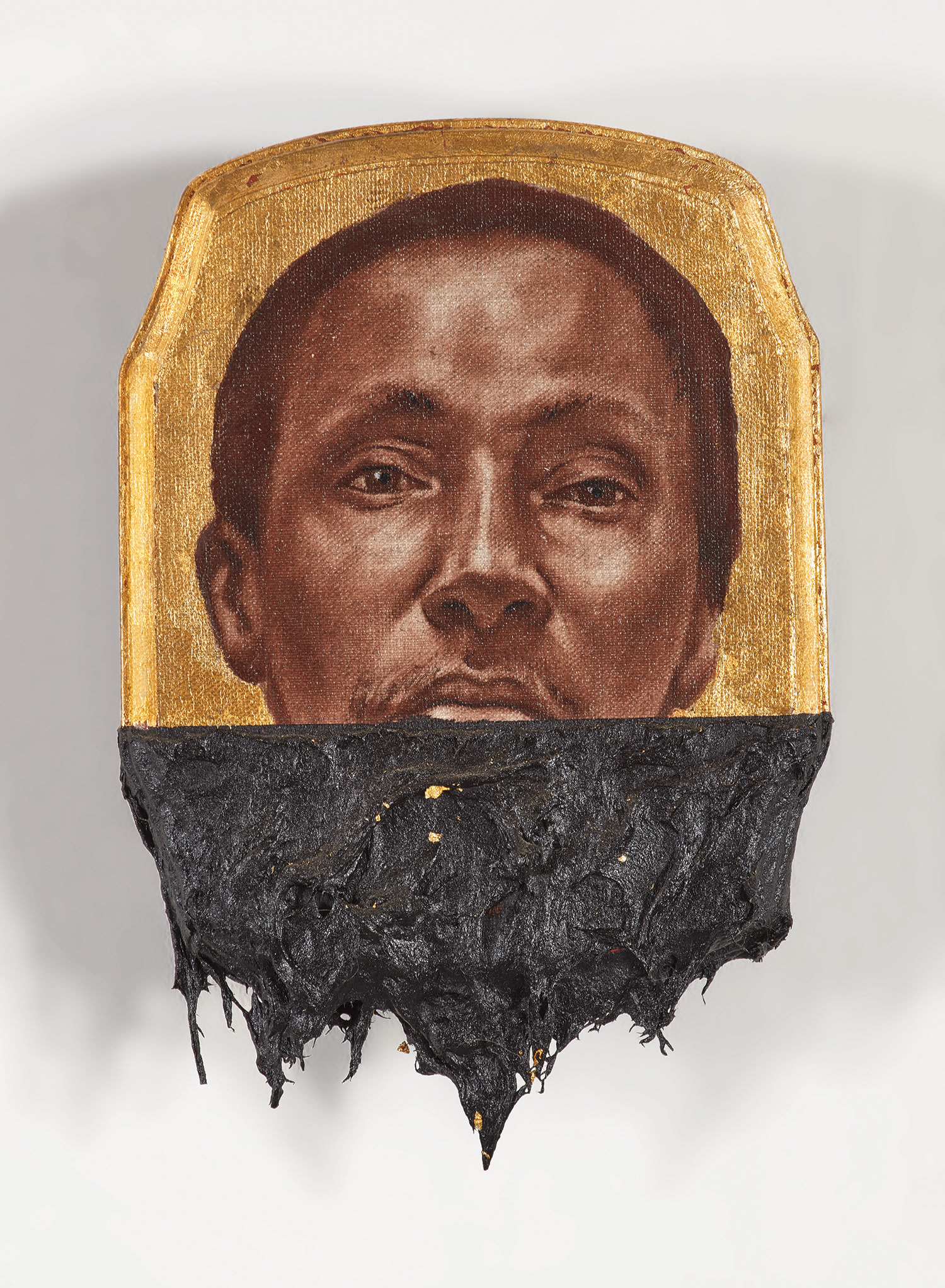
Jerome XIV, 2014
The formal gestures are always deliberate, always legible, and always emotionally loaded. The Jerome Project, which Kaphar began around 2014, represents perhaps the most sustained and devastating achievement of his career to date. The series grew out of his research into criminal justice databases, where he discovered that searching for his own father's name returned dozens of results, dozens of men named Jerome with histories of incarceration. Working in oil, gold leaf, and tar on panel, he created individual portrait panels for each Jerome he found, then gradually submerged them in tar until the figures were partially or wholly consumed.
“The tar is about erasure. It is about what happens to certain bodies in this country.”
Titus Kaphar, interview with The New York Times
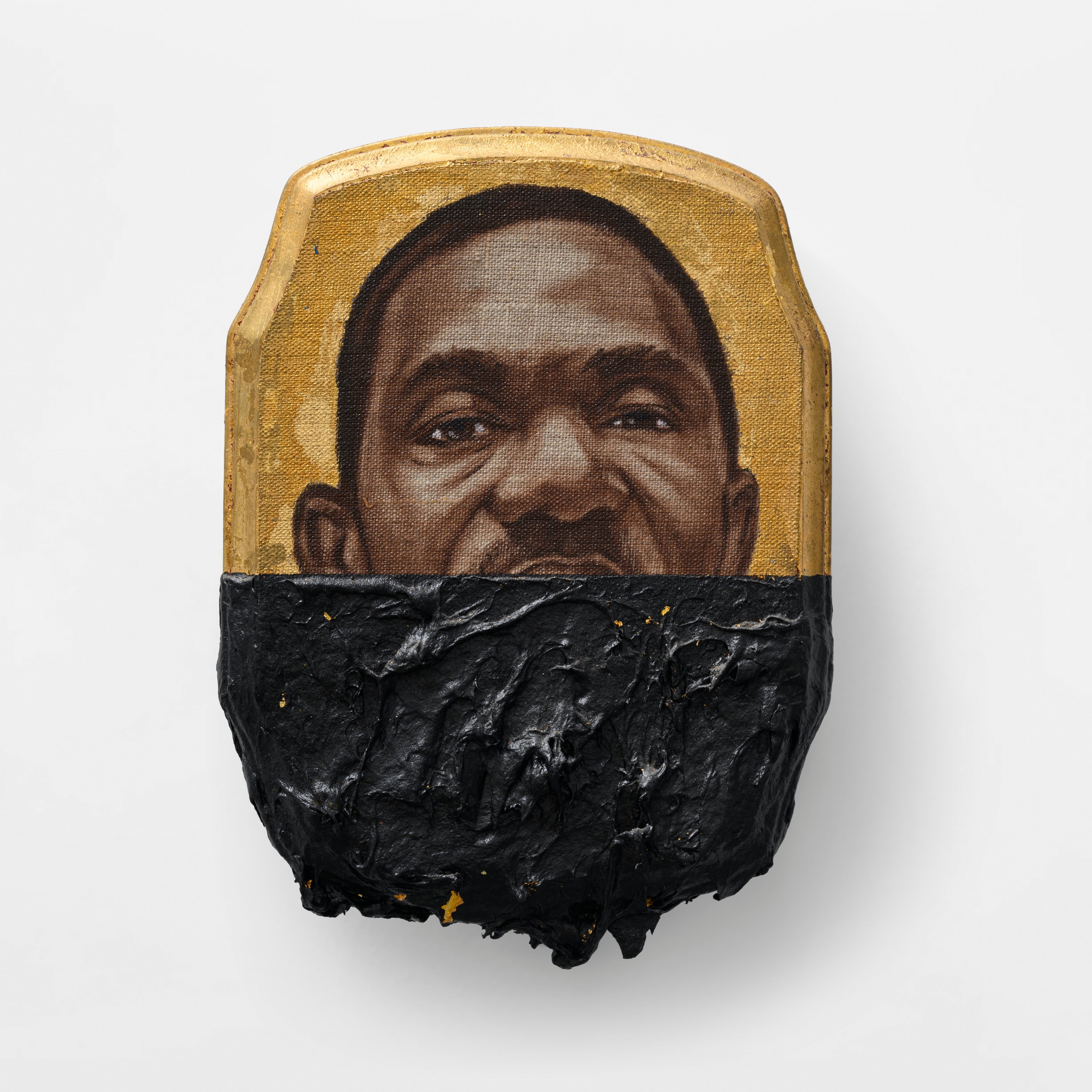
"Jerome XIV" and "Jerome XXIV," both from 2014, are among the most powerful works in this body of work, their golden surfaces interrupted by darkness in ways that feel both ceremonial and mournful. The gold leaf recalls devotional painting, altarpieces and icons, situating these men within a tradition of sacred representation that history never afforded them. The tar does the opposite, threatening to swallow them whole. The tension between those two forces is where the meaning lives.
Titus Kaphar
Jerome XXIV, 2014
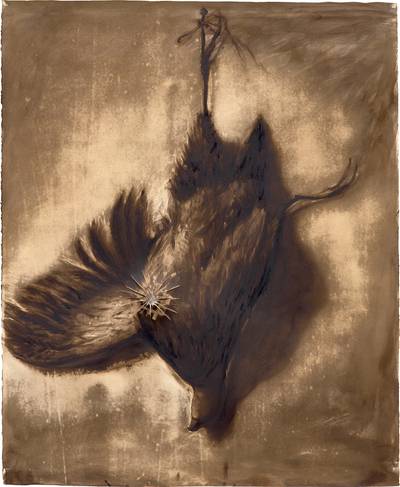
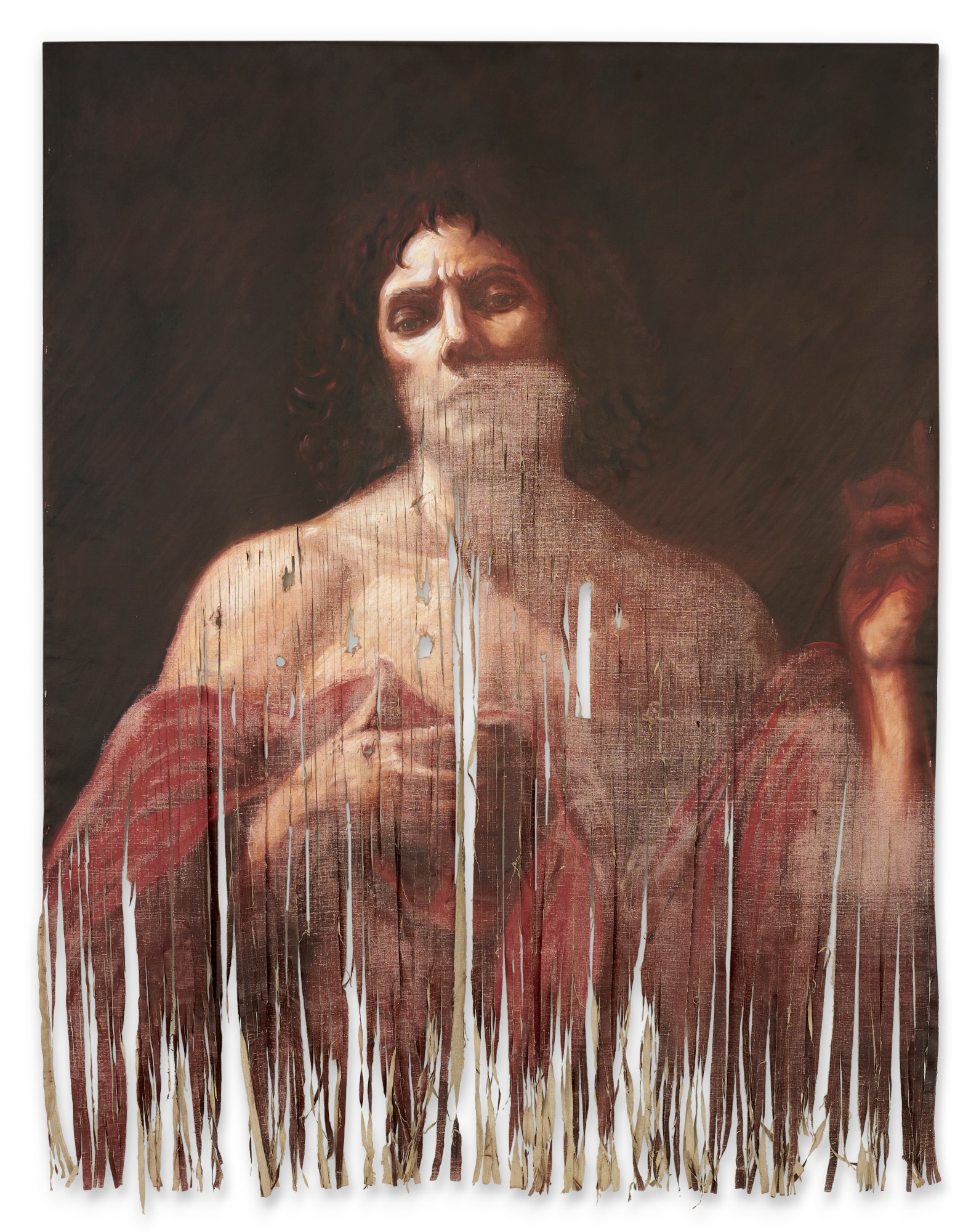
Earlier works like "Martyr" from 2008, executed in oil on cut linen, and "Both King and Accomplice" from the same year, which pairs oil on canvas with a tar covered steel container mounted on a wood base, announced the range of Kaphar's material intelligence. Even in those earlier pieces, he was already fusing painting with sculptural thinking, using physical objects and altered surfaces to complicate what a picture can do. "Nah Momma, She Ain't White, She Just Real Light Skinnedded" from 2006, oil and thread on canvas, introduced the use of thread as a material that both mends and marks, suggesting the stitched together and sometimes unresolved nature of racial identity in America. "The Children" from 2012, oil and tar on canvas presented in the artist's own frame, and "Alternate Endings" from 2016, oil on canvas mounted on panel, each extend his investigation in directions that feel both formally inventive and deeply personal.
For collectors, Kaphar's work offers something that is increasingly rare: aesthetic ambition and moral seriousness operating at the same level of intensity. His paintings reward sustained looking in ways that few contemporary works manage. The physical alterations mean that each piece has a dimensional, almost sculptural presence on the wall, and the layering of art historical reference beneath contemporary urgency gives collectors something to discover over years of living with the work. Institutions recognized this early.
Titus Kaphar
Martyr, 2008
The Museum of Modern Art in New York has exhibited his work, and major collections across the country have acquired pieces from across his career. Works from the Jerome Project in particular have attracted serious institutional interest, and earlier paintings from the 2008 period have performed strongly with private collectors who value the cohesion of his conceptual vision across media. Kaphar belongs to a generation of painters who have fundamentally expanded what figurative work can accomplish. His concerns connect him to artists like Kerry James Marshall, whose excavation of Black life within the Western painting tradition shares a similar depth of historical engagement, and to Kara Walker, whose silhouette works confront the violence encoded in American visual culture.
Like both of those artists, Kaphar is not content to critique from outside a tradition. He enters it fully, masters its tools, and transforms it from within. That approach places him in a lineage that runs back through Romare Bearden and forward into the work of younger painters who cite him as a direct influence. What Kaphar has built over nearly two decades of sustained practice is a body of work that insists on the humanity of people that official histories have filed away or forgotten.
His studio in New Haven, Connecticut, is also home to NXTHVN, a nonprofit incubator he cofounded to support emerging artists and local youth, which speaks to his understanding that making space in the culture requires institutional as well as artistic effort. At a moment when the question of whose stories get told and how they get told sits at the center of every conversation about culture, Kaphar is not simply participating in that conversation. He is one of the people who made it possible to have it at all.