Tim Bavington
Tim Bavington Turns Sound Into Radiant Light
Artist Spotlight · The Collection Editorial
Standing before one of Tim Bavington's monumental canvases, the experience is immediate and almost disorienting in the best possible way. Columns of color, some narrow as a whisper, others broad and declaratory, rise from the bottom edge to the top with a precision that feels both mathematical and deeply felt. Only when you learn that each stripe corresponds to a specific musical note, its pitch, its duration, its place within a song you may have loved for decades, does the full dimension of what Bavington is doing come into focus. His paintings are not illustrations of music.
Tim Bavington
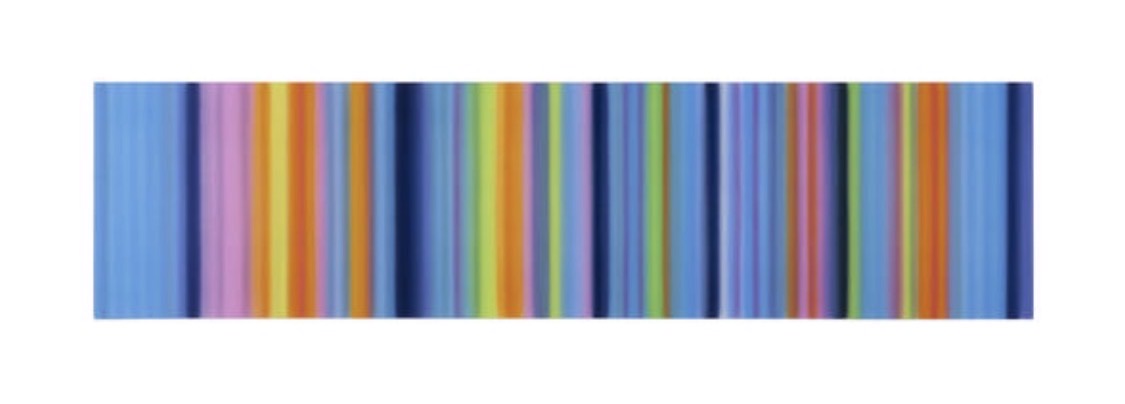
Matchbox Blues (SRV / intro), 2019
They are music, transposed into another frequency entirely. Bavington has been building this singular practice from his base in Las Vegas, Nevada, and in recent years his work has attracted renewed critical attention as collectors and institutions alike reckon with just how much conceptual and emotional weight his canvases carry. His 2019 canvas "Matchbox Blues (SRV / intro)" brought fresh eyes to his ongoing series translating the work of Stevie Ray Vaughan into paint, demonstrating that two decades into this project, Bavington's system has lost none of its urgency or invention. The work distills the opening bars of a Vaughan blues into a cascade of color that pulses with the same tension and release as the guitar itself.
Born in 1966, Bavington came of age during a period when American rock and pop culture were inseparable from visual identity, and the boundaries between disciplines felt genuinely porous. He pursued his studies in art with a seriousness that set him apart from peers who treated music merely as backdrop, and by the time he settled in Las Vegas, he had developed a working method that was entirely his own. Las Vegas itself is a city built on sensation, on spectacle, on the idea that light and color can be organized to produce feeling in a stranger. It is perhaps no accident that Bavington found his deepest artistic voice there.
Tim Bavington
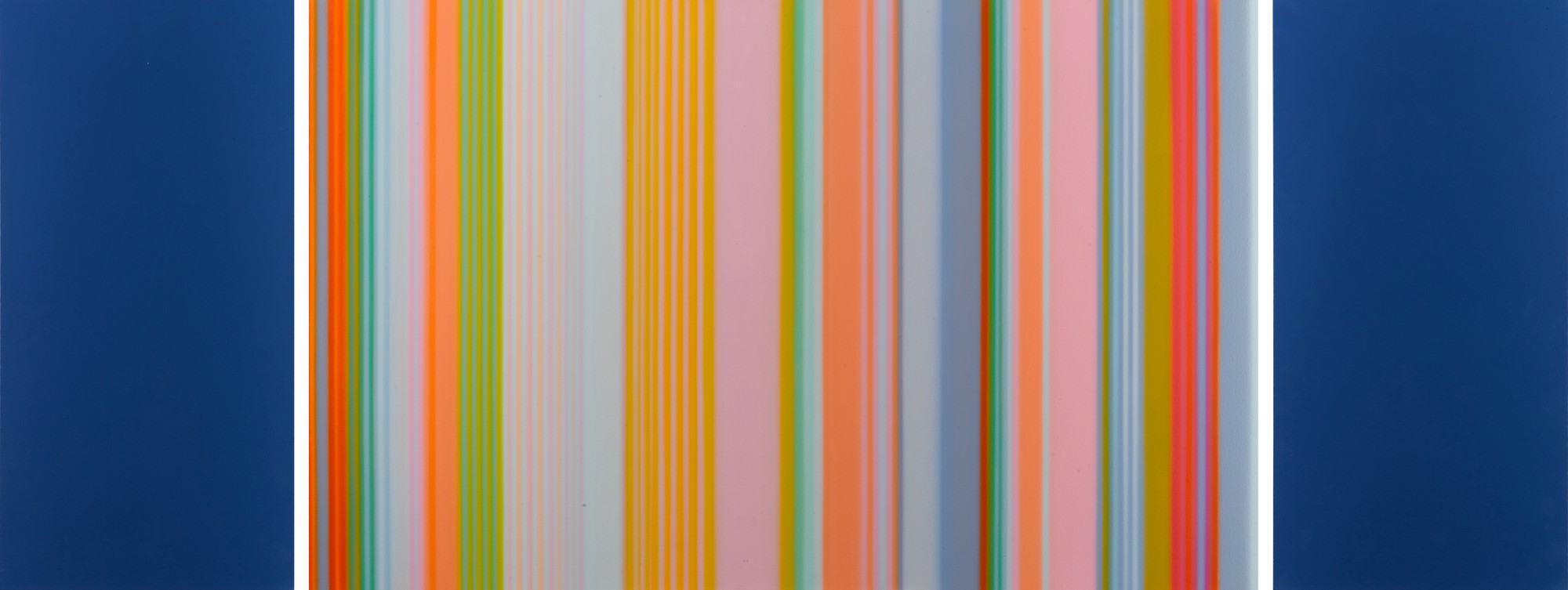
Growin' On Me, 2004
The development of his signature stripe system was a gradual revelation rather than a sudden breakthrough. Bavington spent years working through questions of translation: how does one move faithfully between two sensory registers without reducing either one? He arrived at a solution that honors both sides of the equation. Each note in a musical passage is assigned a color drawn from a carefully constructed palette, and the width of each stripe reflects duration while the arrangement reads left to right like a musical score.
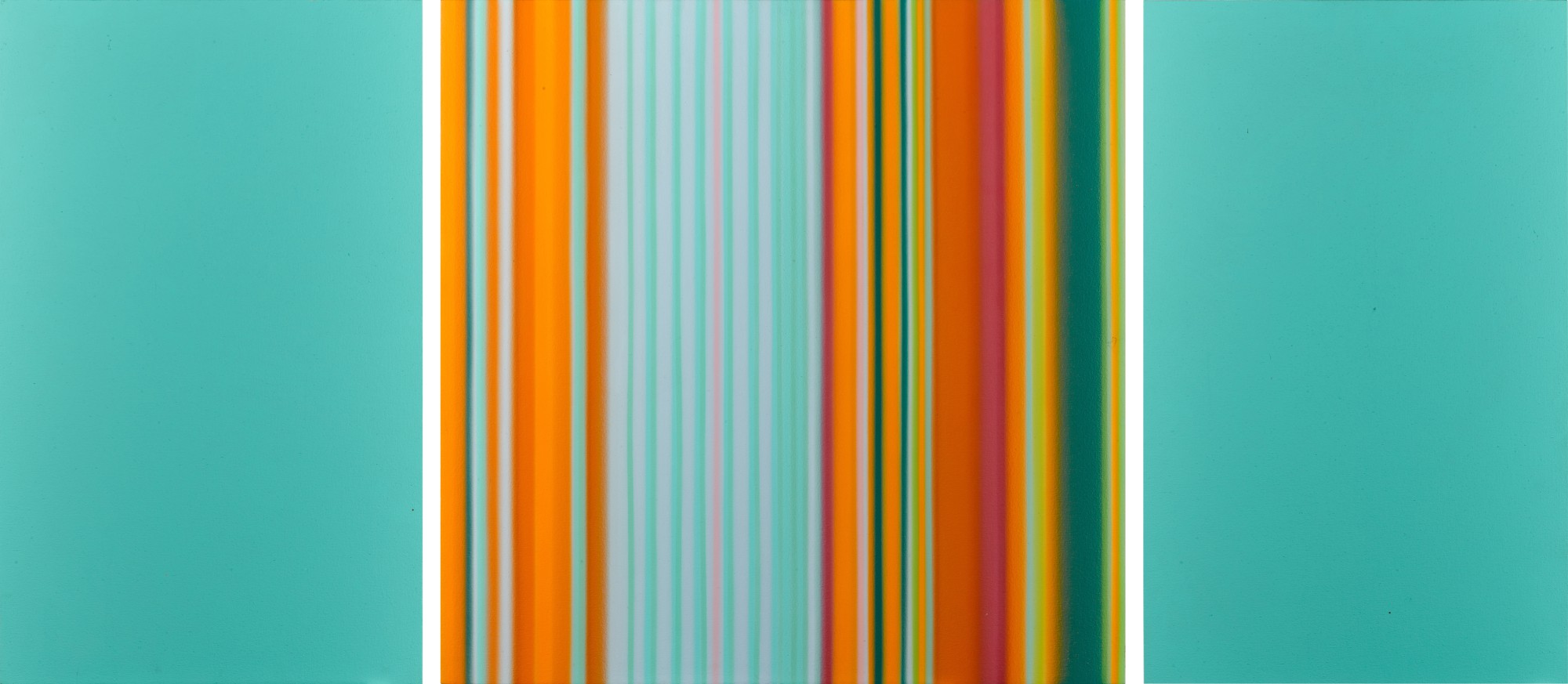
The system is rigorous but not rigid, and the results are paintings that reward both intellectual engagement and pure optical pleasure. His triptych works from 2004, including "Growin' On Me" and "Aint Wastin' Time No More," remain among the most celebrated demonstrations of this approach, the three panel format allowing Bavington to map the structure of a full song with room to breathe and develop across the wall. Those 2004 triptychs also mark an important moment in Bavington's market trajectory. Created in acrylic on canvas, they introduced collectors to the full ambition of his program at a scale that commands a room.
Tim Bavington
Aint Wastin' Time No More, 2004
Collectors who encountered these works early have consistently noted that they function unlike almost any other abstract painting in the way they reward repeated looking. Because the source material is music that listeners know intimately, returning to the canvas with a song fresh in memory produces a genuinely new experience, a kind of double perception that most abstract painting cannot offer. This quality, the painting as an active and personal encounter rather than a fixed object, is one of the key reasons that serious collectors find Bavington's work so compelling. In terms of art historical placement, Bavington belongs to a lineage that includes the great Color Field painters, in particular Kenneth Noland and Gene Davis, whose stripe compositions from the 1960s established that color alone, organized with structural clarity, could be a sufficient and profound subject.
He also inherits something from the Minimalists, particularly in his commitment to system and repetition as generative rather than limiting forces. But where painters like Davis or Noland sought to strip away external reference, Bavington moves in a genuinely different direction: his work is saturated with specific cultural meaning, with the emotional history that listeners carry inside particular songs. Collectors who love both the formal rigor of Ellsworth Kelly and the emotional directness of pop culture will find in Bavington a rare synthesis of both impulses. The market for Bavington's work has developed steadily and with considerable loyalty among collectors who discover him.
His paintings are held in private collections across the United States, and the relatively limited supply of his large scale canvases has helped sustain strong interest. For collectors approaching his work for the first time, the triptych format represents a particularly significant opportunity: these works are among the most complete statements of his method, and finding them available is increasingly rare. Works from his ongoing Stevie Ray Vaughan series, including pieces like "Matchbox Blues (SRV / intro)," carry the added significance of engaging with source material that carries enormous cultural weight for multiple generations of music and art lovers alike. What Bavington ultimately offers is something that very few painters of his generation have managed: a genuinely new reason to look at abstract painting.
At a moment when the art world continues to debate what painting can still do and who it can still reach, his work answers with quiet confidence. The paintings do not demand that you know their conceptual scaffolding to be moved by them. They work first as color, first as light, first as the kind of visual pleasure that stops you mid stride in a gallery. But they also reward the viewer who wants to go deeper, who wants to bring their own relationship to a song into conversation with what is on the wall.
That generosity, intellectual and sensory at once, is the mark of an artist whose practice will only grow in significance as time passes and the full originality of what he has built becomes clearer.