Thomas Moran
Thomas Moran: America's Magnificent Eye Opens Wide
Artist Spotlight · The Collection Editorial
“I have always held that the grandest, most beautiful, or wonderful in nature would, in capable hands, make the grandest, most beautiful pictures.”
Thomas Moran, letter to Ferdinand Hayden, 1871
Stand before any major Thomas Moran canvas and something remarkable happens. The light seems to move. The canyon walls breathe. The water catches fire.
Thomas Moran
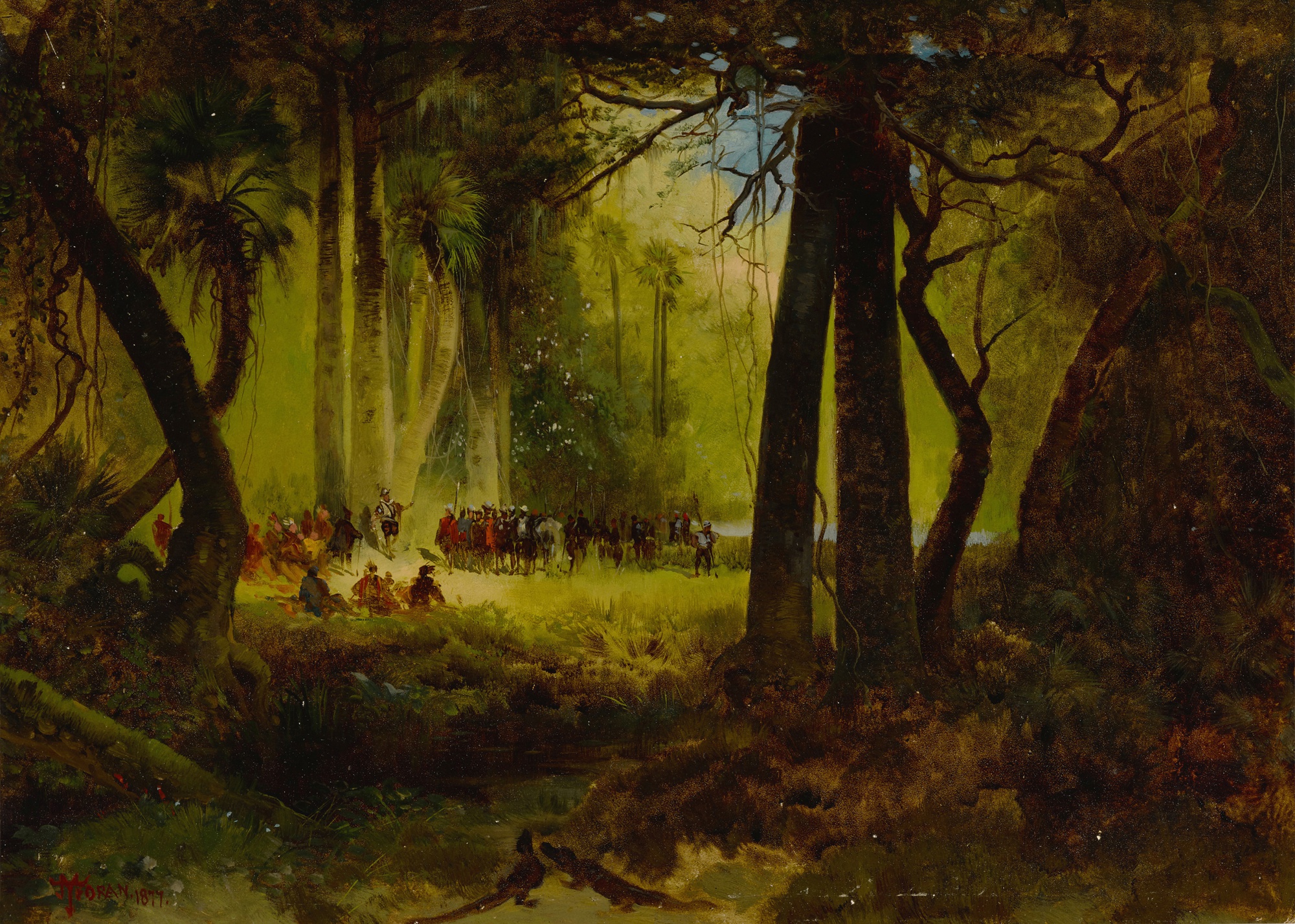
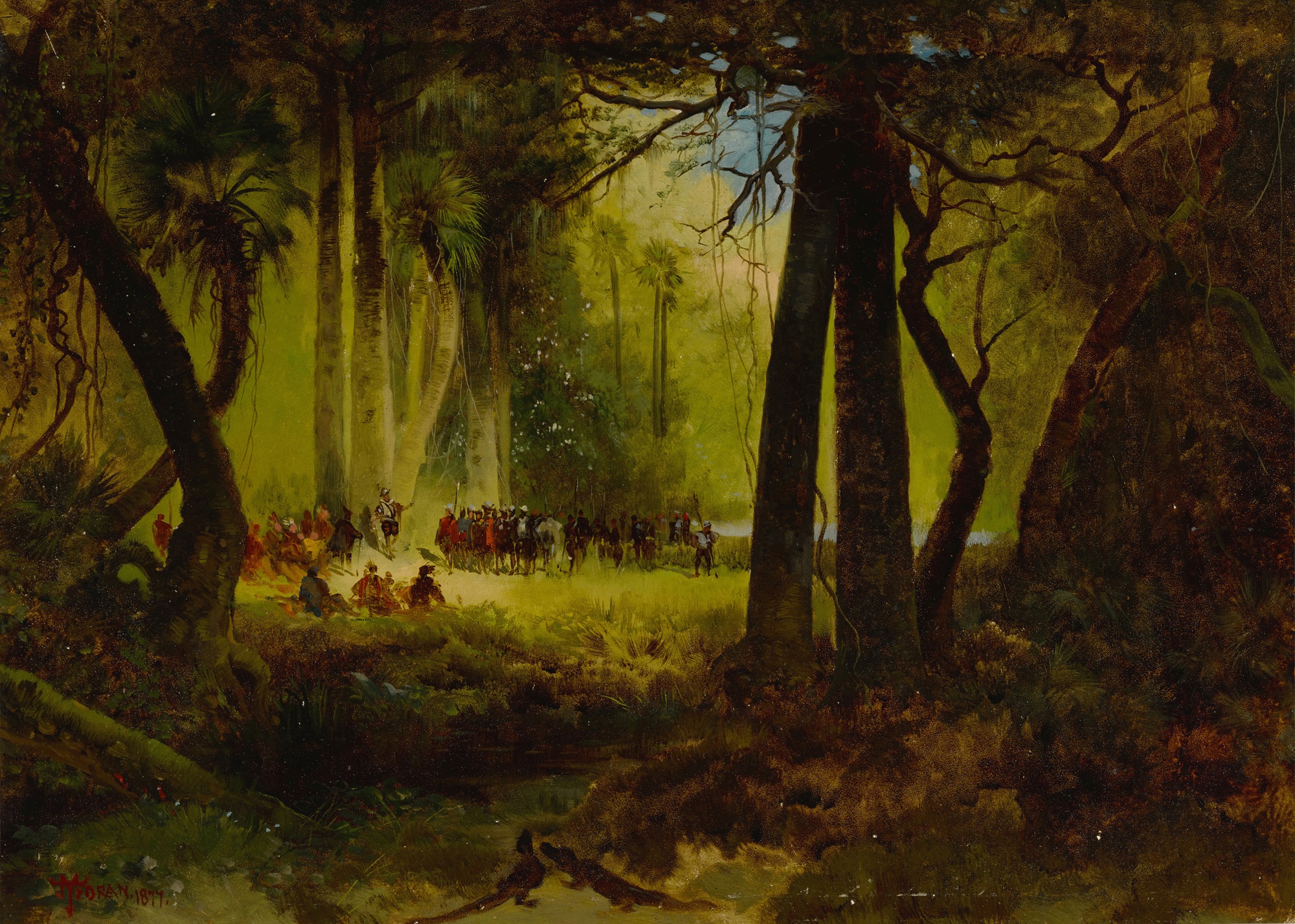
Reception of Dominique de Gourgues by the Indians, 1877
It is the particular genius of this English born American painter that he could render the landscape of a young nation with such operatic grandeur that viewers felt, for the first time, that they truly understood the scale and spiritual weight of what lay west of the Mississippi. Today, as American landscape painting enjoys a sustained reassessment in museum collections and at auction, Moran sits at the very center of that conversation, recognized not merely as a painter of beautiful places but as a foundational figure in the story of how a country came to see itself. Thomas Moran was born in Bolton, Lancashire, England in 1837, the seventh child of a weaver named Thomas Moran Senior. The family emigrated to Philadelphia in 1844, settling into a city that was, at the time, one of the great cultural engines of American life.
Young Thomas showed an early aptitude for art and at fifteen was apprenticed to the engraving firm Scattergood and Telfer, where he developed the extraordinary discipline of line and tonal control that would underpin his painting for the rest of his life. He studied alongside his brother Edward, who would also become a painter of note, and the two absorbed the lessons of the Hudson River School with great seriousness. But it was a journey to England in 1861 that truly opened Moran's eye. He stood before the canvases of J.
Thomas Moran
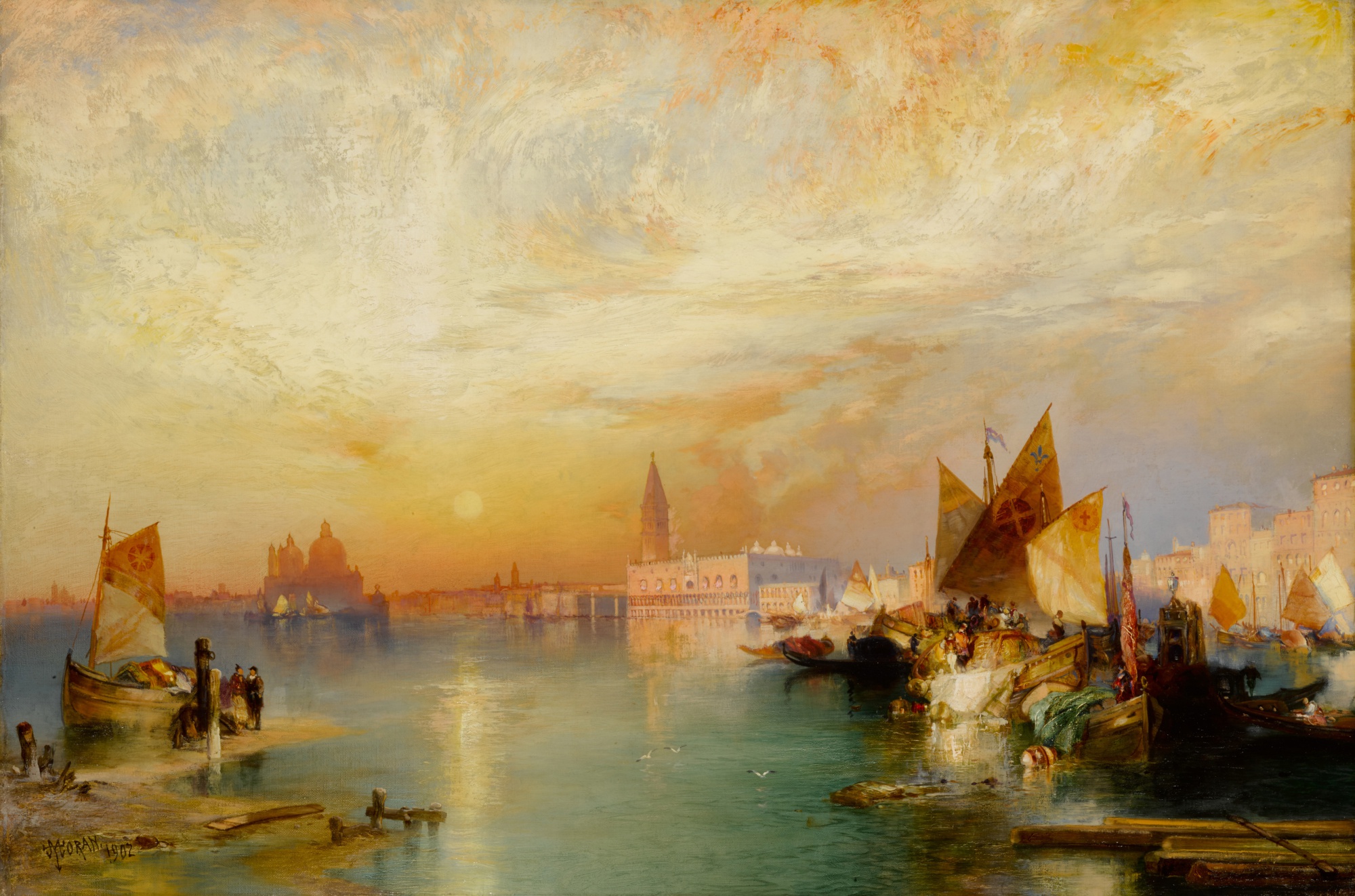
Sunset Santa Maria and the Ducal Palace, Venice
M.W. Turner in London and felt the full force of what light could be made to do when it was handled by an artist who understood it as a metaphysical force and not merely a physical fact. The Turner encounter transformed Moran's ambitions entirely.
“I place no value upon literal transcripts from Nature. My aim was to bring before the public the character of that region.”
Thomas Moran, on his Yellowstone paintings
He returned to America with a conviction that the American landscape deserved the same heroic, luminous treatment that Turner had lavished on the Thames and the Swiss Alps. Through the 1860s he worked steadily, building his reputation and his technical vocabulary, absorbing influences from the Barbizon painters as well as from the Hudson River tradition. Then in 1871 came the expedition that would define his career. Moran joined Ferdinand Hayden's geological survey of the Yellowstone region as the official artist of the expedition, traveling alongside the photographer William Henry Jackson into country that most Americans had only heard described in the reports of trappers and explorers.
Thomas Moran
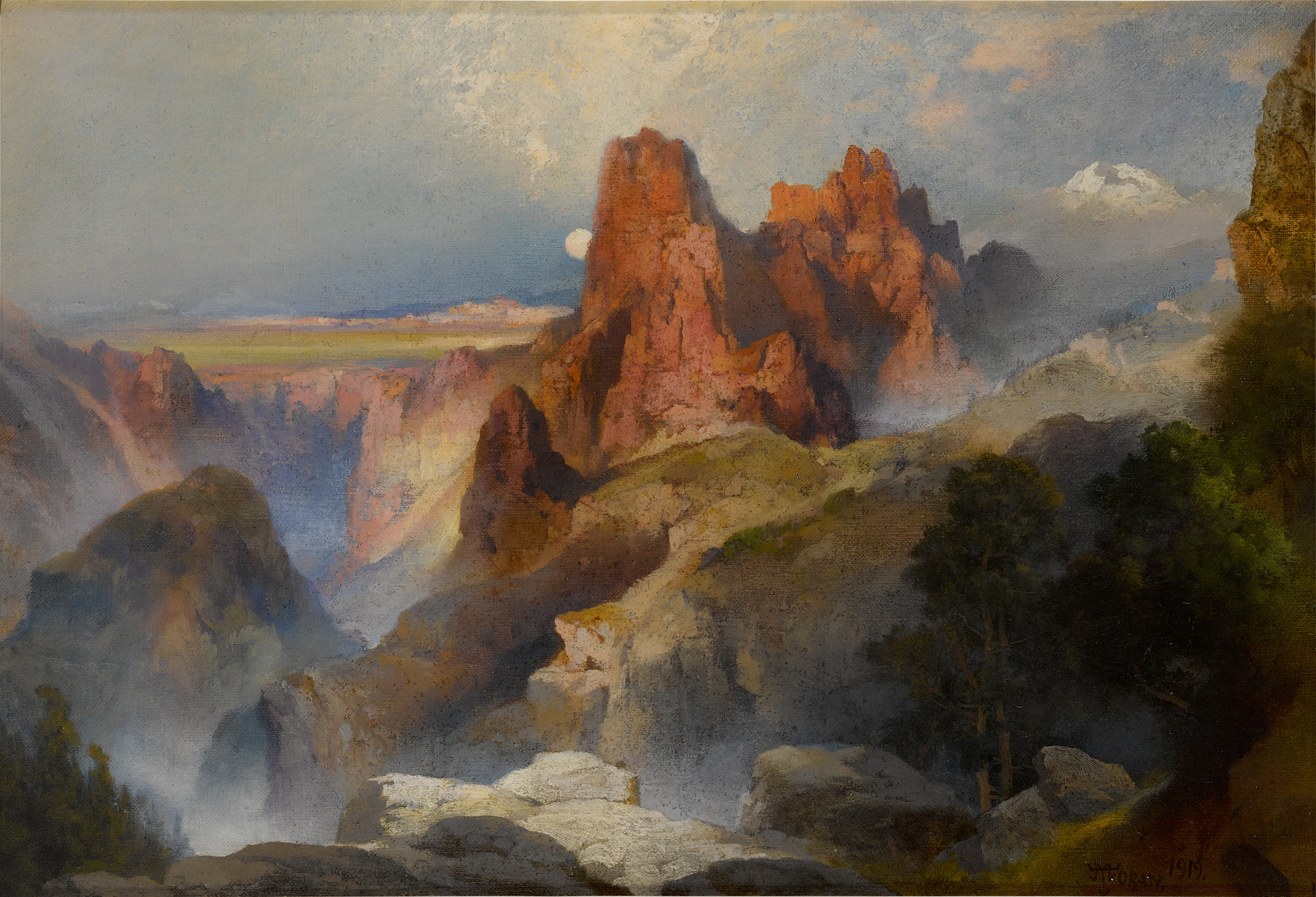
Grand Canyon, 1919
What he witnessed there exceeded anything he had imagined. Geysers, hot springs, canyons cut to extraordinary depths, the sky above it all reflecting colors that no European palette had been trained to describe. The paintings and sketches Moran brought back from Yellowstone created a sensation. His monumental canvas "The Grand Canyon of the Yellowstone," completed in 1872 and measuring twelve by seven feet, was purchased by the United States Congress for ten thousand dollars and hung in the Capitol Building, the first landscape painting ever acquired by Congress.
It is difficult to overstate the cultural significance of that moment. Moran's vision contributed directly to the congressional vote that established Yellowstone as the world's first national park in 1872, and his name became so thoroughly associated with the region that a peak there was named Mount Moran in his honor. He followed the Yellowstone triumph with an equally celebrated expedition to the Grand Canyon in 1873, again producing work of thunderous ambition. His "Chasm of the Colorado," also acquired by Congress, completed a pair of paintings that functioned as something close to national icons.
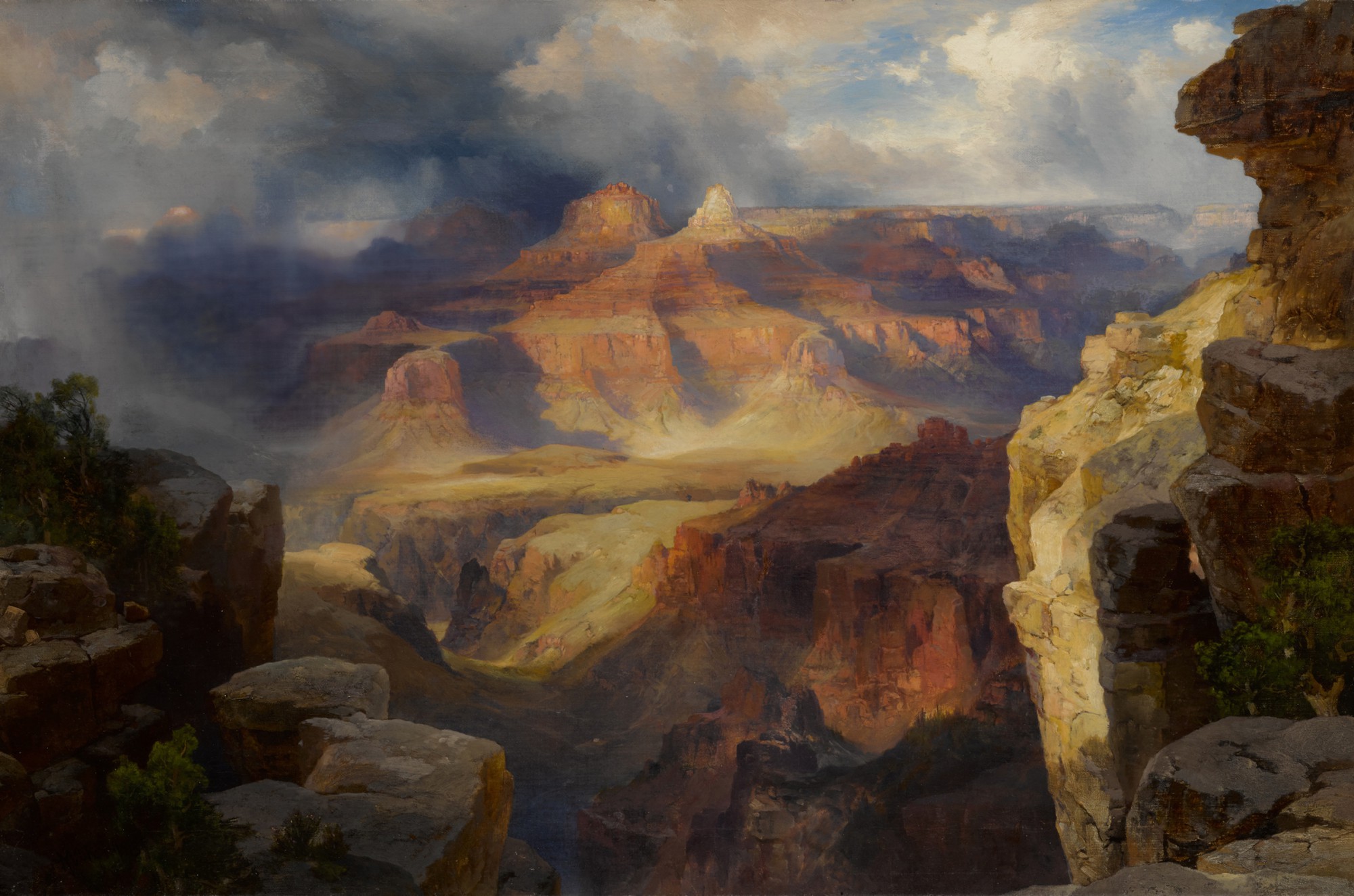
Thomas Moran
Grand Canyon, Arizona (A Miracle of Nature) (Zoroaster Peak, Grand Cañon)
The works available on The Collection illuminate the remarkable breadth of Moran's practice across five decades of sustained creativity. His "Grand Canyon" of 1919, painted when Moran was eighty two years old, demonstrates that his command of color and atmosphere never dimmed. The composition radiates that characteristic Moran gold, the light arriving from some impossible angle to make the canyon walls glow like embers. His "Smelting Works at Denver" from 1892, rendered in watercolor and gouache, reveals a less often discussed dimension of his vision: an interest in the industrial transformation of the American West, which he approached with the same formal rigor he brought to wilderness subjects.
His Venetian canvases, including "Sunset Santa Maria and the Ducal Palace" and "Venice" of 1898 and "The Church of Santa Maria della Salute" of 1908, place him in a rich tradition of Anglo American artists responding to that impossible city, and they allow a direct comparison with Turner that Moran would not have found unwelcome. His treatment of Venetian water and sky is deeply personal, warmer and more golden than Turner's, saturated with the particular quality of late afternoon light that became his signature. For collectors, Moran presents an exceptionally compelling case. His market is supported by the depth of institutional interest in American landscape painting, which has grown considerably since major survey exhibitions at the Smithsonian American Art Museum and other leading institutions reframed the Hudson River School and its descendants as central rather than peripheral to art historical understanding.
Moran's works appear regularly at Christie's, Sotheby's, and Bonhams, with major oils commanding prices well into the millions and works on paper offering a more accessible entry point into his practice. The watercolors and gouaches, such as "The Ruby Range, Nevada" of 1879 and the Fort George Island work of 1878, are particularly prized by discerning collectors because they reveal Moran's process with an immediacy that his large finished oils do not. In these works you can see the artist making decisions in real time, balancing color masses, testing the limits of what the medium can hold. Moran's place in art history is most usefully understood alongside his contemporaries Frederic Edwin Church, Albert Bierstadt, and the generation of painters who took the conventions of the Hudson River School into the Far West and amplified them to match the scale of what they encountered.
Where Church was drawn to the tropics and the drama of natural phenomenon, and where Bierstadt favored a heroic but sometimes theatrical grandeur, Moran brought to his subjects a quality of spiritual reverence that owed as much to Turner as to any American predecessor. He also worked in an era before color photography could document the American landscape, which means his paintings served a documentary function alongside their aesthetic one. Americans looked at his canvases to understand what the West actually looked like, and that gives his work a historical dimension that continues to draw scholars and curators. His legacy is alive in ways that go beyond the walls of museums.
The national park system, which Moran's paintings helped bring into being, now protects millions of acres of the landscape he loved and documented. His influence can be felt in the work of later American painters who understood that the land itself could be a subject of profound philosophical seriousness. And for collectors today, owning a Moran means entering into a conversation that stretches from the English Romantic tradition through the formation of American national identity and into the present moment, when questions about landscape, environment, and the human relationship to the natural world feel more urgent than ever. To collect Thomas Moran is to collect history, vision, and an enduring argument that the world, seen with sufficient attention and love, is magnificent.
Explore books about Thomas Moran
Thomas Moran: America's Painter of the West
Thurman Wilkins
Thomas Moran and the Surveying of the American West
Nancy K. Anderson
The Life and Works of Thomas Moran
Fritiof Fryxell
Thomas Moran: Artist of the Mountains
Peter Hassrick
The West of Thomas Moran
Joni Louise Kinsey
Thomas Moran: Watercolors of the American West
Nancy K. Anderson and William Truettner
The Drawings of Thomas Moran in the Cooper-Hewitt Museum
Roberta Waddell
Thomas Moran: A Search for the Sublime
Lillian B. Miller