Thomas Couture
Thomas Couture: The Master Who Made History
Artist Spotlight · The Collection Editorial
Picture the Salon of 1847 in Paris. The crowds press forward, necks craning, conversations falling to hushed reverence before a canvas measuring nearly eight meters across. Thomas Couture's Romans of the Decadence had arrived, and with it, a painter who seemed to hold the entire tradition of Western art in his hands. The work depicted a scene of Roman excess, gorgeous bodies draped across marble steps, the great statues of ancestors looming overhead in silent judgment, and in doing so it asked an urgent question about the present moment in France.
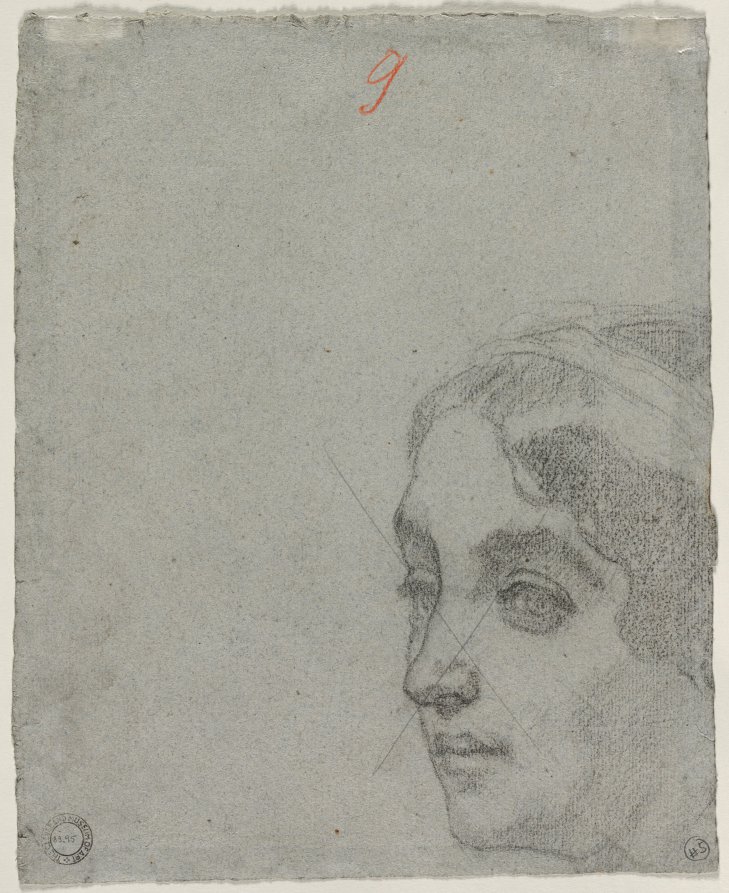
Thomas Couture
Head of a Woman (verso), 1852
The painting caused a sensation, earning Couture the Medal of Honor at the Salon and placing him at the very summit of Parisian artistic life. Couture was born in 1815 in Senlis, a quiet town north of Paris, into modest circumstances that gave little indication of the grand ambitions to come. His family moved to Paris during his childhood, and it was there that his gifts were recognized early enough to set him on a formal path. He entered the studio of Antoine Jean Gros, one of the great Napoleonic painters, and later studied under Paul Delaroche, whose theatrical historical canvases shaped a generation of French artists.
These were not incidental influences. Gros carried the fire of Neoclassicism even as Romanticism was reshaping French culture, and Delaroche had a gift for dramatic storytelling that would leave a lasting mark on Couture's sense of pictorial scale and emotional weight. Couture spent years working toward the Prix de Rome, the most coveted prize in French academic art, and though he did not win it, the discipline and ambition those efforts demanded sharpened his technical command considerably. He developed a rich, warm palette and a facility with the human figure that drew equally on the Renaissance masters he studied and the direct observation of life in Paris.
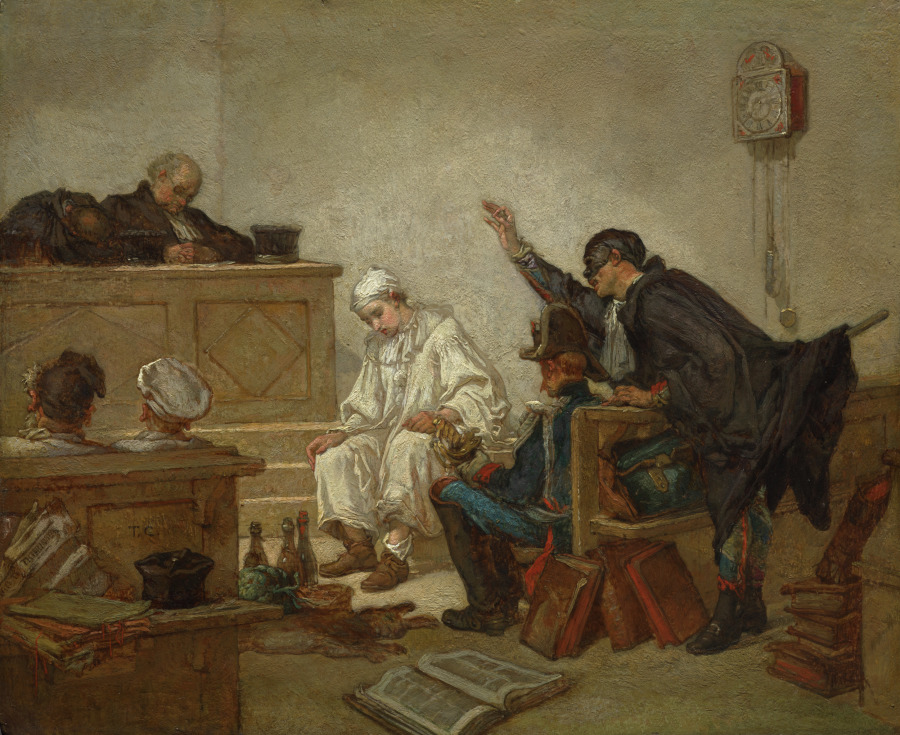
Thomas Couture
Pierrot in Criminal Court, 1864
By the 1840s he had found his voice, one that was rooted in the grand tradition yet alert to contemporary themes. Romans of the Decadence was not merely an exercise in academic skill. It was a work with a moral and political edge, a comment on the corruption of the July Monarchy draped in the clothing of antiquity, and sophisticated Paris audiences understood it perfectly. Beyond the great Salon triumph, Couture's practice encompassed a wide range of subjects and media that collectors are increasingly drawn to explore.
His drawings reveal an artist of extraordinary sensitivity and economy. Works such as Duel after the Masked Ball and Head of a Woman, both from 1852 and executed in black chalk, show a draftsman working at the height of his powers, capturing movement and psychological nuance with minimal means. His oil studies and smaller panels, including the vivid and emotionally charged Pierrot in Criminal Court from 1864, demonstrate a willingness to experiment with allegory and social observation on an intimate scale. Landscape Study with Trees from 1870, rendered in black chalk with white gouache, reveals a quieter, more contemplative side of the artist, one that anticipates the tonal sensibilities of later naturalists.
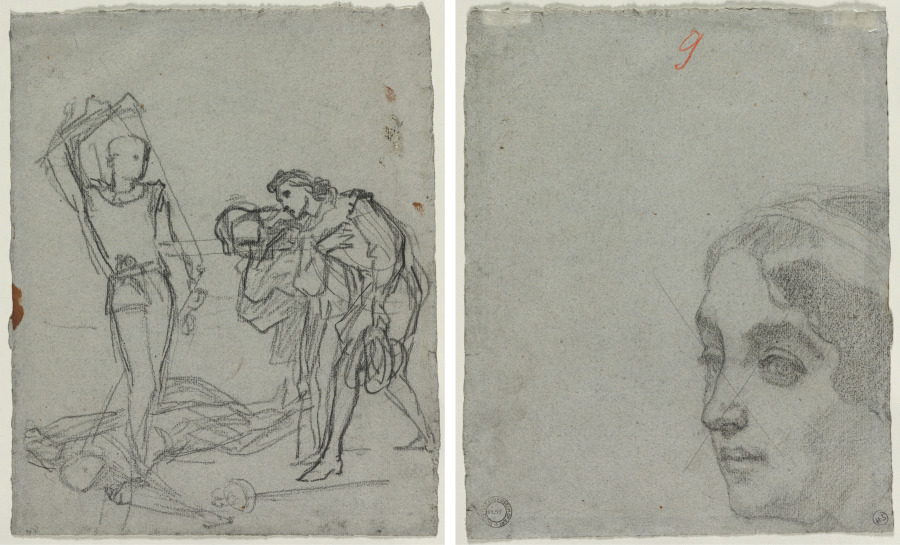
Thomas Couture
Duel after the Masked Ball (recto); Head of a Woman (verso), 1852
A Volunteer of 1792, painted in 1848, connects to the revolutionary fervor of that turbulent year in France and shows Couture responding directly to the political pulse of his moment. Couture also published his ideas about painting and pedagogy in a treatise titled Méthode et Entretiens d'Atelier, and it is in the atelier context that his legacy achieves something remarkable. His teaching studio in Paris became one of the most sought after training grounds of the mid nineteenth century. Édouard Manet studied with Couture for six years, and while the relationship was famously tense, marked by Manet's restlessness against academic convention, the technical grounding Couture provided was foundational.
Henri Fantin Latour also passed through the studio. To have shaped two artists of that caliber places Couture in a lineage of great teacher painters whose influence multiplies through generations. In this sense he stands alongside figures such as Thomas Couture's own teachers, and his influence traces forward through the Impressionists and beyond. For collectors, Couture represents a fascinating and genuinely rewarding area of focus.
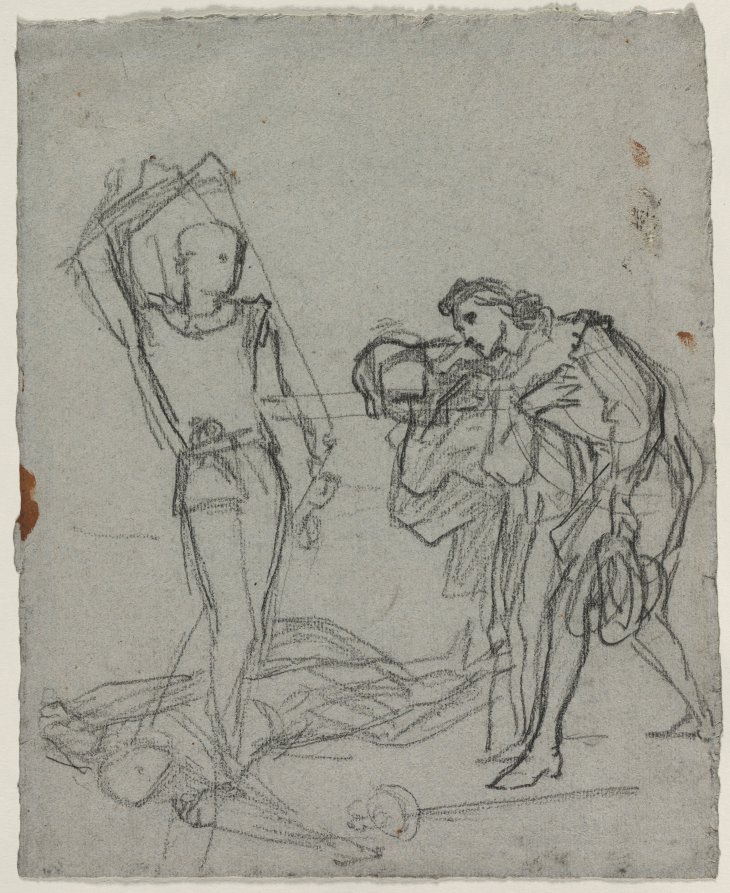
Thomas Couture
Duel after the Masked Ball (recto), 1852
His major paintings occupy important museum collections including the Musée d'Orsay in Paris, which holds Romans of the Decadence, and the Metropolitan Museum of Art in New York. Works that come to market tend to be drawings, sketches, oil studies, and smaller panels, and these offer an opportunity to connect with the working intelligence behind the grand compositions. The drawings in particular reward close attention. Couture was a superb draftsman and his chalk works have a directness and warmth that the finished Salon paintings, for all their magnificence, sometimes hold at a cooler distance.
Collectors interested in the academic tradition, in the bridge between Neoclassicism and the realist and Impressionist movements that followed, and in works with deep art historical resonance will find Couture an artist whose depth rewards serious engagement. Couture's position in art history is one of those that has been somewhat obscured by the very revolution his teaching helped to unleash. The triumph of Impressionism cast a long shadow over the academic painters who preceded it, and for much of the twentieth century the great academic masters were undervalued simply because they were associated with the establishment against which the modernists rebelled. That reassessment has been underway for decades now, and scholars and collectors alike have returned to painters like Couture with fresh eyes.
His ambition, his craft, his willingness to use the grand machine of history painting as a vehicle for contemporary critique, these are qualities that feel vital and relevant rather than dusty. He died in 1879 in Villiers le Bel, having lived long enough to see the world he helped shape transformed almost beyond recognition, and yet the best of his work endures as a genuine achievement of the human imagination. To encounter Couture today, whether in a great museum or in the intimate scale of a drawing on paper, is to meet an artist of real seriousness and uncommon gifts. He believed profoundly in the capacity of painting to carry meaning, to speak across time, and to honor the tradition it was part of while pressing forward into the present.
His students changed the world of art. His works remain touchstones for understanding one of the most dynamic and consequential periods in the history of Western painting. For those who collect with curiosity and historical depth, Thomas Couture is an artist whose moment has quietly, steadily, and deservedly returned.
Explore books about Thomas Couture
Thomas Couture and the Eclectic Vision
Michael Levey
Thomas Couture: Romantic Realist
Albert Boime
Couture and the Chouans: Politics and Painting in Nineteenth-Century France
Patricia Mainardi
Thomas Couture: Paintings and Drawings
Gabriel P. Weisberg
The Methods and Materials of Thomas Couture
Genevieve Lacambre