Théodore Rousseau
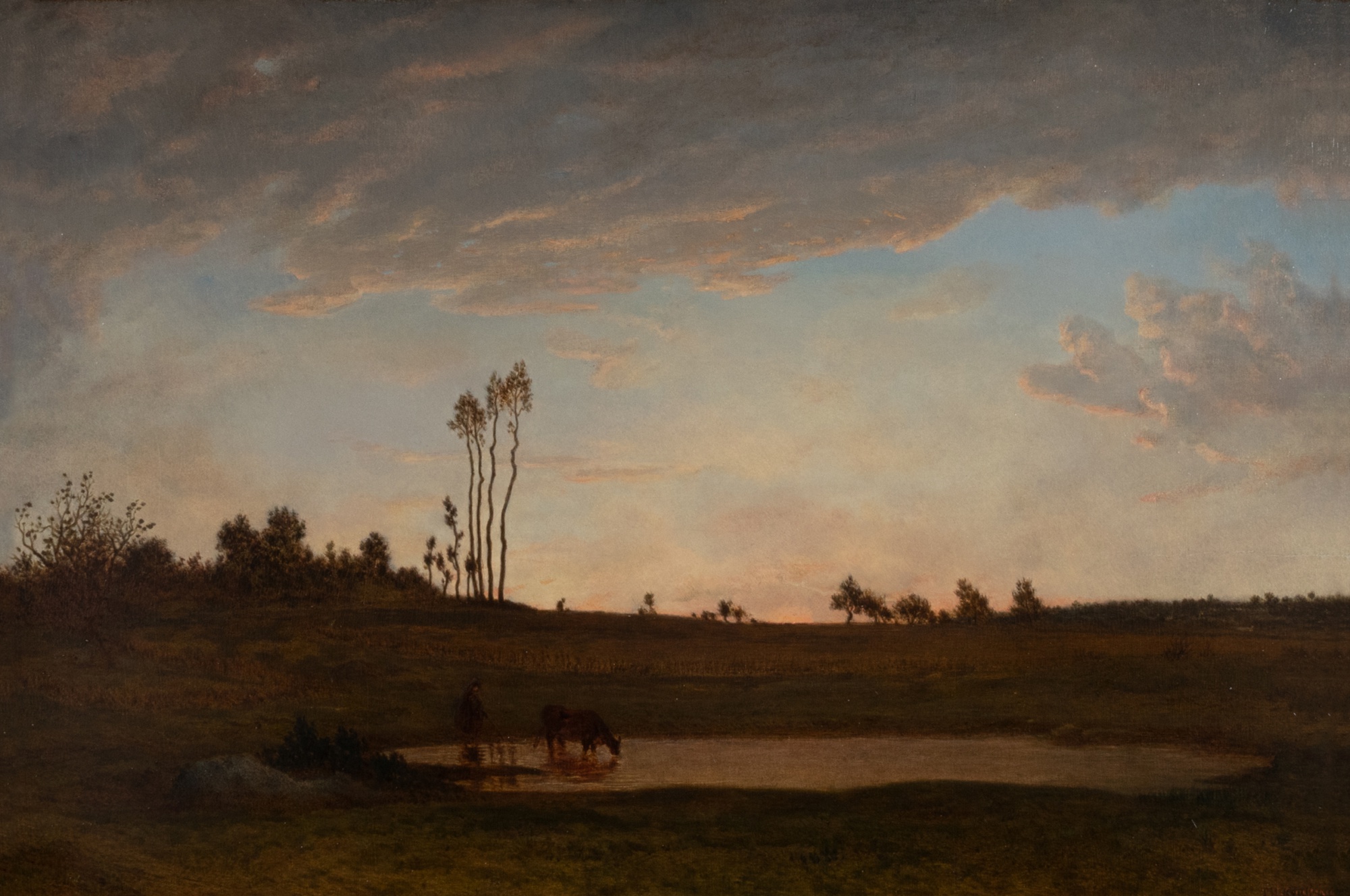
Théodore Rousseau, Prophet of the Forest
Artist Spotlight · The Collection Editorial
“I want to render the impulse of the trees, the passion of a landscape.”
Théodore Rousseau
There is a moment just before dusk in the Forest of Fontainebleau when the light does something almost impossible. The oak canopies hold the last warmth of the sun, the ground pools in violet shadow, and the whole landscape seems to breathe. No painter understood that moment more intimately, or rendered it with greater conviction, than Théodore Rousseau. His canvases have been drawing sustained attention from curators and collectors alike in recent years, as institutions across Europe and North America reassess the Barbizon painters not merely as a stepping stone toward Impressionism but as a major achievement in their own right.
Théodore Rousseau
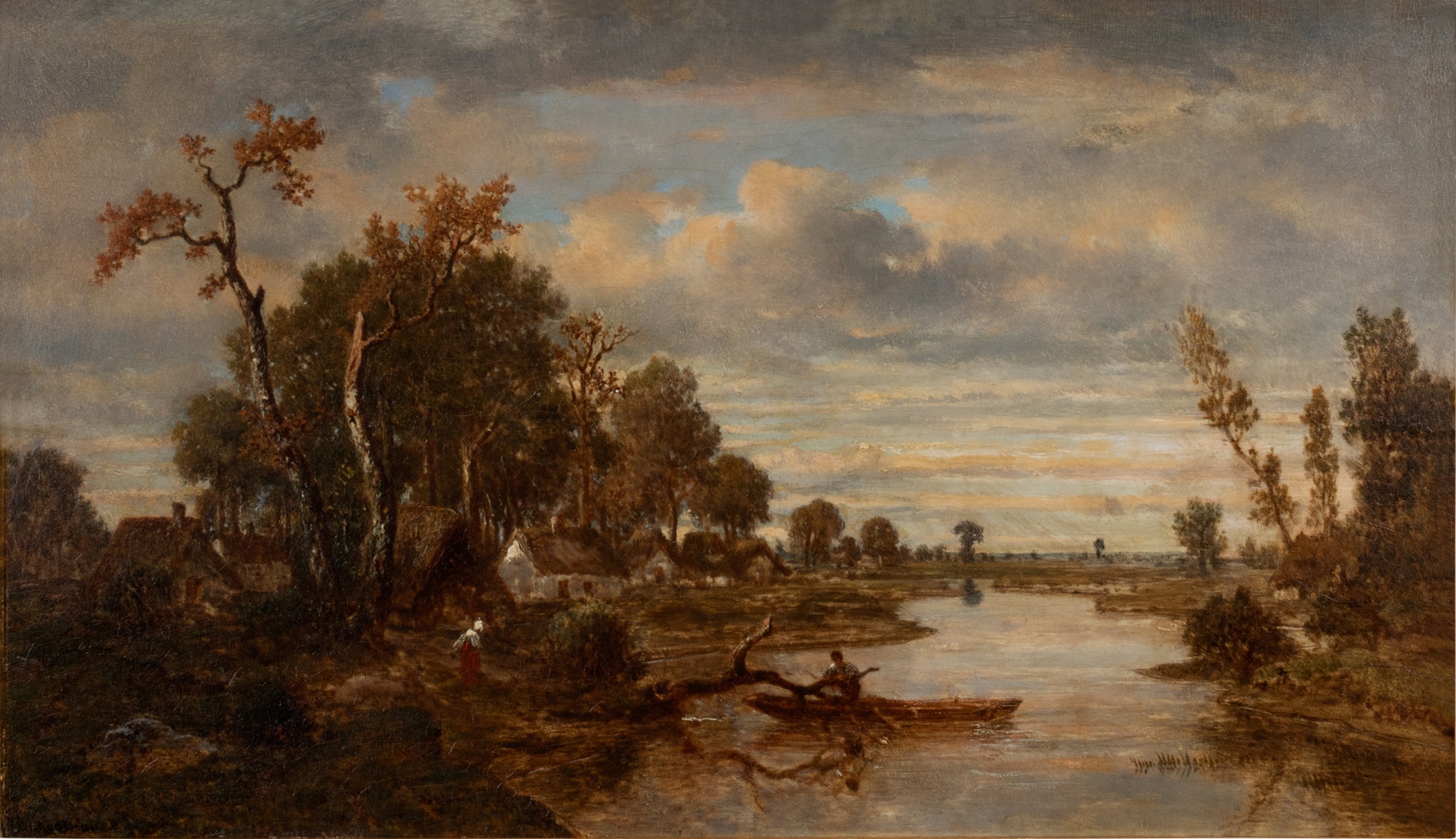
Le Passage du gué
The Musée d'Orsay in Paris, which holds one of the finest concentrations of his work, has continued to foreground Rousseau as a central figure in the story of French landscape painting, and the market has followed, with works on panel and paper commanding serious prices at auction whenever they appear. Pierre Étienne Théodore Rousseau was born in Paris in 1812, the son of a tailor, and grew up in a city that was transforming itself with breathtaking speed. Yet from an early age it was the countryside beyond the city limits that captivated him. He received his first formal training under the history painter Guillaume Lethière and later studied with Jean Charles Joseph Rémond, but the lessons that shaped him most profoundly were the ones he taught himself outdoors.
By his late teens he was already making extended journeys into the Auvergne, Normandy, and the forests south of Paris, filling sketchbooks with direct observations of weather, foliage, and the peculiar drama of provincial light. The discipline of working directly from nature, radical as it still felt in France at the time, became the foundation of everything he would do. The Salon, which controlled the reputation and livelihood of virtually every French painter in the nineteenth century, proved a brutal early obstacle. Beginning in 1836, Rousseau's submissions were rejected so consistently that his contemporaries gave him a sardonic nickname: le Grand Refusé.
Théodore Rousseau
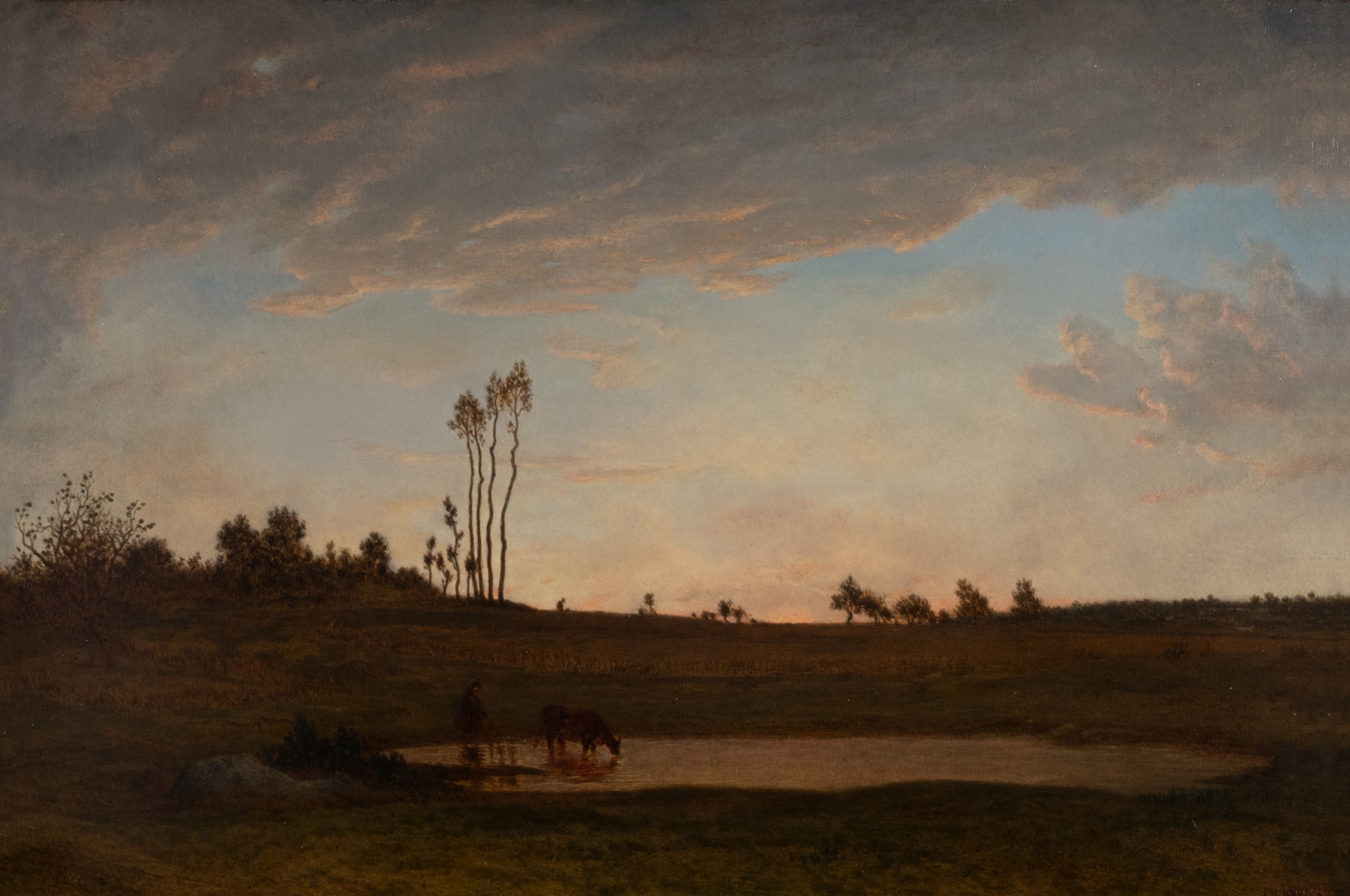
Twilight
The jury, dominated by partisans of academic history painting and idealized classical landscape, had little patience for the unvarnished specificity of his scenes. Rather than compromise, Rousseau deepened his commitment to the landscape as he actually found it. He settled permanently in the village of Barbizon, at the northern edge of Fontainebleau, around 1848, and it was there that his mature vision crystallized into something wholly original. The community he helped anchor, which included Jean François Millet, Narcisse Díaz de la Peña, and Charles François Daubigny, would become known to history as the Barbizon School, though in practice it was less a school than a gathering of kindred spirits united by their faith in the observable world.
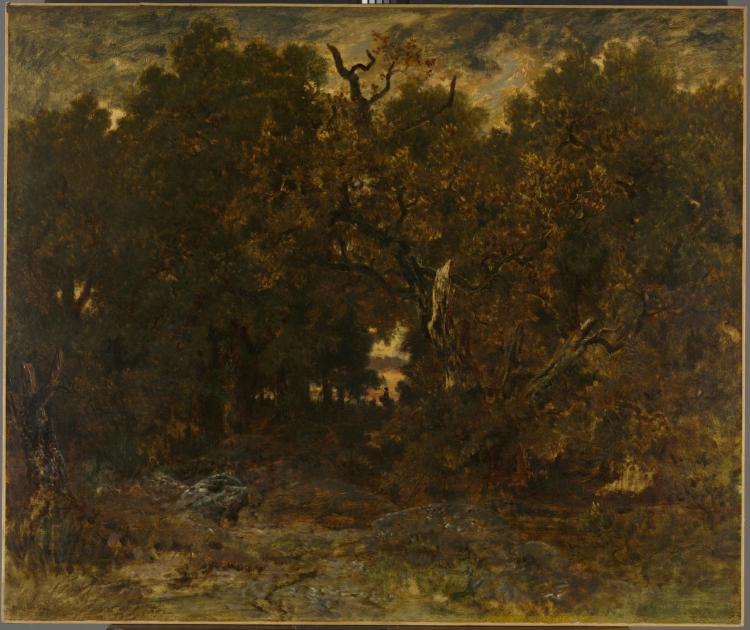
What Rousseau achieved in his Barbizon years was a sustained meditation on the inner life of landscape. His paintings resist easy sentimentality. A work like Leaving the Forest, Fontainebleau: Setting Sun, completed in 1851 and now one of the most recognized images of the period, does not prettify its subject. The trees are ancient and gnarled, the sky is a controlled blaze of amber and pale gold, and the figures moving through the scene are small enough to suggest the genuine scale of the natural world around them.
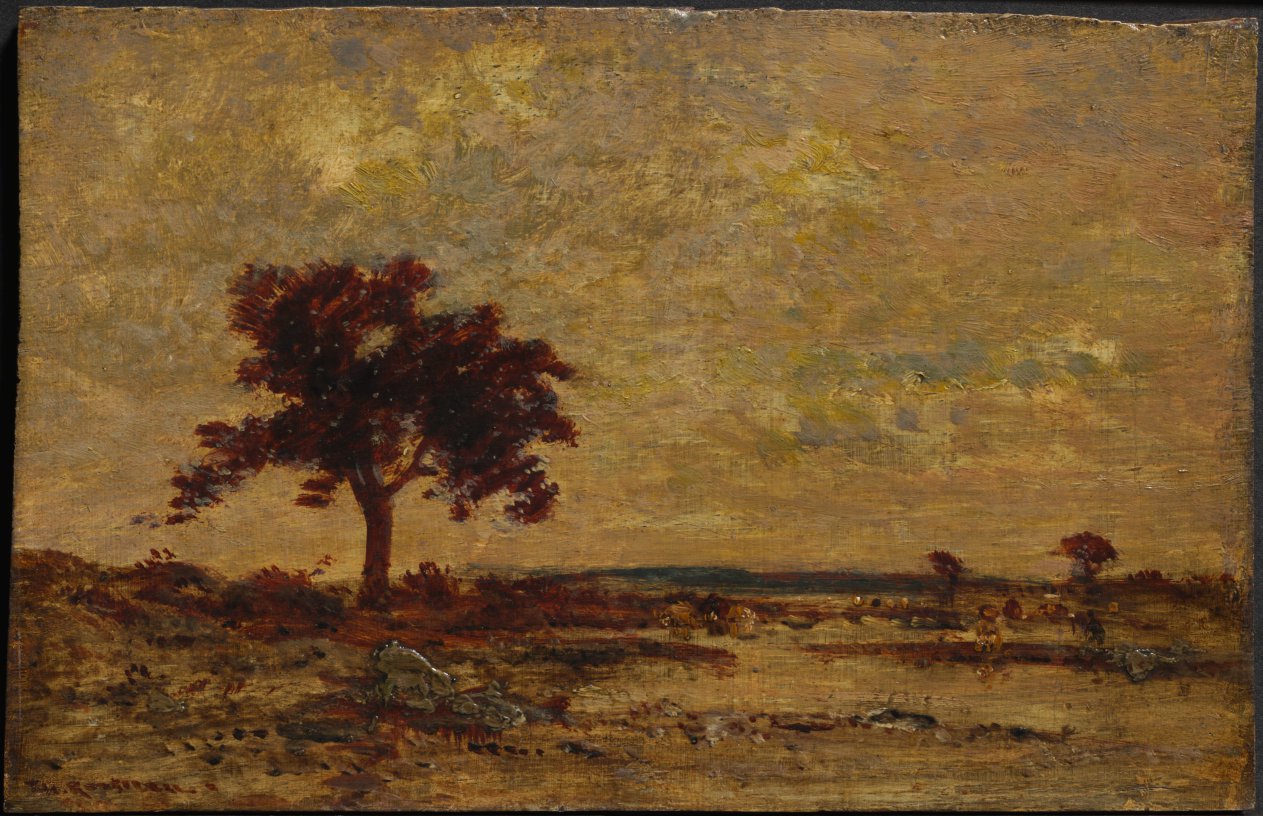
Théodore Rousseau
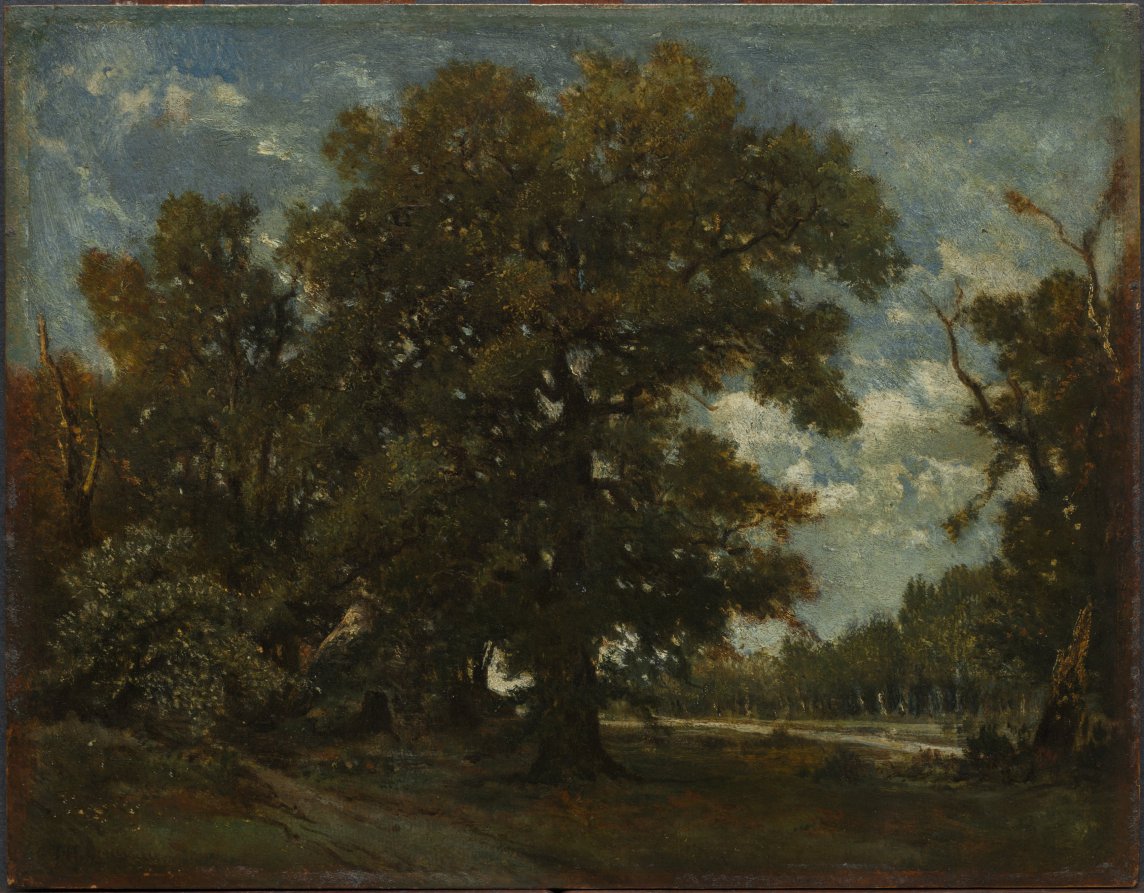
The Oak Tree
The composition earns its emotion through observation rather than invention. Similarly, The Oak Tree, rendered in oil on paper mounted to wood panel, demonstrates his ability to treat a single specimen as a complete world, its form weighted with the particular gravity of something that has stood in one place for centuries. These are not decorative landscapes. They are arguments about how to look.
Rousseau was also among the earliest fine artists to engage seriously with cliché verre, a printmaking process that involved drawing directly onto a glass plate coated with an opaque ground and then exposing photographic paper beneath it. His works in this medium, including Cherry Tree at Blau from 1862 and La Plaine de la Plante à Biau from 1854, place him in remarkable company alongside Camille Corot and Millet, who also experimented with the technique at Barbizon. These prints have a quality entirely their own, a silvery atmospheric softness that complements the warmer densities of his oil work. For collectors, they represent an underappreciated entry point into the work of one of the period's most significant figures, and their relative rarity makes them especially compelling when they appear on the market.
Théodore Rousseau
Leaving the Forest, Fontainebleau: Setting Sun, 1851
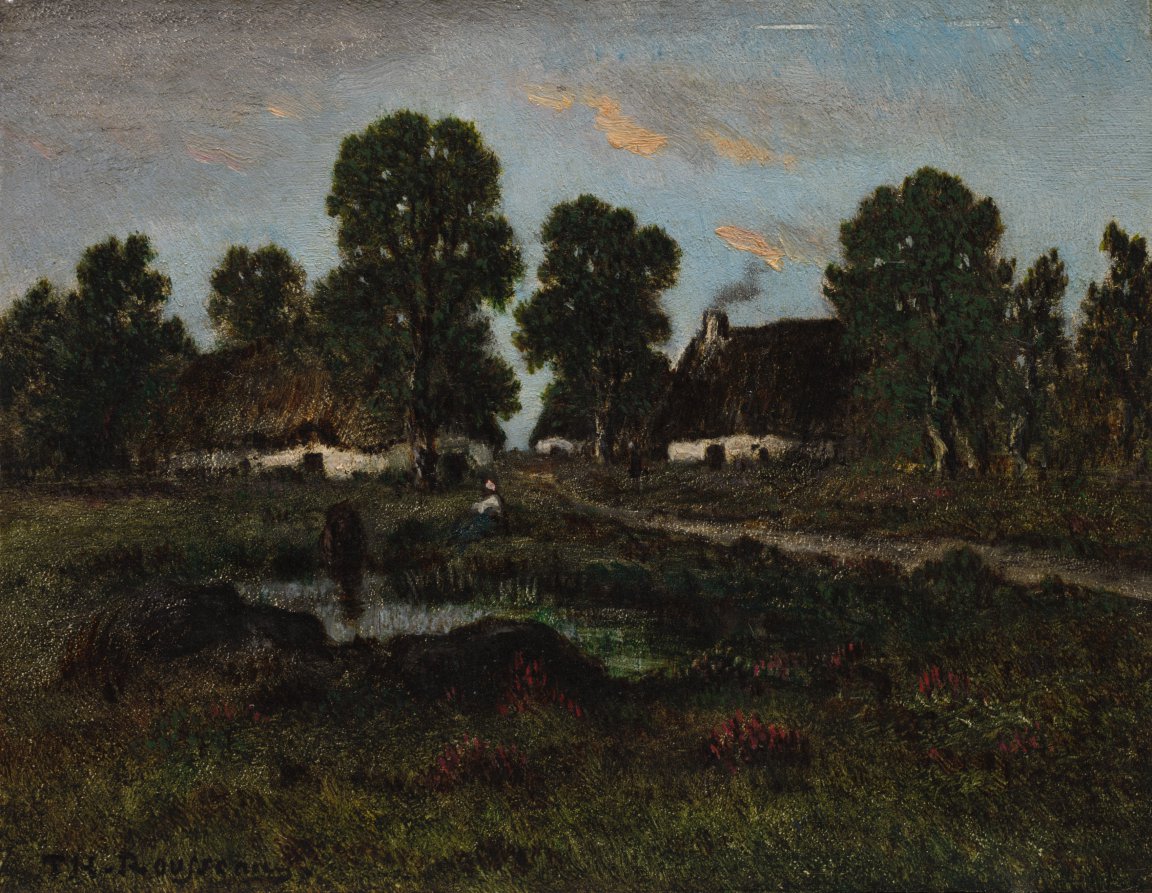
For collectors approaching Rousseau today, several qualities distinguish his work from that of his contemporaries. His handling of paint on panel or on paper mounted to support achieves a physical intimacy that his larger exhibition canvases occasionally forgo in favor of grandeur. Works like Marshlands and Cottages Near Larchant reward close attention, the surface alive with small decisions, a change in impasto here, a shift in temperature there, that reveal the working intelligence behind them. Twilight, among the most atmospherically charged of the works currently available through The Collection, exemplifies his ability to distill an entire emotional register into a narrow band of fading light.
Collectors drawn to the Impressionists would do well to understand that Rousseau arrived at many of their essential convictions a generation earlier and with a philosophical seriousness that gives his work an enduring gravity. Rousseau occupies a precise and irreplaceable position in the genealogy of modern painting. He belongs alongside Corot and Gustave Courbet as one of the figures who made French art ready for what Monet, Sisley, and Pissarro would eventually do with color and light. The Impressionists themselves acknowledged this debt, and the critical rehabilitation of the Barbizon painters over the past several decades has returned Rousseau to the prominence he deserves in institutional collections and scholarly conversation.
He died in Barbizon in 1867, the village he had made famous, and was buried in the forest he had spent a lifetime painting. To own a work by Théodore Rousseau is to hold something from the beginning of a great transformation in how Western painters chose to see the world, not through myth or allegory, but through open eyes and the patient discipline of being genuinely present in a landscape.
Featured Works
Explore books about Théodore Rousseau
Théodore Rousseau
Alfred Sensier
Théodore Rousseau: Catalogue Raisonné of His Paintings
Fronia E. Wissmann
The Barbizon School and 19th-Century French Landscape Painting
Robert L. Herbert
Théodore Rousseau (1812-1867)
Denise Delouche
The Invention of the Landscape
Peter C. Sutton