Thierry Cohen
Thierry Cohen Gives Cities Their Stars Back
Artist Spotlight · The Collection Editorial
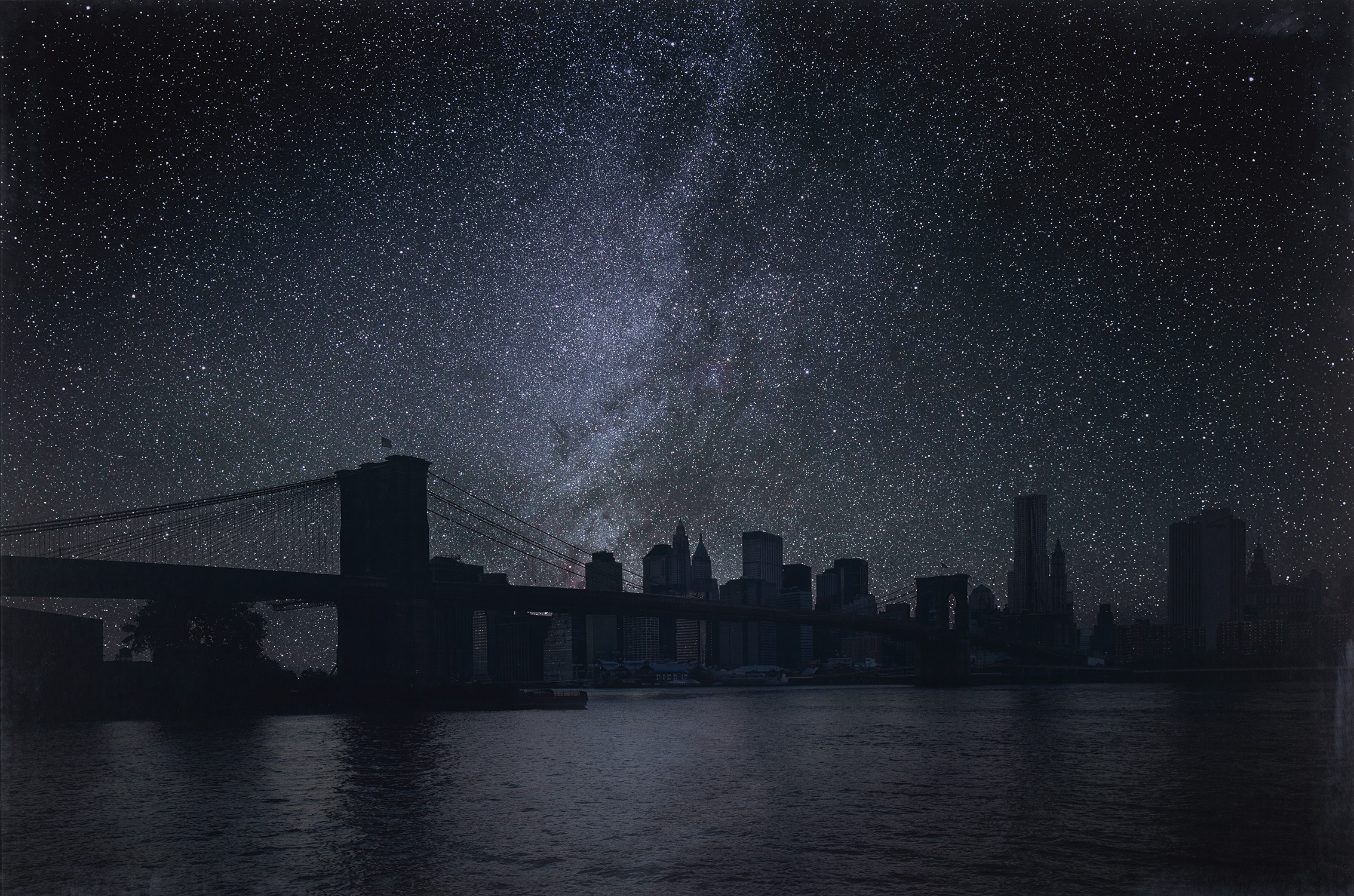
There is a particular moment, well known to anyone who has stood in a darkened gallery before one of Thierry Cohen's vast photographic composites, when the mind quietly reorients itself. The skyline is familiar, perhaps achingly so, the jagged silhouette of Manhattan or the sweeping curve of Rio de Janeiro's bay. But above it, where the familiar orange sodium glow of city light should wash everything into anonymity, an ocean of stars pours across the frame with a density and silence that feels almost confrontational. Cohen's series Villes Éteintes, known in English as Darkened Cities, has been exhibited across Europe, Asia, and the Americas since its emergence in the early 2010s, drawing serious critical attention and finding a devoted international collecting audience.
Thierry Cohen
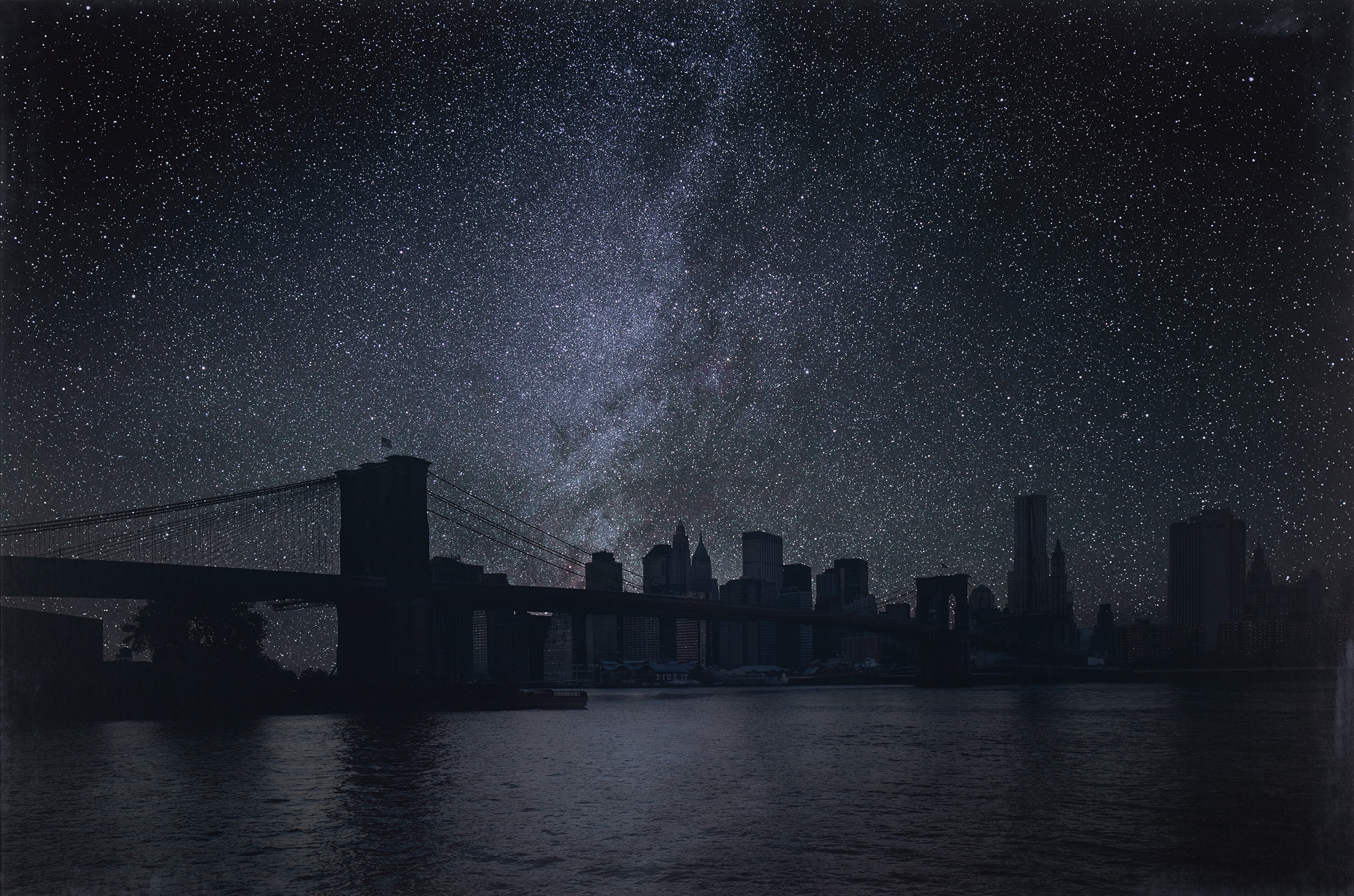
New York 40° 42’ 16’’ N 2010-10-09 LST 3:40 from Darkened Cities
In a cultural moment defined by an intensifying conversation about humanity's relationship to the natural world, his work has never felt more necessary. Cohen was born in France in 1963, and his formation as an image maker came through the commercial and editorial worlds of photography rather than through the traditional fine art academy. This background gave him an unusually precise technical command of light, timing, and the mechanics of large format capture, skills that would later become the invisible scaffolding of his most ambitious conceptual work. Like many photographers of his generation, he spent years developing a rigorous understanding of the medium before the question of what he truly wanted to say with it crystallized into something unmistakable.
The conceptual core of Darkened Cities arrived from a deceptively simple observation: the stars that ancient civilisations used to navigate, to tell time, to build their mythologies and religions around, are still there above our cities. We have simply chosen, without quite deciding to, to erase them. Cohen began researching the relationship between latitude and the night sky, understanding that if he traveled to a location sharing the same latitude as a given city but free from light pollution, and photographed the sky at the precise local sidereal time corresponding to his urban image, the stars he captured would be the exact stars hanging above that city's streets at that moment. The methodology is as poetic as it is scientifically grounded, and it transforms what could have been a simple digital manipulation into something closer to an act of astronomical restoration.
Thierry Cohen
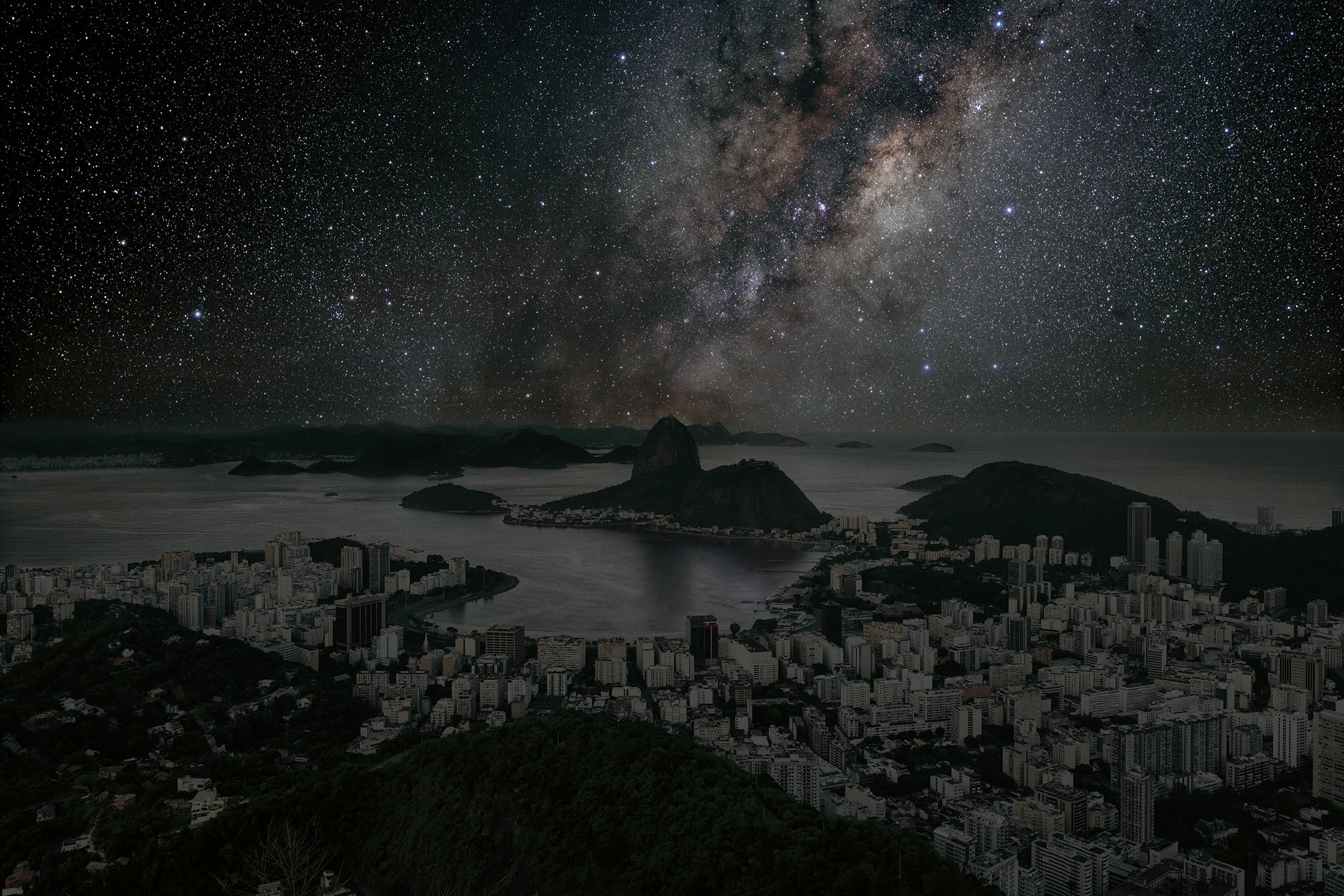
Rio de Janeiro 22° 56’ 42’’ S 2011-06-04 LST 12:34 from Darkened Cities
To create each work, Cohen traveled to remote locations across the world, from the Atacama Desert to the Mojave, from the coast of Morocco to isolated stretches of the Pacific, carrying his equipment to places where darkness is still genuinely dark. The urban half of each composite was photographed separately, typically during the blue hour or in low ambient light, so that the cities appear not blacked out but quieted, breathing, waiting. The precision required across both components is extraordinary. Each print carries coordinates and a timestamp in its title, functioning almost as a scientific document: New York 40 degrees 42 minutes 16 seconds N, 2010 10 09, LST 3:40.
These alphanumeric notations are not decorative. They are the proof of the methodology, the receipt for a transaction between photography and astronomy. The two works available through The Collection represent some of the most compelling pairings in the entire series. The New York image, shot in October 2010, places the iconic Manhattan skyline beneath a sky of almost overwhelming stellar density, the kind of sky that the Lenape people who lived on that island for thousands of years before European settlement would have known intimately.
The Rio de Janeiro image, dated June 2011, pairs the distinctive topography of that coastal city with a southern hemisphere sky of extraordinary beauty. Both are produced as archival pigment prints, face mounted, a presentation method that gives the surface a luminous depth and protects the work for generations. The scale at which Cohen typically presents these works amplifies their emotional impact considerably. Standing before them, one feels less like a viewer and more like a witness.
For collectors, Darkened Cities occupies an enviable position in the contemporary photography market. The series engages serious conceptual territory while remaining visually accessible and, in the best sense of the word, beautiful. It sits comfortably alongside the work of Andreas Gursky in its interrogation of the relationship between human civilization and the wider forces that contain it, and it shares a philosophical kinship with the long tradition of landscape photography that runs from Ansel Adams through to Edward Burtynsky's documentation of industrial transformation. Cohen is, in this lineage, something of a synthesizer: he uses the vocabulary of landscape to speak about urban life, and the tools of documentary photography to make visible something that is, by definition, invisible from where most of his audience stands.
Works from the series have appeared in gallery exhibitions at Sundaram Tagore Gallery, which has represented Cohen's work internationally, and the series has attracted collectors with interests spanning fine art photography, environmental themes, and conceptually rigorous practice. The art historical context for Cohen's practice is rich and varied. The tradition of the composite photograph stretches back to the nineteenth century, to the manipulated prints of Henry Peach Robinson and Oscar Gustave Rejlander, artists who understood that photography's relationship to truth was always more complicated than it appeared. Cohen works in full transparency about his process, which paradoxically lends the images a kind of honesty that straight documentary photography sometimes struggles to achieve.
He is not hiding what the sky looks like above New York. He is showing what it should look like, would look like, once did look like. That rhetorical move, the gentle insistence on a recoverable reality, is what gives Darkened Cities its peculiar emotional charge. Cohen's importance today extends well beyond the gallery wall.
His work has entered educational contexts, environmental advocacy conversations, and public consciousness in ways that relatively few fine art photography series achieve. In an era when light pollution affects more than eighty percent of the world's population and when roughly one third of humanity cannot see the Milky Way from where they live, Cohen's images function as both elegy and invitation. They remind us that the cosmos has not abandoned us. We have simply, temporarily, turned our backs on it.
For collectors who believe that art can shift perception as well as decorate a wall, Thierry Cohen's Darkened Cities represents one of the most quietly urgent bodies of work produced in the twenty first century.