Théobald Chartran
Chartran's Grand Vision Enchants the World
Artist Spotlight · The Collection Editorial
Picture the papal apartments of the Vatican in the late nineteenth century, suffused with golden afternoon light, where a French painter of remarkable composure set up his easel before one of the most powerful figures in Christendom. Théobald Chartran's portrait sessions with Pope Leo XIII were the talk of two continents, and the resulting canvases confirmed what the Parisian art world had quietly known for years: here was a painter of exceptional gifts, one equally at ease in the gilded corridors of Roman Catholicism and the drawing rooms of American industrial wealth. More than a century after his death in 1907, Chartran's work continues to surface in prestigious auction rooms and distinguished private collections, commanding renewed admiration from a generation of collectors hungry for the confidence and craftsmanship of the French academic tradition. Chartran was born in 1849 in Besançon, a city in the Franche Comté region of eastern France with a proud cultural heritage and a tradition of producing figures of intellectual distinction.
Théobald Chartran
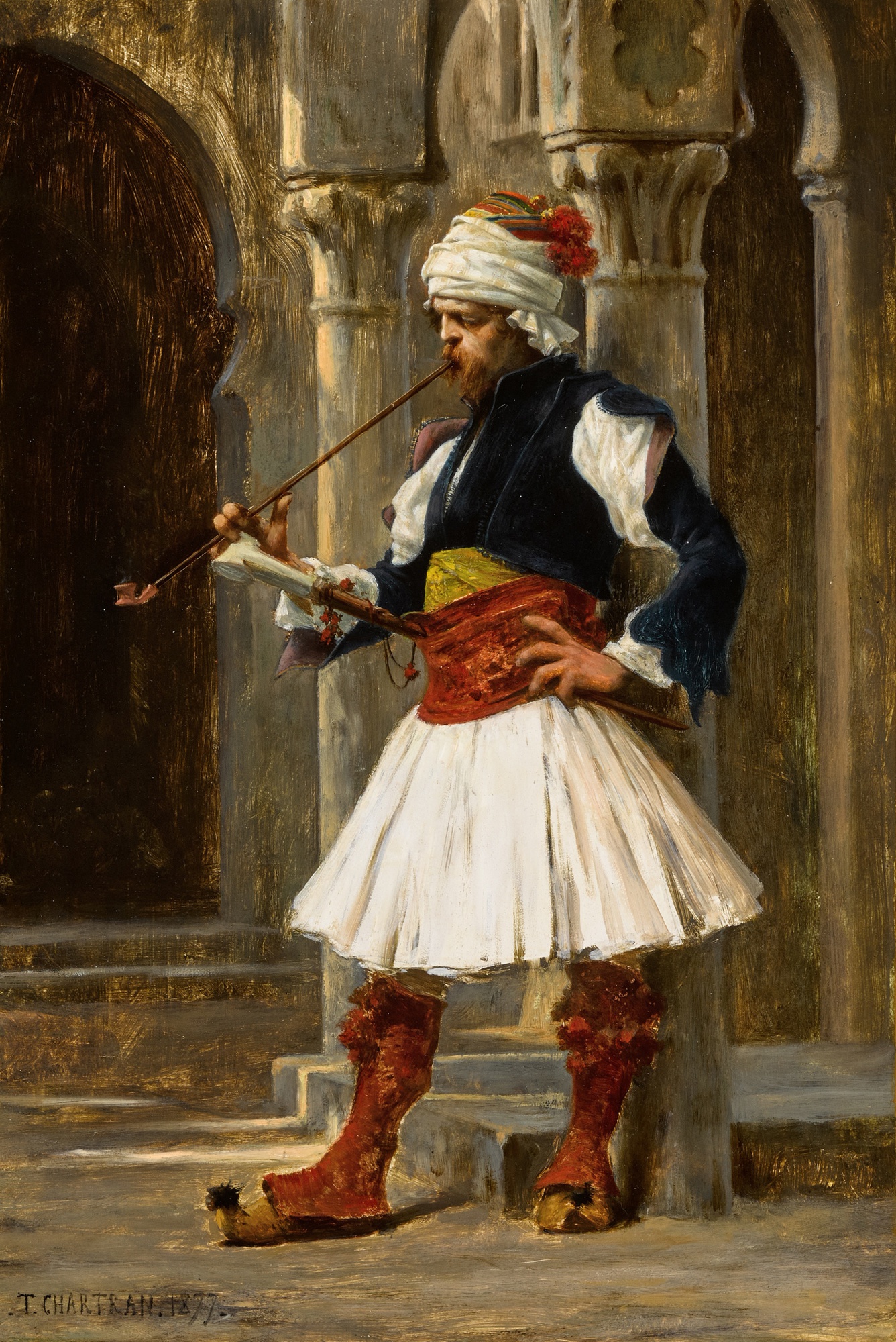
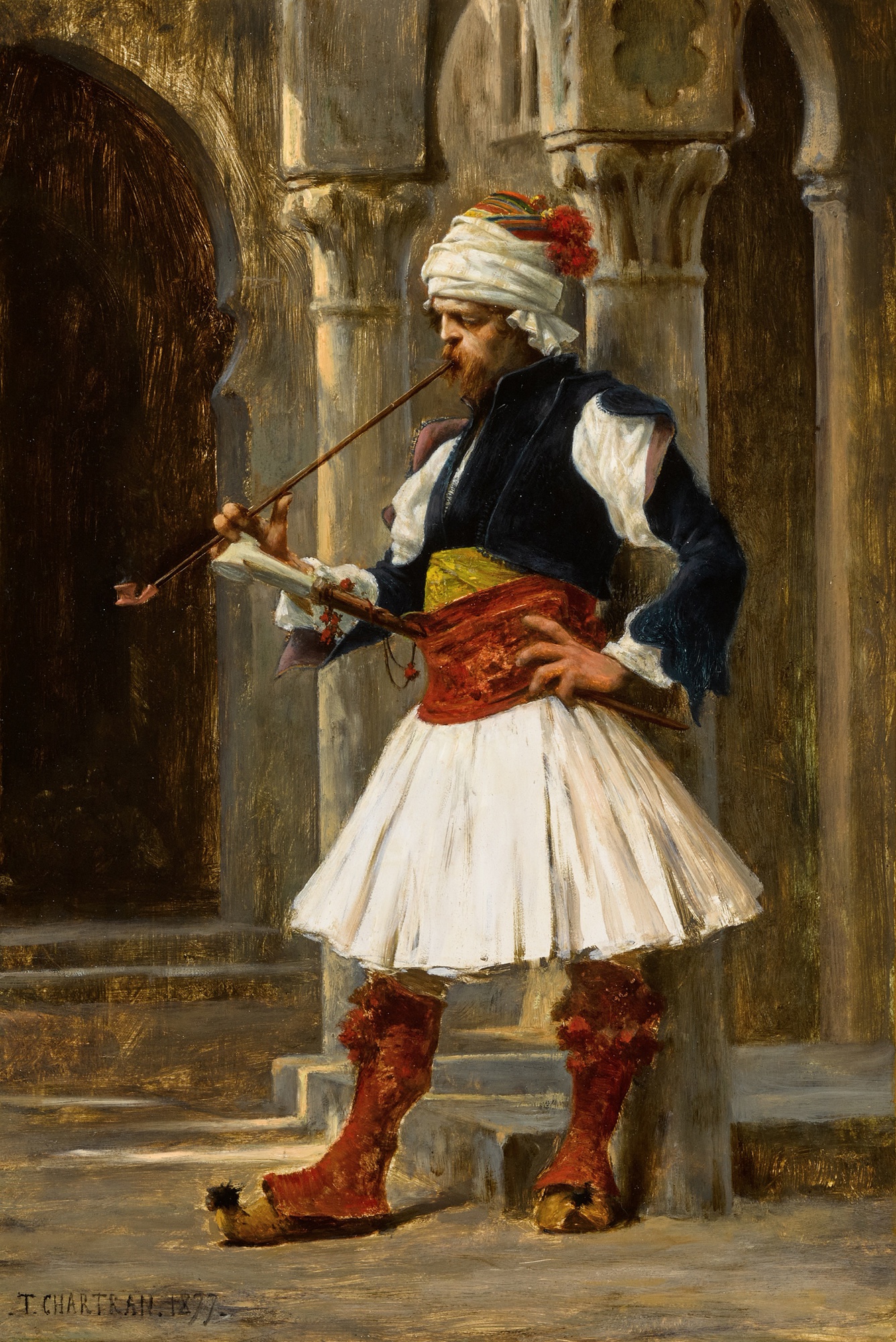
A Bashi-Bazouk
The city had given the world Victor Hugo just decades earlier, and there was something in its serious, provincial ambition that seemed to cultivate those who would go on to make their mark far from home. The young Chartran demonstrated early promise that drew him toward Paris and eventually into the atelier of Alexandre Cabanel at the École des Beaux Arts, one of the most coveted training grounds in the entire European art world. Cabanel, himself a titan of academic painting and the creator of the celebrated Birth of Venus shown at the Salon of 1863, instilled in his pupils a rigorous devotion to draftsmanship, psychological presence in portraiture, and the seamless execution of large scale compositions. The influence of Cabanel's teaching bore fruit quickly and spectacularly.
In 1877, Chartran won the Prix de Rome, the most distinguished award available to a student of the French academic system, which sent him to the Villa Medici in Rome for an extended period of study. The sojourn in Italy was transformative. Rome's layered visual culture, its churches thick with Renaissance and Baroque masterworks, and its living tradition of devotional painting all deepened Chartran's understanding of what monumental painting could achieve. He returned to Paris with an expanded sense of ambition and a technical fluency that was immediately apparent to the critics and jurors of the Paris Salon, where he would go on to exhibit with considerable success and earn the kind of institutional endorsement that opened the doors of Europe's most distinguished households.
Théobald Chartran
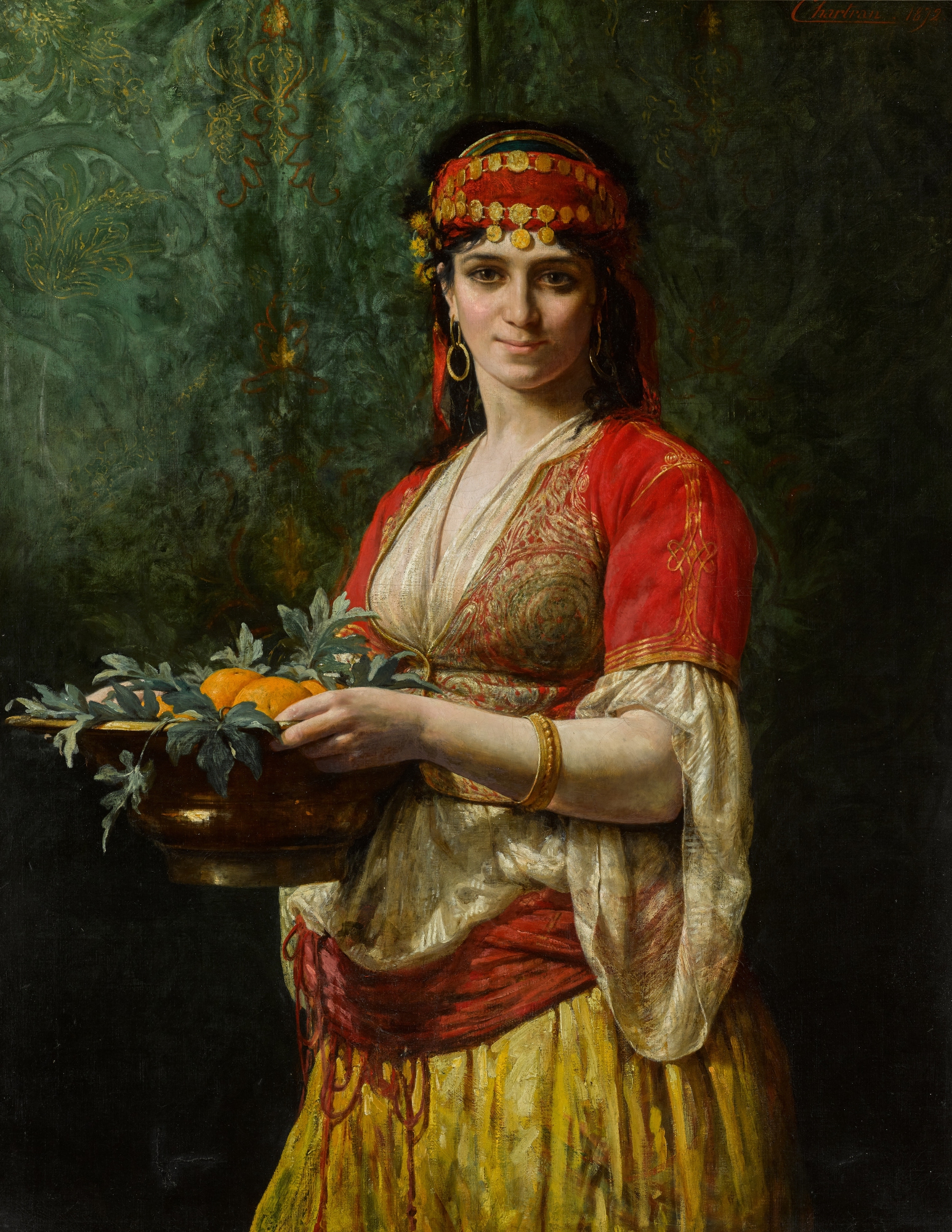
The Orange Seller
Chartran's practice spanned two distinct but complementary modes. On one hand, he was a portraitist of the first order, sought out by cardinals, presidents, and socialites for his ability to render likeness with flattering accuracy and genuine psychological depth. His portrait of Theodore Roosevelt, painted during the American president's time in office, stands as one of the most psychologically alert political portraits of the era, capturing Roosevelt's famous vitality without tipping into caricature. On the other hand, Chartran was a painter of remarkable versatility, equally capable of producing intimate genre scenes of the kind that collectors found irresistible.
Works such as The Orange Seller reveal a painter attuned to the pleasures of everyday observation, the warm Mediterranean light, the textures of fabric and skin, the quiet drama of commercial exchange rendered with a poet's sensitivity. His oil on panel study known as A Bashi Bazouk engages the Orientalist fascination of his era with notable pictorial intelligence, situating itself in a tradition that included figures such as Jean Léon Gérôme and Eugène Fromentin while retaining a distinctly personal touch. Chartran also moved with impressive ease across media. His contributions to Vanity Fair as a caricaturist represent a fascinating and often overlooked dimension of his career.
Théobald Chartran
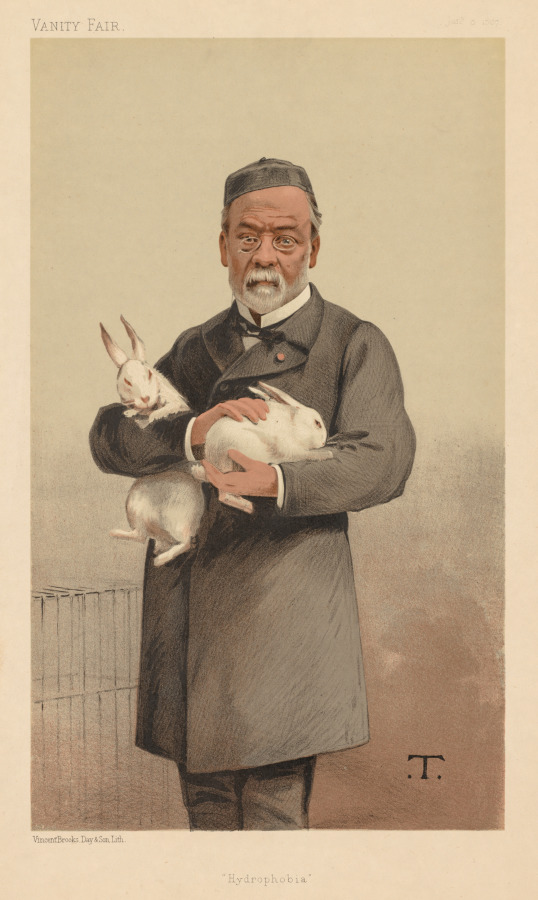
Vanity Fair: "Hydrophobia", 1887
The color lithographs he produced for that publication throughout the late 1870s and into the 1880s, including his witty takes on musical culture with works titled Italian Music and Emotional Music, both from 1879, and his sharply observed Hydrophobia from 1887, demonstrate a gift for satirical economy that sits in productive tension with the grandeur of his Salon submissions. These lithographs were widely circulated and brought his sensibility to a broad audience well beyond the confines of the Parisian art establishment, making him one of the more publicly visible French artists of his generation on the international stage. For collectors approaching Chartran's work today, several considerations are worth holding in mind. His portraits of named historical figures, when they surface on the market, attract spirited bidding from institutional buyers as well as private collectors drawn to the intersection of art history and political or cultural history.
His genre paintings and Orientalist panels, such as the beautifully resolved oil works currently available through The Collection, represent perhaps the most accessible and aesthetically rewarding entry point into his practice. These smaller scale works carry all of Chartran's technical assurance within a format suited to domestic display, and they have benefited in recent years from the broader reassessment of nineteenth century French academic painting that has seen artists such as William Adolphe Bouguereau, Jules Bastien Lepage, and Léon Bonnat reclaim their place at the forefront of serious collecting. The lithographs, meanwhile, offer a more affordable avenue for those beginning their engagement with the period, combining genuine historical interest with the pleasures of a medium that Chartran handled with uncommon finesse. The arc of Chartran's reputation offers a lesson in how artistic fashion works across time.
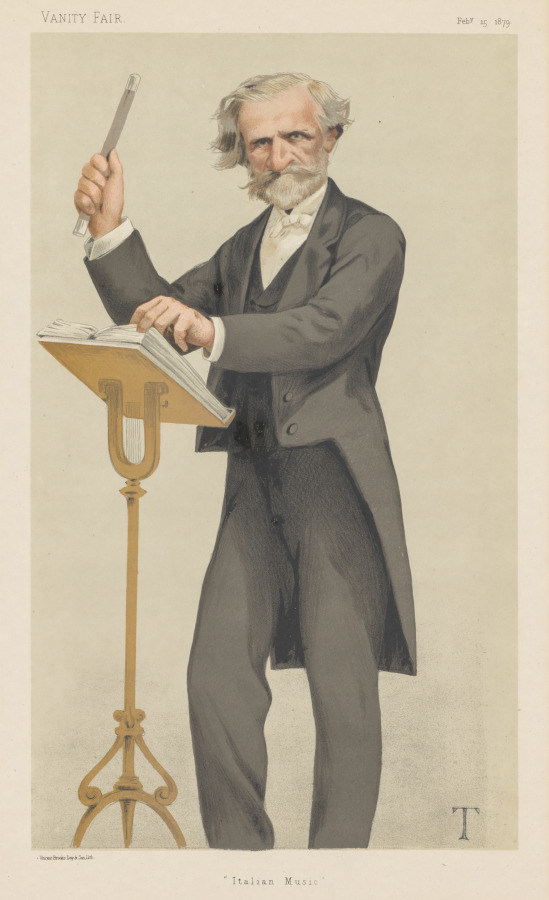
Théobald Chartran
Vanity Fair: "Italian Music", 1879
Like so many painters of the French academic tradition, he experienced a period of relative critical neglect during the twentieth century, as modernist historiography repositioned the Salon as a conservative obstacle to progress rather than what it actually was: a vibrant, contested, and technically extraordinary arena of professional ambition. The revisionist scholarship of recent decades, supported by landmark exhibitions at institutions including the Musée d'Orsay and the Metropolitan Museum of Art in New York, has done much to restore the reputation of painters like Chartran to something closer to the esteem in which their contemporaries held them. Chartran died in 1907 in Neuilly sur Seine, leaving behind a body of work that stretched from the intimate to the monumental, from the satirical to the devotional, and that had crossed the Atlantic multiple times over in its appeal and influence. To encounter his paintings today is to be reminded that technical mastery in the service of genuine human observation is never truly out of fashion.
Explore books about Théobald Chartran