The Connor Brothers
The Connor Brothers Are Rewriting Everything
Artist Spotlight · The Collection Editorial
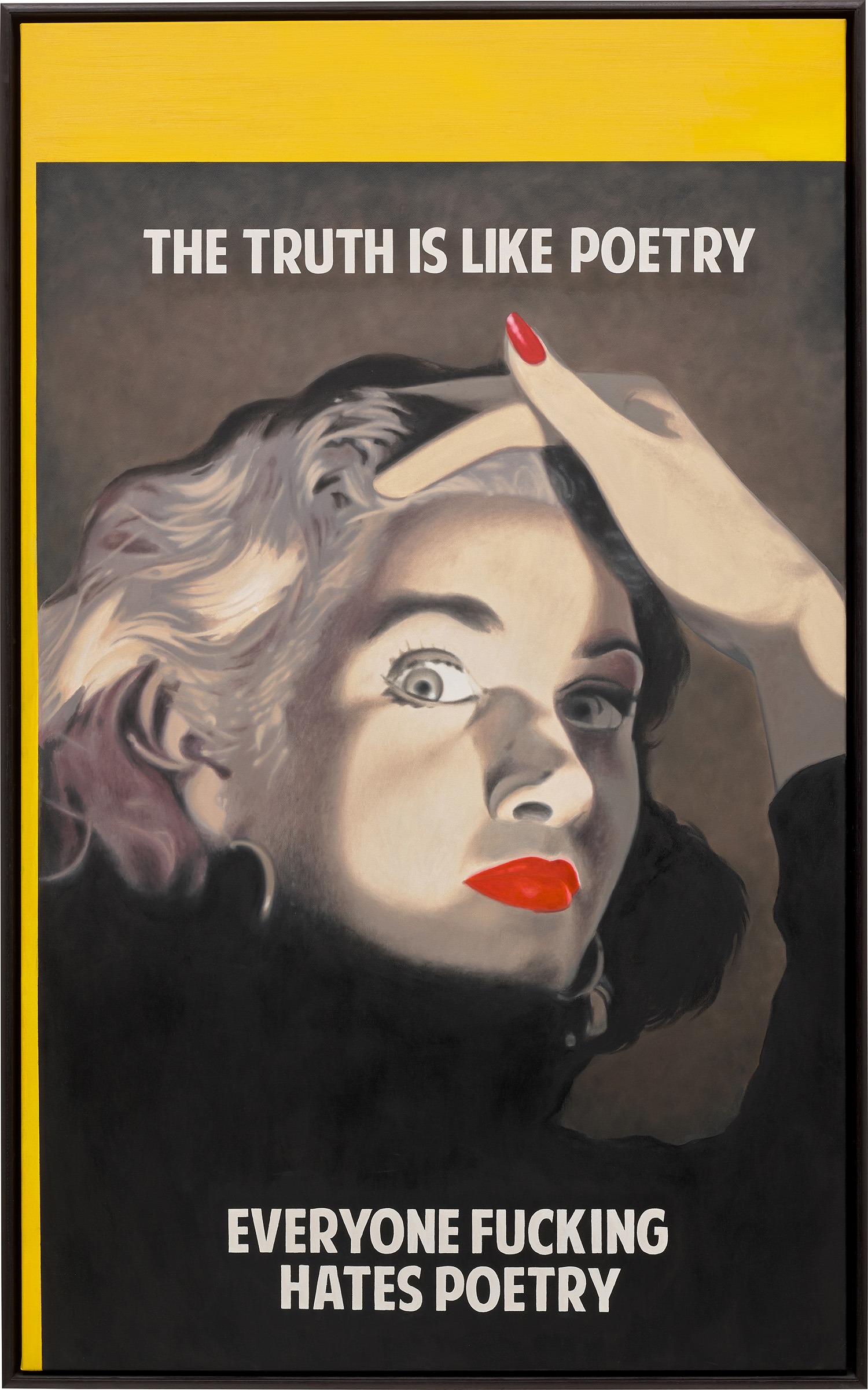
Something remarkable happens when you stand in front of a Connor Brothers work for the first time. The image pulls you in with the lurid warmth of a vintage paperback cover, all bold colours and breathless composition, and then the text lands, and the whole thing shifts register entirely. It is funny and devastating in the same breath. It is also, unmistakably, of this moment.
The Connor Brothers
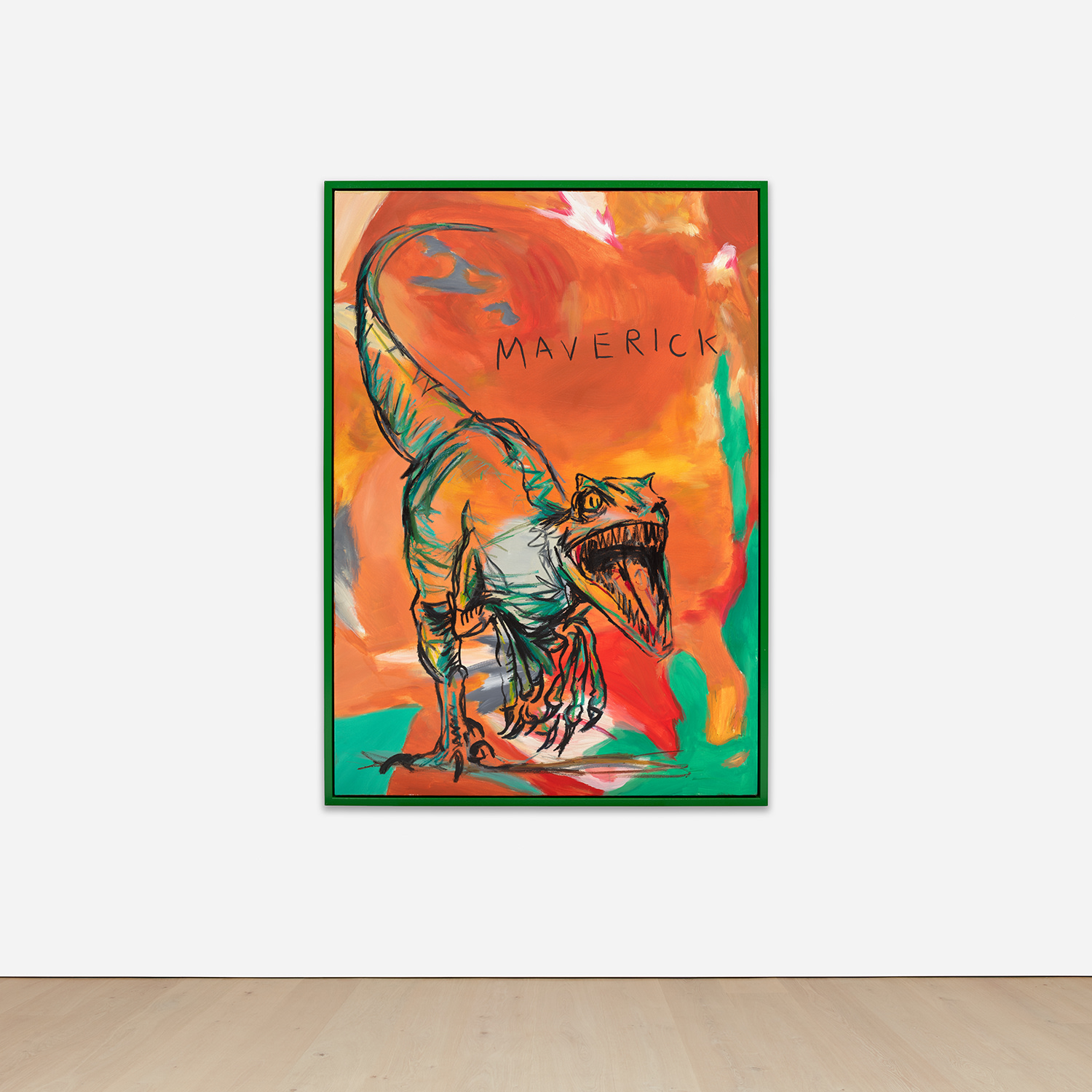
Maverick, 2022
Over the past decade, the British duo have moved from cult underground sensation to one of the most talked about contemporary pairings in the market, with their work appearing at major auction houses, in significant private collections across Europe and the United States, and in cultural conversations that extend well beyond the gallery walls. The story of The Connor Brothers begins with a fiction, and that fiction is part of the work itself. Mike Snelle and James Golding launched the project under elaborately constructed false identities, presenting themselves to the art world as Franklyn and Brendan Connor, two American brothers who had grown up inside a religious cult and whose entire literary and cultural education had come exclusively through pulp fiction paperbacks. The ruse held for longer than most fabrications do in the age of instant information, and it held because the mythology was so perfectly calibrated to the work.
When the real identities of Snelle and Golding were eventually revealed, the unmasking did not diminish the project but deepened it, adding a layer of conceptual seriousness to what some had initially read as pure provocation. Both Snelle and Golding brought distinct but complementary backgrounds to their collaboration. Their formation as artists drew on a broad engagement with popular culture, critical theory, and the visual language of mid twentieth century American commercial illustration. The pulp fiction paperback, with its garish cover art and its promise of escapism, became their central readymade, a found object as richly loaded with cultural meaning as any Duchampian urinal.
The Connor Brothers
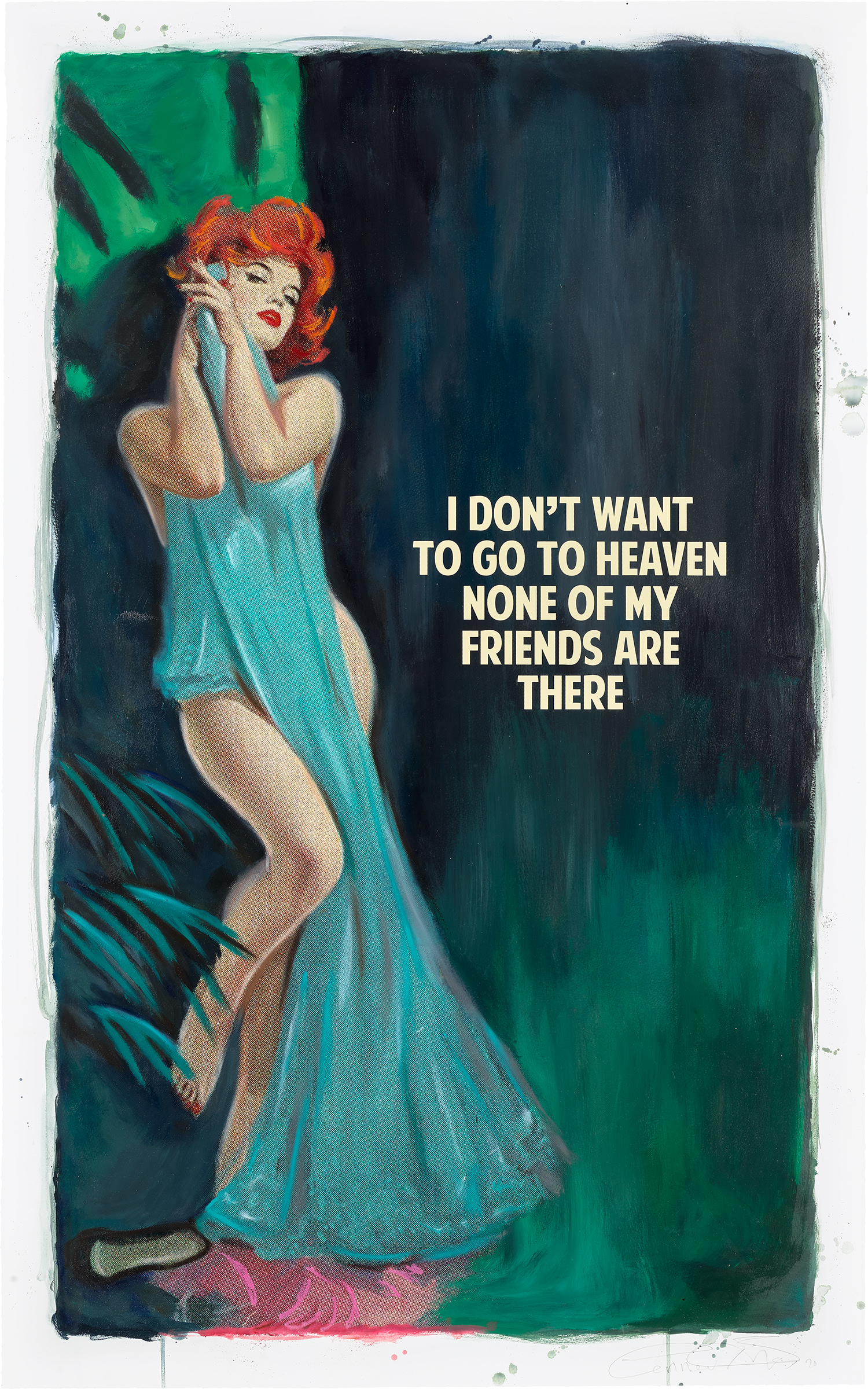
I Don’t Want to Go to Heaven, None of My Friends Are There
By selecting and reworking these objects, they were engaging simultaneously with the history of pop art, the politics of mass culture, and the peculiar emotional textures of nostalgia and anxiety that define contemporary life. The development of their practice has followed a clear and compelling arc. Early works focused tightly on the format of the vintage paperback itself, either as a physical object with hand painted additions or as a source image reproduced and then overlaid with screenprinted text. Works such as Every Saint Has a Past and Hell Is Empty, the latter created in 2017, demonstrate the elegant economy of this approach.
A single phrase, placed with typographic precision over an image of a woman in peril or a brooding stranger, transforms the meaning of both elements entirely. The duo quickly understood that the tension between image and text was not merely decorative but genuinely dialectical, each component questioning and reframing the other. From that foundation they expanded into larger scale works on canvas, incorporating acrylic, oilstick and spray paint in ways that brought their practice into dialogue with street art and abstract expressionism without fully belonging to either. Maverick, created in 2022, exemplifies this evolution, its surface alive with layered mark making contained within one of the artists signature frames that further collapses the boundary between artwork and object.
The Connor Brothers
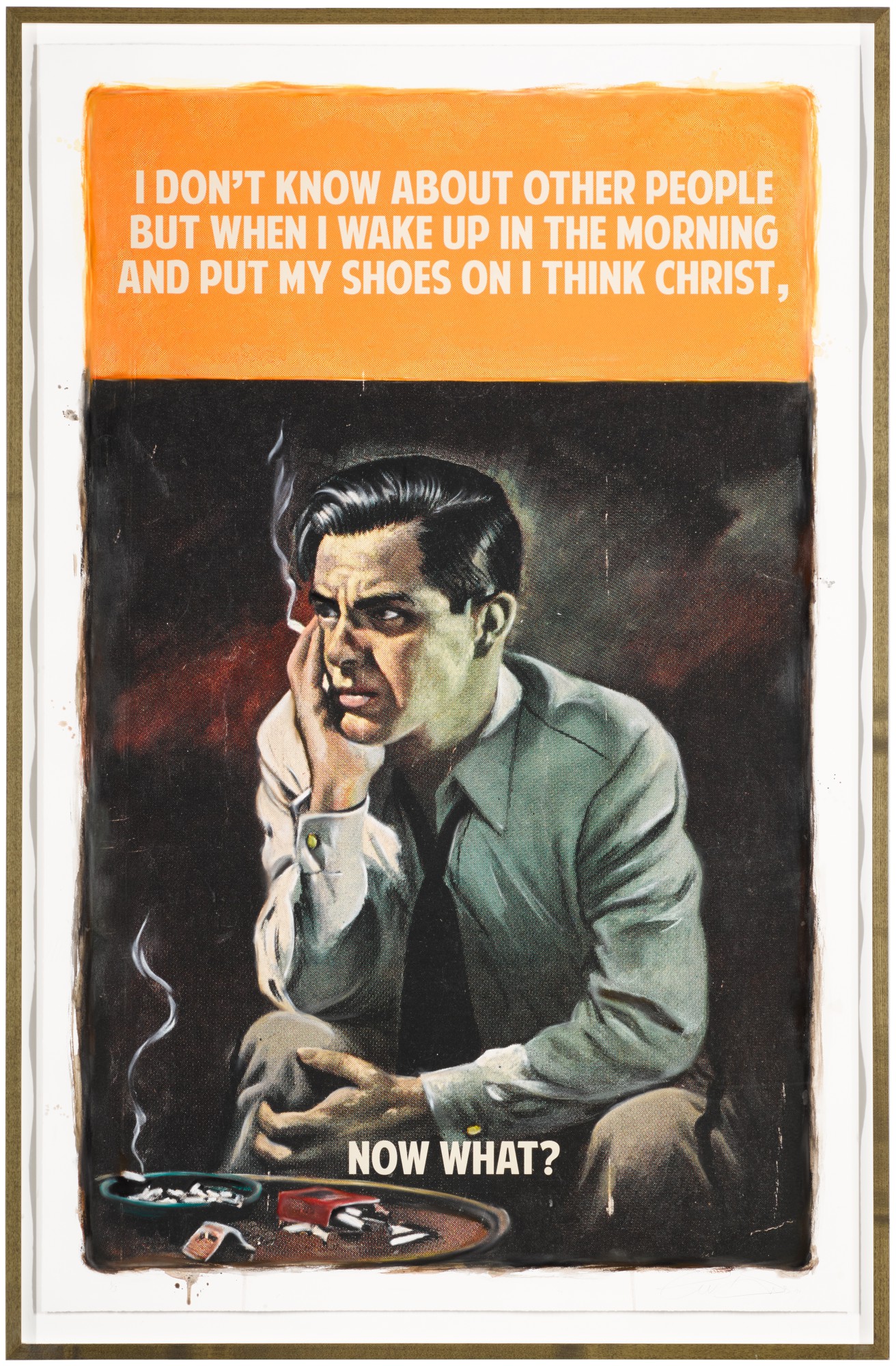
Christ, Now What?, 2020
Christ, Now What, from 2020, and works such as I Can Resist Everything Except Temptation and I Don't Want to Go to Heaven, None of My Friends Are There, demonstrate the range of tonal registers the duo command, from wry wit to something approaching genuine existential tenderness. The subjects of mental health, political disillusionment, and the quiet desperation of modern existence recur throughout, treated not with didactic earnestness but with a lightness that makes the underlying seriousness more rather than less affecting. For collectors, the appeal of The Connor Brothers operates on several levels simultaneously. There is the immediate visual pleasure of the work, its confident use of colour and composition, its satisfying legibility.
There is the intellectual dimension, the awareness that these images are engaged in a sustained critical conversation with the history of art and popular culture. And there is the emotional dimension, the sense that the work is articulating feelings and experiences that are genuinely hard to put into words, and doing so with wit rather than self pity. Works across a range of media and price points are available, from the accessible giclée and screenprint editions on wove paper to unique hand painted canvases and one of a kind altered paperback objects, making the duo an unusually versatile proposition for collectors at different stages of their journey. Within the broader context of contemporary art, The Connor Brothers sit in productive conversation with a lineage that includes the pop art of Ed Ruscha, whose text based works on found surfaces are a clear antecedent, and the appropriation strategies of Richard Prince, though the Connor Brothers bring a warmth and emotional directness that is distinctly their own.
The Connor Brothers
Two works: (i), 2018
Their interest in the aesthetics and anxieties of popular culture also places them alongside artists such as Harland Miller, whose large scale paintings of fictional Penguin paperback covers occupy similar conceptual territory with a comparable commercial and critical success. Like Miller, the Connor Brothers have demonstrated that sophisticated conceptual intent and broad popular appeal are not mutually exclusive, a combination that collectors and institutions alike find increasingly compelling. What the Connor Brothers have ultimately built is something rare in contemporary art: a practice that is immediately recognisable, conceptually rigorous, emotionally generous, and genuinely evolving. The fictional brothers Franklyn and Brendan Connor may have been a construction, but the questions their work asks about identity, belief, escapism, and the stories we tell ourselves are entirely real.
At a moment when the art world is reconsidering the relationship between accessibility and seriousness, between pleasure and critique, the Connor Brothers offer a persuasive argument that these qualities belong together. Their work rewards the first glance and the long look equally, and that is a quality that does not diminish with time.