Suzuki Harunobu
Harunobu: The Master Who Painted Feeling
Artist Spotlight · The Collection Editorial
Imagine Edo period Japan in the winter of 1765, when something quietly extraordinary happened in the workshops of Tokyo's printmakers. A new kind of woodblock print emerged, one that shimmered with as many as a dozen colors registered with such precision that the printed page seemed to breathe. The man responsible was Suzuki Harunobu, and the technique he pioneered, known as nishiki e or brocade picture, would transform Japanese visual culture forever. More than two and a half centuries later, his prints continue to astonish collectors, curators, and anyone fortunate enough to encounter one in person, whether at the Museum of Fine Arts in Boston, the Art Institute of Chicago, the British Museum in London, or at specialized auction presentations in New York and Paris where Harunobu sheets regularly achieve significant results.
Suzuki Harunobu
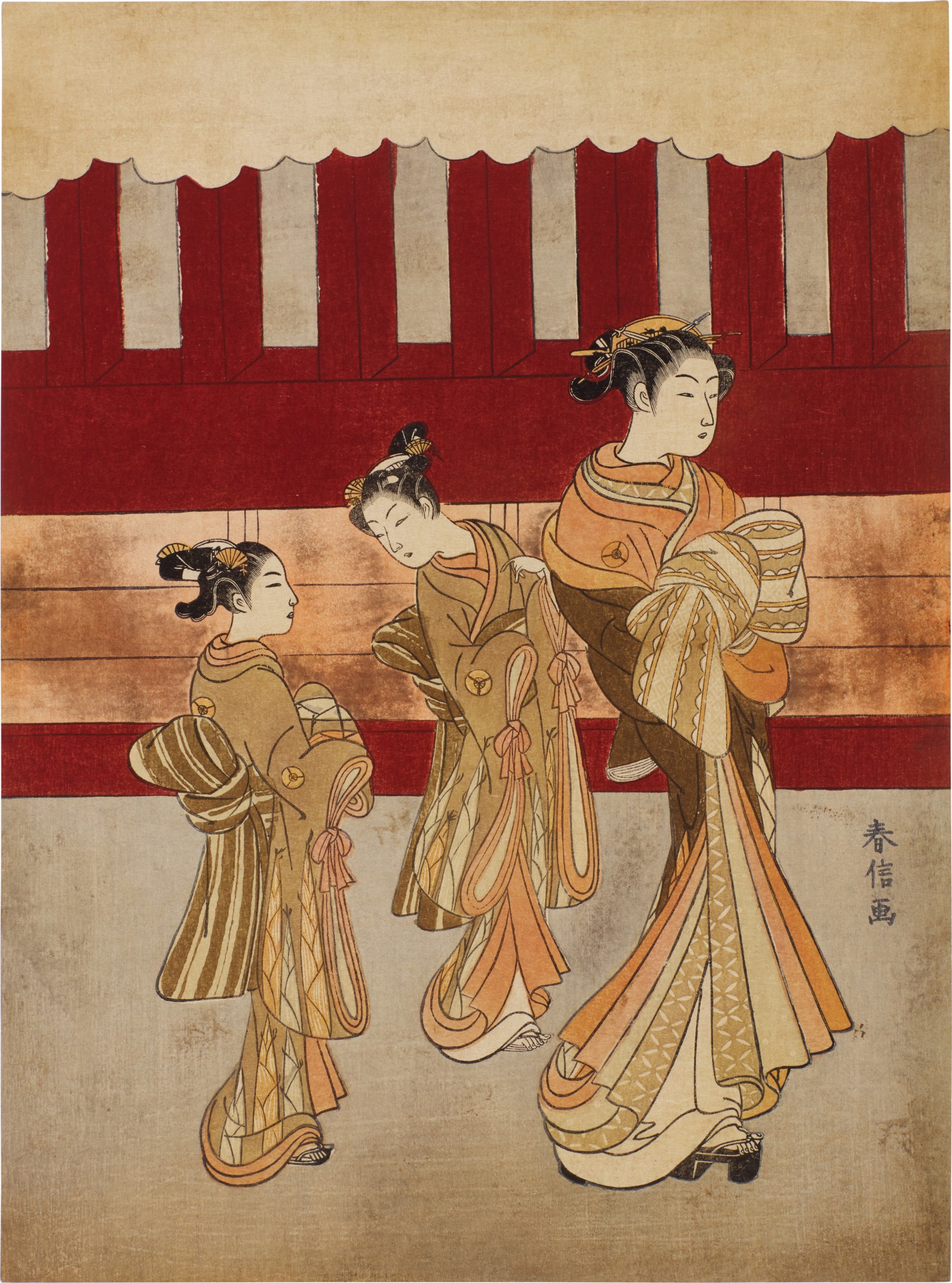
A courtesan accompanied by two kamuro | Edo period, 18th century
Very little is known with certainty about Harunobu's early life, and this mystery has only deepened his allure. He was born around 1725, likely in Edo, the city we now know as Tokyo, and his given name before adopting the artistic name Suzuki Harunobu remains a matter of scholarly debate. He trained within the ukiyo e tradition, the art of the floating world, a practice devoted to depicting the pleasures, fashions, and intimate textures of urban life. His early work showed the influence of masters such as Nishimura Shigenaga and Torii Kiyomitsu, figures who helped establish the conventions of single and two color printing that Harunobu would eventually transcend entirely.
The decisive turning point in Harunobu's career came through the culture of calendar print exchange that flourished among wealthy Edo merchants and samurai aesthetes. In 1765, a group of sophisticated patrons commissioned elaborately printed calendar sheets known as e goyomi as New Year gifts for their circles. Harunobu, working closely with these discerning patrons, used the commission as an opportunity to develop the full polychrome woodblock printing process, coordinating the cutting and registration of multiple blocks with exceptional refinement. The prints that resulted were so admired that he quickly adapted the process for the commercial market, releasing a torrent of nishiki e prints over the remaining five years of his life.
Suzuki Harunobu
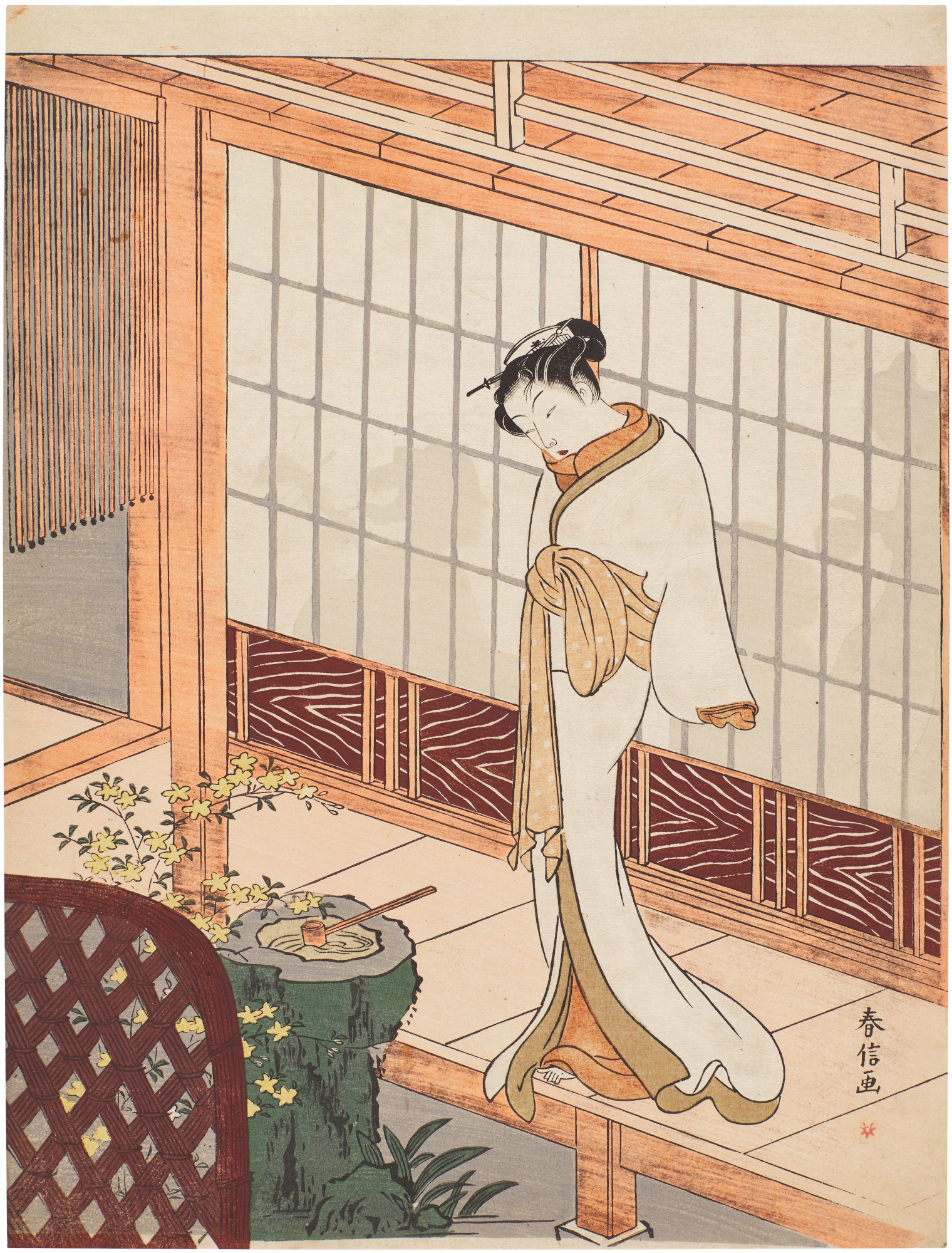
A courtesan standing on an engawa (veranda) | Edo period, 18th century
His output in that brief final period was extraordinary, both in volume and in artistic ambition. What sets Harunobu apart from his contemporaries and successors is a quality that is easier to feel than to name. His figures, typically slender young women and androgynous youths, inhabit a world of exquisite delicacy. They seem to float within their compositions, surrounded by the textures of bamboo screens, paper lanterns, veranda railings, and flowering branches rendered with quiet reverence.
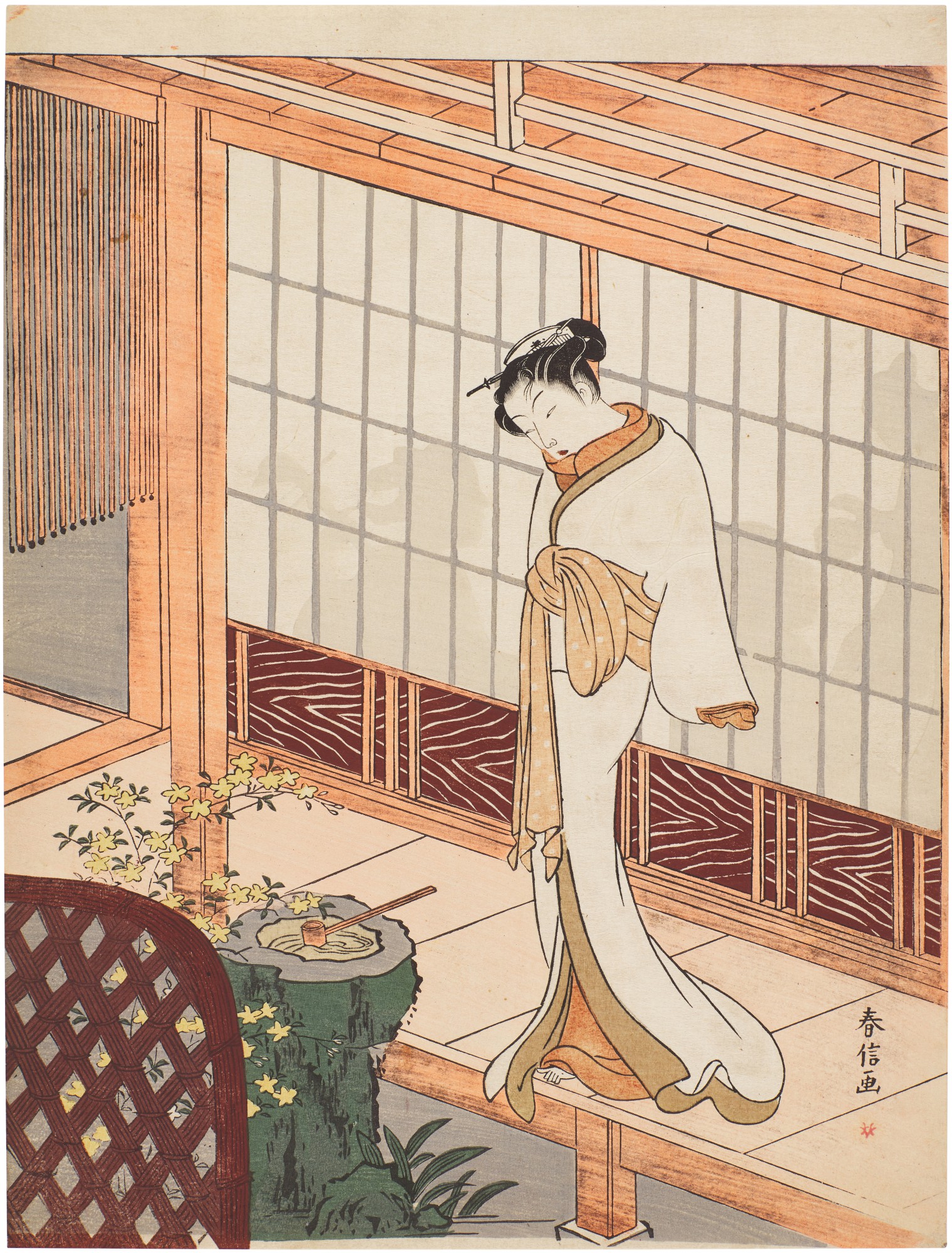
His palette favored soft mauves, warm yellows, pale blues, and tender greens, colors that feel emotionally true rather than merely decorative. Among the works available on The Collection, this sensibility is on full display. A courtesan standing on an engawa, a wooden veranda extending into the garden space, captures the contemplative stillness that Harunobu made his signature. The figure is alone with her thoughts, poised between interior and exterior, and the mood is one of refined melancholy softened by beauty.
Suzuki Harunobu
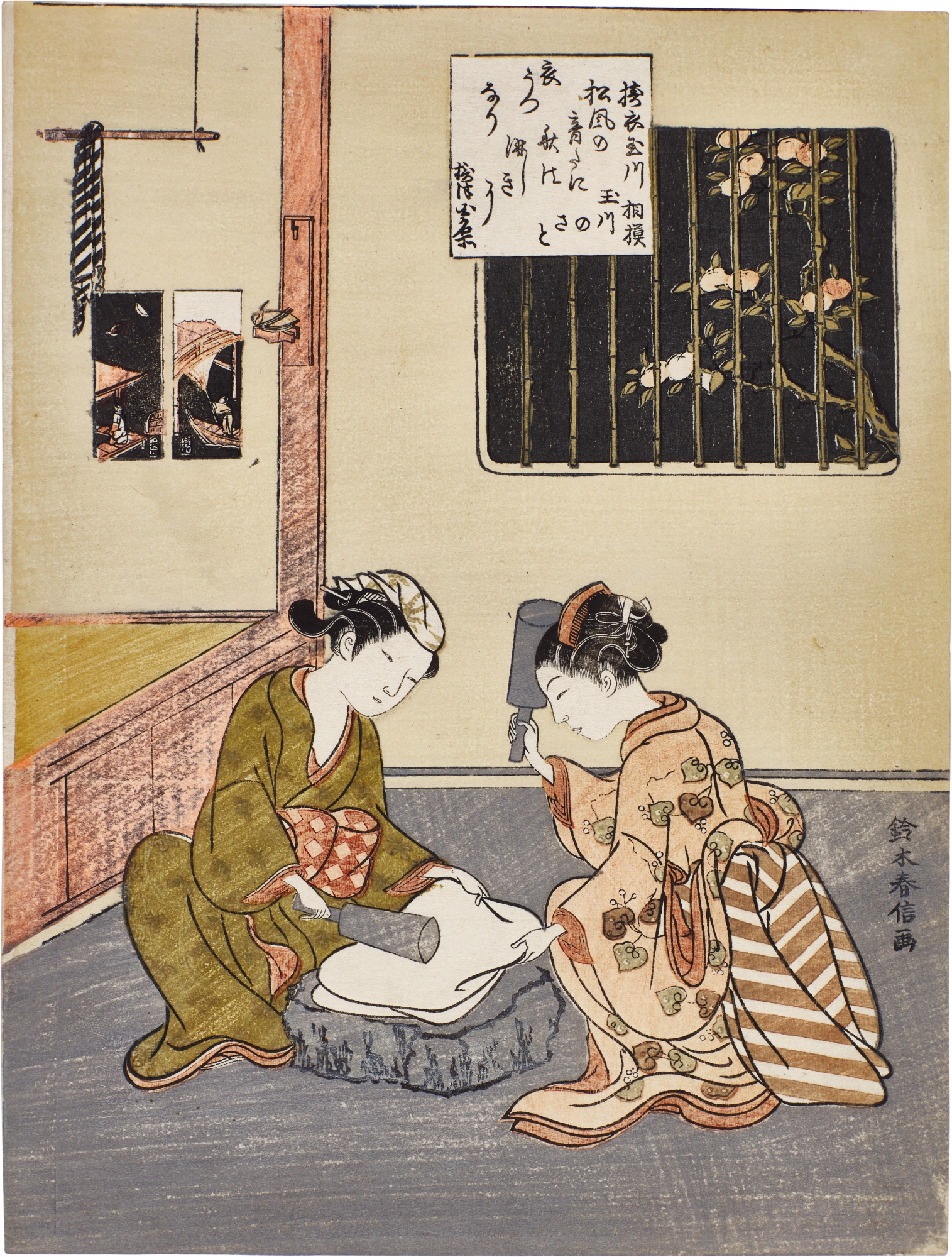
The Cloth-fulling Jewel River, a Famous Place in Settsu Province (Toi no Tamagawa, Settsu no meisho) | Edo period, 18th century
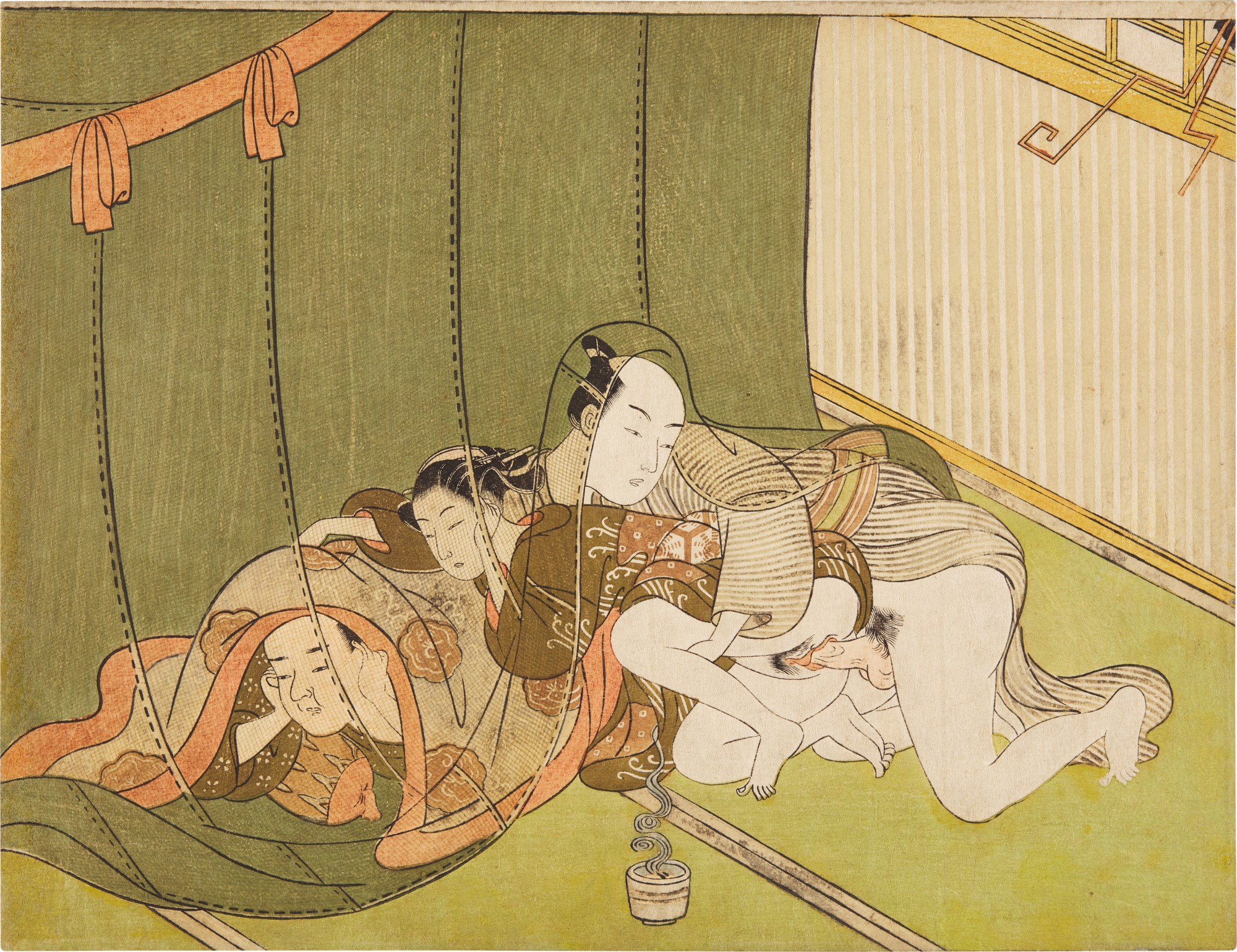
His more intimate compositions reveal another dimension of his art. Works such as the print depicting a noodle vendor observing an amorous couple beside a wheelbarrow at night, or the celebrated scene of lovers beneath a mosquito net while a cuckolded husband clasps his ears and a thunderstorm rages outside, show Harunobu as a storyteller of considerable wit and warmth. He understood that desire and comedy are close neighbors, and his handling of such scenes never tips into the coarse or the crude. Similarly, the composition from the Snow Moon and Flowers series depicting a youth interrupting a girl arranging flowers in an elegant room with a folding screen and a tokonoma alcove demonstrates his mastery of architectural space and seasonal mood.
The collector's seals on several of these works, including those of the legendary Parisian collector Henri Vever and the dealer Hayashi Tadamasa, speak to the long history of Western connoisseurship that has surrounded the finest Harunobu impressions since the late nineteenth century. For collectors, Harunobu represents one of the most rewarding areas of the Japanese print market. The finest impressions, those printed early in the edition with vivid, unfaded color and crisp registration, are among the most prized objects in all of works on paper collecting. The Henri Vever collection, dispersed through Sotheby's in a landmark sale in 1974 and again in subsequent sessions, set benchmarks for quality and provenance that continue to guide the market today.
Suzuki Harunobu
An amorous couple and husband under a mosquito net (kaya) | Edo period, 18th century
Works from that collection carry an additional layer of historical significance, connecting the modern collector to one of the greatest private accumulations of Japanese prints ever assembled in Europe. Condition is paramount with Harunobu: fading, particularly of the fugitive pink tones derived from organic dyes, can diminish the impact of a sheet considerably, and sheets retaining their original freshness command substantial premiums. Subject matter also matters to collectors, with the intimate genre scenes and the formally complex compositions from named series attracting the greatest interest. Within the broader ukiyo e tradition, Harunobu stands as a necessary point of reference.
His immediate successors, including Kitagawa Utamaro, Torii Kiyonaga, and later Katsushika Hokusai and Utagawa Hiroshige, all built upon the chromatic and compositional possibilities he opened up. Utamaro brought a new psychological intensity to the bijin ga, the picture of a beautiful woman, that would have been unthinkable without Harunobu's emotional template. Kiyonaga introduced a more monumental, physically robust female ideal in dialogue with Harunobu's ethereal slenderness. Understanding the tradition means understanding Harunobu as its chromatic originator, the artist who gave the floating world its full visual language.
Harunobu died in 1770, just five years after his greatest breakthrough, at an age that seems impossibly young given the size and influence of his achievement. That brevity gives his career a particular poignancy and intensity, as though he understood, or perhaps simply worked as if, time was short. Today his prints hang in the world's greatest museums and in the collections of discerning private collectors who recognize that the pleasure of living with a Harunobu is inseparable from the pleasure of being alive to beauty. To encounter his work is to be reminded that art at its finest does not shout.
It whispers, and in whispering, it reaches further.
Explore books about Suzuki Harunobu
Harunobu and His Age
Waterhouse, David B.
Japanese Prints during the Edo Period
Michener, James A.
Harunobu: His Life and Works
Kuroda, Genji
The Art of Suzuki Harunobu
Fister, Patricia
Ukiyo-e: Japanese Prints
Hillier, Jack
The Prints of Japan
Hind, Arthur M.