Suzanne Valadon
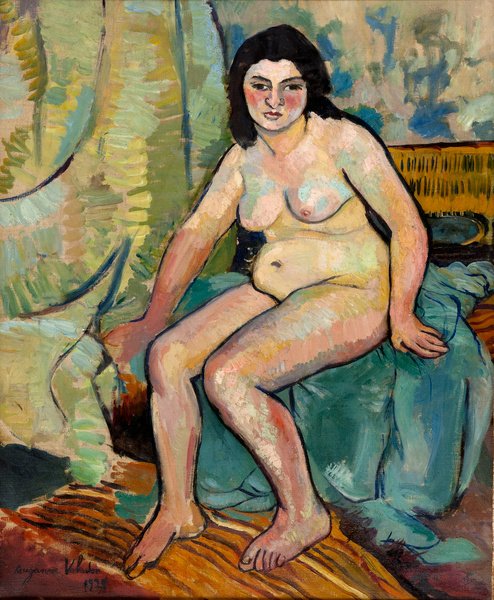
Suzanne Valadon, Montmartre's Most Fearless Eye
Artist Spotlight · The Collection Editorial
“I have always loved beautiful things and I have always made things as beautiful as I could.”
Suzanne Valadon
There is a particular kind of attention that Suzanne Valadon's paintings demand. Standing before "La toilette" or her monumental nude compositions, the viewer quickly understands they are not in the presence of a flattering gaze but an honest one, a gaze that refuses sentiment without sacrificing warmth. In recent years, major institutions have returned to Valadon with renewed seriousness: the Centre Pompidou has featured her work in survey exhibitions of modern French art, and auction houses including Christie's and Sotheby's have seen sustained collector interest in her oils and works on paper. The art world, it seems, is finally catching up to what Valadon always knew about herself.
Suzanne Valadon
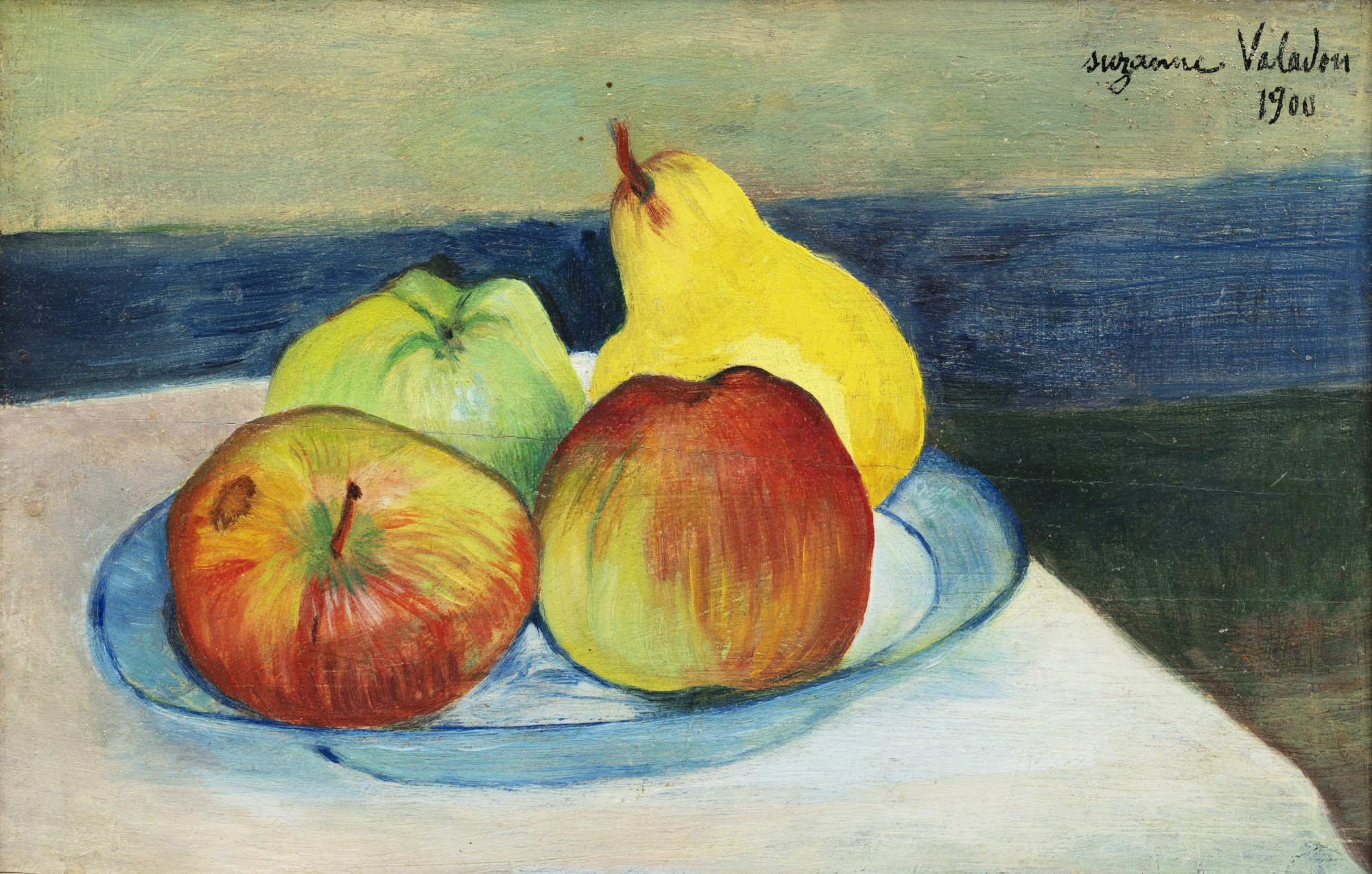
Nature morte aux pommes et à la poire, 1900
She was born Marie Clémentine Valadon in 1865 in Bessines sur Gartempe, in the Haute Vienne region of France, the illegitimate daughter of a laundress named Madeleine. Mother and daughter made their way to Paris while Valadon was still a child, settling in Montmartre, then a working class neighborhood perched above the city, alive with artists, acrobats, and ambition. Valadon trained briefly as a circus acrobat in her early teens, performing until a fall from the trapeze ended that chapter of her life. What came next would prove far more consequential for the history of art.
In the cafes and studios of Montmartre, Valadon found work as a model, and her circle of employers reads like a roll call of Post Impressionist greatness. Pierre Auguste Renoir painted her. Henri de Toulouse Lautrec, with whom she had a formative and complicated relationship, immortalized her features. Edgar Degas, the most demanding eye in Paris, not only posed her but recognized something in her that went beyond the surface.
Suzanne Valadon
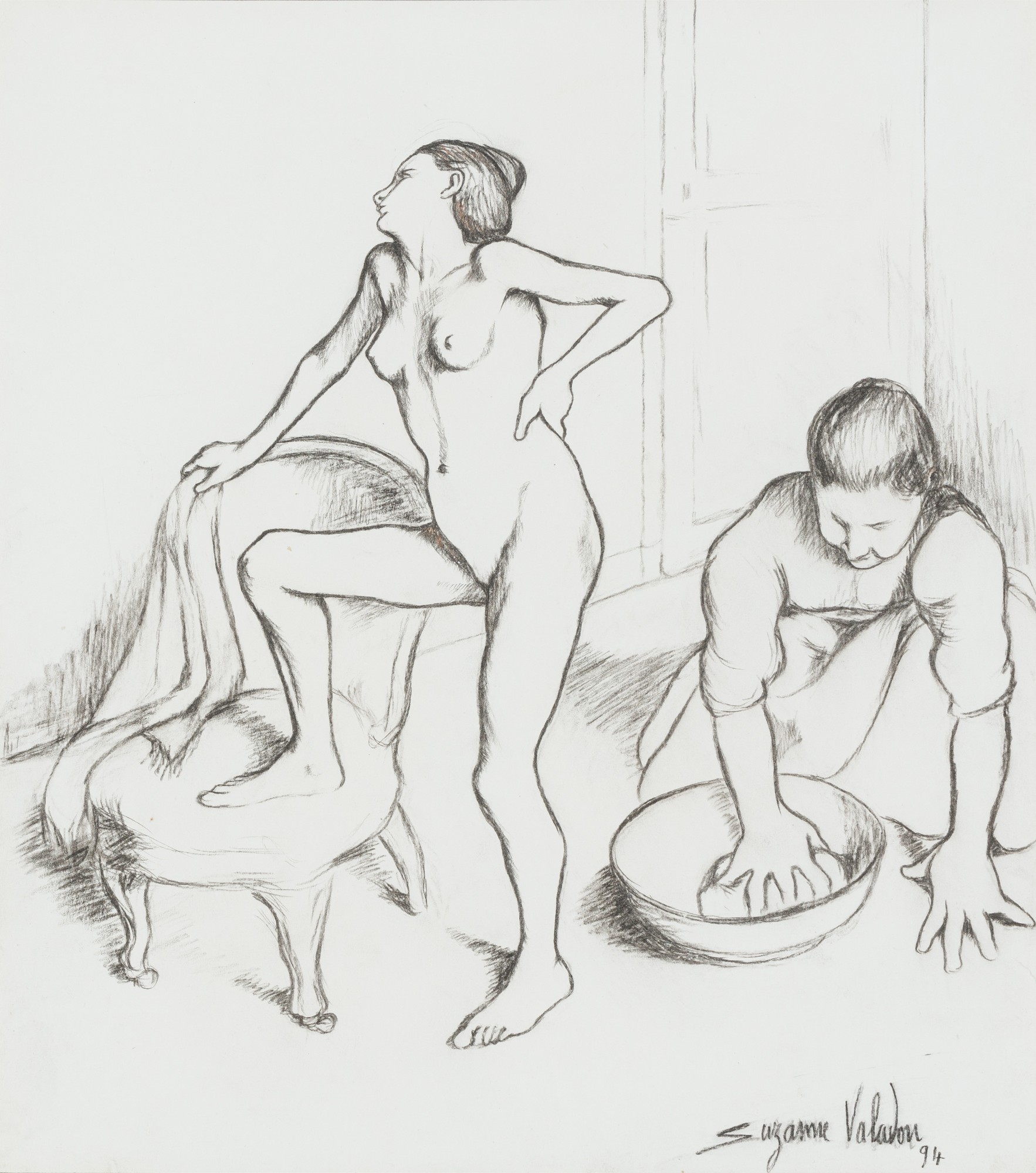
La toilette, 1894
It was Degas who looked at her drawings, made in private from observation and instinct, and saw a genuine artist. He encouraged her, critiqued her, and championed her work at a time when the idea of a female painter from the working class was nearly inconceivable in official French art circles. Valadon taught herself to draw and paint through sustained observation. She watched how light fell across a model's back, how the weight of a body shifts in a chair, how a bowl of apples insists on its own gravity.
Her artistic development was not theoretical but deeply empirical, rooted in looking. By the 1890s she was producing drawings of extraordinary directness, capturing the female nude without the decorative softening that male contemporaries so often applied. In 1894 she became the first woman admitted to the Société Nationale des Beaux Arts, a milestone that arrived not through social connection but through sheer force of her draftsmanship. She would later take up etching and printmaking, producing drypoints and aquatints of remarkable tonal range, and she moved between media throughout her career with a confident fluidity that belied her entirely self taught origins.
Suzanne Valadon
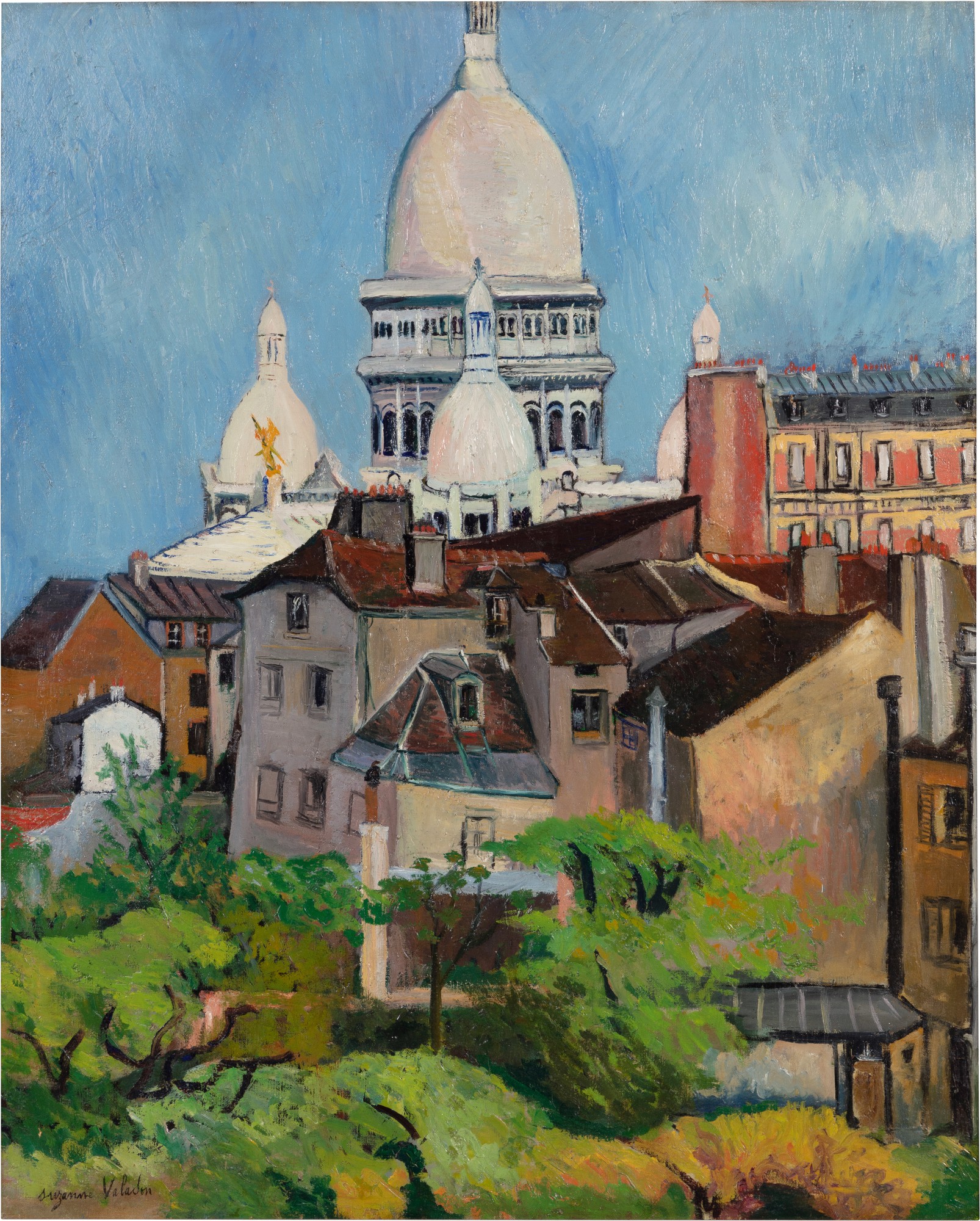
Le Sacré-Cœur de Montmartre, 1917
Her signature works resist easy categorization, which is precisely what makes them so compelling to collectors and scholars alike. "La toilette" from 1894, rendered in pencil on paper, shows a woman washing with an unflinching intimacy that owes nothing to the voyeuristic tradition Degas himself sometimes courted. The figure is not performing for anyone. "Nature morte aux pommes et à la poire" from 1900 demonstrates her gifts as a colorist: the fruit sits with an almost sculptural solidity, the paint applied with a confidence that recalls Cézanne while remaining unmistakably her own.
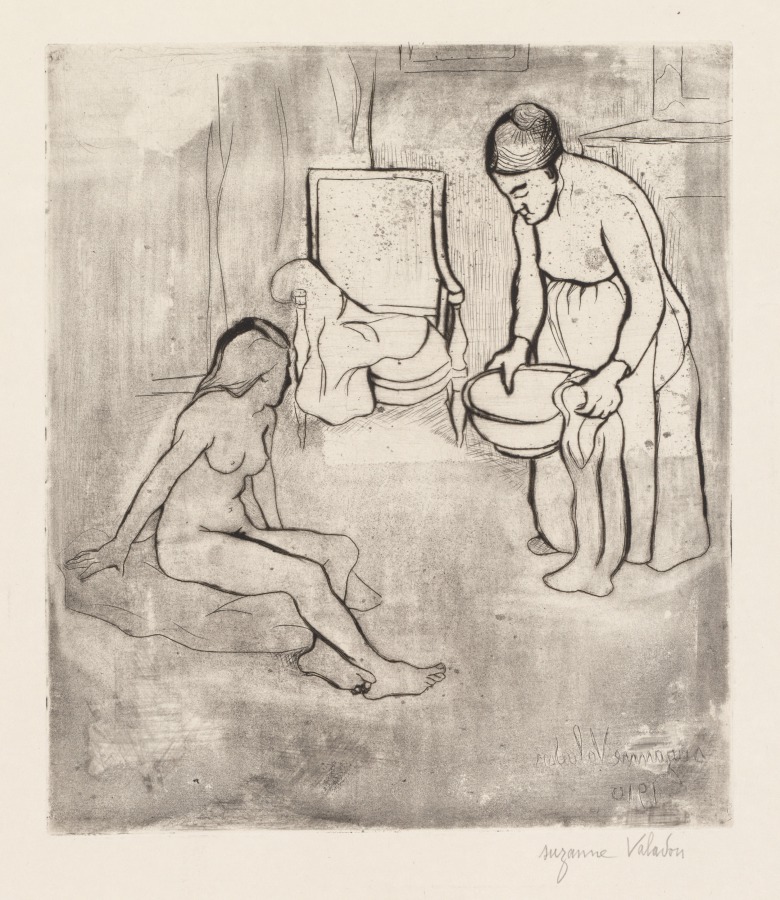
"Le Sacré Coeur de Montmartre" from 1917 shows the famous basilica from the rooftops she knew intimately, the composition bold and the palette vibrating with a quality of observed light rather than picturesque nostalgia. Later works such as "Trois baigneuses nues" from 1935, painted when she was seventy years old, show no diminishment of power whatsoever. For collectors, Valadon presents a remarkable opportunity. Her works on paper, including drawings and prints such as the 1910 drypoint, etching, and aquatint "Grandmother with Louise, Nude Seated on the Floor," offer an entry point into a practice that is both historically significant and aesthetically potent.
Suzanne Valadon
Grandmother with Louise, Nude Seated on the Floor (Grand-Mère et Louise Nue Assise par Terre), 1910
Her oils, when they come to market, draw serious attention: major examples have achieved results reflecting growing institutional and private demand. What to look for is her characteristic line, which has an almost muscular certainty to it, and her color choices, which tend toward the warm and declarative rather than the atmospheric. Provenance from early French collections is relatively common given her Montmartre milieu, and works with exhibition history from her lifetime carry particular weight. Valadon is best understood in the company of her contemporaries while also being understood as apart from them.
Her commitment to the unidealized female nude places her in conversation with Paula Modersohn Becker, the German Expressionist who was working with similarly radical honesty at almost exactly the same moment. Her bold outlines and saturated color relate her to the Fauves, and Matisse's influence and hers occasionally ran in productive parallel. Her son Maurice Utrillo, whom she taught to paint as a means of managing his early struggles, became one of the most celebrated painters of Parisian street scenes, and the two maintained a fraught but deeply intertwined artistic and personal relationship across decades. What makes Valadon matter today is not simply the story, though the story is extraordinary.
It is the work itself. At a moment when the art world is seriously and systematically reassessing which voices were marginalized by the institutions and market forces of the twentieth century, Valadon's paintings and drawings arrive with the force of something that should always have been central. She looked at women's bodies without condescension, she looked at the world of Montmartre without sentimentality, and she looked at still life with the seriousness usually reserved for figure painting. She did all of this while raising a child alone, navigating poverty and then hard won recognition, and refusing, at every point, to make her work easier for others to digest.
That is not a historical curiosity. That is a living standard.
Explore books about Suzanne Valadon
Suzanne Valadon
John Storm
Suzanne Valadon: The Muse Who Became an Artist
Georgette Passador
Valadon: A Life
Justine Picardie

Suzanne Valadon
Paul Petrie

The Letters of Suzanne Valadon
Rosemary Betterton (ed.)

Suzanne Valadon: Painter of Dreams
Cher Krause Knight

A Life of Suzanne Valadon
Antonin Artaud