Steven Arnold
Steven Arnold's Visionary World Shimmers Eternal
Artist Spotlight · The Collection Editorial
In the sun drenched, perfume thick atmosphere of 1970s San Francisco, a young artist was quietly constructing one of the most singular imaginative universes in American art. Steven Arnold, born in 1943, built his world from sequins and shadows, from the sacred and the profane, from bodies adorned and transformed beyond the ordinary. Decades after his passing in 1994, institutions and devoted collectors are returning to his work with fresh urgency, recognizing that what once seemed deliriously niche now reads as genuinely prophetic. His photographs, films, and performances anticipated conversations about gender, identity, spectacle, and the spiritual dimensions of beauty that have never felt more alive.
Steven Arnold
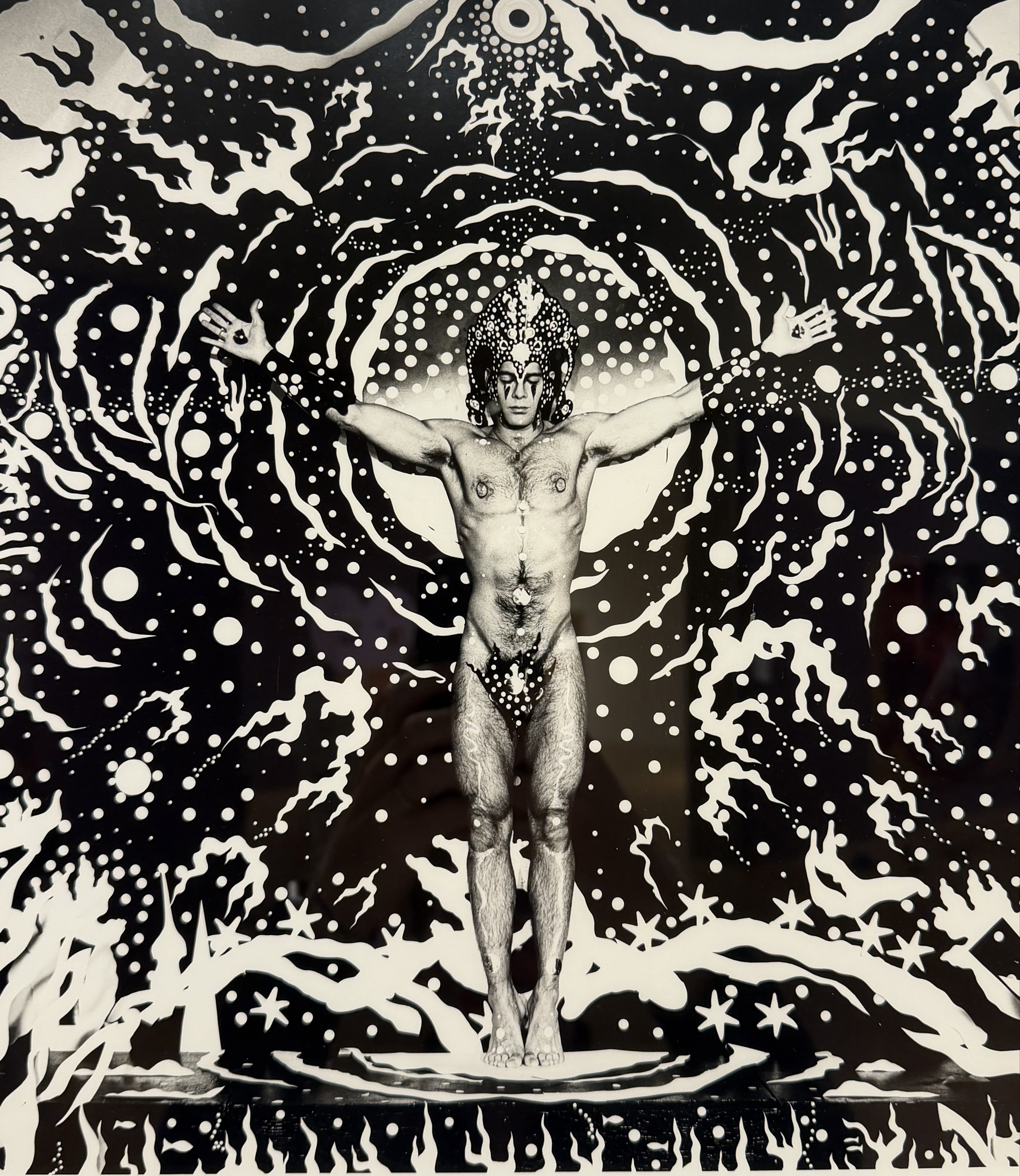
Inventing Infinity, 1990
Arnold grew up in California, and the state's particular cocktail of Hollywood mythology, countercultural energy, and proximity to the Pacific's vast, dreaming light shaped him deeply. He studied at the San Francisco Art Institute, where he absorbed the experimental ferment of the 1960s, and later developed relationships with figures who would define the avant garde edges of American culture. His friendship with surrealist luminary Salvador Dali proved formative, introducing Arnold to a tradition that valued the irrational, the hallucinatory, and the deeply personal as legitimate artistic currencies. Dali recognized in Arnold a kindred appetite for the extraordinary, and that endorsement encouraged Arnold to pursue his most extravagant instincts without apology.
His early filmmaking work announced a sensibility unlike anything else circulating in American experimental cinema. Arnold's 1972 film "Luminous Procuress," produced in association with the legendary San Francisco filmmaker Bruce Baillie and screened at the Museum of Modern Art in New York, drew immediate critical attention. The film is a fever dream of ritualistic eroticism, mythological suggestion, and handcrafted visual opulence that owes as much to Kenneth Anger and Jack Smith as it does to Fellini or Arrabal. Arnold was working in a tradition of visionary underground film, but his particular contribution was an almost devotional quality, a sense that the camera was being used not merely to record but to consecrate.
He was awarded a Blue Ribbon at the American Film Festival and the film was selected for the Berlin Film Festival, confirming that his voice carried beyond the intimate circles of the Bay Area avant garde. As his practice evolved through the 1970s and into the 1980s, Arnold increasingly turned to still photography and elaborate tableau vivant constructions. These works, often featuring elaborately costumed figures posed amid rich assemblages of found objects, textiles, jewels, and organic materials, read as altars to human strangeness and beauty. His photographs occupy a space somewhere between fashion imagery, surrealist staging, and religious icon making.
There is a theatrical intelligence at work in every frame, a sense of an artist who understood that the arrangement of bodies and objects in space could carry genuine metaphysical weight. His circle of collaborators and models included figures from San Francisco's bohemian underground, drag performers, artists, and adventurers who shared his conviction that appearance itself could be a form of philosophy. "Inventing Infinity," his 1990 gelatin silver print, stands as one of the most compelling distillations of his mature vision. The work exemplifies what made Arnold so distinctive: an ability to use the relatively austere grammar of black and white photography to contain something absolutely excessive, ornate, and alive.
The gelatin silver print medium, with its rich tonal range and sense of physical presence, suits his sensibility perfectly. Where color might have tipped his images toward decoration, the monochrome insists on their gravity, their weight as images rather than mere pictures. Collectors drawn to "Inventing Infinity" are encountering a work that rewards sustained attention, one that reveals new layers of intention the longer it is lived with. The collecting conversation around Arnold has been gathering momentum for several years now, driven in part by a broader reappraisal of West Coast experimental and underground art from the 1960s through the 1980s.
Work by artists in adjacent territory, figures like Robert Mapplethorpe, whose formal rigors Arnold shared even as their temperaments differed, or the elaborately staged imagery of Joel Peter Witkin, provides useful context for understanding where Arnold sits in the photographic tradition. Like Mapplethorpe, Arnold understood the still photograph as a space for confrontation with beauty that society found uncomfortable. Like Witkin, he was drawn to the carnivalesque and the grotesque as routes toward the sublime. But Arnold's work carries its own unmistakable frequency, warmer and more celebratory than Witkin, less coolly formal than Mapplethorpe at his most austere.
For collectors approaching Arnold's work, the relative scarcity of his photographs in the market makes each available piece significant. His prints appear at auction and through specialist dealers in photography and works on paper, and they have attracted attention from collectors who build around themes of queerness and representation, experimental photography, and West Coast counterculture. The works hold their value well and carry the additional appeal of art historical importance: Arnold documented and helped shape a specific cultural moment in American life that is now understood to be genuinely irreplaceable. Acquiring his work is not simply an aesthetic choice but an act of preservation and recognition.
Arnold's legacy is best understood as part of a larger flowering of visionary, queer, and spiritually inflected art that emerged from American counterculture and has only grown in critical standing since his death. He belongs in conversation with filmmakers like Jack Smith and Kenneth Anger, with photographers like Mapplethorpe and Peter Hujar, with performance artists and image makers who insisted that beauty was a serious subject and that desire was a legitimate lens through which to examine the world. The art world of the twenty first century, with its expanded understanding of whose stories matter and whose images deserve to be seen, is finally fully equipped to receive what Arnold was offering. His photographs and films do not feel like documents from a vanished world.
They feel like dispatches from an imagination that was simply operating ahead of its time, and that time, generously, is now.