Stanley William Hayter
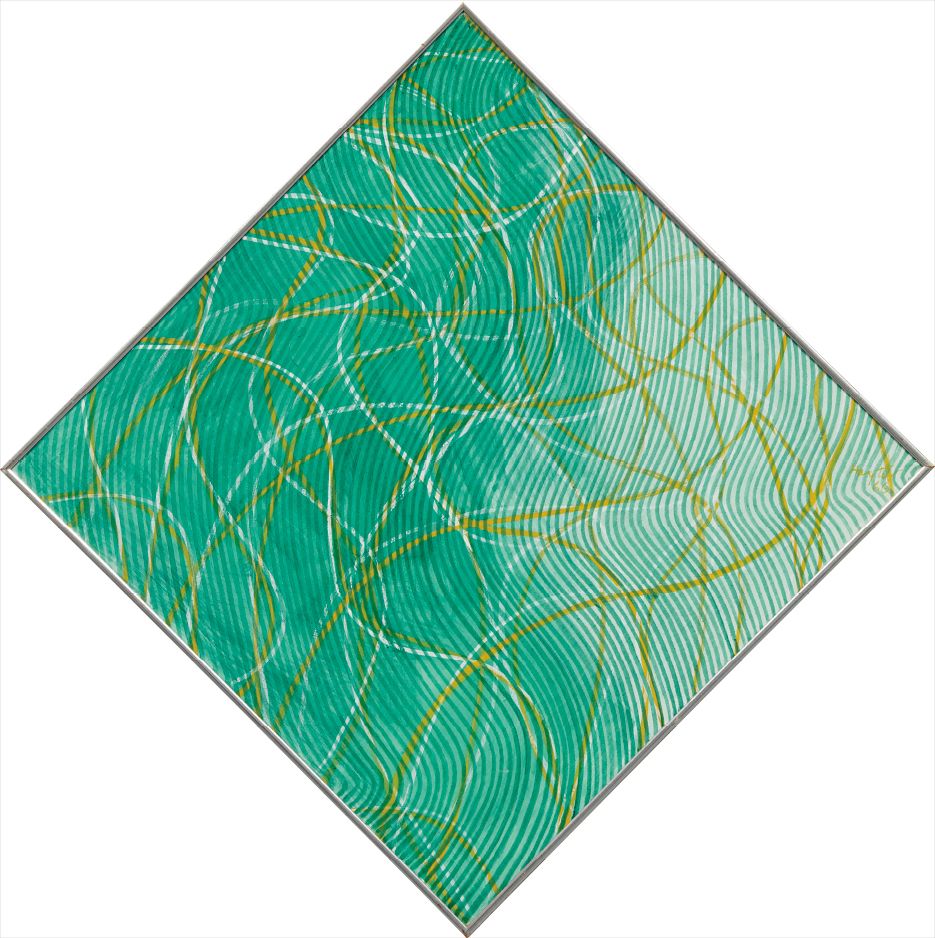
Stanley William Hayter, Master of the Printed Line
Artist Spotlight · The Collection Editorial
“In the use of line for its own sake, we can discover qualities of a purely plastic nature.”
New Ways of Gravure, 1949
There are artists who make work, and then there are artists who remake the conditions under which art becomes possible. Stanley William Hayter belongs firmly to the second category. When the Centre Pompidou in Paris mounted a survey of postwar printmaking that traced the radical reinvention of intaglio technique across the twentieth century, Hayter's name appeared not as one contributor among many but as the gravitational center around which an entire generation of innovators had orbited. His studio, Atelier 17, was not simply a place where prints were made.
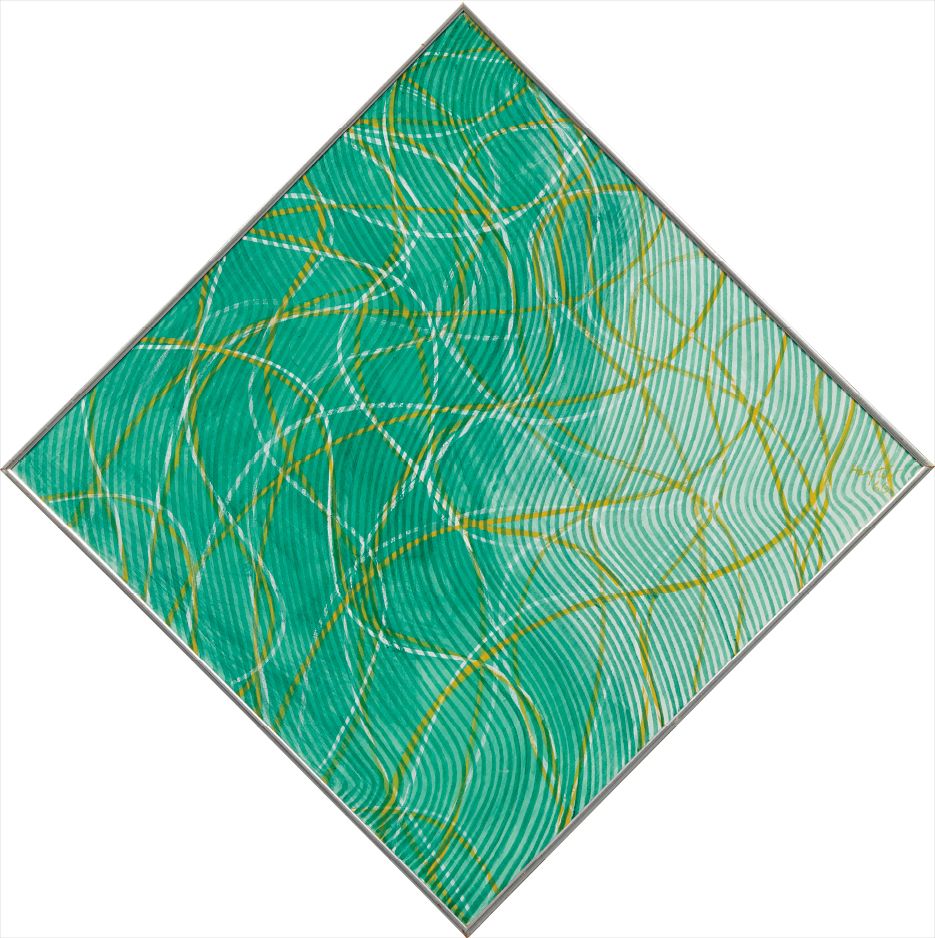
Stanley William Hayter
Composition, 1966
It was a laboratory, a philosophy, and a community that transformed what the printed image could say and do. Hayter was born in Hackney, London, in 1901, into a family with artistic leanings. His father was a painter, and that early exposure to the making of images left a lasting impression. He studied chemistry at King's College London and worked briefly for the Anglo Persian Oil Company in Iran, an experience that took him far from the conventional path of the art student but gave him a rigorous, almost scientific disposition toward material and process.
When he arrived in Paris in 1926, he brought that analytical temperament with him, enrolling under the master engraver Joseph Hecht and immersing himself in the ancient discipline of intaglio printmaking with the intensity of a researcher who has found his true subject. Paris in the late 1920s and into the 1930s was, of course, one of the most fertile moments in the history of Western art, and Hayter moved through its currents with remarkable ease. He founded Atelier 17 in 1927, initially at his own studio on the Rue Campagne Première, and the workshop quickly became a gathering place for Surrealists, abstractionists, and experimental spirits of every kind. Joan Miró, Pablo Picasso, Alberto Giacometti, and Alexander Calder all worked at the atelier, drawn by Hayter's insistence that printmaking was not a reproductive medium but an exploratory one.
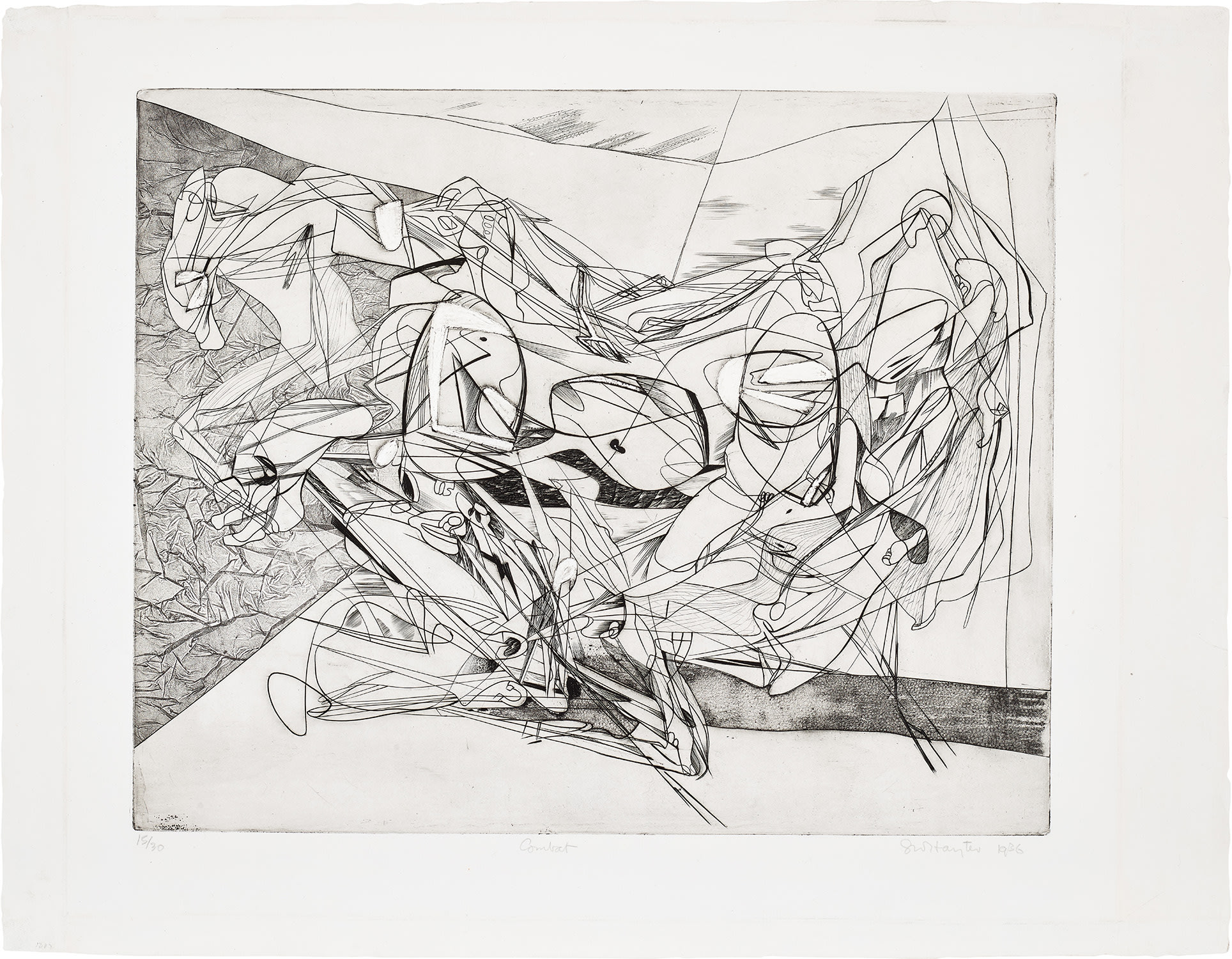
Stanley William Hayter
Combat (B. & M. 102)
He believed the resistance of the metal plate, the unpredictability of acid, and the physical demands of the press were not limitations but generative forces that could unlock imagery the hand alone could never produce. When the Second World War forced the closure of the Paris atelier, Hayter relocated to New York, reopening Atelier 17 there in 1940. This proved to be one of the most consequential moves in twentieth century art history. The abstract expressionists who were then forging what would become the dominant movement of the postwar era came into contact with Hayter's methods, and the encounter was electric.
Jackson Pollock, Mark Rothko, and Louise Bourgeois all spent time working at the New York iteration of the atelier, absorbing Hayter's ideas about automatism, simultaneity of color printing, and the expressive potential of line etched into metal. The cross pollination between Hayter's European Surrealist affiliations and the raw ambitions of the New York School produced ripples that can still be felt today. Hayter's own work as an artist is inseparable from his innovations as a technician and teacher. He developed new approaches to simultaneous color printing from a single plate, a breakthrough that allowed him to achieve effects of extraordinary vibrancy and spatial complexity within the intaglio process.
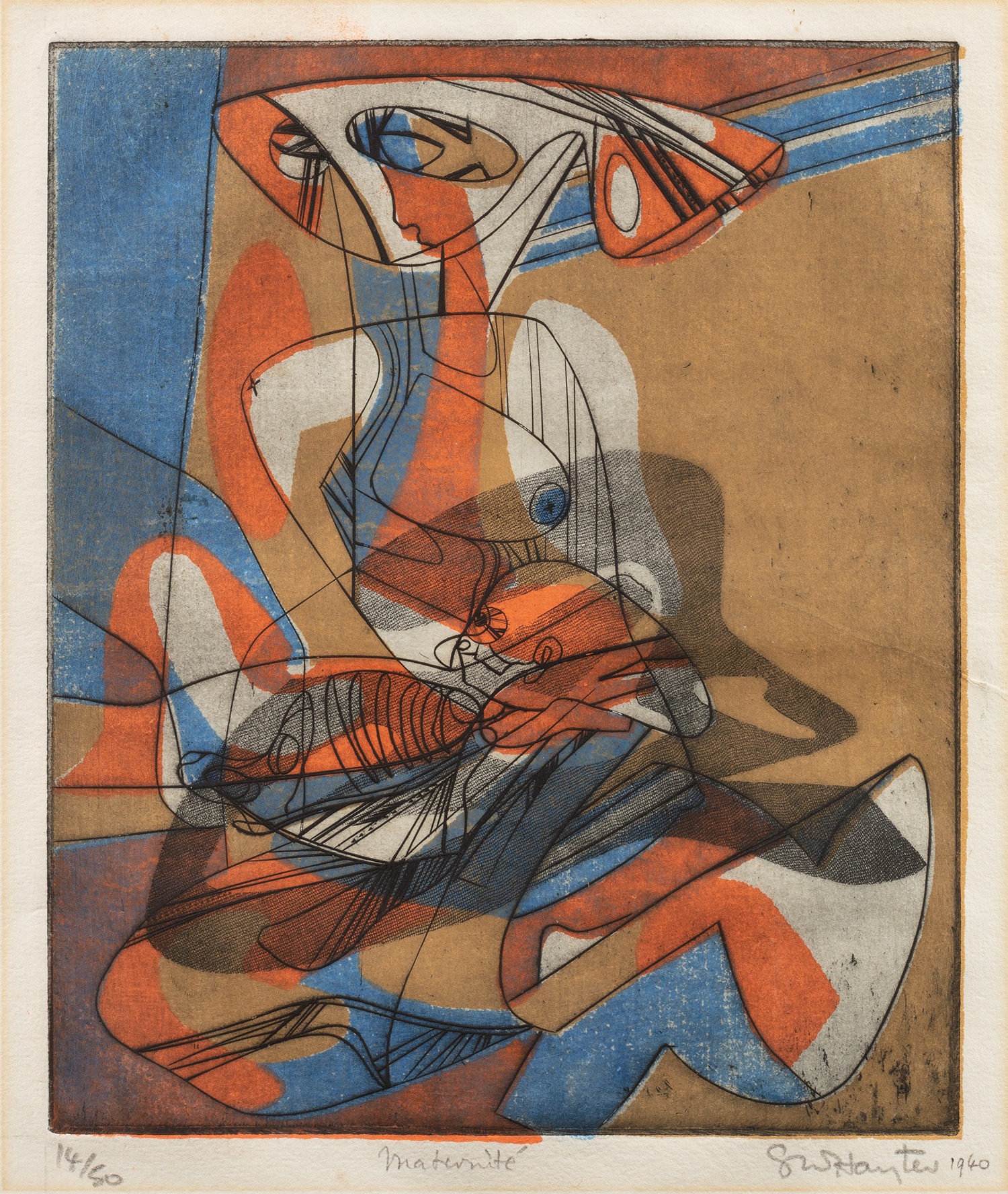
Stanley William Hayter
Maternité (Maternity) (B. & M. 132)
Works like "Combat," catalogued by Binoche and Morel as number 102, exemplify his mature vision: lines that carry the energy of automatic drawing, forms that suggest biomorphic struggle and tension, the whole image held together by a compositional intelligence that is both instinctive and deeply considered. Printed on Kochi paper, the work breathes with a particular warmth, the surface becoming an active participant in the final image rather than a passive support. "Maternité," catalogued as number 132, demonstrates his mastery of combining etching and screenprint in a single work, achieving chromatic richness that expanded what printmaking could aspire to as a fine art medium. His oil paintings, represented by works such as "Composition" from 1966, reveal the full scope of his visual intelligence beyond the print studio.
In these canvases, the linear energy of his graphic work finds expression in sweeping, fluid gestures that owe something to both Surrealist automatism and the gestural abstraction that defined serious painting in the mid twentieth century. Color in these works is not decorative but structural, organizing the picture plane with the same rigorous intuition that governed his printed compositions. They remind us that Hayter was never simply a printmaker who also painted. He was a complete artistic thinker whose ideas found different forms depending on the demands of the moment.
For collectors, Hayter's work offers a rare combination of historical importance and genuine aesthetic pleasure. His prints occupy a position that is both academically significant and visually alive, which is not always the case with artists whose reputations rest primarily on their influence. The Binoche and Morel catalogue raisonné provides a reliable framework for identifying and verifying works, and collectors would do well to pay close attention to paper quality, margin condition, and printing state, as Hayter was meticulous about these variables and they meaningfully affect the presence of the final work. His output ranges from relatively accessible works on the secondary market to rarer examples that command serious attention at auction, particularly those that document his most innovative technical experiments of the 1940s and 1950s.
To understand Hayter fully, it helps to see him in relation to the artists with whom he was in dialogue across his long career. Miró's biomorphic vocabulary, Picasso's restless formal invention, and the Americans who passed through the New York atelier all left traces in his work, just as his ideas left traces in theirs. He occupies a position analogous in some ways to that of Hans Hofmann, another artist whose greatness as a teacher has sometimes overshadowed his stature as a maker of objects. But as with Hofmann, sustained looking at the work itself makes a compelling case for an artist whose contributions were not incidental to the century's story but central to it.
Hayter returned to Paris in 1950 and reopened Atelier 17 there, continuing to work and teach until late in his life. He died in Paris in 1988, having spent more than six decades reshaping the possibilities of the printed image. His legacy is alive in every serious print studio in the world, in the curricula of art schools that teach intaglio, and in the collections of those fortunate enough to own his work. To hold a Hayter print, to follow the line as it cuts and curves across the plate's memory, is to participate in one of the great adventures of twentieth century art.
Explore books about Stanley William Hayter
Stanley William Hayter and Atelier 17
Donna Stein
Hayter and his Printmakers
William S. Lieberman
Stanley William Hayter: A Catalogue Raisonné
Peter Black
About Prints
Stanley William Hayter
New Ways of Gravure
Stanley William Hayter