Srihadi Sudarsono
Srihadi Sudarsono: Light, Spirit, and Java
Artist Spotlight · The Collection Editorial
There are painters whose work you encounter once and carry with you forever, a luminous residue that resurfaces unexpectedly, the way a gamelan melody might drift across a crowded room. Srihadi Sudarsono is one of those painters. Across Indonesian auction houses and international gallery spaces alike, his canvases have in recent years commanded renewed and serious attention, with major works appearing at Christie's and Sotheby's Asia sales and drawing competitive bidding from collectors across Southeast Asia, Hong Kong, and beyond. His reputation, long cherished within Indonesia, has steadily crossed borders, and the art world beyond the archipelago is catching up with what Javanese cultural life has always known: that Srihadi was among the most gifted and spiritually attuned painters of the twentieth century.
Srihadi Sudarsono
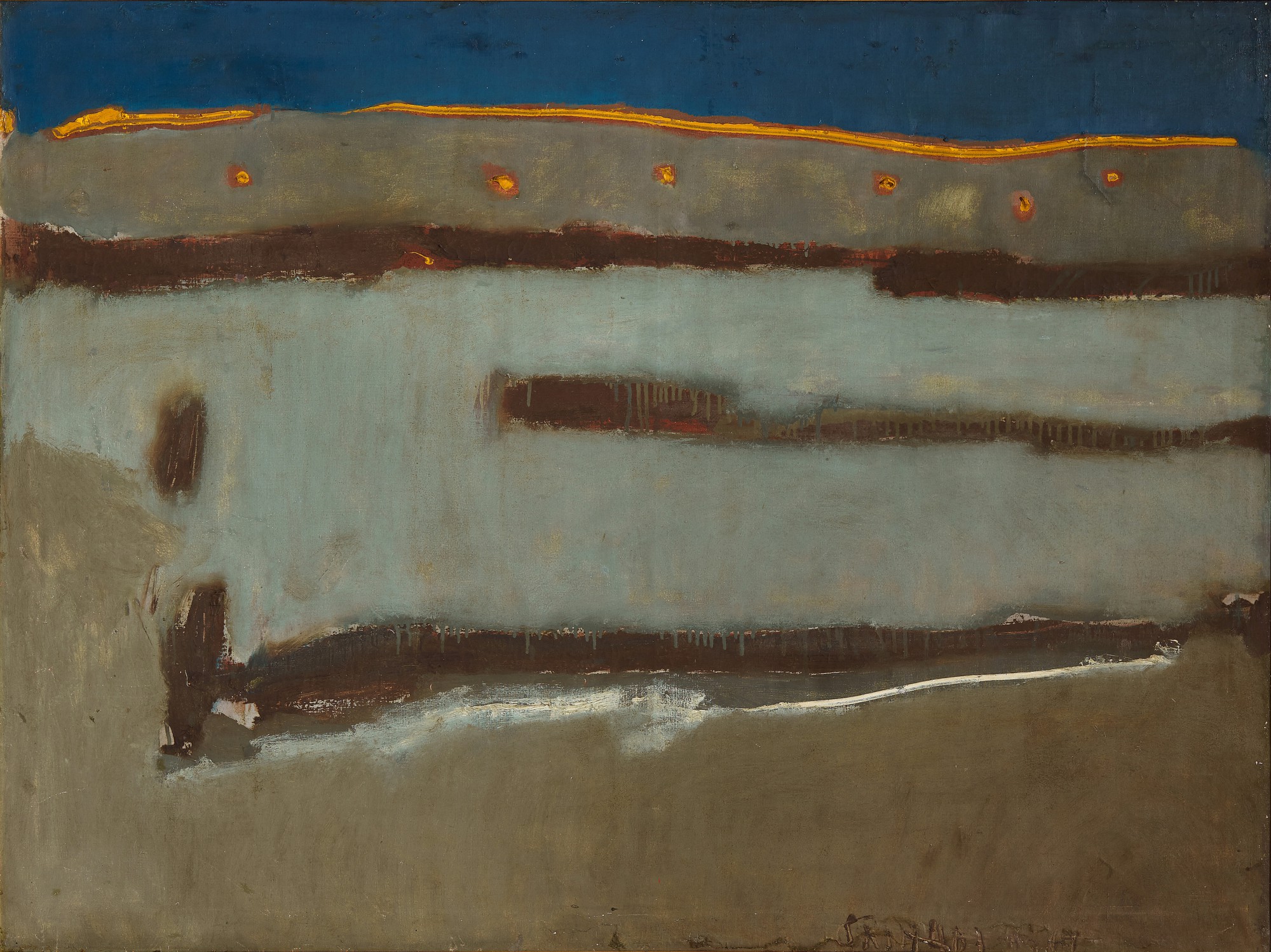
Ricefields 稻田, 1967
Born in Solo, Central Java, in 1931, Srihadi Sudarsono grew up immersed in the refined artistic traditions of the Javanese court. Solo, known formally as Surakarta, was and remains a center of classical Javanese culture, where the arts of batik, wayang shadow puppetry, and court dance were not merely entertainment but devotional practice. This early absorption in a world where the visual and the spiritual were inseparable would prove foundational. Srihadi pursued formal artistic training at the Bandung Institute of Technology, then the most rigorous and internationally oriented art school in Indonesia, where he studied under the Dutch painter Ries Mulder and absorbed the post Impressionist and modernist currents flowing through that institution in the 1950s.
Bandung in those years was a crucible, producing a generation of artists determined to synthesize a global artistic vocabulary with deeply Indonesian sensibilities. Srihadi later traveled to the United States to continue his studies, an experience that deepened his engagement with Western abstraction and modernism while doing nothing to loosen his roots in Javanese philosophy and aesthetics. He moved with ease between these two worlds, never allowing one to overwhelm the other, and it is precisely this balance that gives his work its distinctive character. Where some artists of his generation lurched toward pure Western abstraction or retreated into a conservative regionalism, Srihadi found a third path: a luminous semi abstraction in which recognizable forms dissolve at their edges, as if everything in the world were in the gentle process of becoming something else.
Srihadi Sudarsono
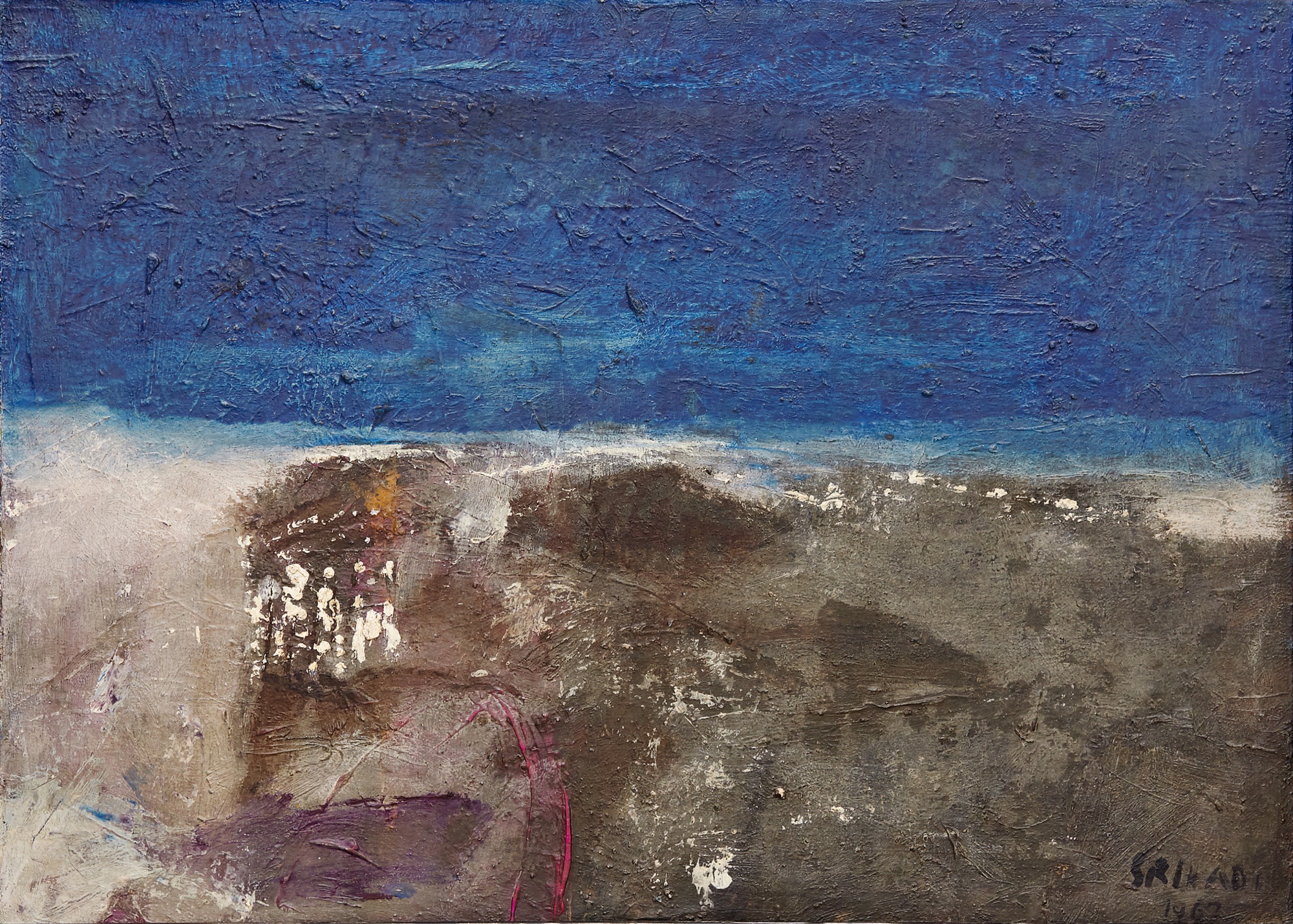
Atenas (Athens) 雅典, 1962
This visual quality is not merely stylistic. It is philosophical. It reflects the Javanese concept of kehalusan, a refined sensibility in which the boundaries between the earthly and the divine are porous and permeable. His artistic practice moved through several rich periods.
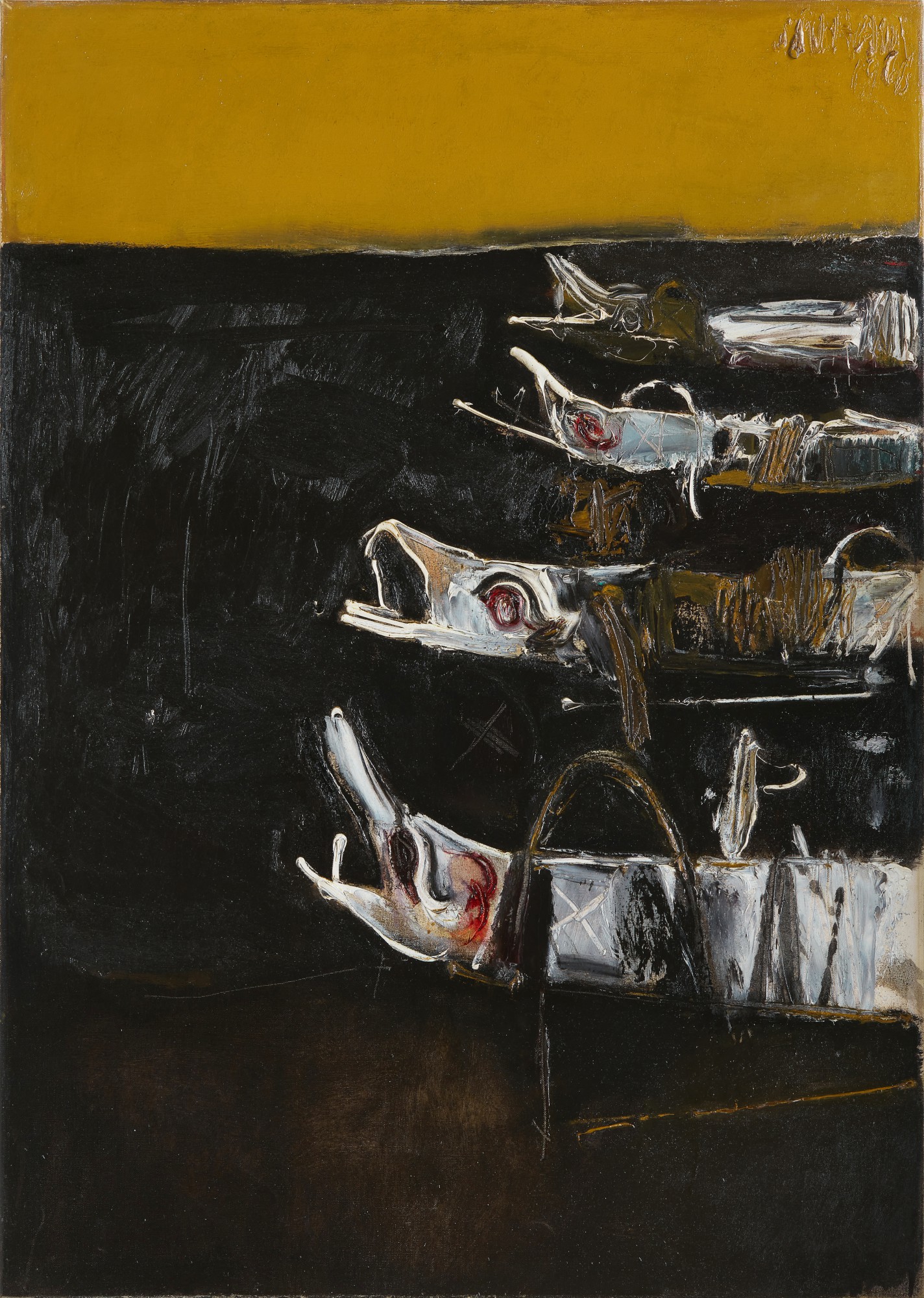
Early works from the 1960s, such as the 1962 oil on board titled Atenas (Athens) and the 1966 canvas Boats on Sanur Beach, Bali, reveal a painter already at ease with color as emotional structure. These are not purely representational works, nor are they fully abstract. They sit in a luminous middle ground where light seems to emanate from within the paint surface itself, suffusing the scene with a quality of stillness that is almost meditative. The 1967 Ricefields, one of the most arresting of his works in terms of its formal elegance, demonstrates how Srihadi could take a subject as fundamental to Indonesian life as the terraced paddy field and transform it into a study of pure visual rhythm, green planes dissolving into light, horizon lines becoming suggestions rather than facts.
Srihadi Sudarsono
Boats on Sanur Beach, Bali 沙努爾海灘上的船隻, 巴厘島, 1966
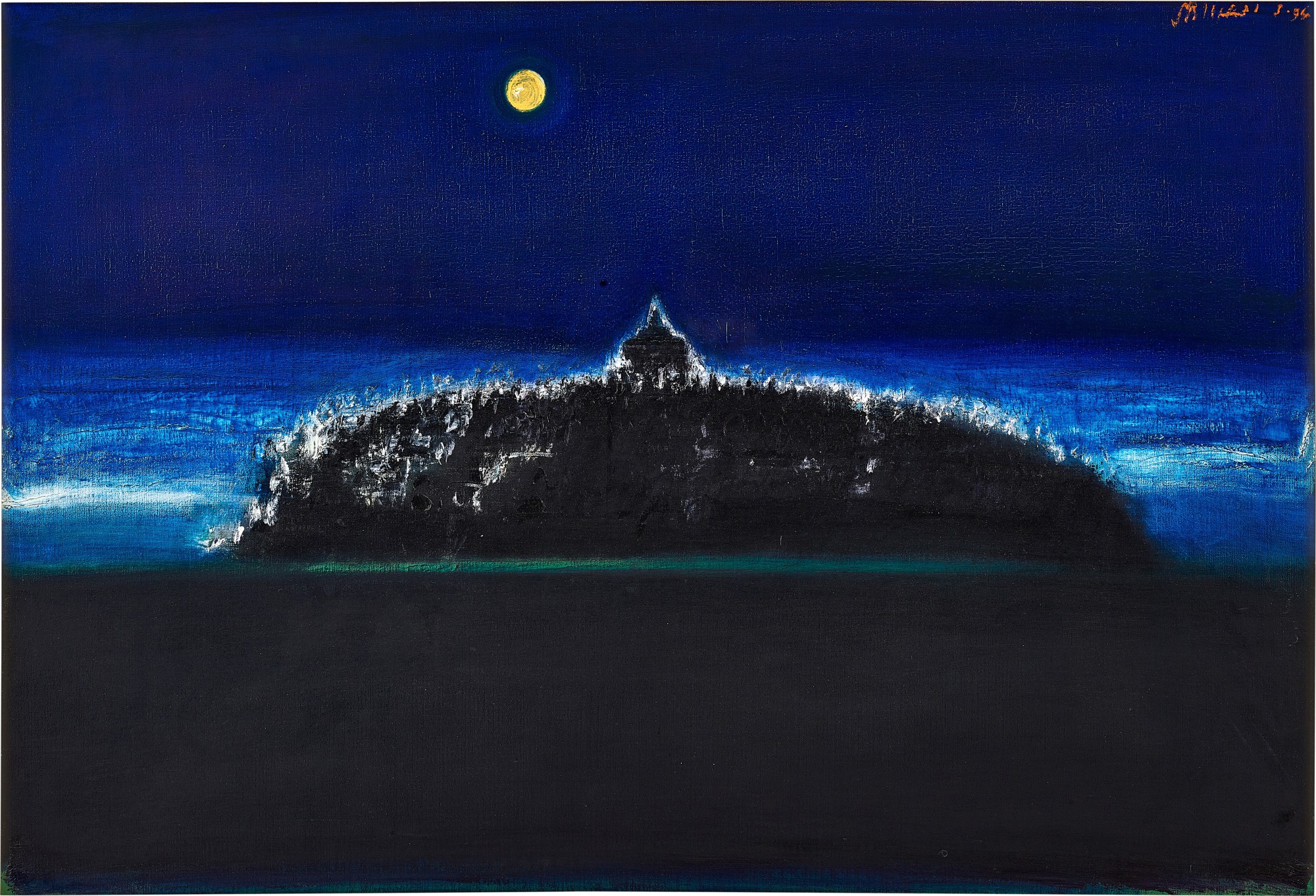
It is landscape painting as spiritual exercise. As his career matured, Srihadi's attention turned increasingly toward the sacred and the ceremonial. The 1994 Borobudur, Alam Meditasi, which translates roughly as Borobudur, the Realm of Meditation, is among the most significant works of his later period. The great Buddhist stupa of Borobudur, that ninth century monument rising from the plains of Central Java, provided Srihadi with a subject perfectly aligned with his artistic vision: an ancient structure dedicated to the dissolution of the self into something larger and more eternal.
His rendering is not documentary but experiential, the monument appearing to breathe within its painted atmosphere. The 1997 canvas Bedoyo Ketawang, depicting the sacred court dance of the Javanese royal tradition, achieves something similar in a figurative register. The dancers are simultaneously present and ethereal, their forms trailing into the canvas ground as if the act of sacred performance were itself a form of disappearing into transcendence. These late works represent the fullest expression of a vision that Srihadi had been developing across four decades.
Srihadi Sudarsono
Borobudur, Alam Meditasi 婆羅浮屠, 冥想境界, 1994
For collectors, Srihadi's work presents a compelling proposition on multiple levels. His paintings span a range of periods, subjects, and scales, offering points of entry for collectors at various stages of engagement with Indonesian modernism. The most sought after works are his large scale oils, particularly those depicting dancers, sacred monuments, and landscapes from the 1960s through the 1990s, where his handling of light and his command of tonal structure are at their most confident. Prints and works on paper, such as the Bercermin IV series, offer a more accessible entry point while demonstrating the same quality of lyrical abstraction.
Auction results for major Srihadi canvases have shown consistent strength at regional sales, and savvy collectors have recognized that his work remains significantly undervalued relative to his historical importance and the quality of his output. For anyone building a serious collection of Southeast Asian modernism, Srihadi is not optional. To understand Srihadi's place in art history is to understand the broader project of Indonesian modernism. He belongs to a generation that also produced figures such as Affandi, whose expressionist urgency offered a very different response to the same cultural moment, and Hendra Gunawan, whose politically charged figurative work engaged with the revolutionary period of Indonesian independence.
Srihadi's response was more inward, more concerned with the interior life of culture than with its external conflicts. In this sense he might be compared to certain contemporaries in other traditions, to painters working at the intersection of spiritual contemplation and modernist form. His closest international analogues might be found among the Japanese Mono ha artists or certain painters of the American Transcendentalist tradition, though his Javanese framework is entirely his own and irreducible. Srihadi Sudarsono passed away in 2006, leaving behind a body of work that grows more resonant with each passing year.
In an era when the art world is actively and rightly expanding its canon beyond Western centers, his paintings offer something that purely market driven rediscoveries rarely provide: genuine depth. His canvases are not interesting because they have been overlooked and are therefore newly fashionable. They are interesting because they are beautiful, because they are wise, and because they carry within them a vision of the world that remains urgently necessary. Light dissolving form, the sacred made visible in the everyday, the physical world as a doorway into something larger: these are not provincial concerns.
They are universal ones, and Srihadi pursued them with a lifetime of devotion and skill.