Sonia Delaunay
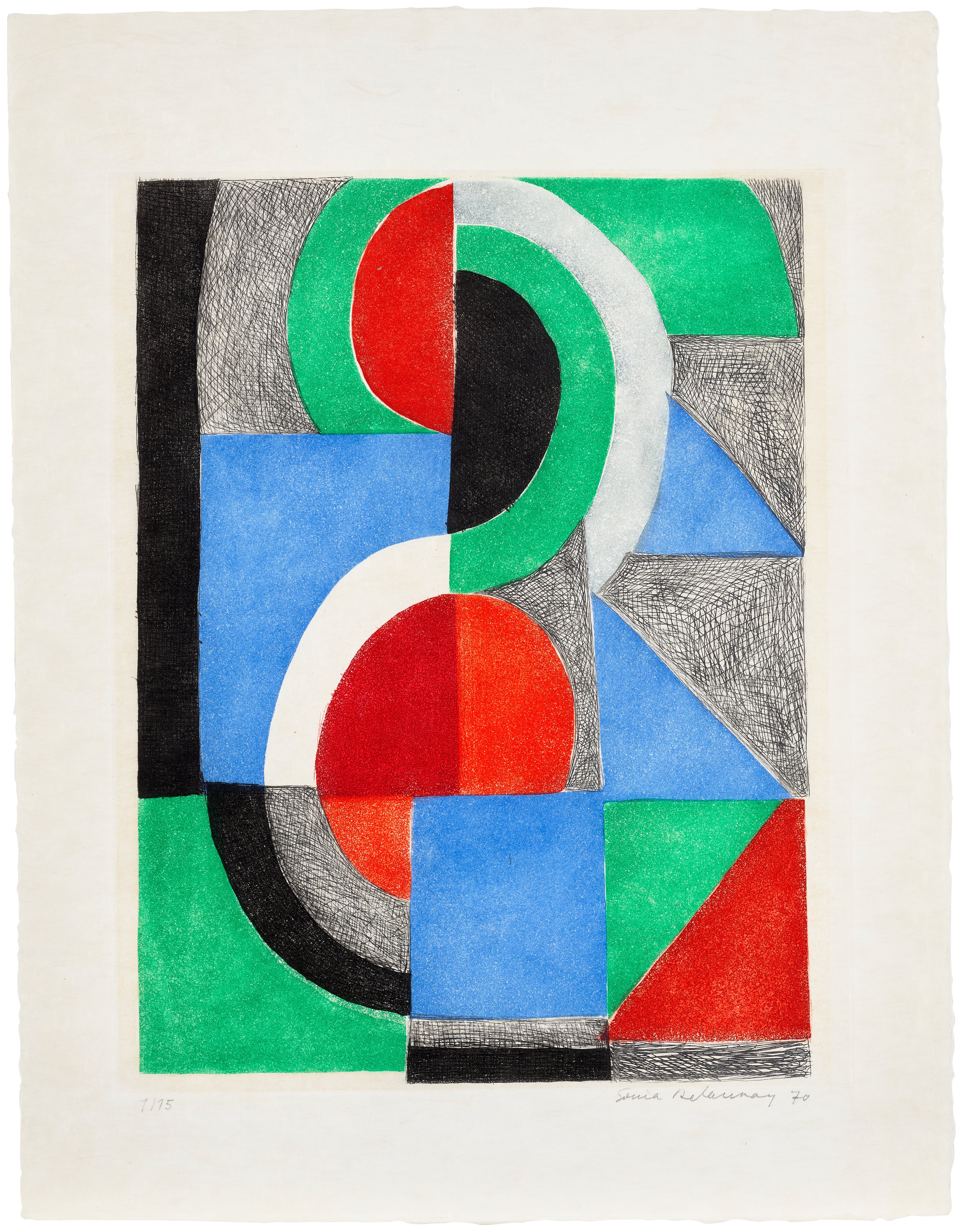
Sonia Delaunay: Color as Pure Living Force
Artist Spotlight · The Collection Editorial
“Color is the skin of the world.”
Sonia Delaunay
In the spring of 2023, the Musée d'Art Moderne de Paris quietly reaffirmed what serious collectors and curators have known for decades: Sonia Delaunay is one of the most consequential artists of the twentieth century, and her work continues to feel shockingly, irresistibly alive. Her compositions in gouache and lithograph pull viewers across rooms. Her rhythms do not ask for attention so much as simply command it. To stand before one of her great color studies is to understand, in your body before your mind, what she meant when she spoke of painting as a physical and almost musical experience.
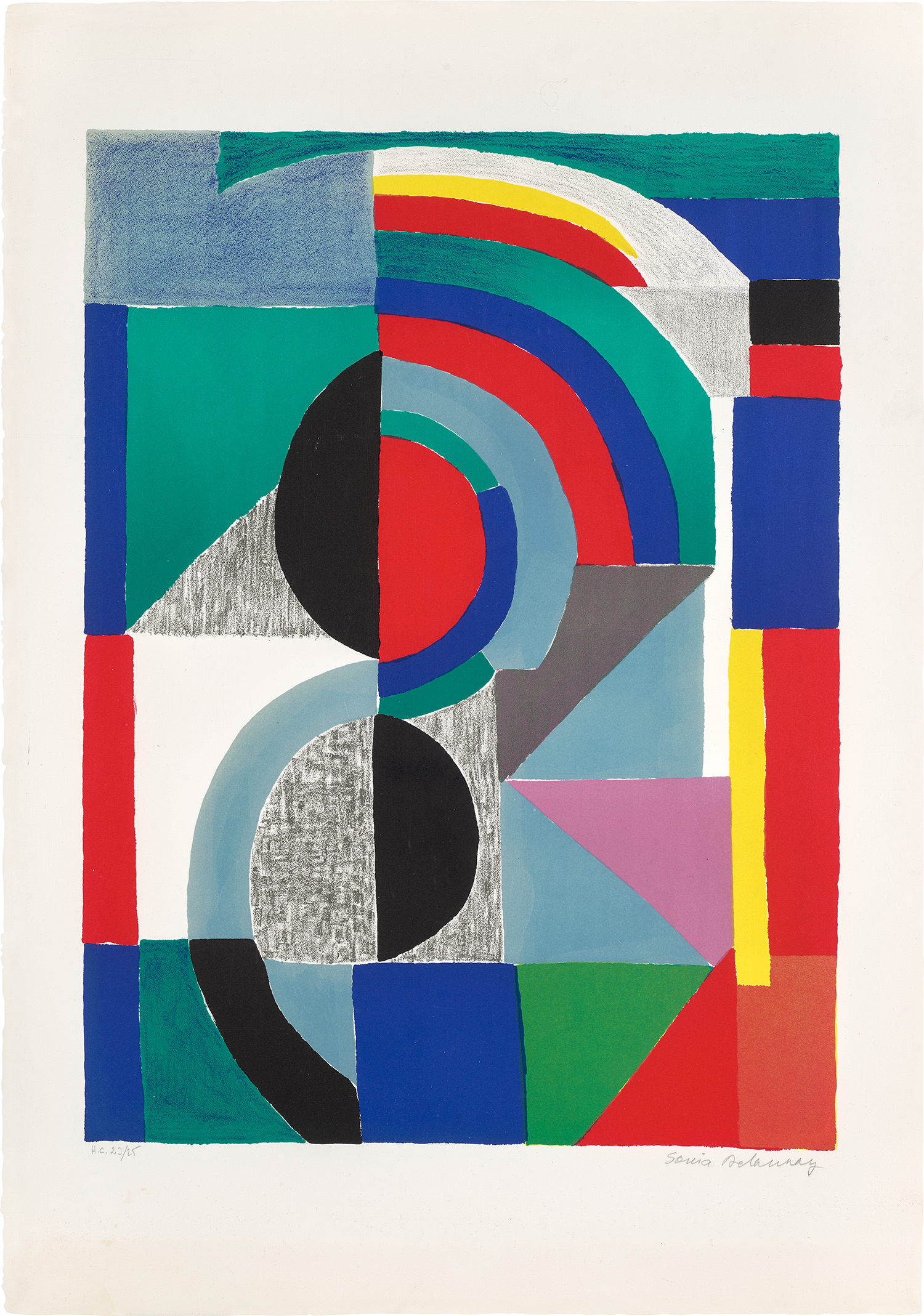
Sonia Delaunay
Icône (Icon)
Sonia Delaunay was born Sarah Stern in 1885 in Hradyzk, in what was then the Russian Empire, in present day Ukraine. Raised partly by a wealthy maternal uncle in Saint Petersburg, she received an education that introduced her early to European culture, music, and the decorative arts. At eighteen she moved to Germany to study drawing in Karlsruhe, and then in 1905 she arrived in Paris, the city that would define her life and where she would spend most of the following seven decades. Paris in those years was the most creatively charged place in the world, and the young Sonia absorbed its energies with extraordinary hunger and intelligence.
Her formal development accelerated quickly. She enrolled at the Académie de la Palette in Paris and immersed herself in the work of Paul Gauguin and Vincent van Gogh, whose expressive use of color made a permanent impression on her thinking. By 1910 she had married the French painter Robert Delaunay, a partnership that was among the great artistic collaborations of the modern era. Together they would develop Orphism, a movement rooted in the idea that pure color relationships, rather than representational form, could generate their own visual and emotional structure.
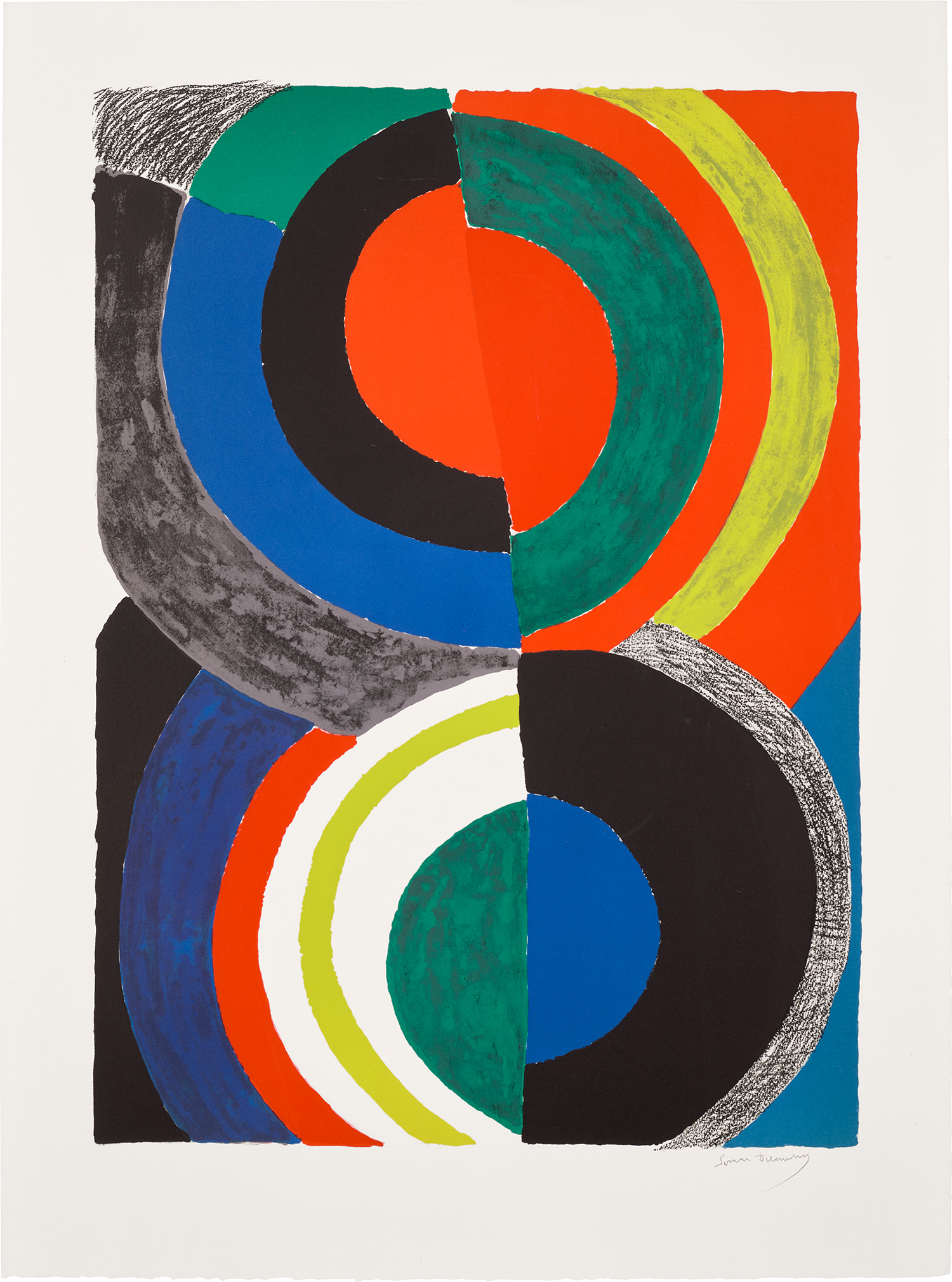
Sonia Delaunay
Idole (Idol)
The critic Guillaume Apollinaire gave the movement its name, but it was Sonia and Robert together who gave it its visual grammar. What distinguished Sonia from the very beginning was her refusal to confine her ideas to the canvas. She applied her color theory to textiles, fashion, bookbindings, stage sets, and interior design with the same seriousness and invention she brought to painting and printmaking. In 1911 she created a patchwork quilt for her infant son Charles from scraps of fabric, an object now recognized as a foundational work of twentieth century abstraction.
“I played with colors as one might express oneself in music, by the fugue of colors.”
Sonia Delaunay
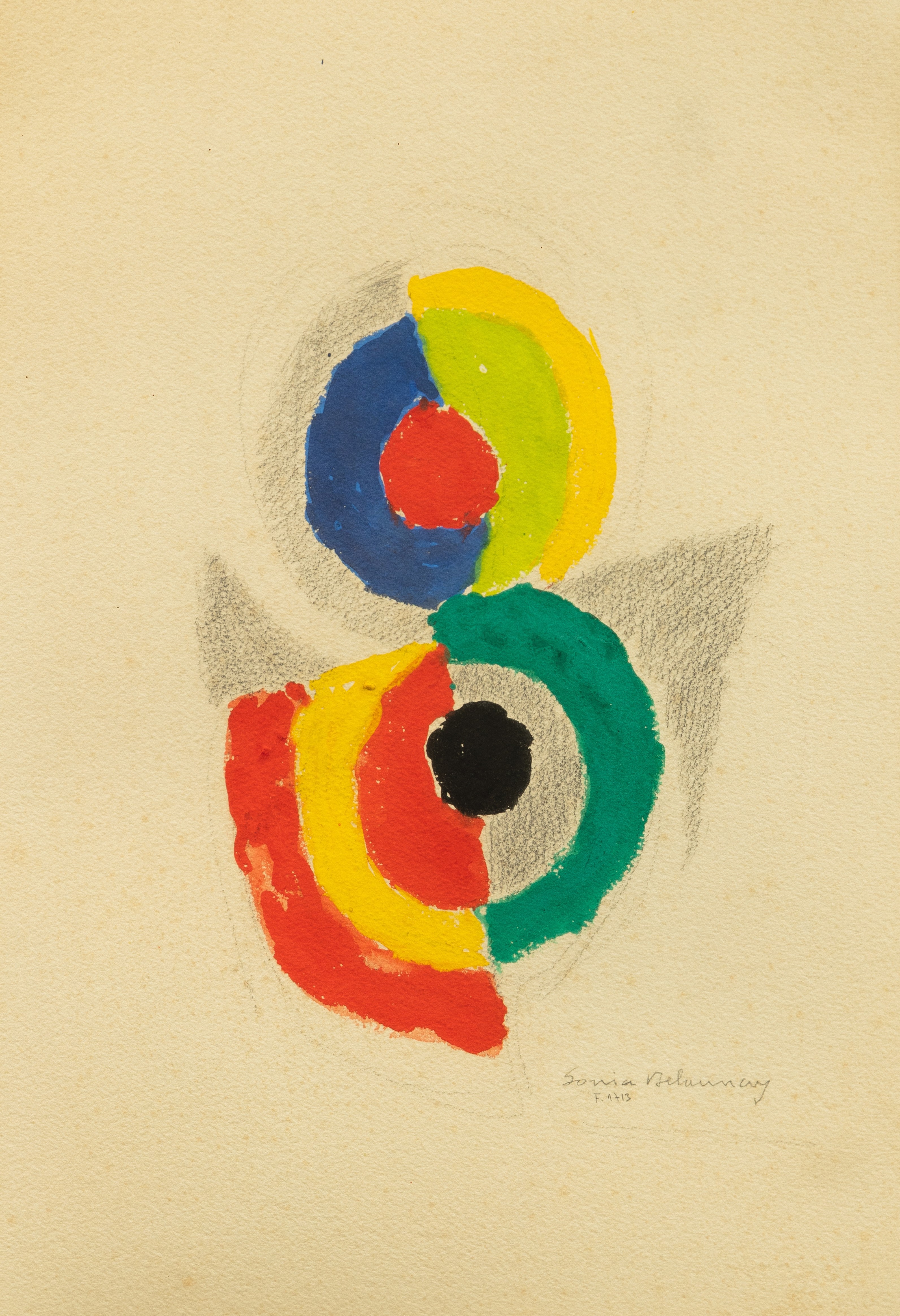
In the 1920s she became one of the most influential figures in Parisian fashion, designing textile collections that brought her simultaneous geometries into the lived world. She understood, long before most of her contemporaries, that the boundaries between fine art and applied art were artificial constructions, and she simply ignored them. The works available through The Collection offer a rich and varied window into her printmaking practice, which occupied her throughout the latter decades of her career with particular intensity. Works such as Rythme coloré (Variante I) from 1952, rendered in gouache on paper mounted on canvas, demonstrate the fully matured language of what she called simultaneous contrast: fields of color placed in deliberate adjacency so that they vibrate against one another and create the sensation of movement without any representational reference whatsoever.
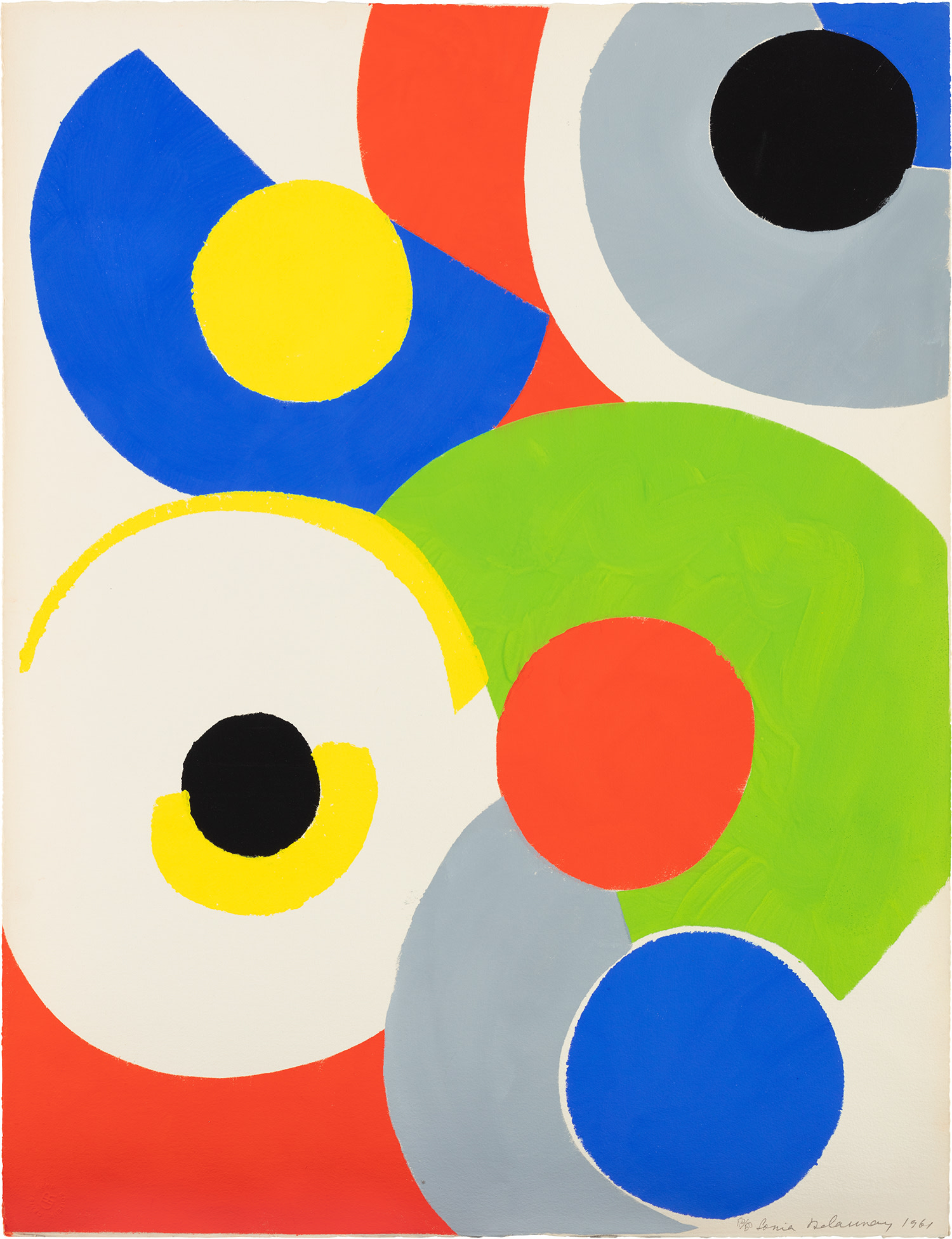
Sonia Delaunay
Poésie de mots, poésie de couleurs (The Poetry of Words, The Poetry of Colors): one plate
Her lithographs on Arches paper, including Icône, Idole, Lille, Automne, Plougastel, and Venise, reveal her mastery of color printing as a medium for generating optical warmth and spatial depth. The pochoir plate from Poésie de mots, poésie de couleurs, on Johannot paper, connects her visual practice explicitly to her long engagement with poetry and literary culture, including her celebrated collaborations with the poet Blaise Cendrars. From a collecting perspective, Delaunay's works on paper and prints represent one of the most compelling opportunities in twentieth century modernism. Her gouaches in particular have attracted sustained institutional and private interest, and auction records over the past decade confirm steady appreciation across her output.
Works on Arches paper in strong color with full margins command particular attention, as condition and paper quality are critical to the vitality of her color effects. Collectors who are drawn to the Orphist and Constructivist traditions, or who admire the work of figures such as Robert Delaunay, František Kupka, and Fernand Léger, consistently find in Sonia's work a combination of conceptual rigor and sensory pleasure that is genuinely rare. Her prints are also unusually accessible entry points: produced with the same seriousness as her paintings and carrying the full weight of her visual intelligence. Within the broader narrative of modern art, Delaunay occupies a position that has been gradually and rightly expanding for half a century.
Sonia Delaunay
Rythme couleur, étude
For too long she was discussed primarily in relation to her husband, a critical habit that serious scholarship has worked hard to correct. The 1975 retrospective at the Bibliothèque Nationale in Paris, organized to honor her at the age of ninety, was a landmark moment of recognition. The Musée National d'Art Moderne in Paris holds a significant body of her work, as does the Fundación Juan March in Madrid, which organized a major survey of her legacy in more recent years. Artists as varied as Bridget Riley, who shared her fascination with optical color dynamics, and the broader tradition of pattern and decoration in late twentieth century art owe a visible debt to the vocabulary she developed.
Sonia Delaunay lived and worked until 1979, dying in Paris at the age of ninety four. She outlived Robert by more than four decades, and in those years she became the primary custodian and advocate of the visual ideas they had developed together, while continuing to produce original work of real ambition. Her longevity was not merely biographical: it meant that she was able to see her ideas absorbed into the culture, into fashion, design, and art education, and to know that the world had caught up with where she had always been. Today, collecting her work is an act of alignment with one of modernism's most generous and visionary minds, an artist who believed that color was not a decorative element but a living force capable of transforming human experience.
Explore books about Sonia Delaunay
Sonia Delaunay: A Retrospective
Arthur A. Cohen
Sonia Delaunay
Michel Hoog
Delaunay
Francoise Monnin
The New Art of Color: The Writings of Robert and Sonia Delaunay
Robert Delaunay, Sonia Delaunay
Sonia Delaunay: Art into Life
Guillaume Apollinaire, Others

Sonia Delaunay
Sjöberg, Ulf

Sonia Delaunay: The Birth of Modern Design
Cahan, Susan