Simeon Solomon
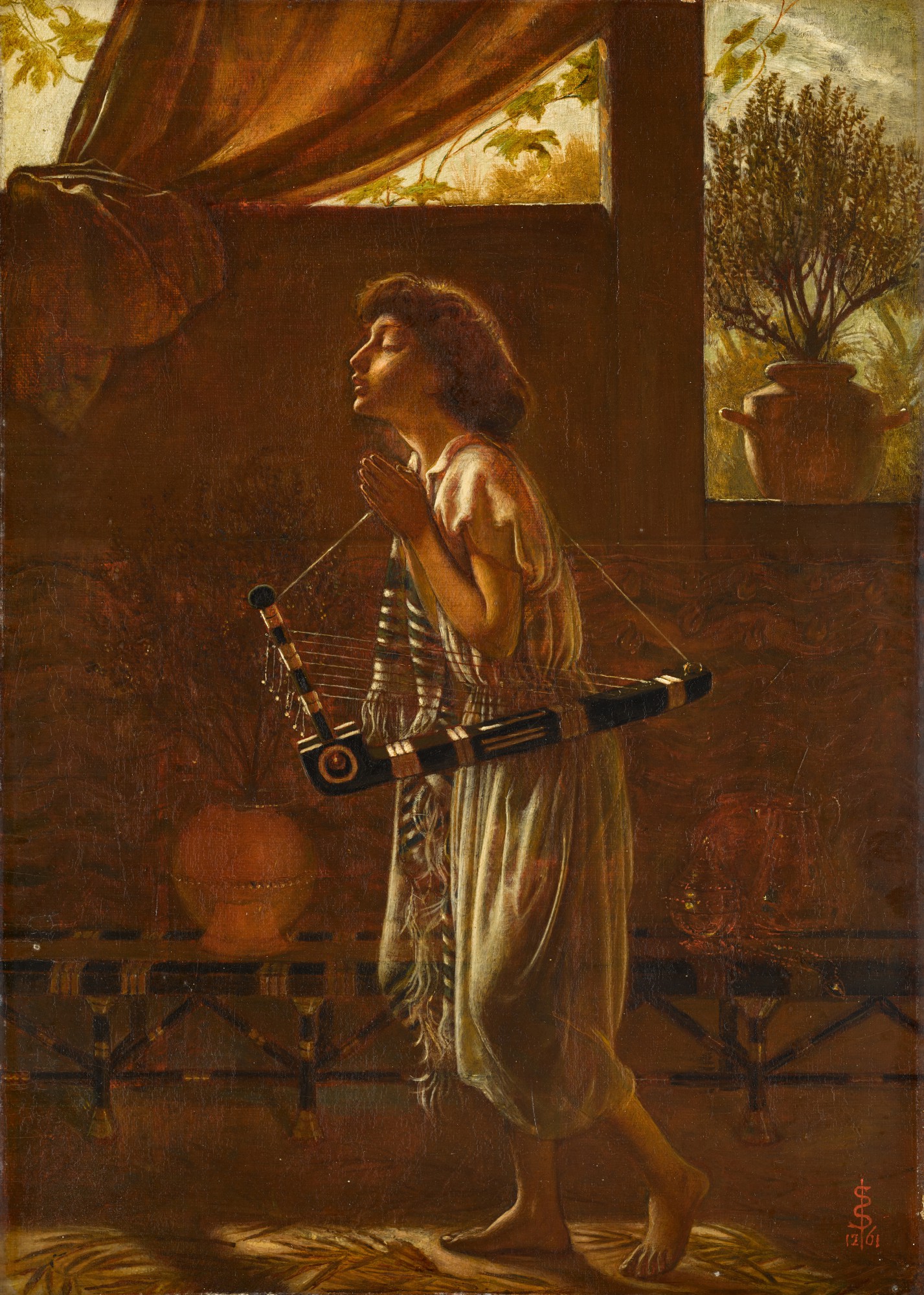
Simeon Solomon, Visionary of Sacred Beauty
Artist Spotlight · The Collection Editorial
Picture London in 1858: a prodigiously gifted eighteen year old walks into the Royal Academy Summer Exhibition and sees his own painting hanging on the wall among the established names of Victorian art. That young man was Simeon Solomon, and the confidence, technical mastery, and emotional depth he displayed at that extraordinary age would go on to define a body of work that now feels not merely ahead of its time but permanently, urgently modern. More than a century after his death in 1905, Solomon is experiencing a long overdue reconsideration, with scholars, curators, and collectors recognising in his luminous figures and layered symbolism a painter who quietly expanded what Victorian art could say and feel and mean. Solomon was born in 1840 into a prominent Jewish family in London, the youngest of eight children in a household where art was already a way of life.
Simeon Solomon
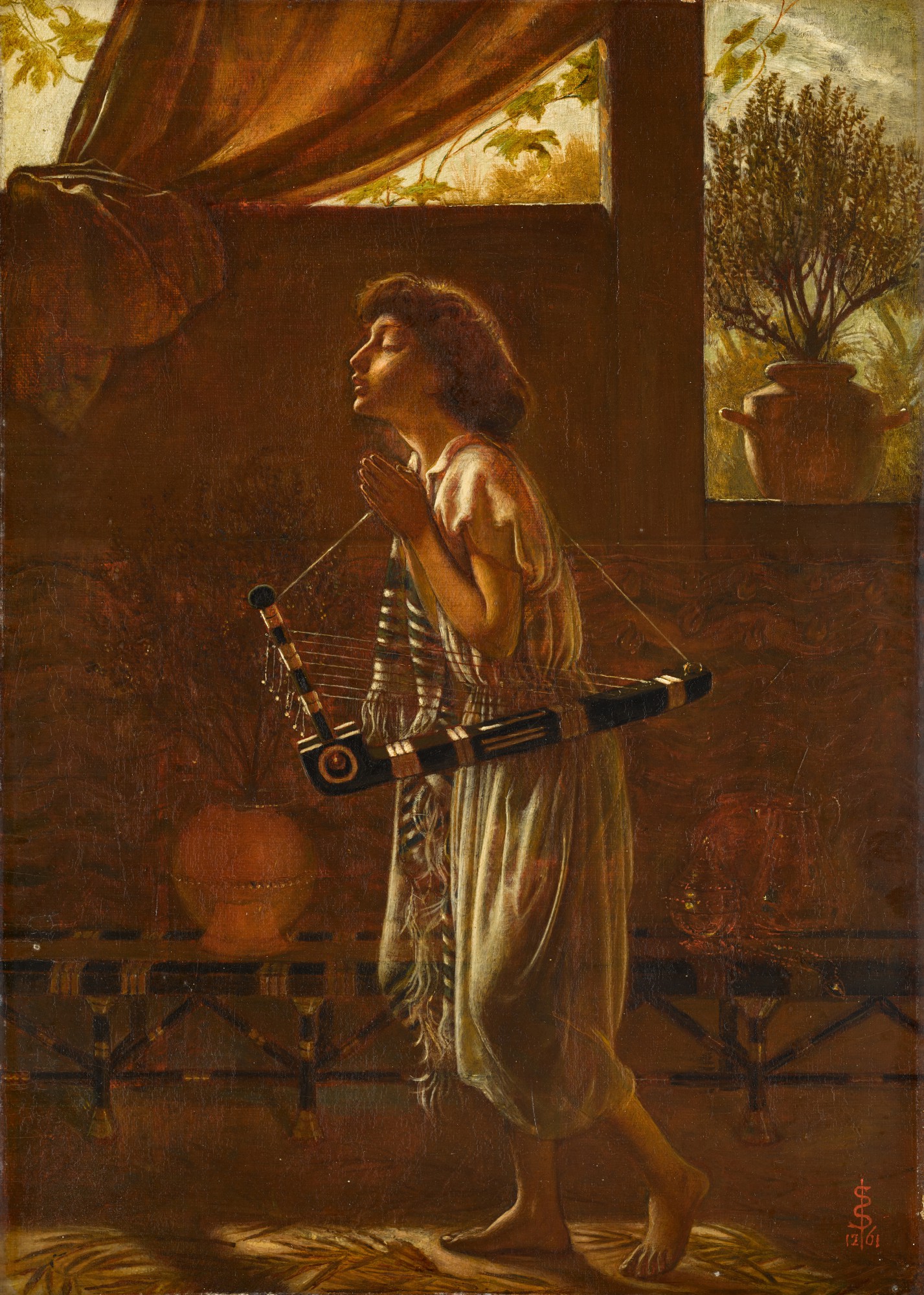
The Child Jeremiah
His older siblings Abraham and Rebecca were both practising artists, and the family's Jewish identity would prove not incidental but foundational to his entire creative vision. Growing up in the East End and later moving within London's interconnected artistic and intellectual communities, Solomon absorbed the traditions of his faith alongside the aesthetic currents sweeping through mid Victorian England. He enrolled at the Royal Academy Schools and quickly distinguished himself as a student of rare gifts, drawing on biblical narrative with an intimacy and sensory richness that set him apart from the more decorous treatments common among his contemporaries. His early association with the Pre Raphaelite circle proved transformative.
Solomon became close to Dante Gabriel Rossetti, Edward Burne Jones, and Algernon Charles Swinburne, friendships that deepened his commitment to aesthetic beauty, symbolic complexity, and the pursuit of an almost spiritual intensity in paint. The Pre Raphaelites had already declared war on academic convention, and Solomon found in their company both creative permission and genuine affection. His work from the 1860s, much of it depicting scenes from Jewish religious life alongside classical and allegorical subjects, brought a warmth and specificity to the movement that was entirely his own. These paintings were not simply illustrations of received stories but meditations on devotion, longing, and the interior life of the human soul.
Simeon Solomon
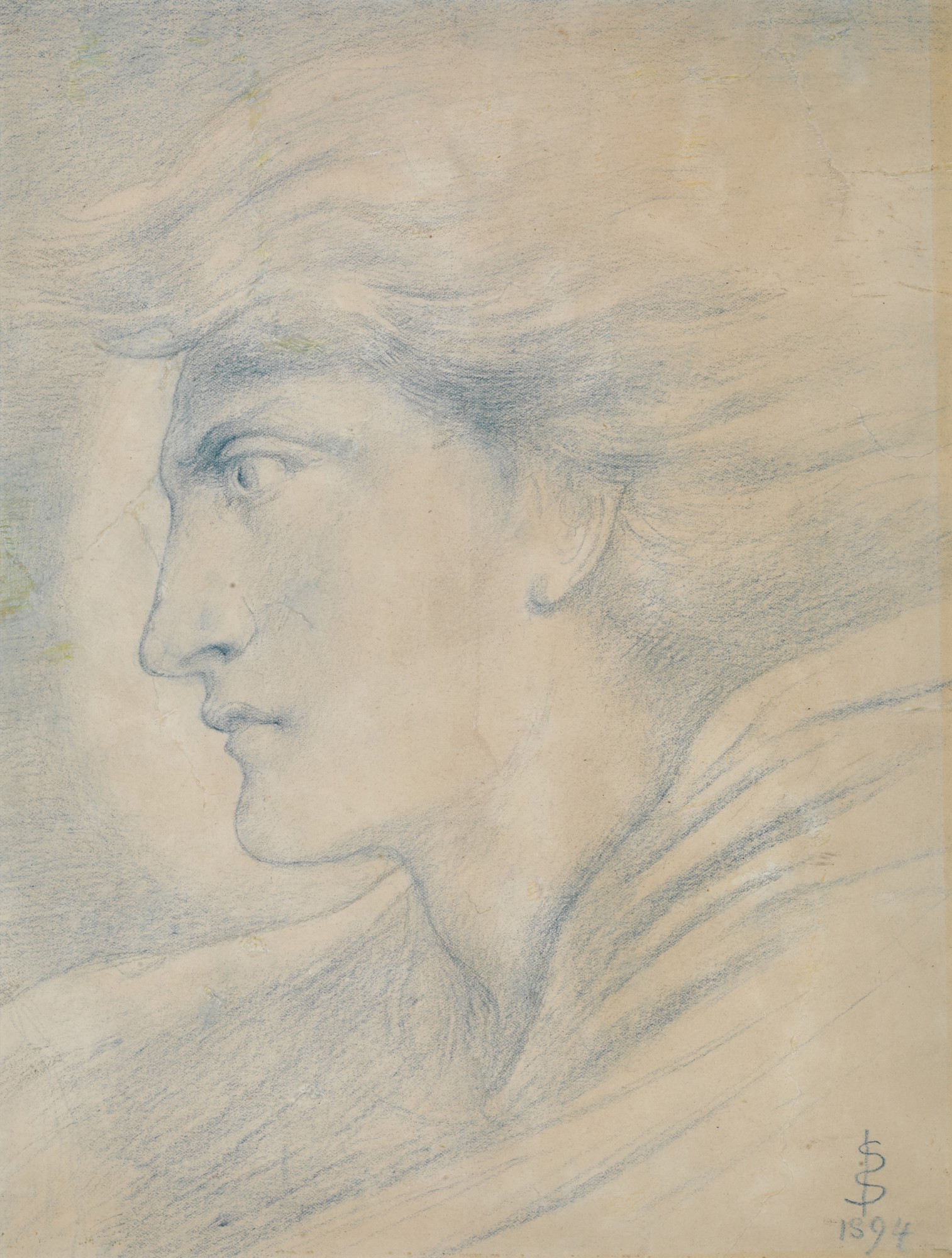
Allegory
What makes Solomon's mature work so compelling is its capacity to hold multiple emotional registers simultaneously. His figures, often androgynous, draped in soft robes, heavy with contemplation, seem to exist at the threshold between the sacred and the sensuous. Works from the late 1860s and early 1870s reveal an artist pushing steadily toward a visual language of pure feeling, influenced by his reading of Walter Pater and his conversations with Swinburne about the relationship between art, beauty, and desire. Among the works now held on The Collection, The Child Jeremiah demonstrates this quality with particular force: rendered in oil on canvas, the image carries the weight of prophetic calling alongside a tender psychological observation that no academic painter of the period could easily match.
The blue crayon work titled Allegory, meanwhile, shows Solomon at his most freely expressive, the medium itself contributing a softness and intimacy that feels almost confessional. Solomon's crayon and chalk drawings deserve special attention from collectors seeking to understand the full range of his achievement. Following the upheaval of his personal life in the 1870s, when his arrest on charges related to homosexual conduct effectively ended his place in mainstream Victorian society, Solomon continued to work prolifically in drawing, producing hundreds of small scale allegorical heads that circulated among a small but devoted group of admirers. These works, often depicting figures with titles drawn from classical mythology or spiritual abstraction, have a haunting repetitive quality that scholars now read as both a coping mechanism and a sustained artistic statement.
They are intimate objects, made for private contemplation, and they carry a biographical resonance that adds layers of meaning to their already charged imagery. For collectors, Solomon occupies a genuinely distinctive position in the market for Victorian and Pre Raphaelite art. His work appears at auction with enough regularity to establish a track record but with sufficient rarity to reward those who pursue it with patience and knowledge. Drawings and works on paper by Solomon have attracted serious attention at the major London salerooms, and institutional interest has grown notably since the late twentieth century reassessment of his life and work.
The Tate holds examples, as does the Birmingham Museum and Art Gallery, which has one of the stronger concentrations of Pre Raphaelite holdings in the country. Private collectors are drawn to Solomon for reasons that go beyond market calculation: there is a quality of emotional honesty in his best work that resonates across the distance of a hundred and fifty years, speaking to questions of identity, spirituality, and the courage it takes to be fully oneself. To place Solomon within art history is to understand how much the canonical story of Victorian painting has benefited from revision. He belongs in conversation not only with Rossetti and Burne Jones but with Gustave Moreau in France, whose similarly symbolic and sensuous treatment of mythological subjects was unfolding at almost exactly the same moment.
Solomon's Jewish subjects also anticipate later explorations of religious and cultural identity in art, giving him a relevance to conversations that extend well beyond the Pre Raphaelite framework through which he is most commonly discussed. Scholars including Gayle Seymour and others who have written on nineteenth century constructions of gender and sexuality have returned repeatedly to Solomon as a central figure, a painter whose imagery anticipated the aestheticist and Symbolist movements that would dominate the following decade. The legacy of Simeon Solomon is ultimately a story about resilience and the persistence of beauty. His career was interrupted by forces that would have silenced many artists entirely, and yet he kept working, kept imagining, kept producing images of extraordinary delicacy and power until the very end of his life.
Today, as institutions and collectors look with fresh eyes at the full complexity of Victorian culture, Solomon emerges not as a footnote or a curiosity but as a central figure whose work rewards sustained attention. To collect Solomon is to participate in a reclamation, to recognise in his shimmering, searching figures something that Victorian society could not fully accommodate but that we, at last, are in a position to honour.
Explore books about Simeon Solomon
Simeon Solomon: A Life
Melissa Hardie
Simeon Solomon and the Aesthetic Movement
Christopher Newall
The Drawings of Simeon Solomon
Leonée Ormond
Simeon Solomon: Painter of Dreams
Simon Reynolds
Victorian Artists and Their Communities
Deborah Cherry