Shen Yinmo
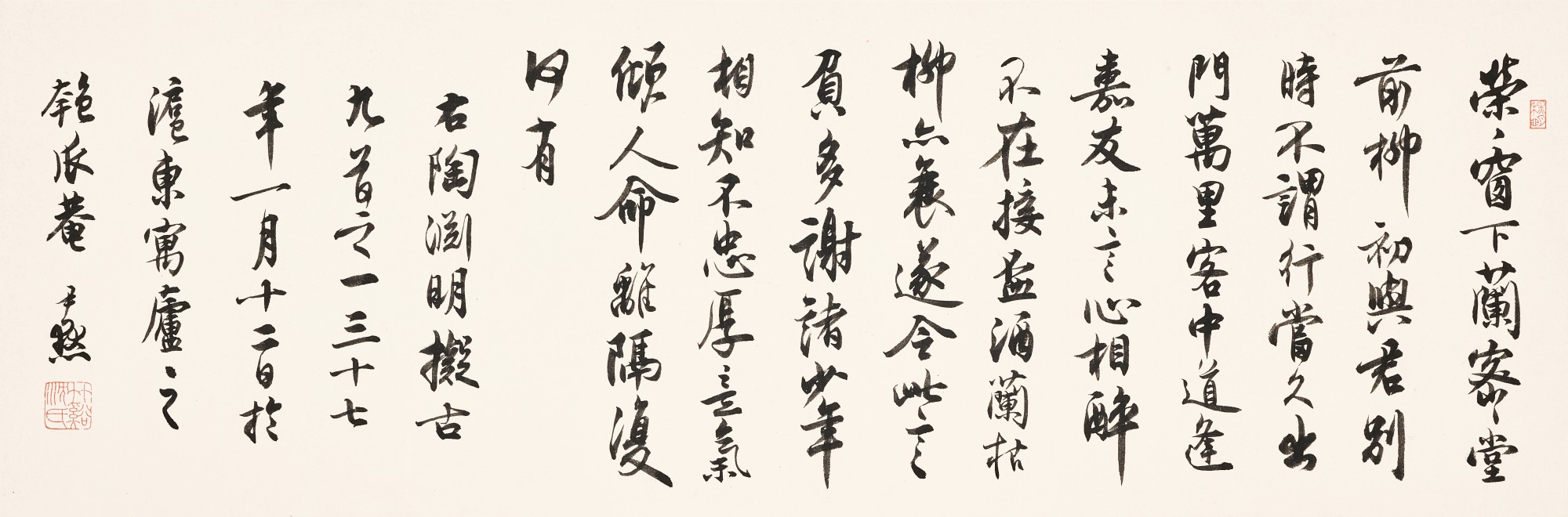
The Master Who Wrote With Light
Artist Spotlight · The Collection Editorial
There are moments in the history of Chinese art when a single hand changes the way an entire civilization reads beauty. In the grand galleries of the Shanghai Museum, visitors still pause before examples of early twentieth century Chinese calligraphy with a reverence that speaks to something timeless. Shen Yinmo, born in 1883 in Zhejiang Province, stands at the very heart of that tradition, a figure whose contribution to modern Chinese visual culture was so profound that to trace the lineage of contemporary Chinese calligraphy is inevitably to trace a path back to him. His story is one of intellectual courage, exquisite refinement, and a lifelong devotion to the idea that the written character is among the highest forms of human expression.
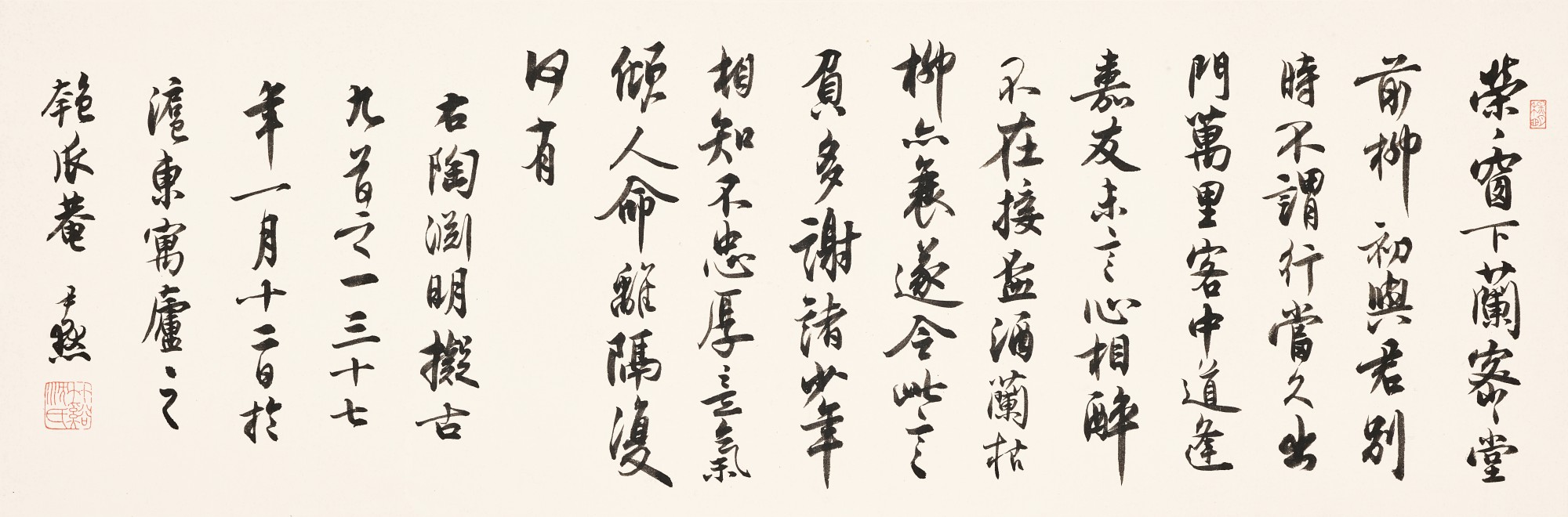
Shen Yinmo
Shen Yinmo, Calligraphy in Xingshu
Shen Yinmo came of age during one of the most turbulent and generative periods in Chinese history. The collapse of the Qing Dynasty in 1912 and the ferment of the May Fourth Movement of 1919 created a cultural landscape in which artists, writers, and intellectuals were urgently renegotiating what it meant to be Chinese and modern at the same time. Shen was not a bystander in this conversation. He studied classical Chinese literature and the ancient scripts deeply, grounding himself in the Tang and Song dynasty masters, yet he moved among the progressive intellectuals of his era with ease.
He was part of the circle associated with Peking University during a period when that institution was the intellectual engine of a nation reimagining itself, and the company he kept, poets, scholars, and reformers, shaped both his aesthetic sensibility and his philosophical outlook. As an artist, Shen Yinmo devoted himself above all to the practice of Chinese calligraphy, an art form that Western audiences have sometimes struggled to fully appreciate but which within Chinese culture carries the weight that painting, sculpture, and poetry carry in the Western tradition combined. He worked across the classical scripts, from the formal precision of kaishu, the standard script, to the fluid and expressive xingshu, or running script, and his command of each was considered extraordinary by his contemporaries. What set Shen apart was not simply technical mastery, though that was beyond question.
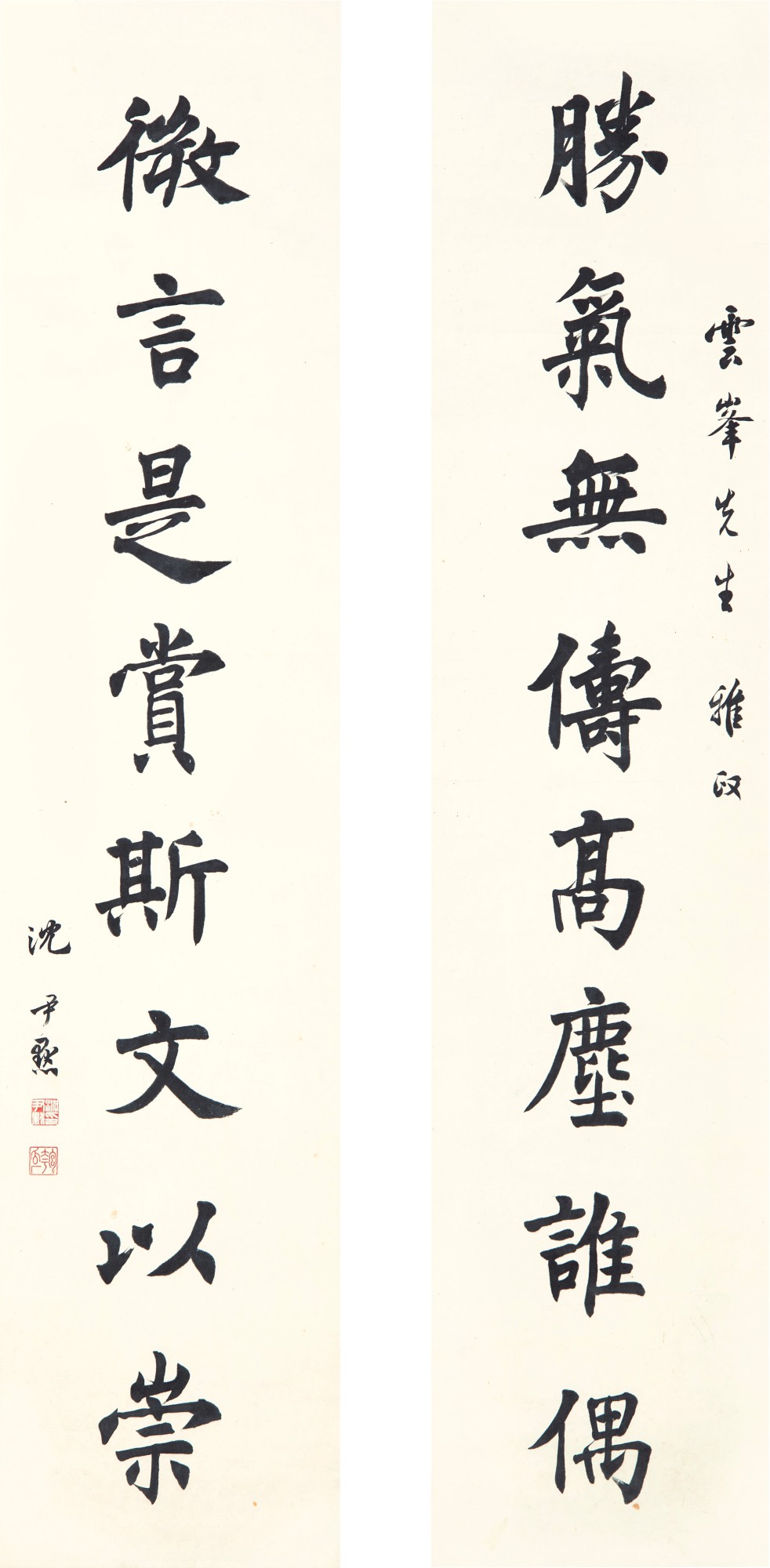
Shen Yinmo
楷書八言聯 Calligraphy Couplet in Kaishu
It was his understanding that each stroke of the brush carried within it the full moral and emotional weight of the person who made it. For Shen, calligraphy was not transcription. It was revelation. The works available through The Collection offer a rare and genuinely moving window into his practice.
His calligraphy executed in xingshu demonstrates the qualities that made his name: strokes that move with the ease of water yet carry structural intelligence in every turn, a rhythm that feels both inevitable and surprising, and an ink quality that speaks to decades of disciplined training. The kaishu couplet, a pair of hanging scrolls presenting an eight character parallel composition, shows the other dimension of his genius. Kaishu demands absolute control, the suppression of spontaneity in favor of architectural clarity, and Shen achieves that clarity while somehow preserving a warmth and humanity that lesser calligraphers sacrifice on the altar of correctness. These are not museum pieces to be admired from a distance.
They are works that reward long acquaintance, works that reveal more the more time one spends with them. For collectors approaching Chinese calligraphy, Shen Yinmo represents a particularly compelling entry point precisely because his reputation, while enormous within specialist circles, has not yet been fully absorbed into the Western market in the way that, say, certain Chinese ink painters of his generation have. His works appear at major auction houses including Christie's and Bonhams in their Chinese art sales, and informed collectors have long recognized that acquiring a strong example of his calligraphy is acquiring a piece of modern Chinese cultural history at the highest level. The couplet format, which he worked in throughout his career, has a particular resonance for collectors interested in the domestic and ceremonial traditions of Chinese art, since paired scrolls were designed to inhabit a space, to create a dialogue between two walls, to mark significant occasions.
To live with a Shen Yinmo couplet is to live with a certain quality of attention. To understand Shen Yinmo fully it helps to situate him alongside the other great calligrapher and ink artists of his era. Yu Youren, a contemporary who also combined political engagement with a profound calligraphic practice, offers one point of comparison, particularly in the way both men saw the cultivation of script as inseparable from the cultivation of character. Among painters working in ink during the same period, Qi Baishi and Huang Binhong were doing parallel work, insisting that the classical Chinese aesthetic tradition was not exhausted but alive and capable of speaking to a modern world.
Shen belonged to this generation of artists who refused the false choice between tradition and modernity, who argued instead that the deepest traditions, when truly understood and truly practiced, are always contemporary. Shen Yinmo lived until 1971, a long life that carried him through extraordinary upheavals, the fall of imperial China, the republican period, the war years, and the establishment of the People's Republic. Through all of it he wrote, practiced, taught, and theorized. His writings on aesthetics and artistic philosophy remain important documents in the history of Chinese art criticism, and his influence on subsequent generations of calligraphers in mainland China, Taiwan, and the diaspora communities beyond is difficult to overstate.
He trained students who trained students, and the principles he articulated about the relationship between brush, ink, and paper continue to shape practice today. To collect a work by Shen Yinmo is to hold something that connects, in an unbroken chain, the classical masters of the Tang dynasty to the living tradition of Chinese calligraphy in the present moment. That is not a small thing. It is, in the fullest sense, an inheritance.
Explore books about Shen Yinmo
Shen Yinmo: A Life of Calligraphy and Seal Carving
Wang Fangyu
The Seals of Shen Yinmo: A Catalogue Raisonné
Tseng Yu-ho
Shen Yinmo and Modern Chinese Calligraphy
He Changming
The Collected Writings of Shen Yinmo
Shen Yinmo; edited by Fang Hao
Shen Yinmo: Seal Art and Cultural Significance
Lo Ch'ing