Shen Hanwu
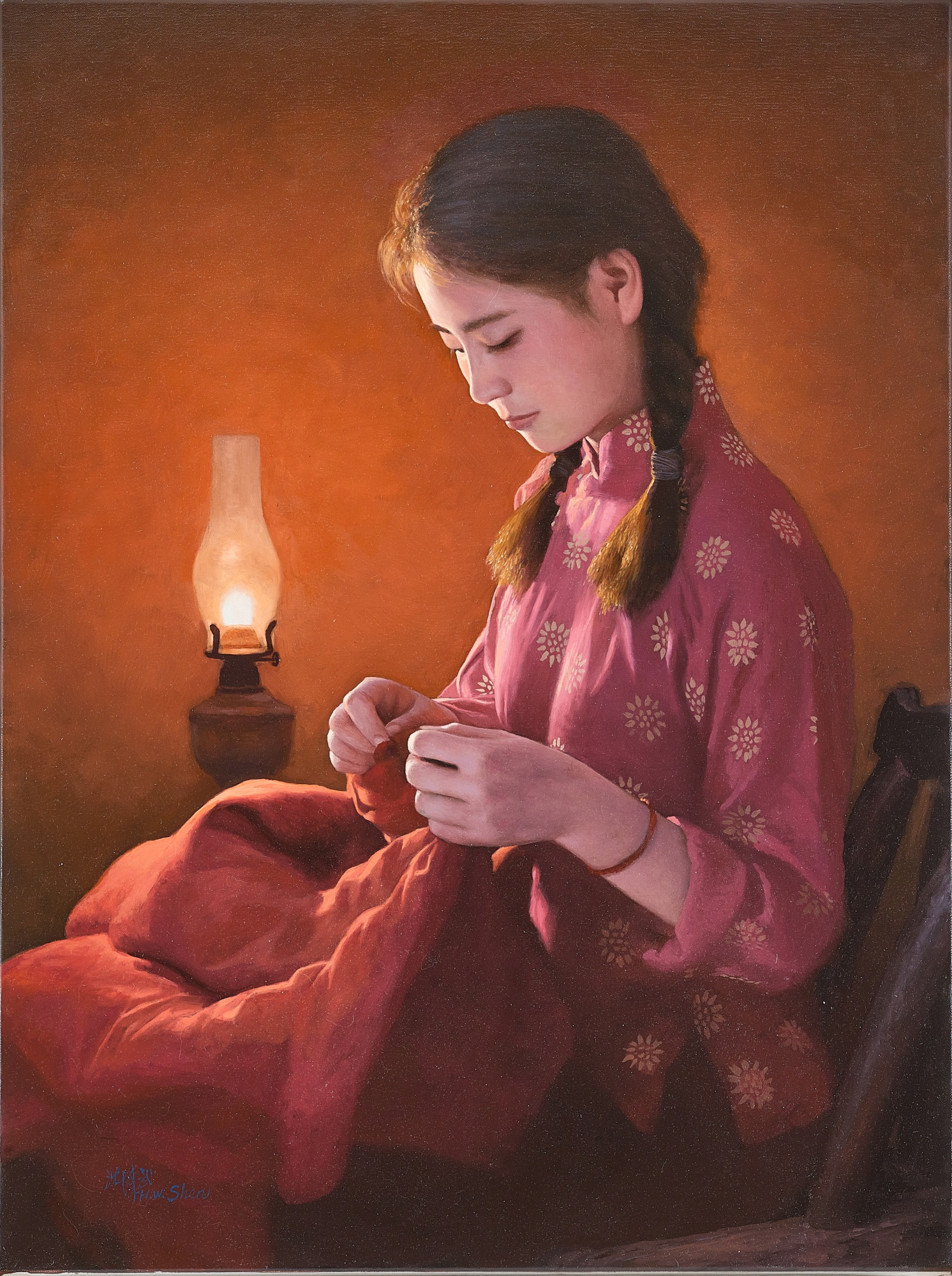
Shen Hanwu, Where Two Worlds Meet
Artist Spotlight · The Collection Editorial
There are artists who belong entirely to their moment, and there are artists who move through time like a current beneath still water, carrying something older and more essential than any single era can claim. Shen Hanwu is the latter. Born in 1872 at the twilight of the Qing dynasty, he lived and painted across one of the most turbulent and transformative stretches in Chinese history, eventually setting down his brush in 1953, four years into the People's Republic. That arc alone, spanning the fall of an empire, the chaos of the Republican period, Japanese occupation, civil war, and the birth of a new China, would be remarkable for any life.
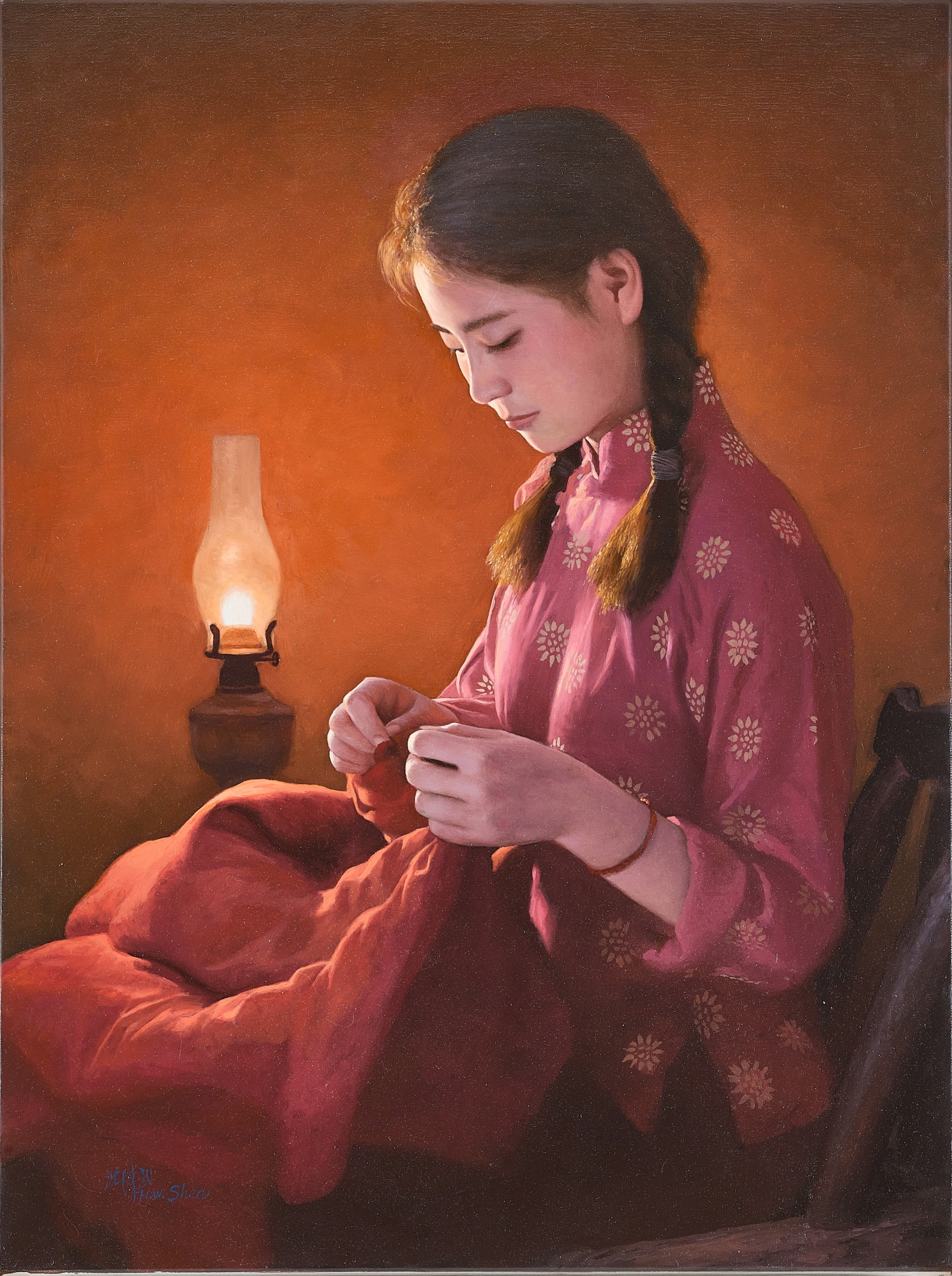
Shen Hanwu
Comfort of warm light 暖光
For a painter, it produced something extraordinary: a body of work that holds classical discipline and modern feeling in a single, trembling breath. Shen was born in 1872 into a China where the literati painting tradition still held immense cultural authority, even as the world outside the studio was fracturing. The literati ideal, rooted in the Tang and Song dynasties and refined through centuries of scholarship, held that painting was not merely craft but a form of self cultivation, a means of expressing the inner character of the educated man through brushwork, ink, and the faithful engagement with nature. Shen came of age within this tradition, studying under masters of the late Qing period who passed down the technical vocabulary of the great classical schools.
His early formation was deeply scholarly, shaped by close reading of painting manuals, careful copying of Song and Yuan masters, and the kind of patient apprenticeship that produced not just technical skill but a philosophical orientation toward mark making itself. As the Qing court collapsed in 1911 and China entered the turbulent Republican era, Shen Hanwu's practice began its most fascinating evolution. The artists of his generation faced a profound question: what did Chinese painting mean in a modernising nation that was increasingly in conversation, and sometimes in conflict, with Western aesthetic values? Some painters abandoned ink entirely for oil and European academic technique.
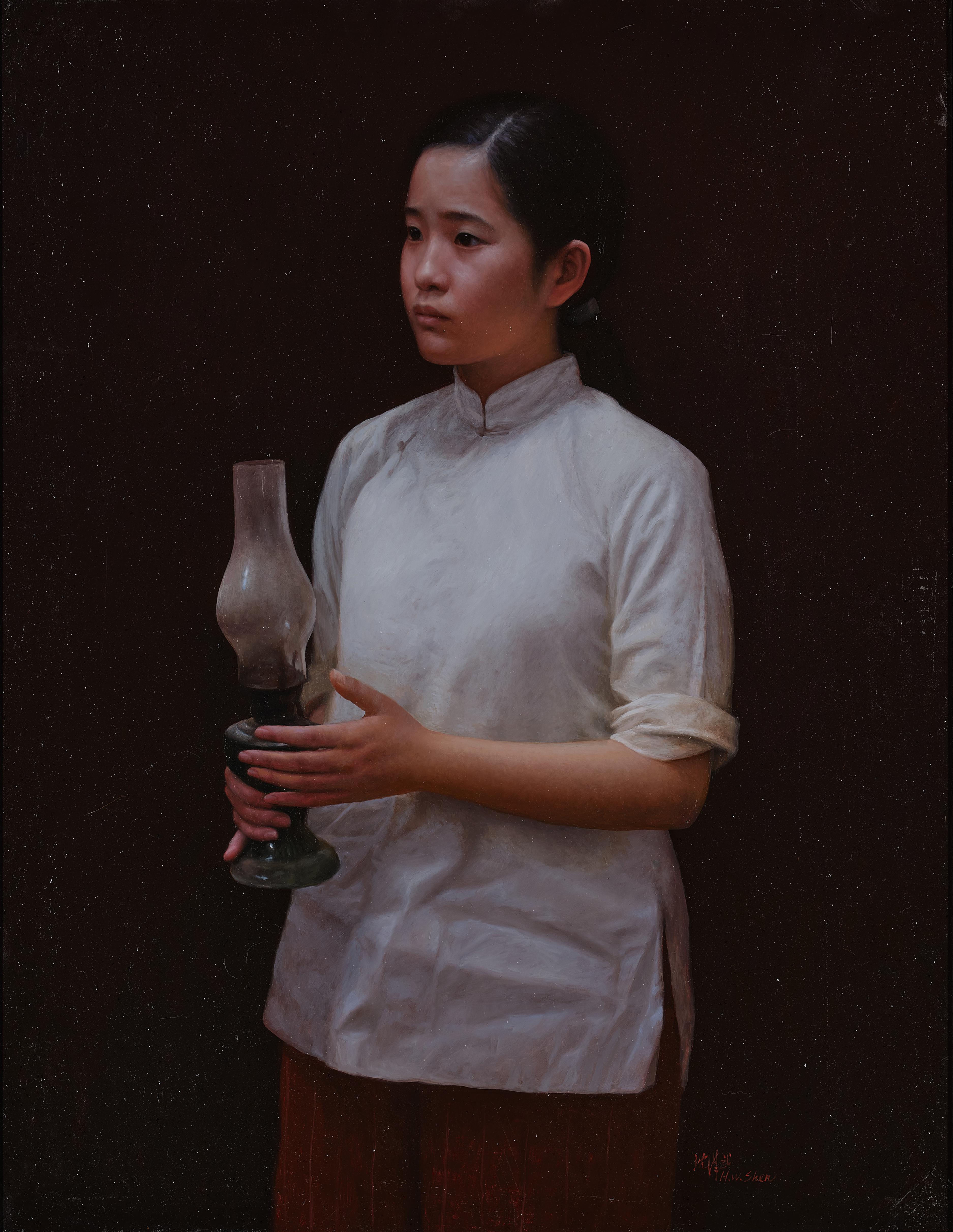
Shen Hanwu
It's Time to Light Up
Others retreated into strict traditionalism as a form of cultural resistance. Shen occupied a more nuanced position, one that becomes clearer when you look at the works he produced across the middle decades of his life. He was not a rigid traditionalist, nor was he a wholesale convert to Western methods. He was, instead, an artist in genuine dialogue with his moment, absorbing influence without surrendering the essential sensibility of his training.
What makes Shen Hanwu's mature output so compelling is precisely the tension between these two modes. Works such as "Comfort of Warm Light" and "It's Time to Light Up," both executed in oil on canvas, reveal a painter who has carried the atmospheric sensitivity and compositional instinct of classical ink painting into a Western medium. These are not simply Chinese subjects rendered in oil. They are paintings in which the quality of light, the sense of space, and the emotional register feel inflected by something deeper and older than the European painterly tradition.
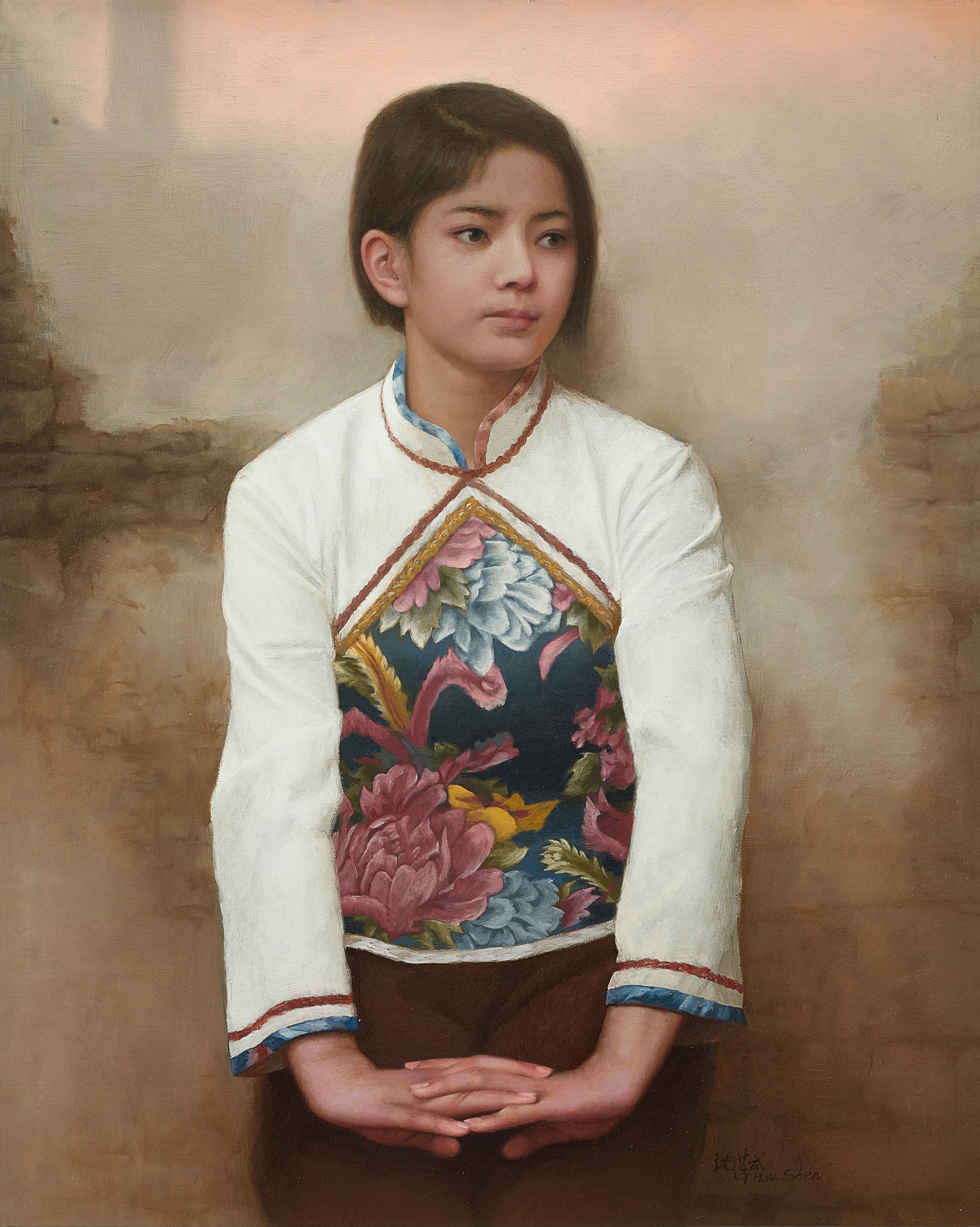
Shen Hanwu
Yu Fen 玉芬, 2022
The handling of warm luminescence in "Comfort of Warm Light" suggests a painter whose eye was trained to read subtle gradations of tone across paper and silk, and who brings that trained sensitivity to bear on the very different demands of canvas and pigment. "It's Time to Light Up" shares this quality, its title suggesting both the literal act of illumination and something more poetic, an invitation toward awareness and presence. The work titled "Yu Fen" carries particular significance. Dated 2022 in the platform record, which raises intriguing questions about attribution, provenance, and the dating conventions sometimes applied to posthumous editions or later documentation of works, the piece is listed as oil on canvas and continues the figure composition strand of Shen's practice.
Figure painting in the Chinese classical tradition carried enormous weight, requiring the painter to capture not just physical likeness but the inner spirit of the subject, what classical critics called "spirit resonance" or qi yun. To give a figure painting a personal name as a title is an act of intimacy and respect, placing the individual at the centre of artistic attention rather than subordinating her to symbolic or narrative function. This work invites close looking and rewards it. From a collecting perspective, Shen Hanwu represents precisely the kind of artist whose significance tends to be understood fully only in retrospect.
His works have appeared at Christie's and Bonhams, where his scrolls and hanging panels have attracted meaningful collector attention, a sign that the market has begun to reckon seriously with his place in the history of Chinese painting between the imperial and modern periods. Collectors drawn to this transitional generation of Chinese painters often find that the works hold a particular emotional charge, carrying the weight of historical rupture while remaining formally and aesthetically coherent. For those building collections with a focus on modern Chinese art or on the cross cultural exchanges of the early twentieth century, Shen offers an important and still underappreciated entry point. In the broader art historical context, Shen Hanwu belongs to a generation that includes figures such as Qi Baishi, who was born just a decade after Shen in 1864, and Huang Binhong, born in 1865, both of whom navigated the transition from Qing to Republican to Communist China with remarkable creative energy.
Like Shen, these painters were rooted in the literati tradition and forced into conversation with modernity not by choice but by circumstance, and some of the most interesting work of the twentieth century in Chinese art emerges precisely from that productive friction. Understanding Shen alongside these contemporaries enriches the appreciation of each, placing individual brushstrokes within the larger story of how Chinese painting survived, adapted, and ultimately endured. Shen Hanwu died in 1953, leaving behind a practice that stretched across eight decades and two entirely different Chinas. His legacy is one of quiet persistence and genuine synthesis, the achievement of an artist who refused easy answers and kept asking difficult questions through the one language he trusted most: paint on surface, form in space, light against shadow.
To encounter his work now is to feel the presence of a long and thoughtful life, one that chose beauty and discipline as its response to a century that offered very little of either. That choice feels, in the present moment, not merely historical but urgent.