Sayed Haider Raza
Raza: Where the Cosmos Meets Canvas
Artist Spotlight · The Collection Editorial
“The Bindu is the source of all creation. It is the point where everything begins and to which everything returns.”
Sayed Haider Raza, interview
In the spring of 2023, a landmark retrospective organized across institutions in New Delhi and Mumbai drew tens of thousands of visitors eager to stand before the vivid, meditative canvases of Sayed Haider Raza. The Raza Foundation, established by the artist before his death and dedicated to nurturing young Indian artists and thinkers, continues to ensure that his vision radiates far beyond the walls of any single museum. That ongoing institutional energy, combined with sustained auction enthusiasm across Christie's, Sotheby's, and Pundole's, confirms what serious collectors have understood for decades: Raza is not simply a chapter in art history but a living force within contemporary visual culture. To encounter his work today is to feel the particular electricity of a painter who spent a lifetime building a bridge between continents, philosophies, and centuries.
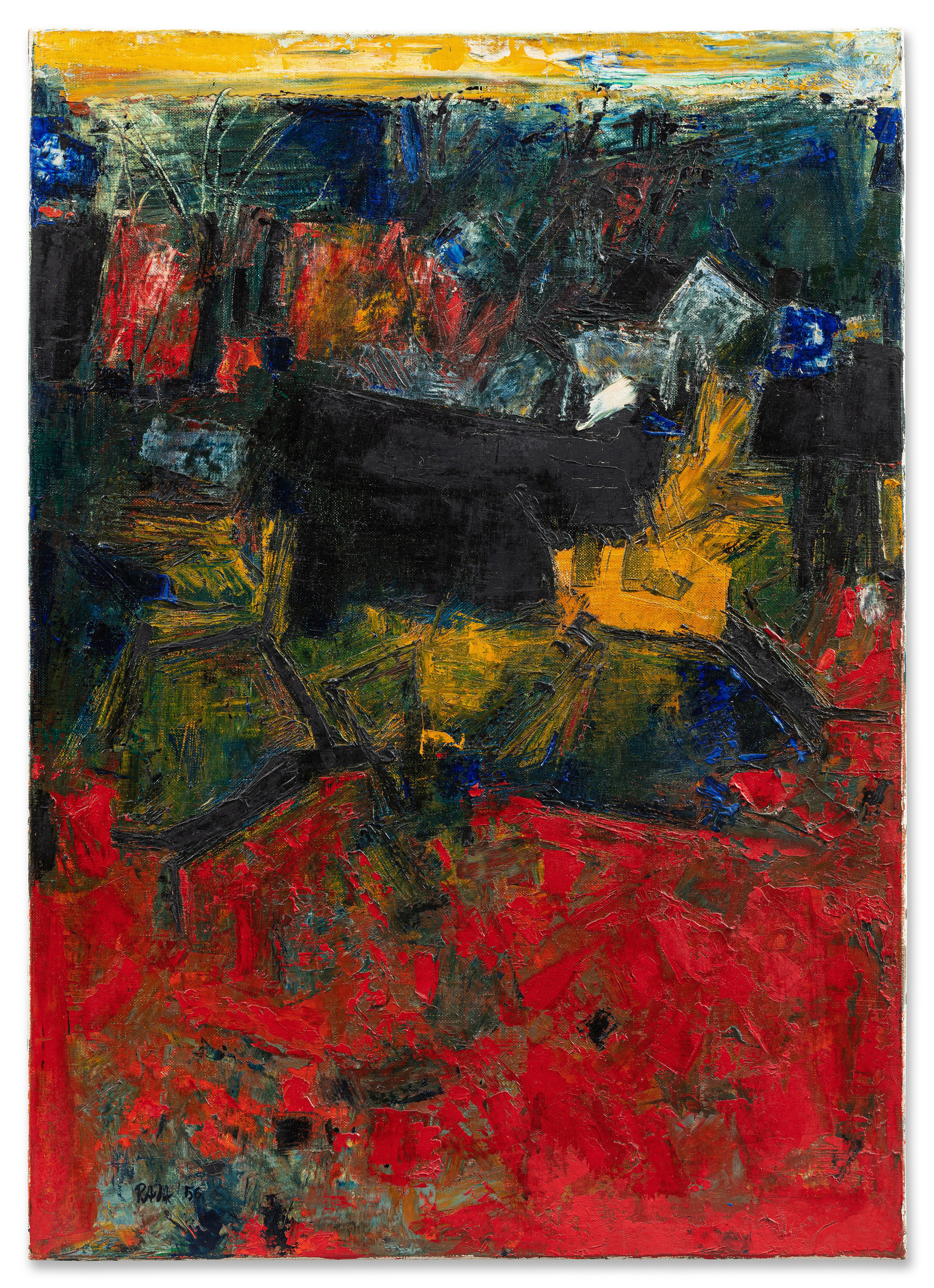
Sayed Haider Raza
Composition, 1956
Sayed Haider Raza was born in 1922 in Babaria, a small town in what is now Madhya Pradesh in central India. His father was a forest ranger, and the landscape of that region, its dense greens, ochre earth, and the particular quality of light falling through forest canopy, left permanent impressions on a young and acutely sensitive mind. He showed an early aptitude for drawing and was encouraged to pursue formal study, eventually enrolling at the Nagpur School of Art before moving to Bombay, where he studied at the Sir J.J.
School of Art in the mid 1940s. Bombay in that period was an extraordinarily charged environment: India was approaching independence, intellectual and cultural life was fervent, and young artists were grappling seriously with the question of what a modern Indian art might actually look like. It was in Bombay in 1947 that Raza became one of the founding members of the Progressive Artists Group alongside Francis Newton Souza, Maqbool Fida Husain, Krishnaji Howlaji Ara, Sadanand Bakre, and Hari Ambadas Gade. The group was a declaration of intent: these painters refused both the nostalgic romanticism of the Bengal School and simple imitation of European academicism.
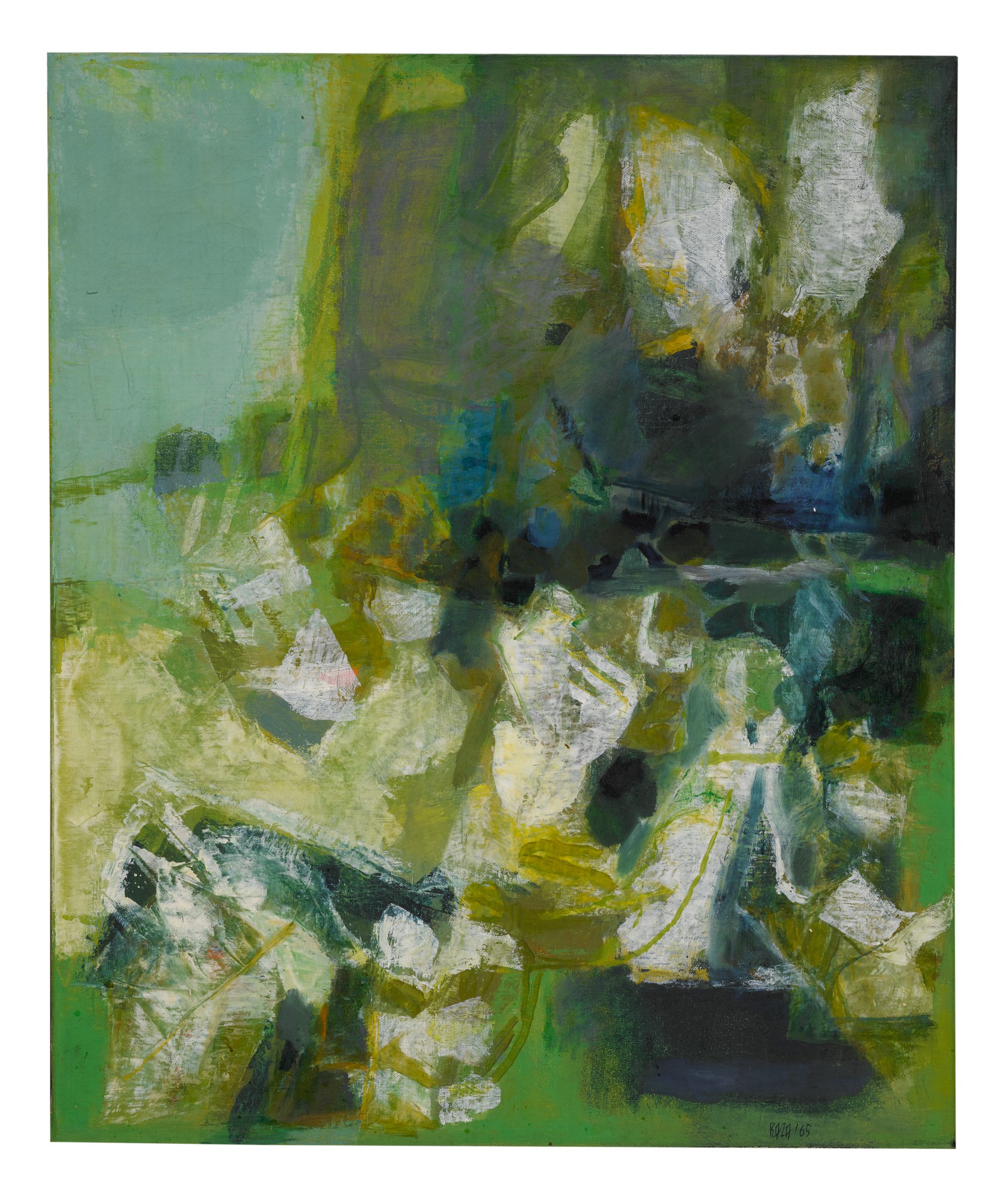
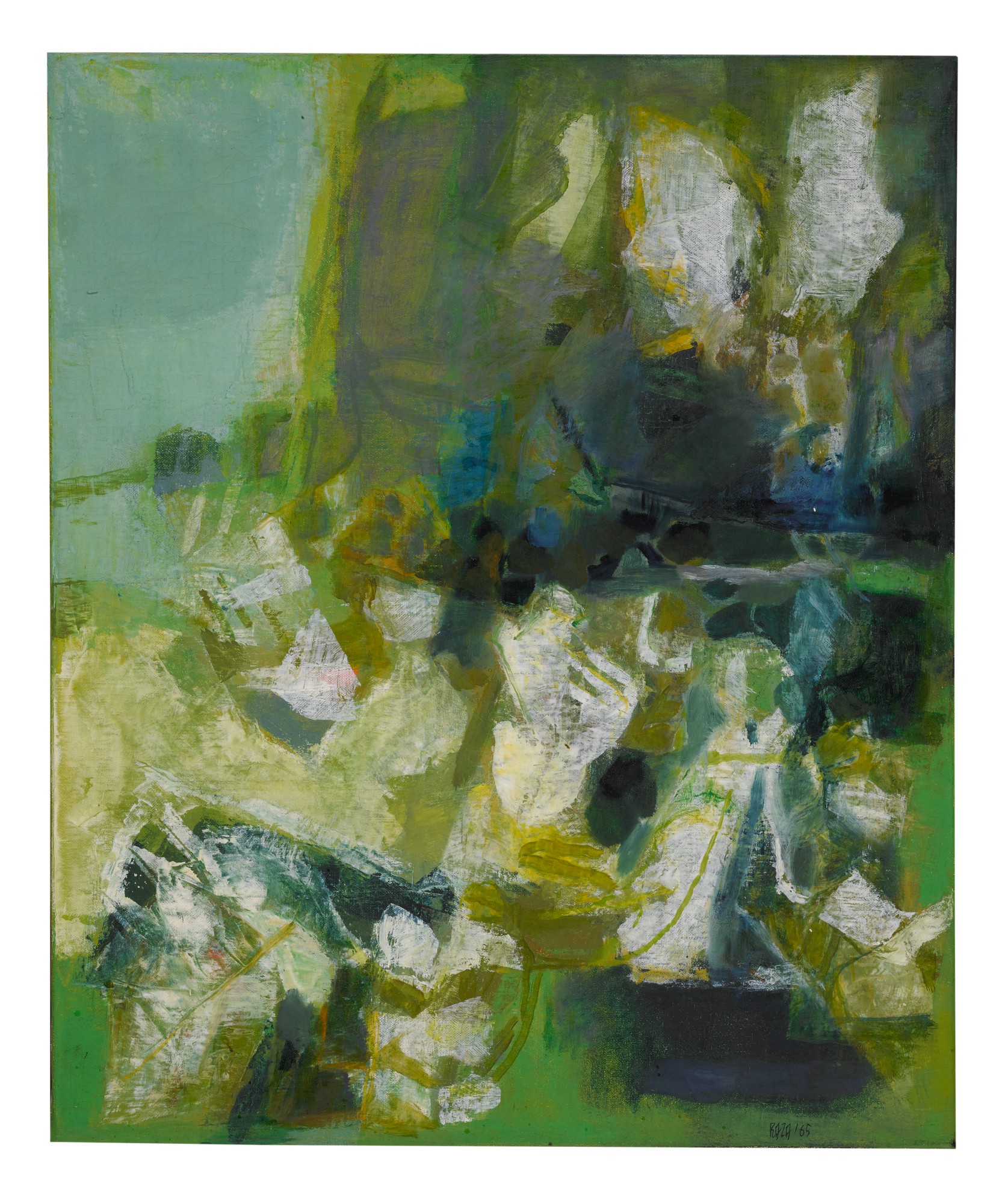
Sayed Haider Raza
Prairie, 1965
They wanted to absorb the lessons of Cézanne, Matisse, and the European avant garde while remaining rooted in their own experience and visual inheritance. The Progressive Artists Group lasted only a few years as a formal entity, but its influence on Indian modernism was seismic, and Raza remained one of its most eloquent embodiments for the rest of his long life. In 1950, Raza received a French government scholarship and traveled to Paris, where he enrolled at the École Nationale Supérieure des Beaux Arts. Paris in the early 1950s was the center of world art, and Raza immersed himself fully, befriending artists, absorbing the lessons of Braque and the color theories of the School of Paris, and developing the richly tonal, thickly painted landscapes that would define his first major period.
“I paint what I feel deeply. India is in my blood, in my bones, in my breath.”
Sayed Haider Raza
Works from the 1950s and early 1960s, including the bold and atmospheric Composition of 1956 and the brooding Village au ciel orange from the same year, show a painter of tremendous physical confidence, building surfaces with loaded brushwork and exploring the emotional weight of color in a way that owed much to European expressionism while remaining unmistakably personal. His paintings of Provence, the French countryside, and later works like Prairie from 1965 and the moody L'oasis from 1961, earned him significant recognition in France. He won the Prix de la Critique in Paris in 1956, the first non French artist to receive the honor, a fact that speaks both to the quality of his work and to the remarkable position he had earned within the Parisian art world. The transformation that defines Raza's mature and late career began slowly in the 1970s and accelerated through the 1980s and beyond.
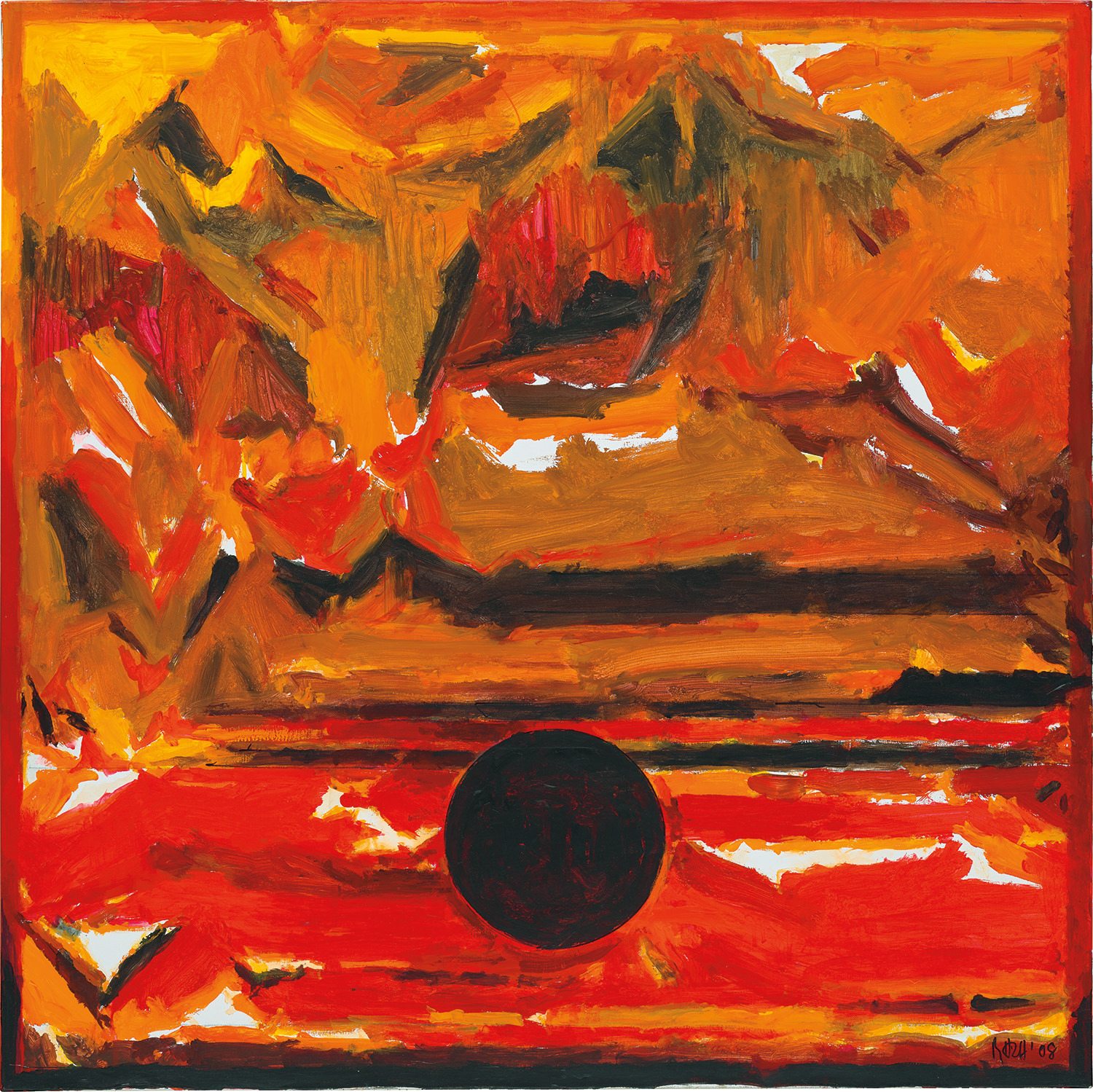
Sayed Haider Raza
Landscape and Bindu, 2008
Returning in spirit and in subject matter to India, Raza found himself drawn toward the philosophical and cosmological traditions of Tantra, Vedic thought, and Indian classical symbolism. The result was the emergence of the Bindu, the dot or point that would become his signature image and the organizing principle of his most celebrated works. In Sanskrit philosophy, the bindu represents the point of origin of all existence, the moment before creation, the place where the infinite condenses into form. For Raza, it was also deeply personal: he described the moment of his encounter with this symbol as a kind of homecoming, a recognition that everything he had been searching for in color, geometry, and spiritual resonance could be gathered into this single, luminous form.
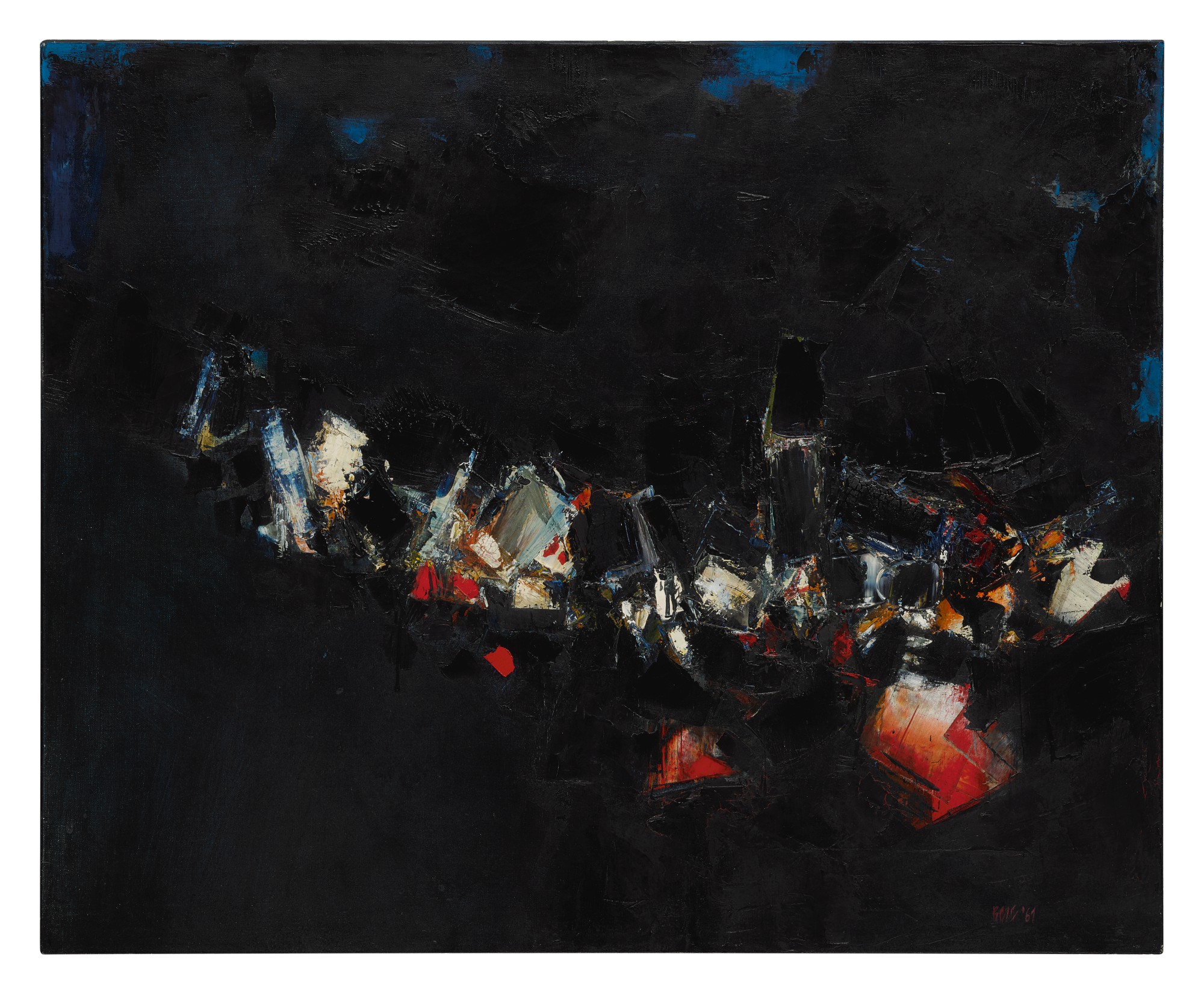
The Bindu works are executed in bold geometric compositions, concentric squares and triangles radiating outward from a central point, in colors of extraordinary vibrancy. They are simultaneously abstract and deeply symbolic, demanding both visual and contemplative engagement. For collectors, Raza's body of work presents a rich and rewarding field. The early French period landscapes, such as Drame au Village from 1961 and Crépuscule à Ste Agnès from 1962, offer the pleasure of seeing a great colorist at work in a recognizable world, painting with sensuous directness and atmospheric depth.
Sayed Haider Raza
Drame au Village, 1961
Works from the 1960s and 1970s, like the Untitled of 1978, chart the crucial transitional period when the figurative and the abstract begin their dialogue within a single canvas. The mature Bindu works, including Landscape and Bindu from 2008, represent the artist at his most philosophically realized and are the works most eagerly sought at auction. Raza's paintings have achieved significant results at the major South Asian art sales, with top works consistently reaching and exceeding estimates, and his position within the Blue Chip category of Indian modern art is firmly established. Collectors are advised to pay particular attention to provenance, condition, and the presence of the artist's characteristic framing choices, such as the panel works made in the artist's own frame, which add an intimate and personal dimension to the object.
Within the broader context of art history, Raza occupies a distinctive position that rewards comparison and contrast. His relationship to Color Field painting, as practiced by artists like Mark Rothko and Barnett Newman in the United States, is genuine but arrives at similar territory from entirely different philosophical premises. Where Rothko pursued a secular sublime rooted in existential experience, Raza drew on ancient cosmological systems. The geometric abstraction of his late works invites comparison to artists such as Vasudeo Santu Gaitonde, whose own practice of meditative abstraction developed along parallel though distinct lines within India, and to the broader global conversation about spirituality and abstraction that included figures as different as Hilma af Klint and Agnes Martin.
Raza is the artist who most completely synthesized the lessons of European modernism with the depth of Indian philosophical tradition, and that synthesis gives his work a genuinely universal resonance. Raza returned permanently to India in 2010 after six decades in France, a return that felt to many like a completion, the closing of a grand circle. He continued to paint with undiminished energy until his death in New Delhi in July 2016 at the age of 94. The Raza Foundation carries his commitment forward, supporting artists, funding scholarships, and organizing exhibitions and dialogues that honor the breadth of his intellectual and aesthetic vision.
His work hangs in the collections of major institutions including the Centre Pompidou in Paris and the National Gallery of Modern Art in New Delhi, and it continues to find passionate new admirers with every auction season and every exhibition. To collect Raza is to participate in one of the great stories of twentieth century art: a story of movement and rootedness, of rigor and joy, of a painter who looked at a single point and found within it the whole universe.
Explore books about Sayed Haider Raza
Sayed Haider Raza: Catalogue Raisonné
Geeta Kapur
Sayed Haider Raza
Asit Kumar Haldar
Raza: Paintings and Drawings
Mulk Raj Anand
Sayed Haider Raza: The Essence of Form
B. N. Goswamy
The Art of Sayed Haider Raza
M. F. Husain
Raza: A Retrospective
National Museum, New Delhi
Sayed Haider Raza: Life and Work
Lalit Kala Akademi