Saul Steinberg
Saul Steinberg, The Artist Who Drew Thinking
Artist Spotlight · The Collection Editorial
“The life of the creative man is led, directed, and controlled by boredom. Avoiding boredom is one of our most important purposes.”
Saul Steinberg
There is a drawing that stops visitors cold at the Smithsonian's National Portrait Gallery. It is a self portrait by Saul Steinberg in which the artist draws himself drawing himself, the pen looping back through layers of paper and hand and intention until the very act of looking becomes the subject. It is funny and vertiginous and philosophically exact all at once. That drawing, made sometime in the 1960s, has become one of the most reproduced images in twentieth century American art, and it captures everything that made Steinberg singular: the wit that was never merely decorative, the line that always carried an idea, the refusal to be only one thing.
Saul Steinberg
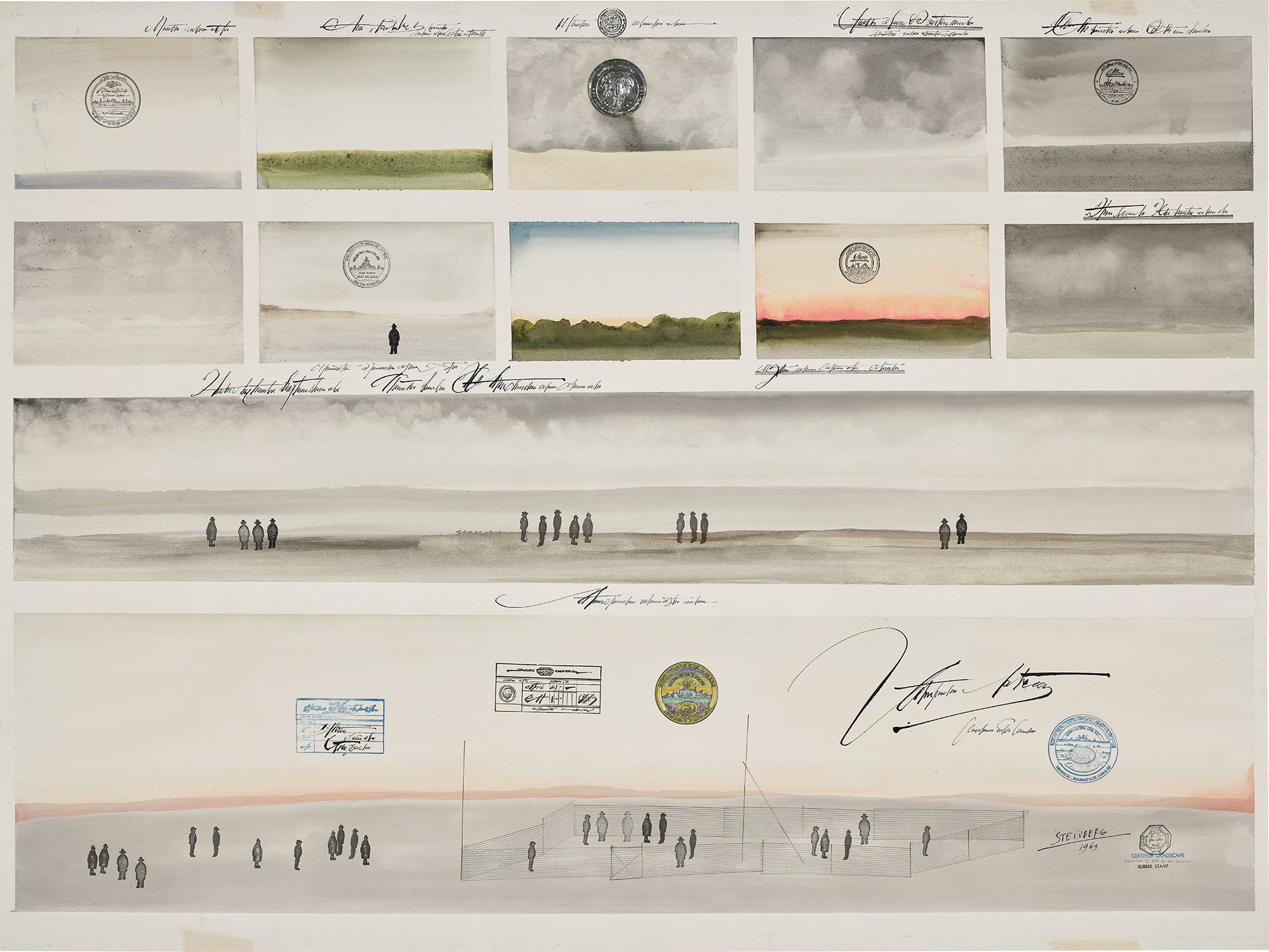
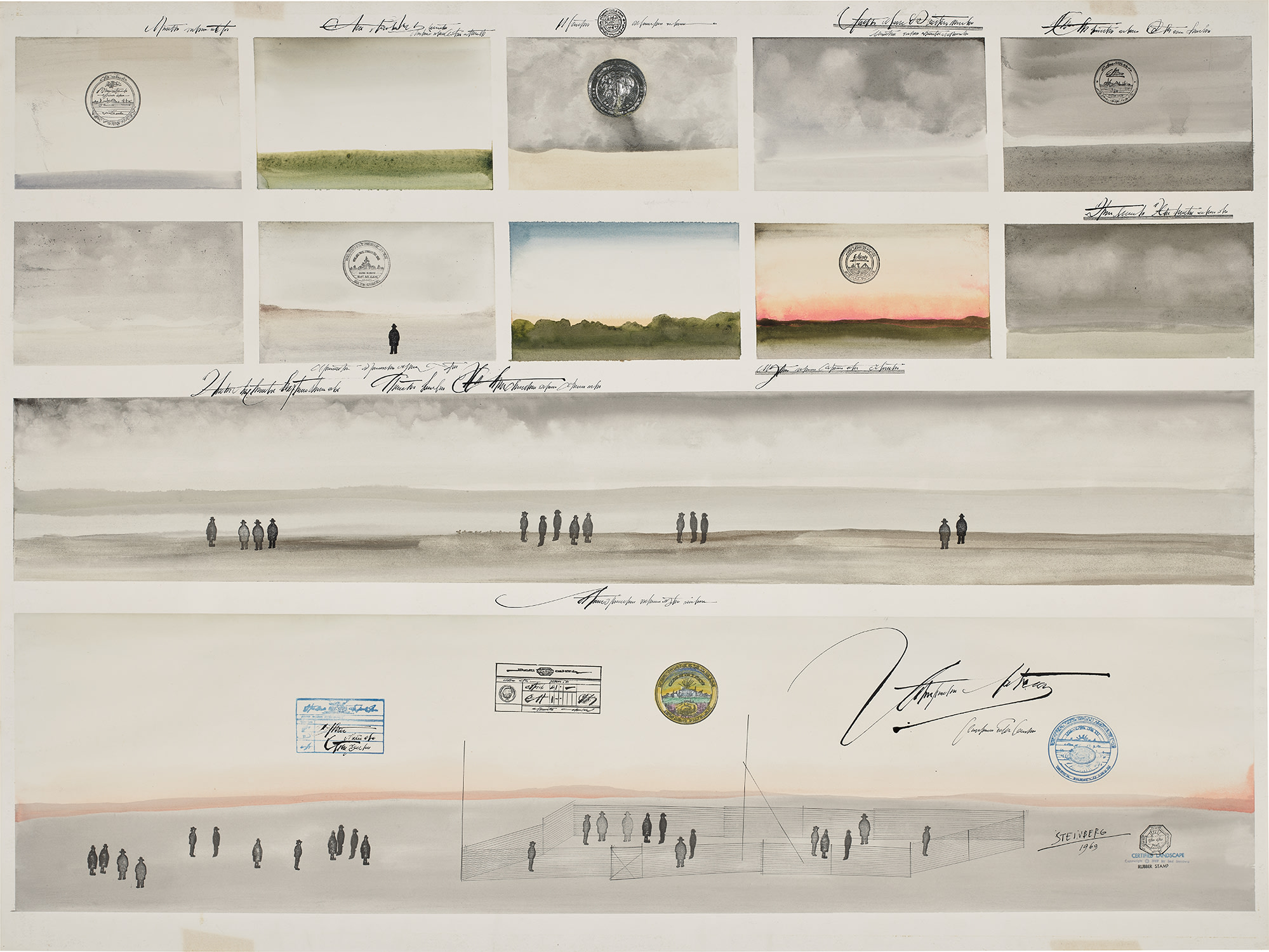
Twelve Landscapes, 1969
Saul Steinberg was born on June 15, 1914, in Râmnicu Sărat, a small town in Romania, and grew up in Bucharest in a Jewish family of modest means. He studied philosophy and sociology at the University of Bucharest before enrolling at the Regio Politecnico di Milano, where he earned a doctorate in architecture in 1940. That architectural training never left him. It gave his drawings their structural precision, their delight in perspective and spatial play, their understanding of how a line defines not just a shape but a world.
Milan also introduced him to modernist design culture, to the clarity and conceptual ambition of the Italian avant garde, and to the satirical press where he first published his cartoons. The rise of fascism forced Steinberg to flee Europe. After a period in the Dominican Republic, he arrived in the United States in 1942, eventually becoming an American citizen and serving in the Navy during the Second World War. His wartime experience took him to China, India, and North Africa, broadening a visual vocabulary that was already cosmopolitan and restless.
Saul Steinberg
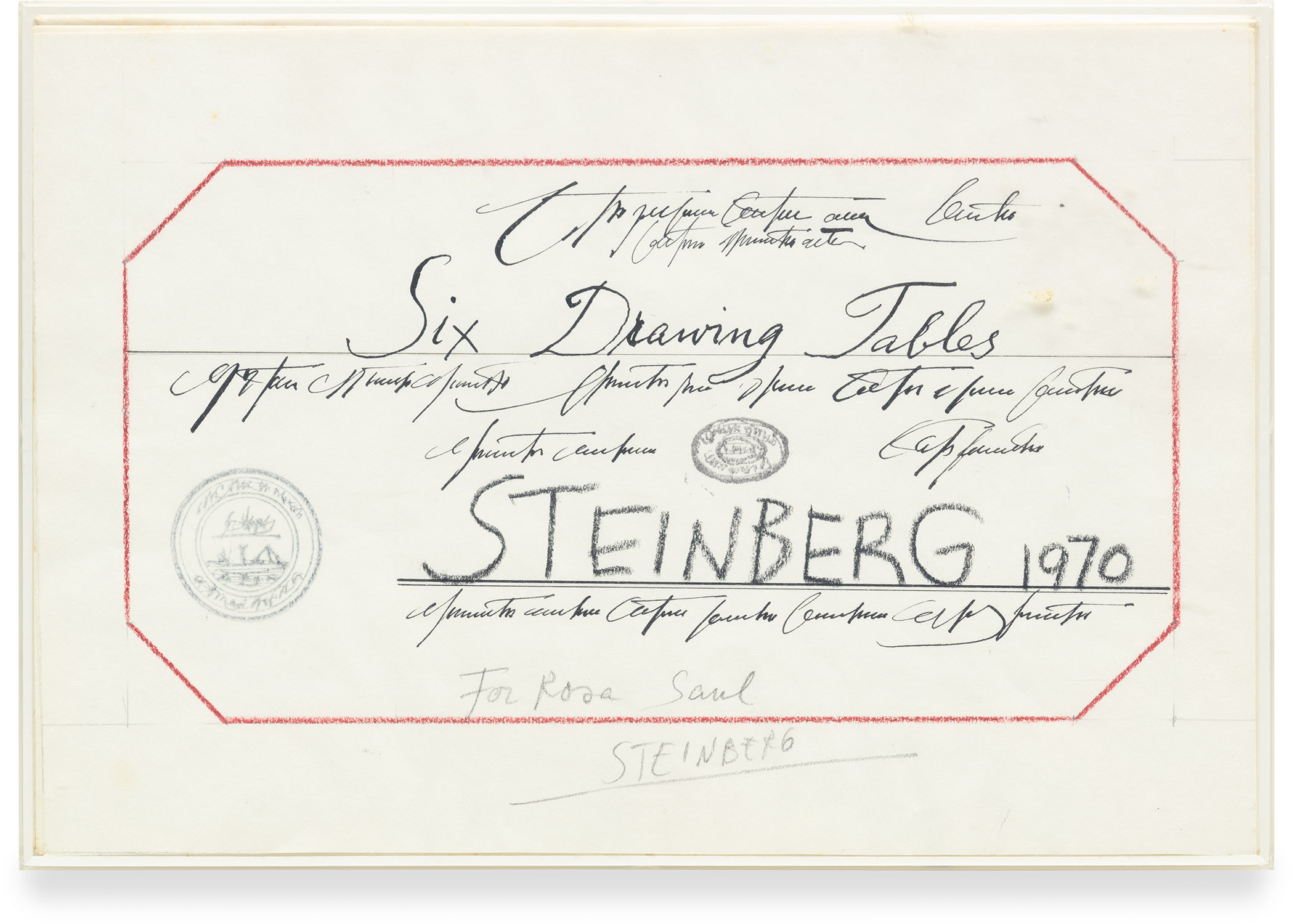
Portfolio Label, from Six Drawing Tables Portfolio
New York City became his permanent home after the war, and the city entered his work as a recurring character: its skylines, its street grids, its social taxonomies, its immigrant energy all folded into drawings that were simultaneously local and universal. He settled into a studio life divided between Manhattan and a home in Springs, on Long Island, where he became a neighbor and friend to Willem de Kooning and other painters of his generation. His relationship with The New Yorker, which began in 1941 and continued for more than five decades, gave Steinberg both a vast audience and a kind of creative freedom rare in commercial publishing. He contributed hundreds of covers and interior drawings to the magazine, and those contributions shaped the visual identity of American intellectual culture in the postwar decades.
“I am a writer who draws.”
Saul Steinberg
But to understand Steinberg only through that association is to miss the full depth of his practice. He showed extensively in galleries and museums throughout his career, including major exhibitions at the Museum of Modern Art in New York and the Whitney Museum of American Art, which mounted a significant retrospective in 1978. He was represented by the Pace Gallery for much of his later career, a relationship that placed him firmly within the conversation of serious contemporary art rather than the softer category of illustration. What makes Steinberg's work so enduring is the quality of his thinking as much as his draftsmanship, though the draftsmanship is extraordinary.
Saul Steinberg
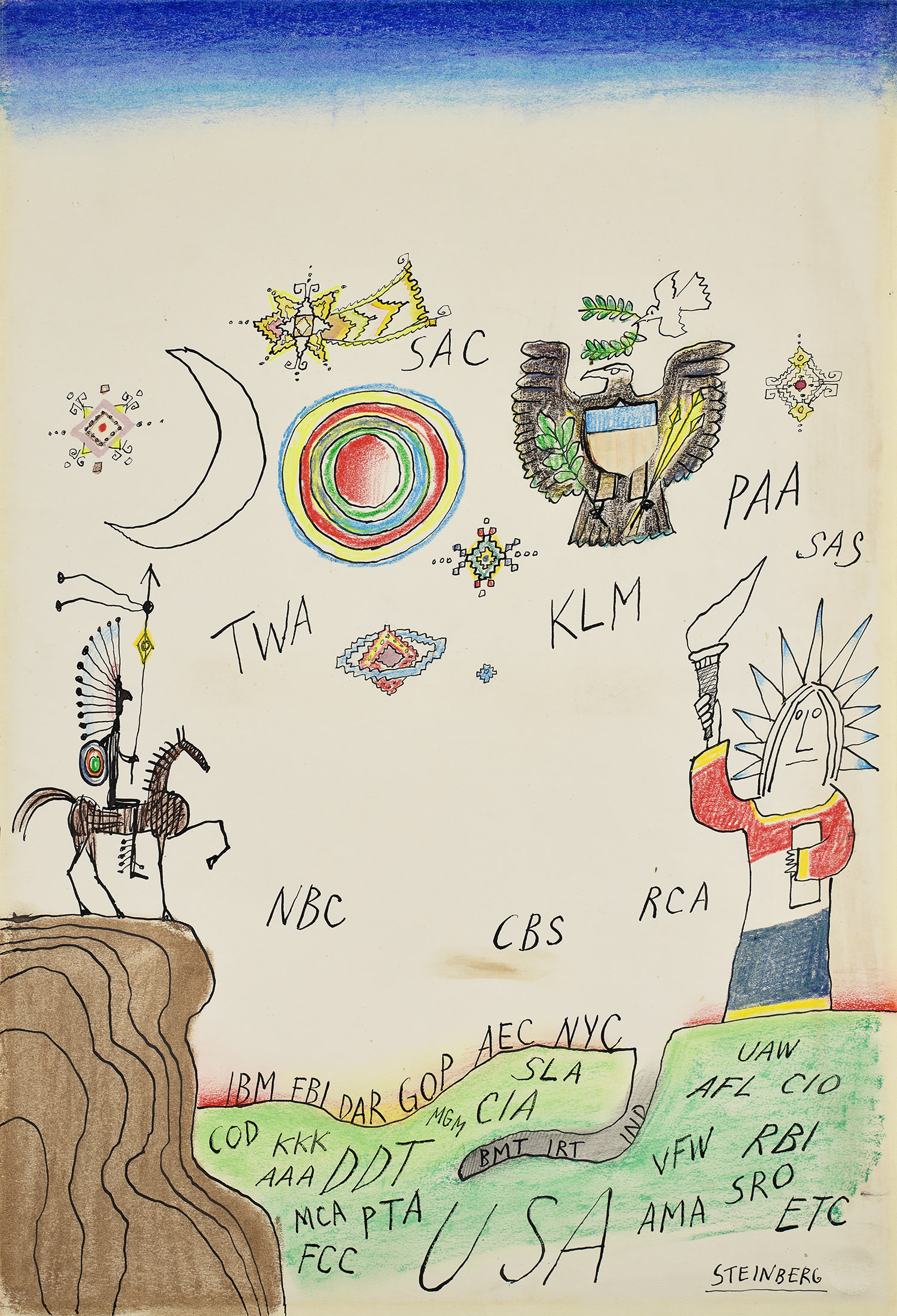
Cover of, 1964
He worked across watercolor, ink, rubber stamp, graphite, collage, and three dimensional construction with equal fluency, and his best works hold open a space between categories that most art would rather close. A work like The Real Table from 1972, which combines an actual wood drafting table with collaged and painted surfaces, asks the viewer to locate the boundary between representation and object and then dissolves it entirely. His Certified Landscapes series from 1968 and works such as Twelve Landscapes from 1969 bring together watercolor and ink with rubber stamp bureaucratic insignia, transforming the pastoral into a meditation on authenticity, documentation, and the comic solemnity of official verification. These are works of genuine conceptual ambition dressed in the most elegant visual wit.
For collectors, Steinberg offers a rare combination: works that are intellectually rewarding, visually irresistible, and historically significant across multiple collecting categories. His prints, particularly those produced in collaboration with Gemini G.E.L.
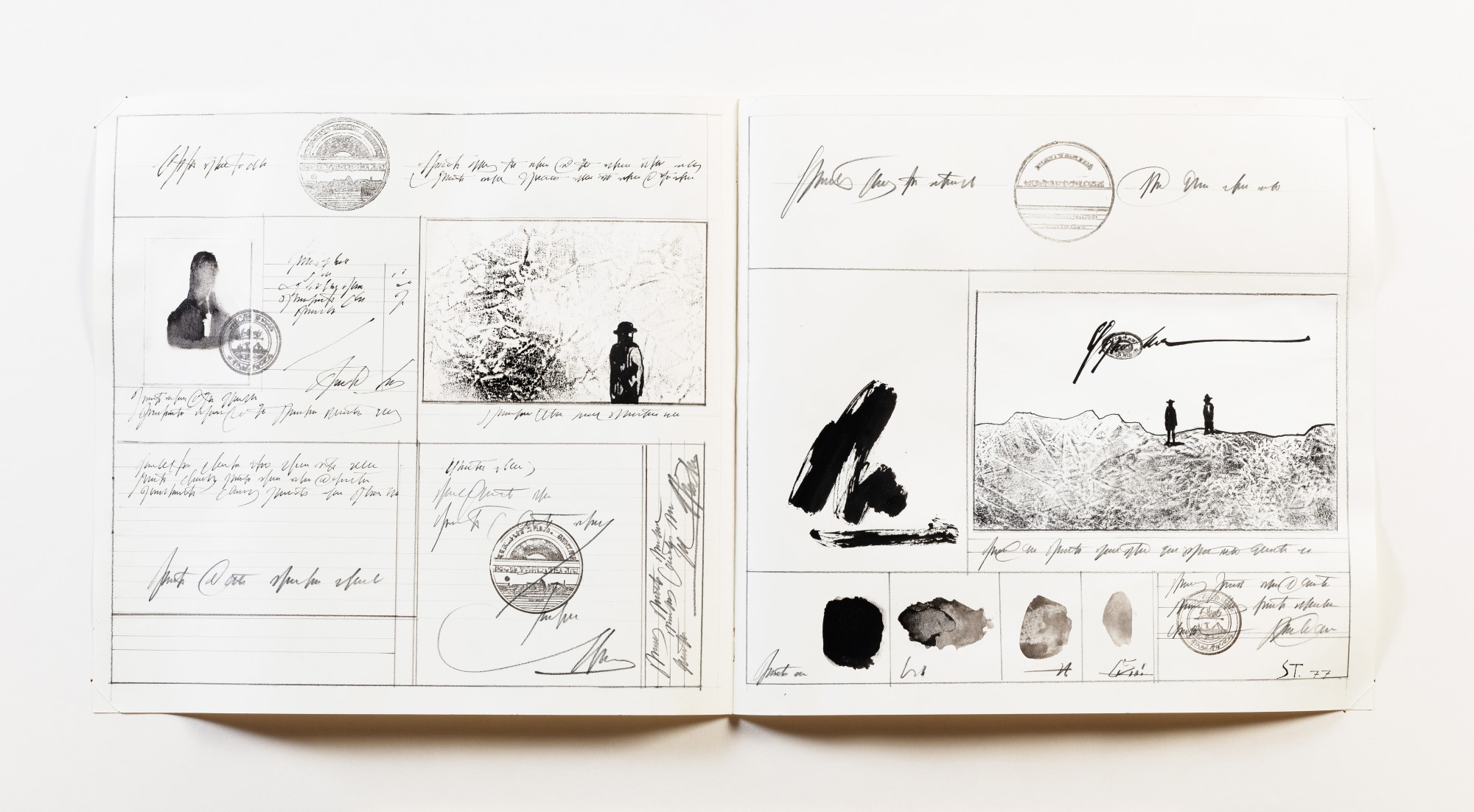
Saul Steinberg
Notes et témoignages sur la vie de Jean Hélion, 1977
in Los Angeles, are highly regarded both for their technical quality and for the way they carry the full weight of his ideas in editions that remain accessible relative to his unique works on paper. The Sphynx series and the Provincetown lithographs from Gemini represent his printmaking at its most inventive, with his characteristic motifs of self examination, landscape, and linguistic play rendered with all the precision of his unique works. Collectors who have focused on postwar American works on paper have long understood that Steinberg sits comfortably beside artists such as Jasper Johns, Robert Rauschenberg, and Cy Twombly, all of whom shared his interest in the materiality of marks and the relationship between language and image. His work also resonates with the draftsmanly philosophical tradition of Paul Klee, whom Steinberg admired deeply, and with the satirical lineage running from Honoré Daumier through George Grosz.
The market for Steinberg has grown steadily in recent decades as the critical reassessment of his work has moved him decisively out of the illustration ghetto and into the museum canon where he always belonged. Works on paper and unique collage pieces attract particular attention at auction, with institutions and private collectors competing for examples that demonstrate the full range of his conceptual and technical ambition. His watercolors and ink drawings that integrate rubber stamps and collage elements, such as the portfolio works bearing his characteristic notarial humor, reward close study and repay long ownership in ways that purely decorative work rarely does. Saul Steinberg died in New York City on May 12, 1999, leaving behind a body of work that continues to generate new admirers with each passing decade.
The Saul Steinberg Foundation, established after his death, has worked to document and promote his legacy with scholarship and loans to major institutional exhibitions. What strikes you most, returning to his work today, is how contemporary it feels: his preoccupation with identity and its constructed nature, his suspicion of official narratives, his delight in the strangeness of language and its relationship to the visible world, all of these feel less like historical concerns than live questions. In an era saturated with images and starved for genuine visual thought, Steinberg's line remains one of the most intelligent and companionable in modern art.
Explore books about Saul Steinberg
Saul Steinberg
Harold Rosenberg

Saul Steinberg: A Life
Deirdre Bair
Saul Steinberg: Illuminations
Saul Steinberg
The Discovery of America
Saul Steinberg
Saul Steinberg: Drawings and Prints
Museum of Modern Art
Saul Steinberg: Retrospective
Whitney Museum of American Art
All in Line
Saul Steinberg