Saul Leiter
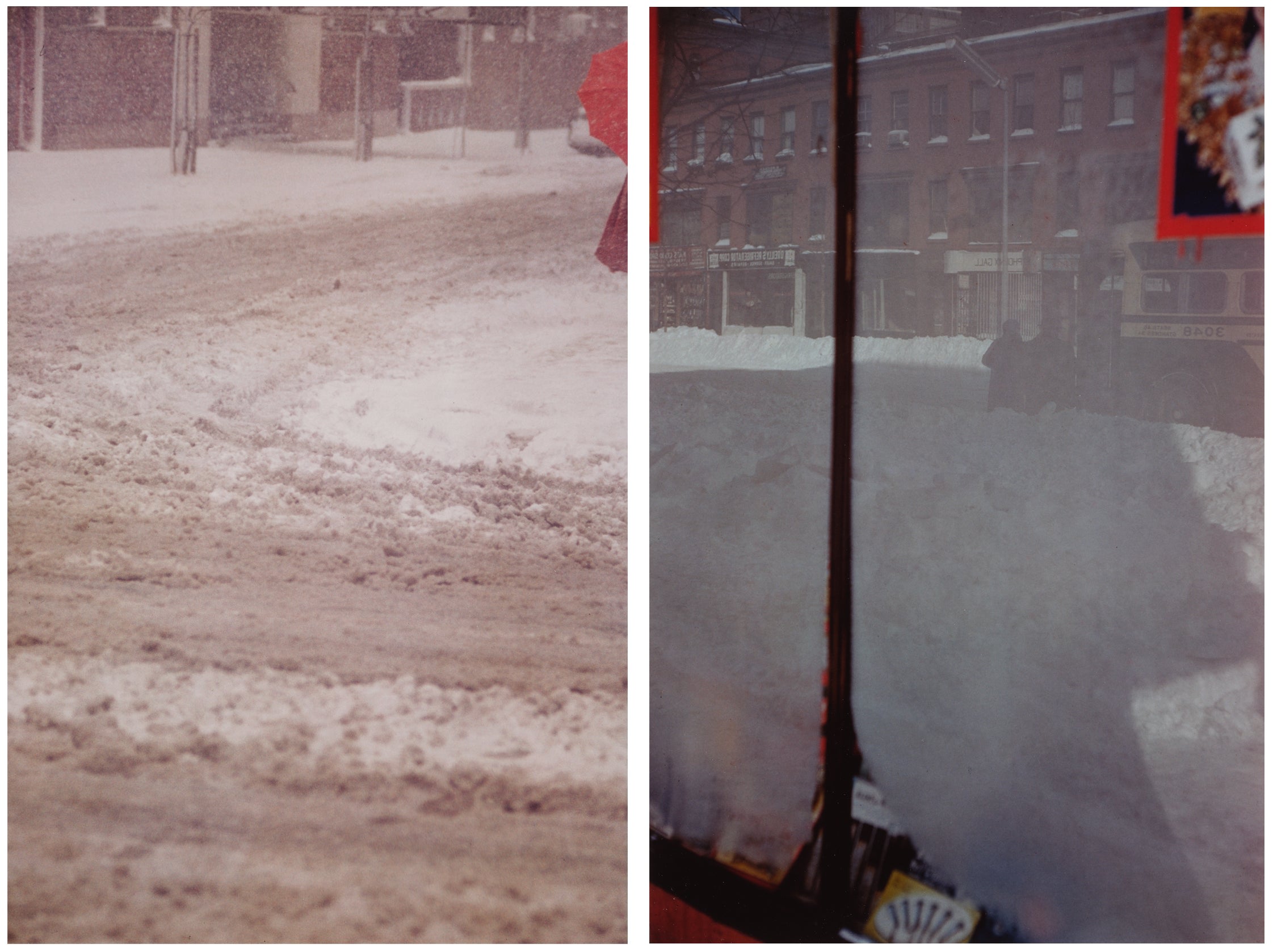
Saul Leiter, The Poet of Color
Artist Spotlight · The Collection Editorial
“I have a long history of not being in a hurry.”
Saul Leiter, In No Great Hurry, 2013
Picture New York City in the early 1950s, a winter morning somewhere in the East Village, the streets softened by falling snow. A woman moves through the frame beneath a red umbrella, her figure half dissolved by the wet air, the city rendered as pure feeling rather than fact. This is the world Saul Leiter saw before almost anyone else knew how to look at it that way. His photograph Red Umbrella, one of the most quietly celebrated images in the history of color photography, condenses an entire philosophy of seeing into a single frame: the everyday made luminous, the street transformed into something close to a dream.
Saul Leiter
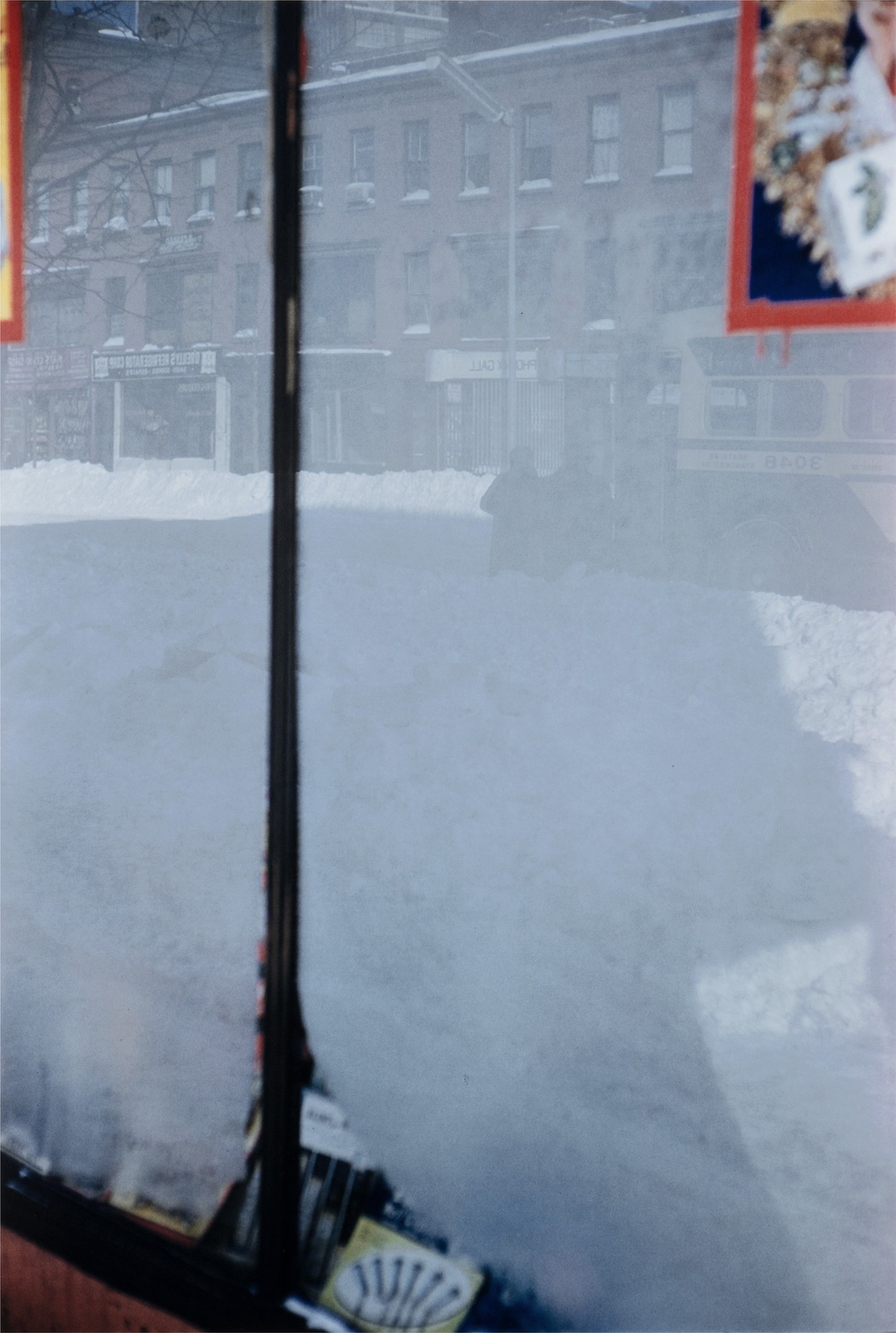
Snowy Scene
Decades after it was made, it remains one of the most recognized works in the medium, an image that collectors and curators return to again and again as proof that photography could be as emotionally complex and formally sophisticated as any painting on canvas. Leiter was born in Pittsburgh, Pennsylvania in 1923, the son of a distinguished Talmudic scholar who had very different ambitions for his boy. His father wanted him to follow a rabbinical path, and Leiter enrolled in a seminary in Cleveland before making the decisive break that would define the rest of his life. At twenty three he abandoned his studies and moved to New York City, drawn by the cultural energy of a metropolis in full artistic ferment.
He arrived with almost nothing, but he arrived in the right place at the right moment. The friendships he formed in those early years were formative in the deepest sense. His closest companion and neighbor in the East Village was the painter Richard Pousette Dart, and through him Leiter was absorbed into the world of Abstract Expressionism, spending time with painters who were reinventing American art in lofts and studios just blocks from where he walked every day with his camera. It was in this context, saturated by the ideas and visual ambitions of painters like Mark Rothko and Willem de Kooning, that Leiter began to develop what would become one of the most distinctive voices in photography.
Saul Leiter
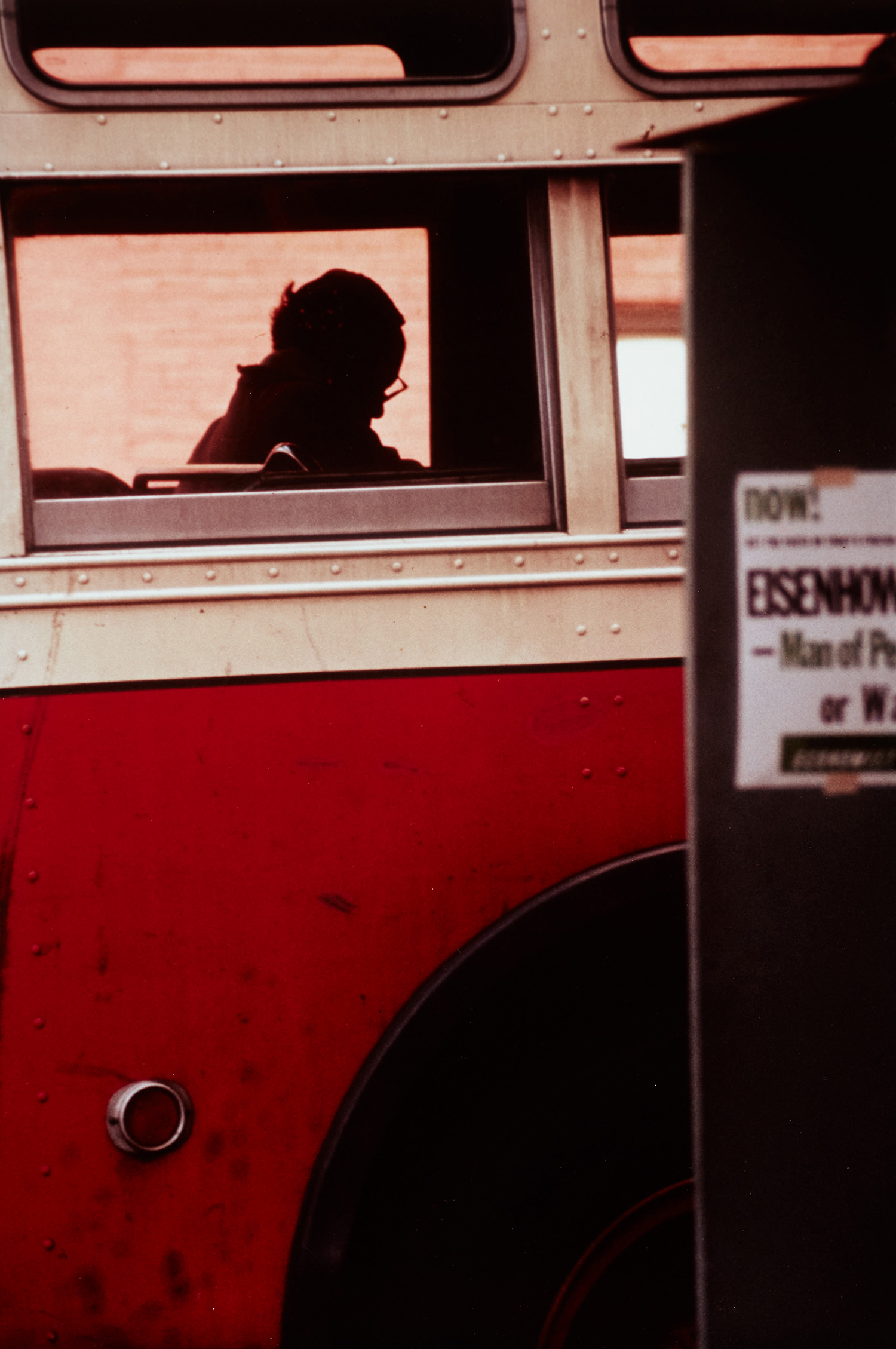
Bus, New York
He took up painting himself and practiced it seriously throughout his life, and this dual commitment was never incidental to his photographs. The painterly qualities in his images, the flattening of space, the use of reflected light and rain soaked glass as compositional elements, the bold cropping that pushes familiar subjects to the very edge of abstraction, all of this came from a mind equally fluent in two visual languages. He began working in color at a time when the fine art world considered color photography to be inherently commercial, a judgment that strikes us today as almost comically mistaken. Leiter simply ignored it and kept working.
“I spent a great deal of my life being ignored. I was always happy about that. It allowed me to focus on what I wanted to do.”
Saul Leiter
The photographs he made throughout the 1940s and 1950s in and around his East Village neighborhood constitute one of the most sustained and coherent bodies of work in postwar American art. Images such as Snowy Scene, Bus New York, and Foot on the El share a quality that is difficult to name precisely but instantly recognizable: they are hushed, intimate, and full of considered formal intelligence. Leiter was drawn to moments when the city seemed to fold in on itself, when a rain streaked window or the frosted glass of a storefront would transform an ordinary street corner into something layered and mysterious. He worked close to home, photographing neighbors, friends, lovers, and strangers with equal attention and tenderness.
Saul Leiter
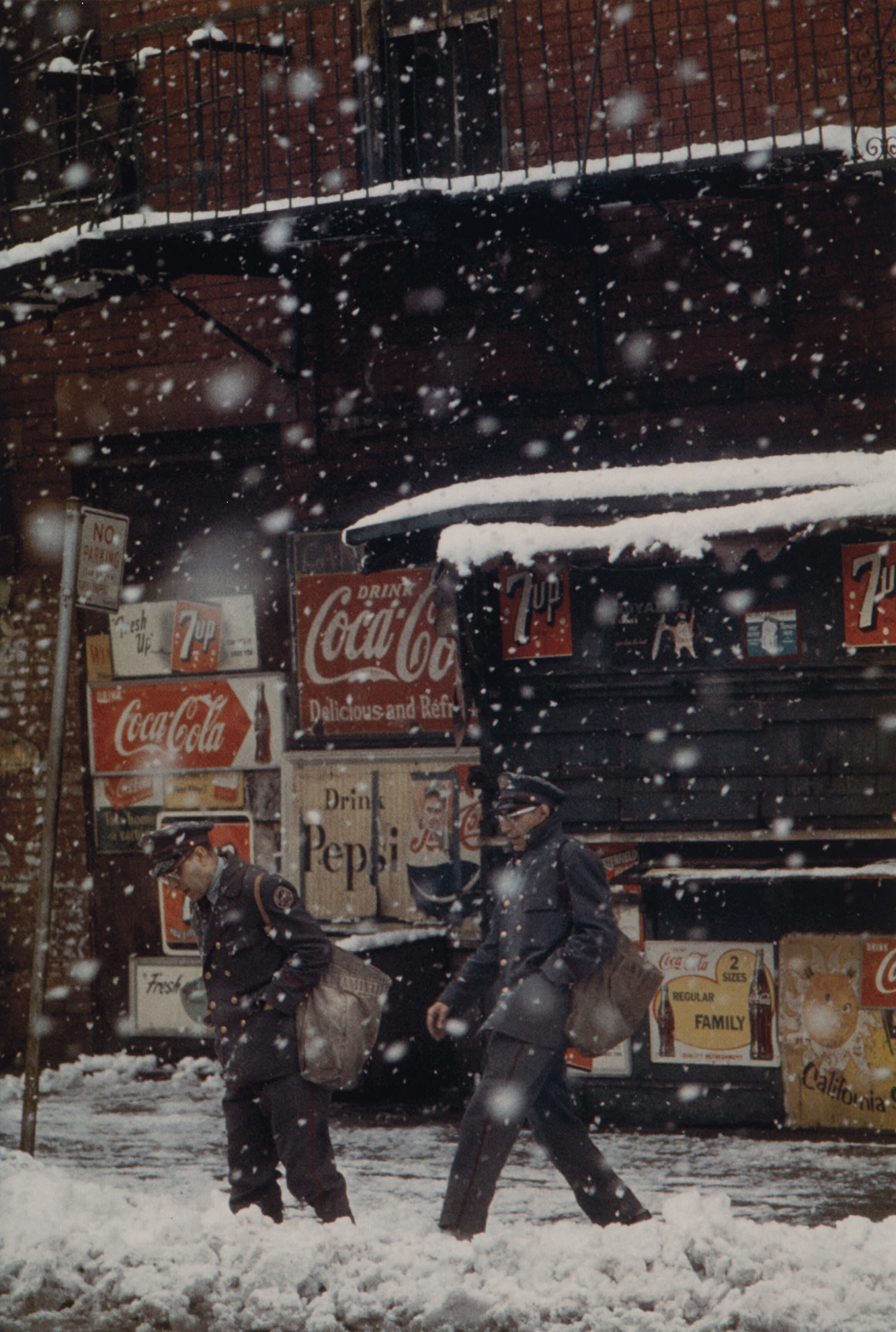
Postmen
His palette, often built around soft grays, muted blues, and sudden shots of saturated red or amber, feels unlike anything produced by his contemporaries. For much of his career, Leiter worked in relative obscurity outside the commercial photography world, where he built a respected practice in fashion photography for magazines including Harper's Bazaar and Esquire. His fine art work was not widely exhibited or collected during the decades when his contemporaries were gaining institutional recognition. It was not until the publication of Early Color by Steidl in 2006 that the full scale of his achievement in color photography became widely known to a new generation of collectors, curators, and photographers.
“Not everything has to have a meaning. A snow covered car is a snow covered car.”
Saul Leiter
The book became something close to a revelation in photography circles, and the retrospective exhibition that followed at the Rudolph Kicken Gallery in Cologne and elsewhere in Europe consolidated his reputation as a master whose work had been sitting quietly, waiting to be properly seen. The documentary film In No Great Hurry, released in 2013 and directed by Tomas Leach, offered a final, intimate portrait of the artist in his lifetime and brought him to an even broader international audience. For collectors approaching Leiter's work, the market offers a range of entry points that reflect both his significance and the particular character of his output. Chromogenic prints and dye destruction prints, many printed later from original negatives under the artist's supervision, represent the most widely available works and remain among the most sought after photographs in the contemporary market for postwar American photography.
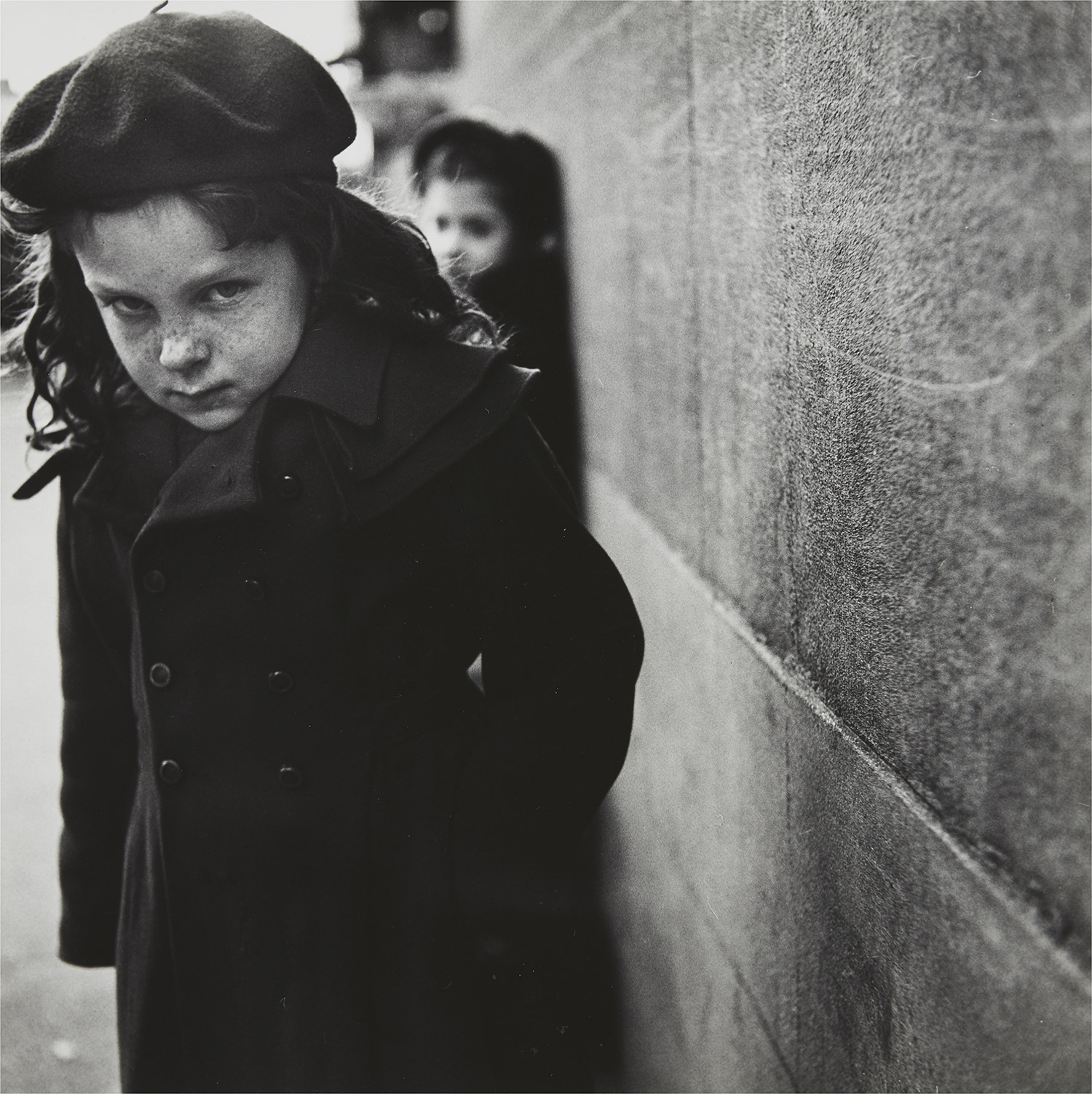
Saul Leiter
1950s
Works such as Red Umbrella and Snowy Scene appear regularly at auction and at specialist photography galleries, where they consistently attract serious attention. The scarcity of vintage prints from the 1940s and 1950s means that later authorized prints carry real weight for collectors who want to engage with his signature imagery. His paintings, which received far less attention during his lifetime, represent a genuinely underexplored area for collectors interested in the full range of his sensibility. Leiter's place in art history sits at a productive intersection of movements and influences.
His work anticipates and in certain ways exceeds the achievements of photographers like Ernst Haas and Fred Herzog, who were also working in color in the 1950s and exploring its expressive possibilities. His formal concerns align him with the quieter, more observational tradition in American photography that runs from Helen Levitt through to contemporary photographers like Alex Webb. The comparison to painters is equally illuminating: there is something in his treatment of reflected light and compressed pictorial space that invites comparisons to Pierre Bonnard and Édouard Vuillard, both of whom Leiter admired. He was, in the most genuine sense, an artist who belonged to more than one tradition simultaneously.
Saul Leiter died in New York in November 2013 at the age of eighty nine, in the same neighborhood where he had lived and worked for six decades. He left behind a body of work whose reputation has grown steadily and shows every sign of continuing to do so. His photographs endure because they are made from genuine feeling and genuine looking, from the particular attention of a man who found the extraordinary inside the ordinary every single day he walked out of his door. In an era of relentless visual noise, his images ask something rare of us: to slow down, to attend, and to notice how much beauty has always been there, waiting in the snow and the glass and the light of an ordinary street.
Explore books about Saul Leiter
Saul Leiter: Early Color
Saul Leiter
Saul Leiter: In My Head
Saul Leiter
Saul Leiter: Over the Rooftops
Saul Leiter

Saul Leiter: Photographs
Saul Leiter, Margit Erb
Saul Leiter: Erkundungen
Saul Leiter

Saul Leiter: Women
Saul Leiter
Saul Leiter: Outtakes
Saul Leiter, Margit Erb
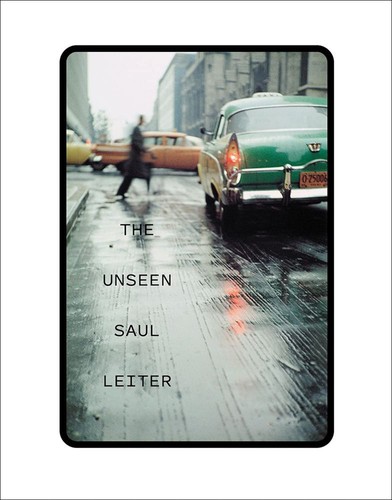
Saul Leiter: Color
Saul Leiter