Sascha Braunig
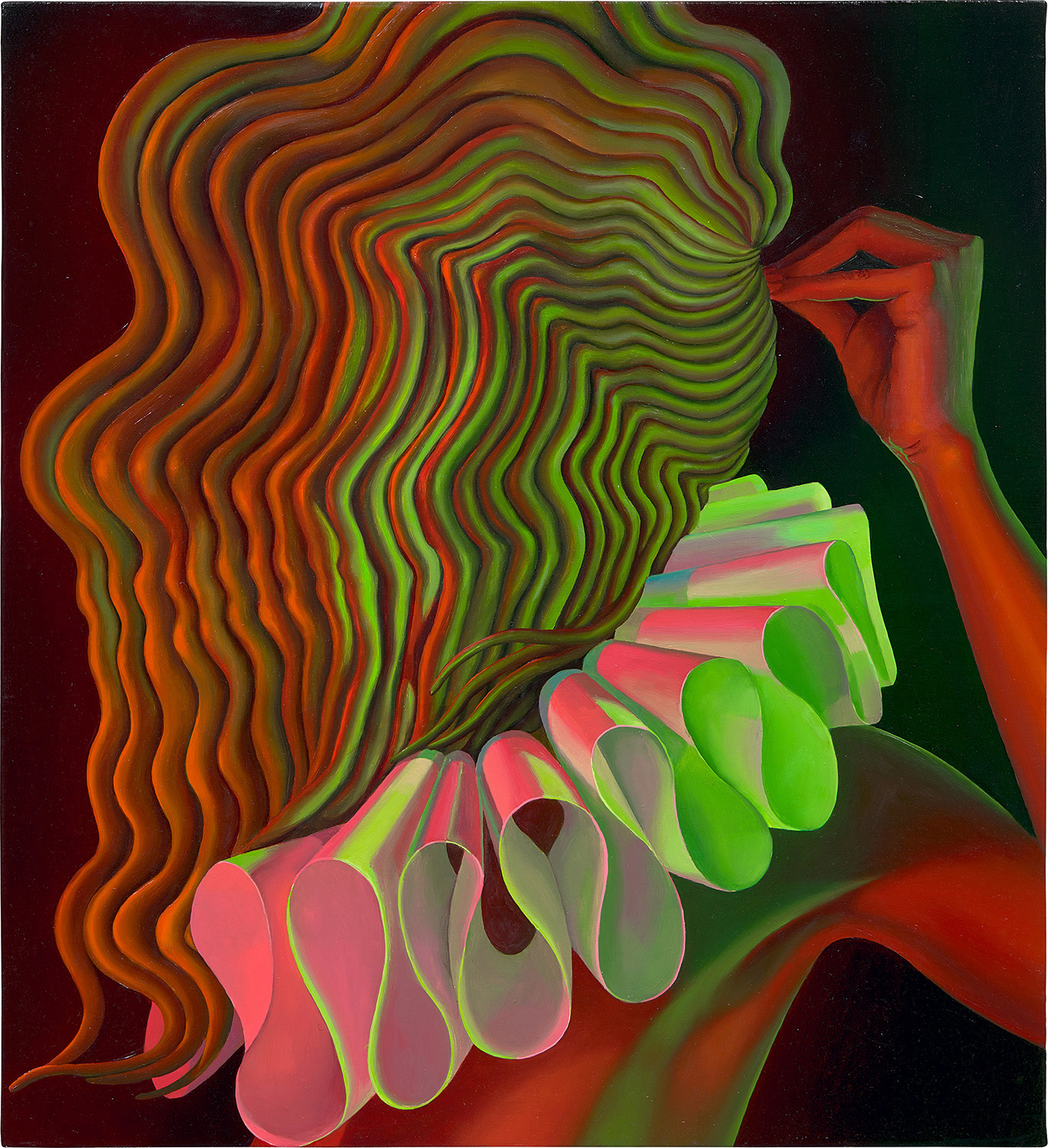
Sascha Braunig, Painting Bodies Into Being
Artist Spotlight · The Collection Editorial
Something quietly electric has been happening in contemporary figurative painting, and Sascha Braunig sits at its most charged center. Over the past decade, her work has moved from the walls of smaller gallery presentations into serious institutional and collector conversations, earning a reputation as one of the most genuinely original painters working in North America today. Her canvases arrive already feeling canonical, as though they have always belonged in the company of the painters we now consider essential. To encounter a Braunig in person is to feel the full force of a singular vision, one that refuses to settle into any easy category while remaining completely, viscerally legible as painting.
Sascha Braunig
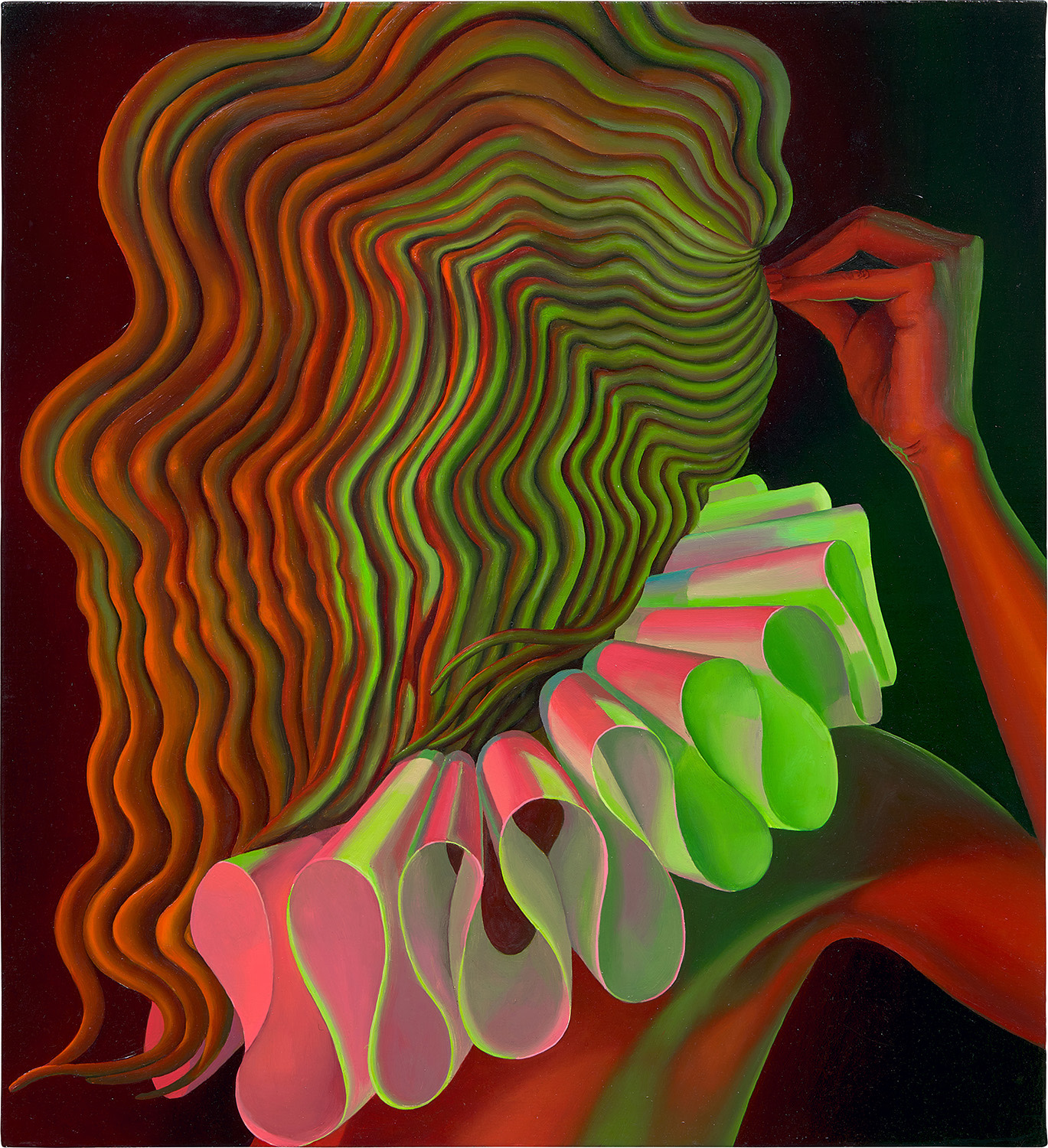
Bossy Pins, 2012
Braunig was born in 1983 and grew up shaped by the dual cultural inheritance that comes with a Canadian and American formation. That in between quality, a sensibility that belongs fully to neither one place nor one tradition, seems to have given her work its particular quality of productive unease. She studied at Yale School of Art, where she earned her MFA, an environment that sharpened her conceptual instincts while keeping her tethered to the discipline of the painted surface. Yale in the early 2000s was a place where figuration was neither celebrated nor dismissed but where the pressure to justify every formal decision became a kind of gift, one that Braunig absorbed and transformed into the meticulous rigor that now defines her practice.
Her early work announced that something unusual was arriving. Figures appeared already in a state of compression, as though the canvas itself were applying pressure from all sides. Braunig developed a vocabulary that combined precise geometric patterning, fabric rendered with almost hallucinatory attention, and bodily forms that seemed to exist somewhere between anatomy and architecture. The influence of artists like Dorothea Tanning and Meret Oppenheim is legible in the surrealist undertow, but Braunig is never illustrating a tradition.
Sascha Braunig
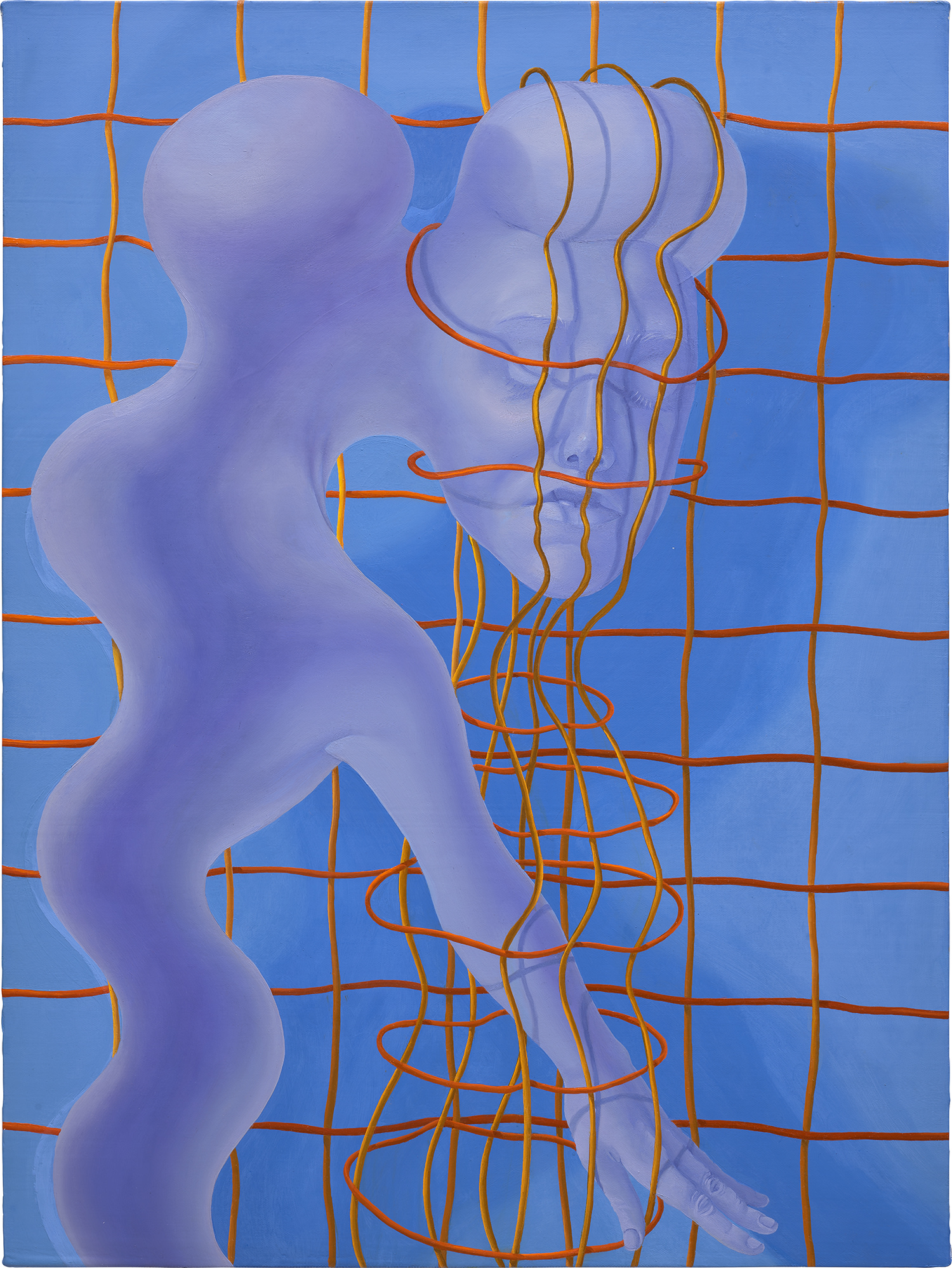
Blue Loomer, 2013
She is using it as a ladder and then pulling the ladder up after her. The paintings that established her reputation arrived in a concentrated burst of production in the early 2010s, and they remain among the most discussed works of that moment in American painting. "Bossy Pins," painted in 2012 in oil on canvas laid on panel, introduced many viewers to her mature method: a figure whose body is simultaneously wrapped, constrained, and adorned, the fabric patterns creating a visual field that the eye cannot easily leave. A year later, "Blue Loomer" from 2013, again oil on canvas over panel, extended this investigation into color and spatial ambiguity.
The figures in these works seem to generate their own gravity. They are not placed in space so much as they constitute space, bending it around themselves through the sheer insistence of Braunig's formal decisions. The work continued to evolve with confident intelligence through the mid decade. "Reef," from 2015, painted in oil on linen over panel, signals a deepening interest in the relationship between the organic and the constructed.
Sascha Braunig
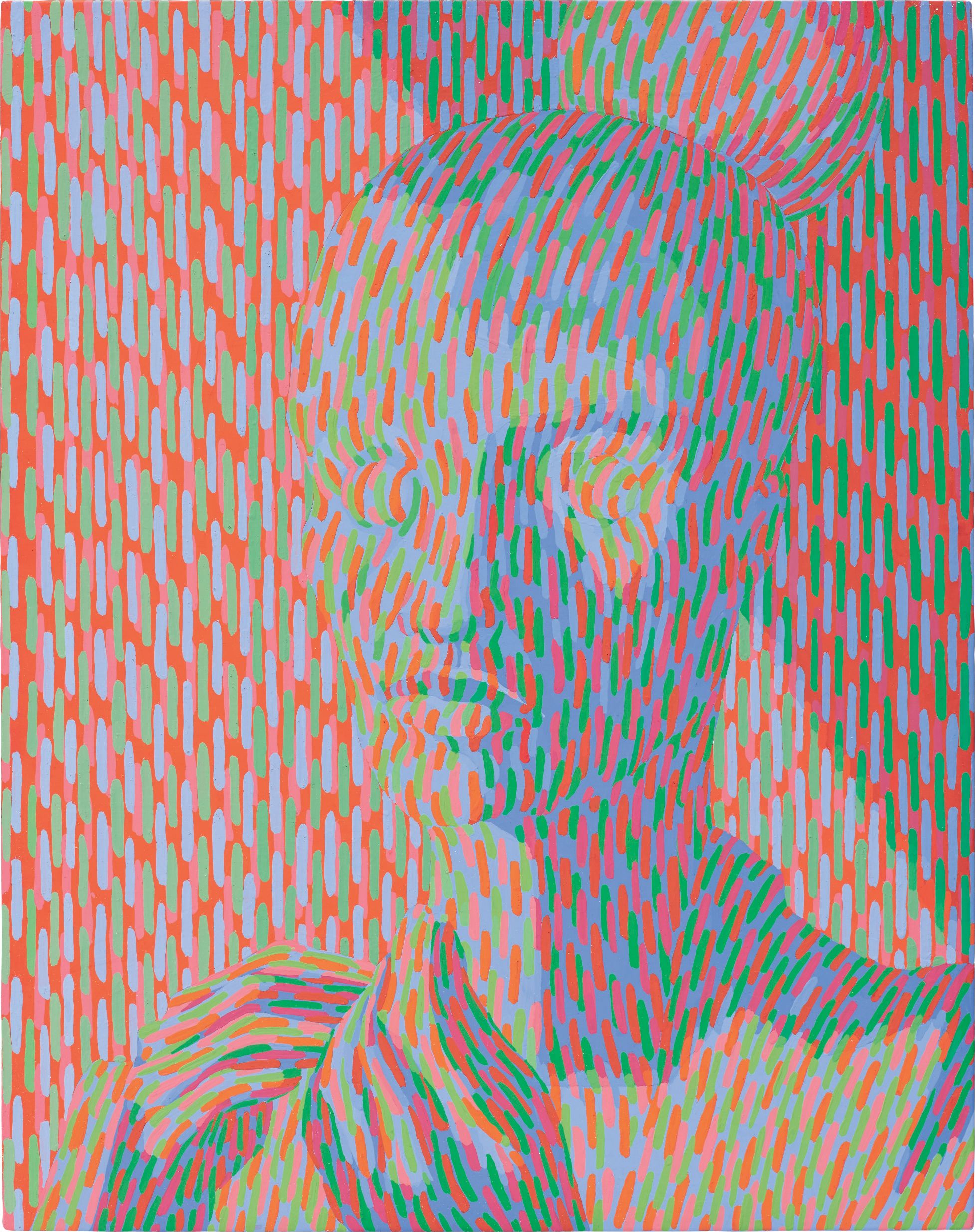
Edith
The title gestures toward natural forms while the surface delivers something stranger and more architectural, a characteristic Braunig move that keeps the viewer productively off balance. "Edith," painted on panel, brings an unusual degree of psychological specificity through its title, suggesting portraiture while delivering something far more ambiguous. By 2021, with "Chalice" in oil on linen over panel, Braunig was demonstrating that her formal interests had not calcified into mannerism but had continued to open outward, incorporating new structural complexity while retaining the intimate scale and intensity that make her work so immediately commanding in person. For collectors, Braunig's work presents a convergence of qualities that serious buyers recognize as rare.
The paintings are rigorously conceived and flawlessly executed, operating at a level of craft that rewards sustained looking. They are also deeply embedded in the conversations that matter most to contemporary art: questions of bodily autonomy, the politics of representation, the relationship between pattern and identity, and the philosophical problem of where a figure ends and its environment begins. Collectors who have built around contemporary figuration know that the field has seen an extraordinary decade of attention, but they also know that not every painter working in this mode is doing something that will hold up. Braunig holds up.
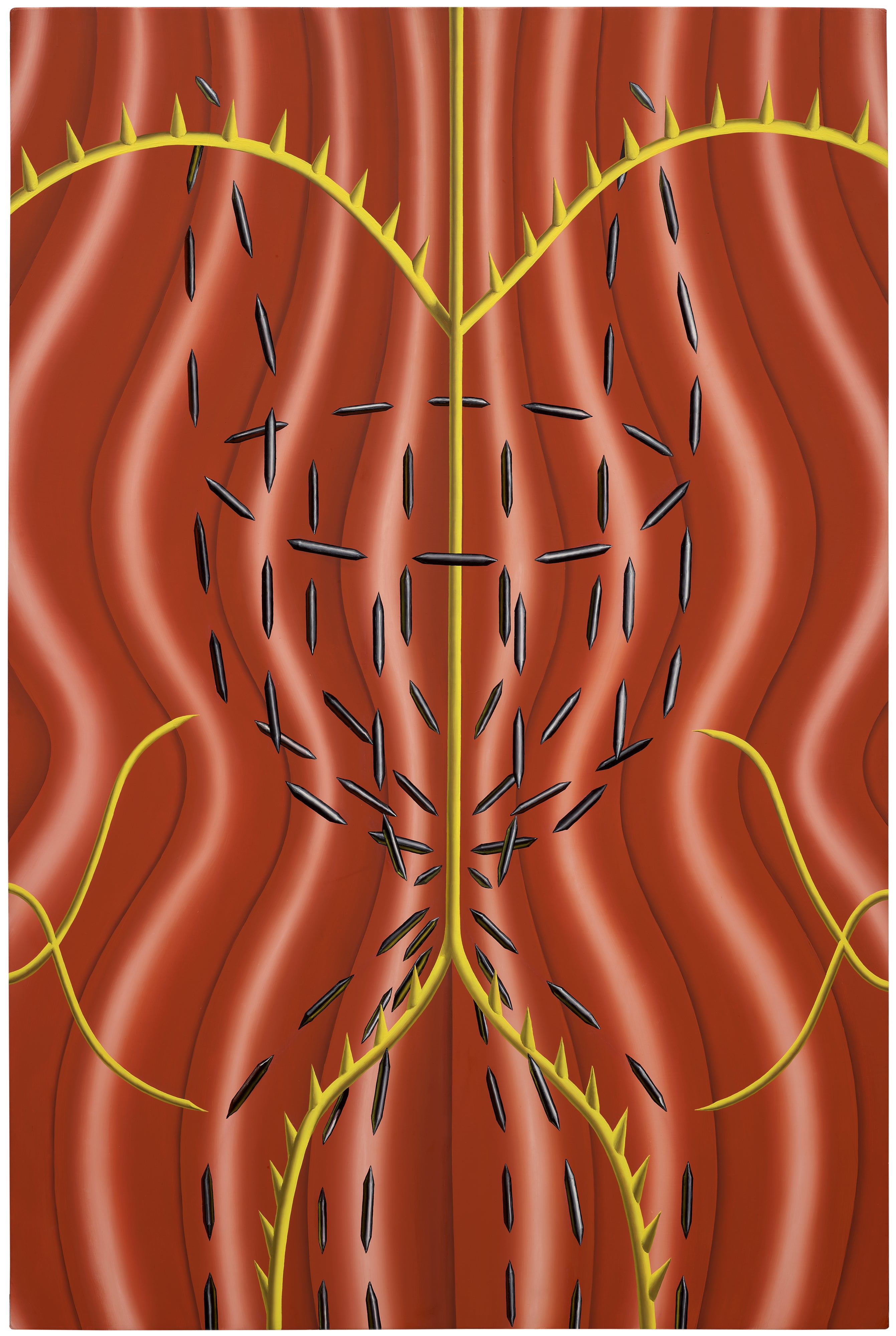
Sascha Braunig
Chalice, 2021
Her works function as both objects of formal pleasure and as propositions about what painting can know that other mediums cannot. The context for Braunig's achievement is a generation of painters who collectively rehabilitated figuration as a serious critical enterprise. Artists such as Lynette Yiadom Boakye, Amy Sillman, and Nicole Eisenman have each staked out distinct territories within contemporary figurative painting, and Braunig belongs in that company without being confused with any of them. Her closest affinities might be with painters who push the figure toward something psychological and pressurized, where the body becomes a site of inquiry rather than a subject of depiction.
There is also a lineage worth acknowledging that runs through Balthus and Francis Bacon, not in style but in the willingness to use the painted body as a space where anxiety and beauty become indistinguishable from each other. What Braunig represents for collectors and for the broader culture of painting is something more than a strong individual talent. She is a proof of what committed, rigorous, imaginative painting can still do. In a moment when images are produced and consumed at a speed that makes looking feel almost impossible, her work insists on slowness, on the rewards that come from sustained attention, and on the irreplaceable experience of standing before a painted surface that was made by a single mind working with complete conviction.
To collect Braunig is to believe in painting's future. Given the quality of the evidence she has produced, that belief seems not like faith but like good judgment.