Santiago Sierra
Santiago Sierra Makes the Invisible Finally Visible
Artist Spotlight · The Collection Editorial
“I'm not trying to denounce anything. I'm trying to show reality as it is.”
Santiago Sierra, interview with Artforum
In the autumn of 2023, the Museo Reina Sofía in Madrid reaffirmed what the international art world has long understood: Santiago Sierra is among the most morally serious and formally rigorous artists working today. His practice has been the subject of sustained institutional attention across Europe, the Americas, and Asia for over two decades, and the appetite for his work shows no sign of diminishing. Collectors, curators, and critics continue to return to his output not because it is comfortable, but because it is necessary, a body of work that refuses to let capital and labour exist in polite silence beside one another. Sierra was born in Madrid in 1966, coming of age during the final years of Francoism and the turbulent transition to Spanish democracy.
Santiago Sierra
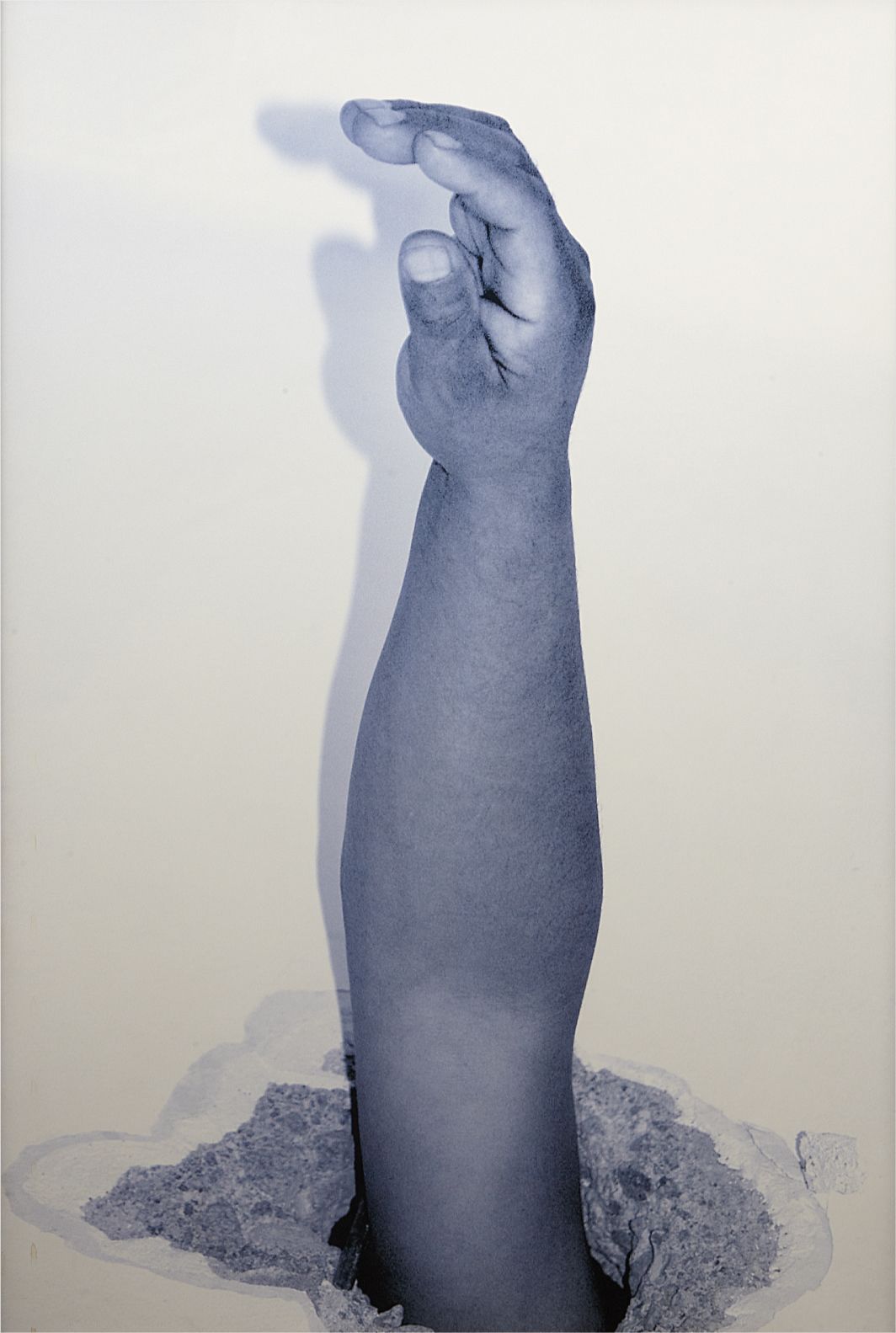
Brazo de obrero atravesando el techo de una sala de arte desde una vivienda
That formative political atmosphere, one charged with questions about who holds power and who bears its costs, left a permanent imprint on his sensibility. He studied fine arts in Madrid before relocating to Hamburg and later, crucially, to Mexico City, where he settled in the mid 1990s. The move to Mexico proved transformative. Living and working in a megacity defined by vast economic inequality, Sierra found the conceptual and human material that would fuel his mature practice.
The stark visibility of class stratification in Latin America gave shape to ideas he had been circling and sharpened them into something precise and unanswerable. Sierra emerged from a tradition that takes conceptual art at its word, insisting that the idea and its execution are inseparable from the social conditions in which they occur. He absorbed the lessons of artists like Hans Haacke, whose institutional critique laid the groundwork for art that interrogates the structures surrounding it, and the legacy of minimalism, whose formal economy he appropriates and redirects toward political ends. But Sierra's most distinctive move was to bring the body, specifically the bodies of economically vulnerable workers, into the centre of the frame.
Santiago Sierra
Person Facing into a Corner
Where minimalism evacuated the human presence, Sierra restores it, and in doing so makes the human cost of aesthetic experience impossible to ignore. The works available through The Collection offer a superb cross section of this practice at its most concentrated. Works such as "Person Paid to have 30 cm line tattooed on them" and "Hiring and arrangement of 30 workers in relation to their skin colour" are paradigmatic Sierra: black and white photographs that document actions in which participants were remunerated at local market rates to submit their bodies or labour to the demands of the piece. The photographs are beautiful objects, composed with the cool authority of documentary tradition, yet what they record is a transaction that implicates the viewer in the very systems of exploitation the work anatomises.
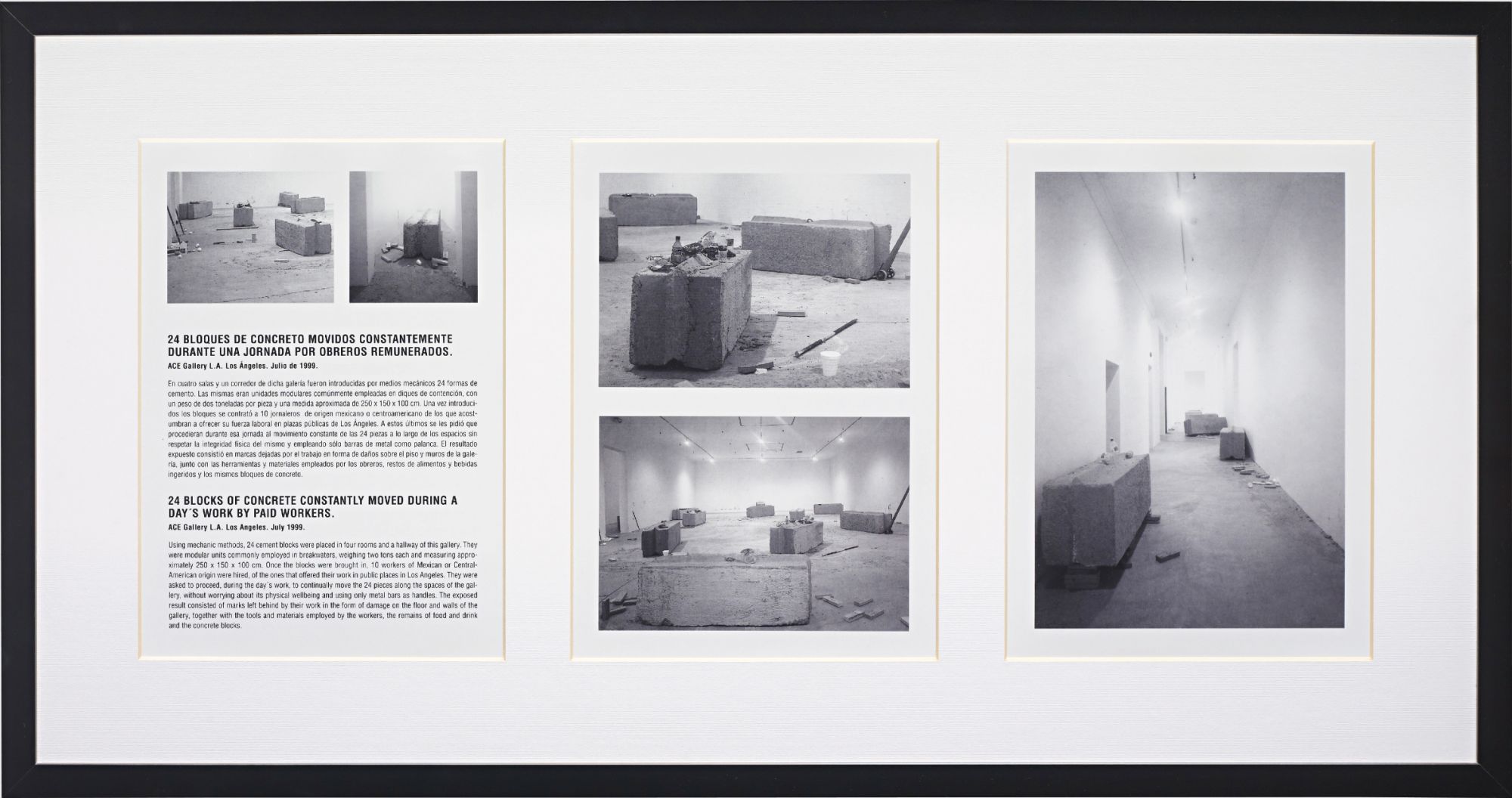
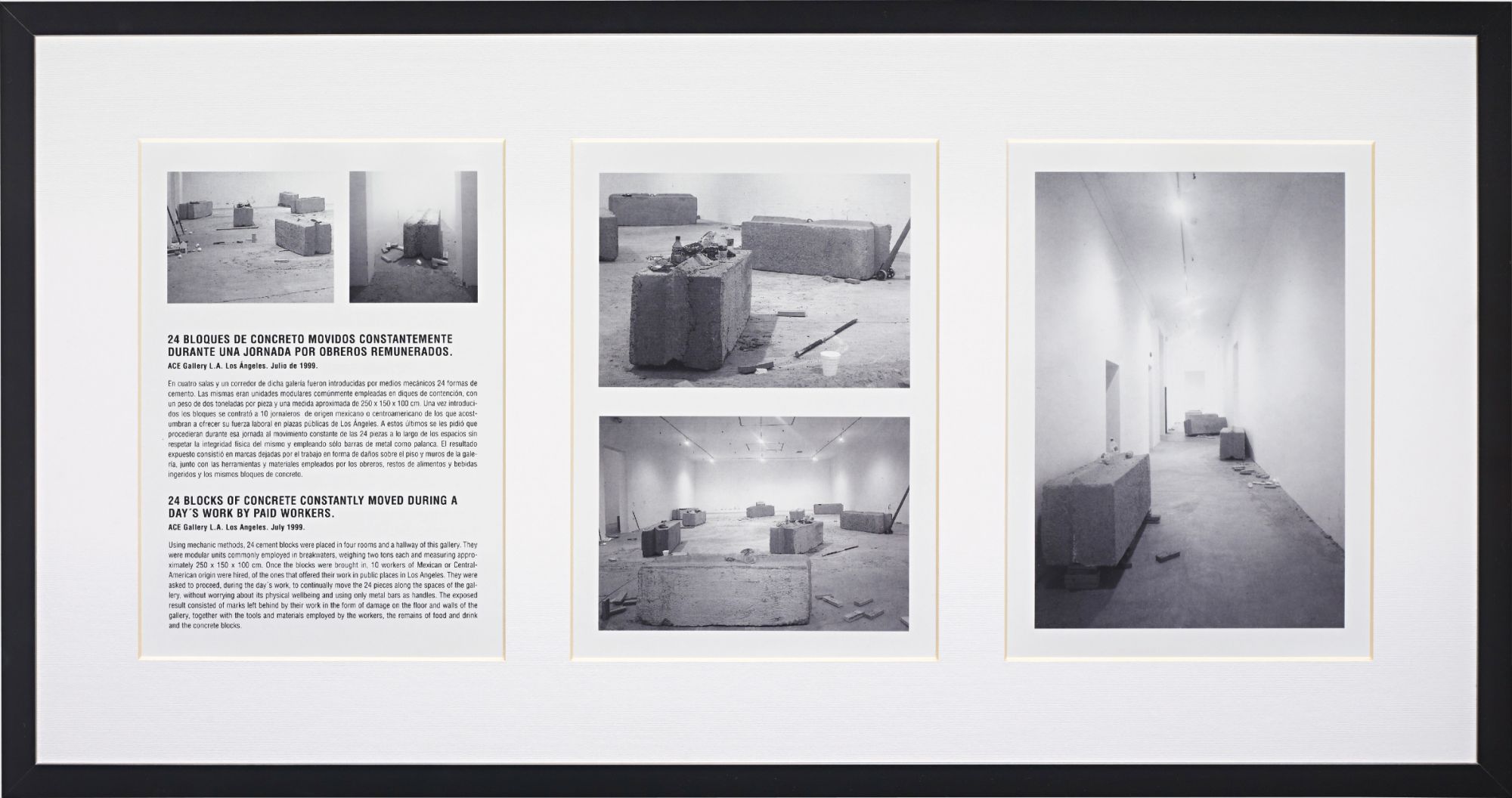
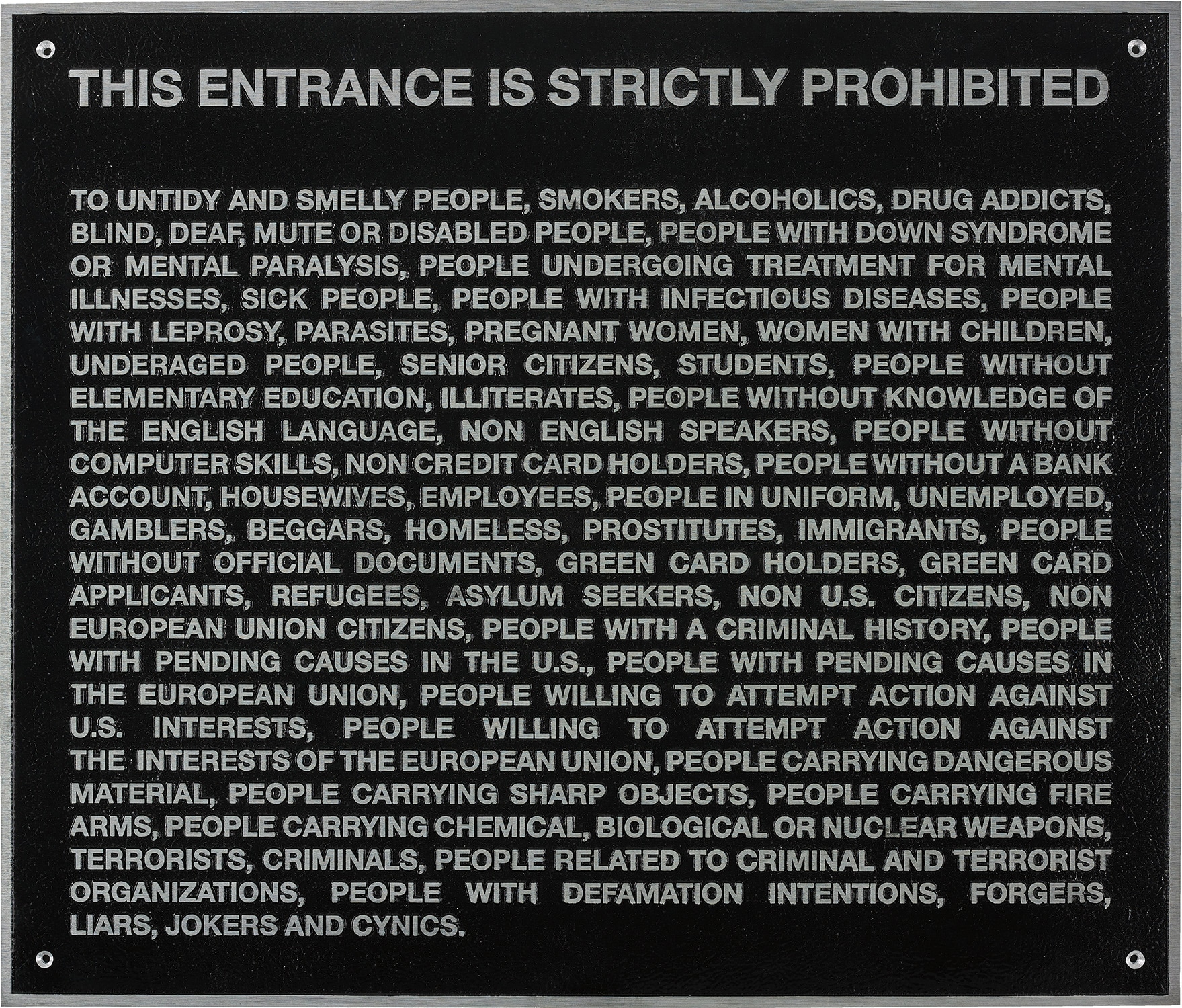
"24 Blocks of Concrete Constantly Moved During a Day's Work by Remunerated Laborers" performs a similar operation in the register of physical toil, making visible the Sisyphean logic of wage labour stripped of any productive purpose. The work exists as both chromogenic print and as a documented performance, and in either form it carries the same uncomfortable charge. The "Door Plate" works and the broader Door Cycle pieces, including "Aviso Público (Public Notice)", demonstrate another dimension of Sierra's intelligence. Cast in aluminium with the spare authority of official signage, these objects occupy an uncanny threshold between institutional language and artistic gesture.
Santiago Sierra
24 Blocks of Concrete Constantly Moved During a Day's Work by Paid Workers
They look like the bureaucratic infrastructure of power, the kind of placard that hangs outside a ministry or a bank, and yet they are art objects, privately held, collectible, and in that shift lies a quietly devastating commentary on who controls access and who is kept outside. "Brazo de obrero atravesando el techo de una sala de arte desde una vivienda" extends this logic spatially, with the literal arm of a worker breaking through the gallery ceiling from the dwelling above, a gesture that renders the invisible labour sustaining the art world shockingly, almost comically, present. From a collecting perspective, Sierra's work occupies a distinctive and highly defensible position in the market. His editions and multiples, including the Door Cycle works, offer an accessible entry point into a practice that commands serious critical respect, while his unique photographic works and large scale documentation pieces represent more substantial commitments that have appreciated steadily as his institutional profile has grown.
Galerie Peter Kilchmann in Zurich and Lisson Gallery have both represented his work internationally, bringing him before the most discerning collectors in Europe and the United States. His work entered major institutional collections relatively early, and the subsequent decades have only deepened the sense that acquiring Sierra is acquiring a piece of genuinely consequential art history. The photographic works, printed on Fujicolor Crystal Archive paper with the archival rigour that bespeaks long term value, are particularly sought after for their combination of formal quality and conceptual weight. Sierra belongs to a generation of artists, including Tino Sehgal, Rirkrit Tiravanija, and Thomas Hirschhorn, who radicalized the social turn in contemporary art during the late 1990s and early 2000s, insisting that the relationship between art and its economic conditions was not merely a background consideration but the very substance of the work.

Santiago Sierra
Door Plate, 2006
Yet Sierra distinguishes himself from many of his peers through an unflinching willingness to foreground discomfort rather than community, exchange rather than gift. His work does not offer the warmth of social practice; it offers the cold clarity of a contract, and in that clarity is a form of profound respect for the people whose labour he documents and the audience he refuses to let off the hook. The legacy Sierra is building is one that will only grow more legible with time. As global conversations about inequality, migration, precarious labour, and the ethics of art collecting deepen, his practice reads less like provocation and more like prophecy.
He identified, with remarkable early precision, the fault lines along which contemporary society would crack, and he made work that sits directly on those lines. For collectors who want art that participates in the most serious intellectual and moral conversations of our moment, and that does so with formal beauty and rigorous intelligence, Sierra represents an extraordinary and enduring opportunity.
Featured Works

Explore books about Santiago Sierra
Santiago Sierra
Okwui Enwezor
Santiago Sierra: Works 1995-2002
Various
Santiago Sierra
Museo Tamayo
Santiago Sierra: A Retrospective
Cuauhtémoc Medina
Santiago Sierra: Political Sculptures
Hal Foster