Samuel Palmer
Samuel Palmer's Eternal, Luminous English Dream
Artist Spotlight · The Collection Editorial
“The Valley of Vision lies before me, and if I could but grasp it firmly, all my work would be done.”
Samuel Palmer, letters
There are moments in the history of British art when a single body of work seems to hold the entire soul of a nation inside it. When the Ashmolean Museum in Oxford mounted a celebrated display of Samuel Palmer's Shoreham period works, visitors stood before small, densely worked canvases and felt something almost physical: the warmth of a harvest moon, the weight of ripe grain, the hush of a valley folding itself into night. Palmer was not simply painting landscapes. He was painting a state of grace, and nearly a century and a half after his death in 1881, that vision has never felt more urgently, more beautifully alive.
Samuel Palmer
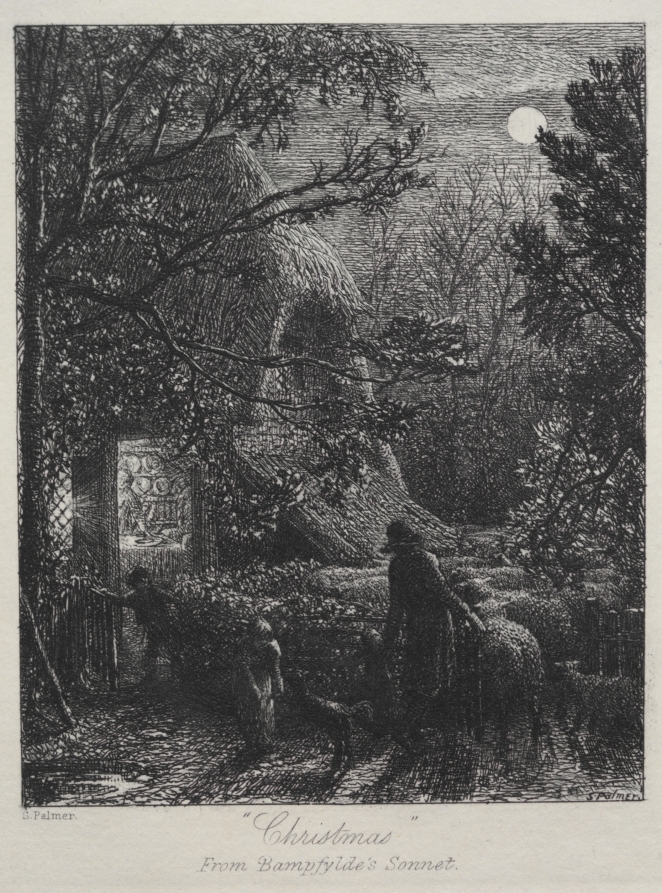
Christmas (Folding the Last Sheep), 1850
Samuel Palmer was born in Newington, London, in 1805, the son of a bookseller with a deep love of literature and a nonconformist faith that would permanently color his son's imagination. He was a prodigious and sensitive child, largely educated at home, and he encountered the poetry of John Milton and Virgil at an age when most boys were still learning their letters. By the time he was fourteen he was exhibiting landscapes at the Royal Academy, a fact that speaks less to ambition than to the almost alarming intensity with which he engaged with the visible world. London in the early nineteenth century was a city transforming itself through industry and commerce, and Palmer responded not with enthusiasm but with a yearning for something older, slower, and more holy.
The great pivot of Palmer's formation came through his friendship with William Blake, whom he met in 1824 when Palmer was just nineteen years old. Blake was then in his late sixties, a visionary largely dismissed by the mainstream art world, but to Palmer he was a revelation. Blake's wood engravings for Thornton's edition of Virgil showed Palmer that a landscape could be charged with spiritual electricity, that moonlight and shadow could carry the weight of divine meaning. This encounter sent Palmer toward the village of Shoreham in Kent, where he settled around 1826 and spent the most concentrated and extraordinary years of his creative life, from roughly 1826 to 1835.
Samuel Palmer
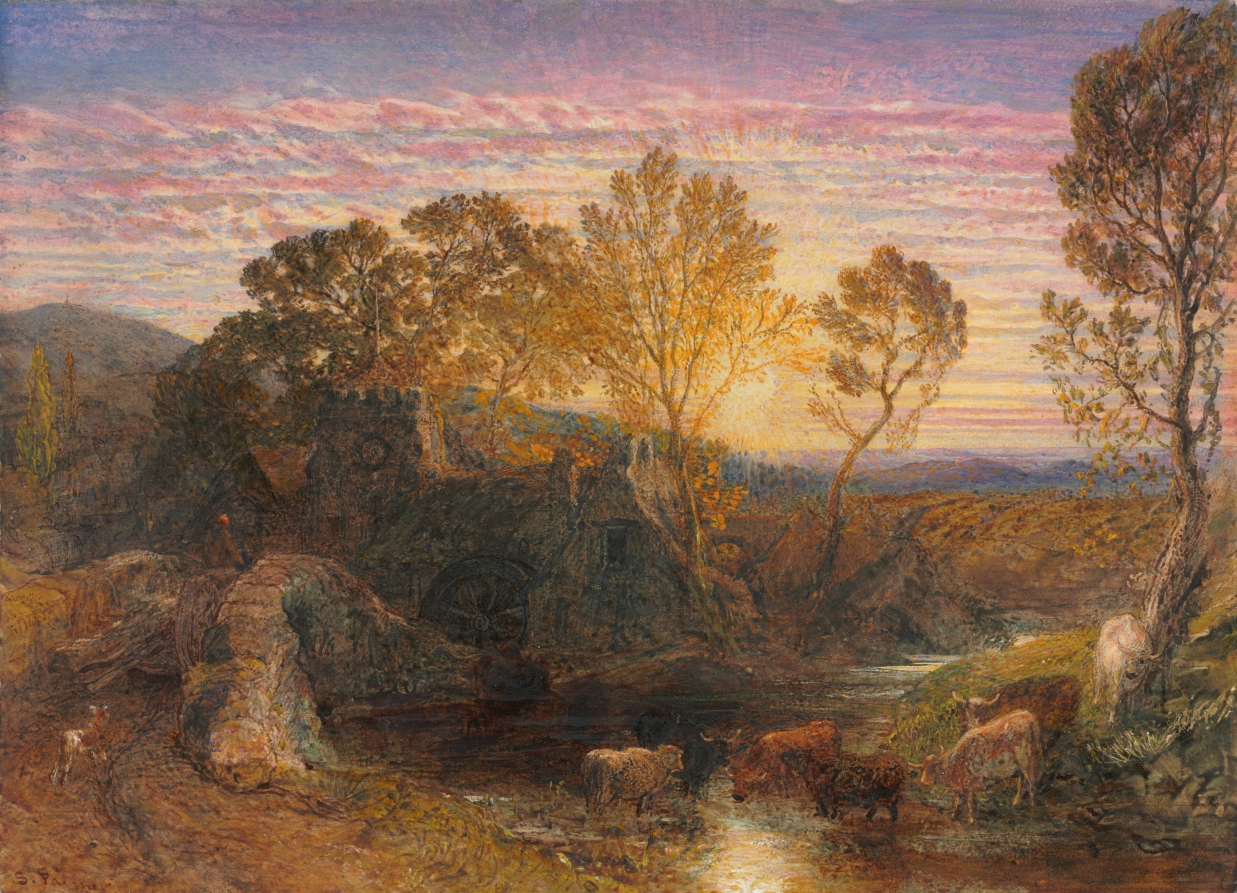
The Golden Hour, 1865
He called the valley around Shoreham his "Valley of Vision," and the phrase is not metaphor. He meant it literally. The Shoreham works are among the most remarkable achievements in the entire tradition of British painting. Palmer worked in pen and ink, watercolor, tempera, and oil, often layering media in ways that created surfaces of extraordinary density and richness.
“Excess is the essential vivifying spirit of the finest art.”
Samuel Palmer, notebook
His moons are impossibly large and golden, his apple orchards grotesquely, ecstatically abundant, his shepherds and reapers moving through a landscape that feels simultaneously ancient and timeless. There is nothing quite like them in the art of their period. They have affinities with the Northern European Gothic and with the pastoral tradition stretching back through Claude Lorrain, but they arrive at something entirely their own: a sacred Englishness saturated with a longing that is almost painful in its beauty. The circle of young artists Palmer gathered around him at Shoreham called themselves the Ancients, a name that captures their shared conviction that the deepest truths were rooted in antiquity and faith rather than in the progressive spirit of the age.
Samuel Palmer
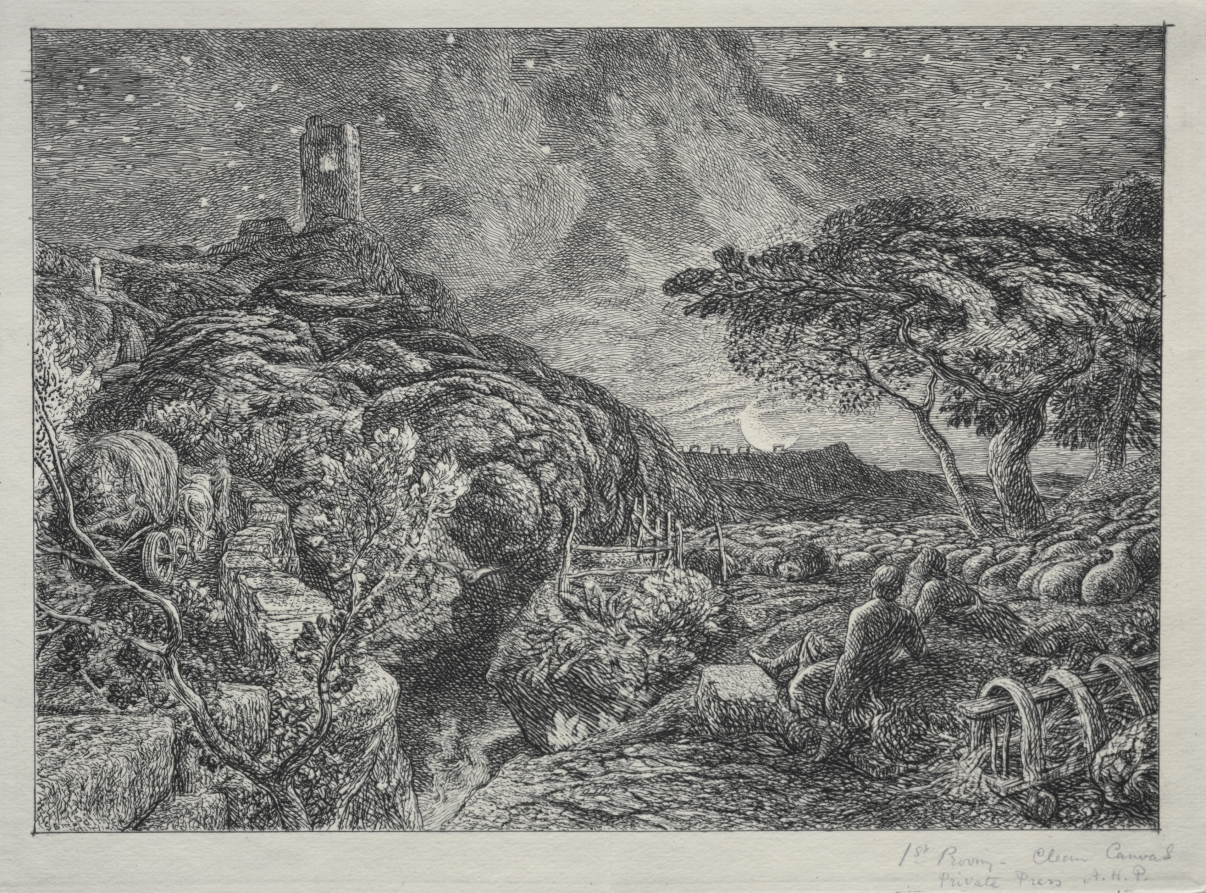
The Lonely Tower, 1879
After his marriage to Hannah Linnell in 1837 and a honeymoon journey through Italy, Palmer's work shifted. The visionary intensity of the Shoreham years gave way to a more conventionally accomplished manner, and for several decades he produced pleasing but less electrifying paintings and watercolors that found a respectable audience without setting the art world alight. It is a story familiar from the lives of many artists: the commercial and social pressures of adult life filing down the sharper edges of a singular vision. Yet Palmer never entirely abandoned his deepest impulses, and in the final decades of his life he found in etching a medium that allowed something of the old fire to return.
Works like The Lonely Tower, The Rising Moon, The Early Plowman, and The Weary Plowman crackle with a concentrated drama that places them among the finest etchings produced in Victorian Britain. The Skylark soars above a twilit field with almost unbearable lightness. Christmas, subtitled Folding the Last Sheep, brings a tenderness to agrarian labor that feels genuinely devotional. For collectors, Palmer presents a landscape of exceptional richness and genuine variety.
Samuel Palmer
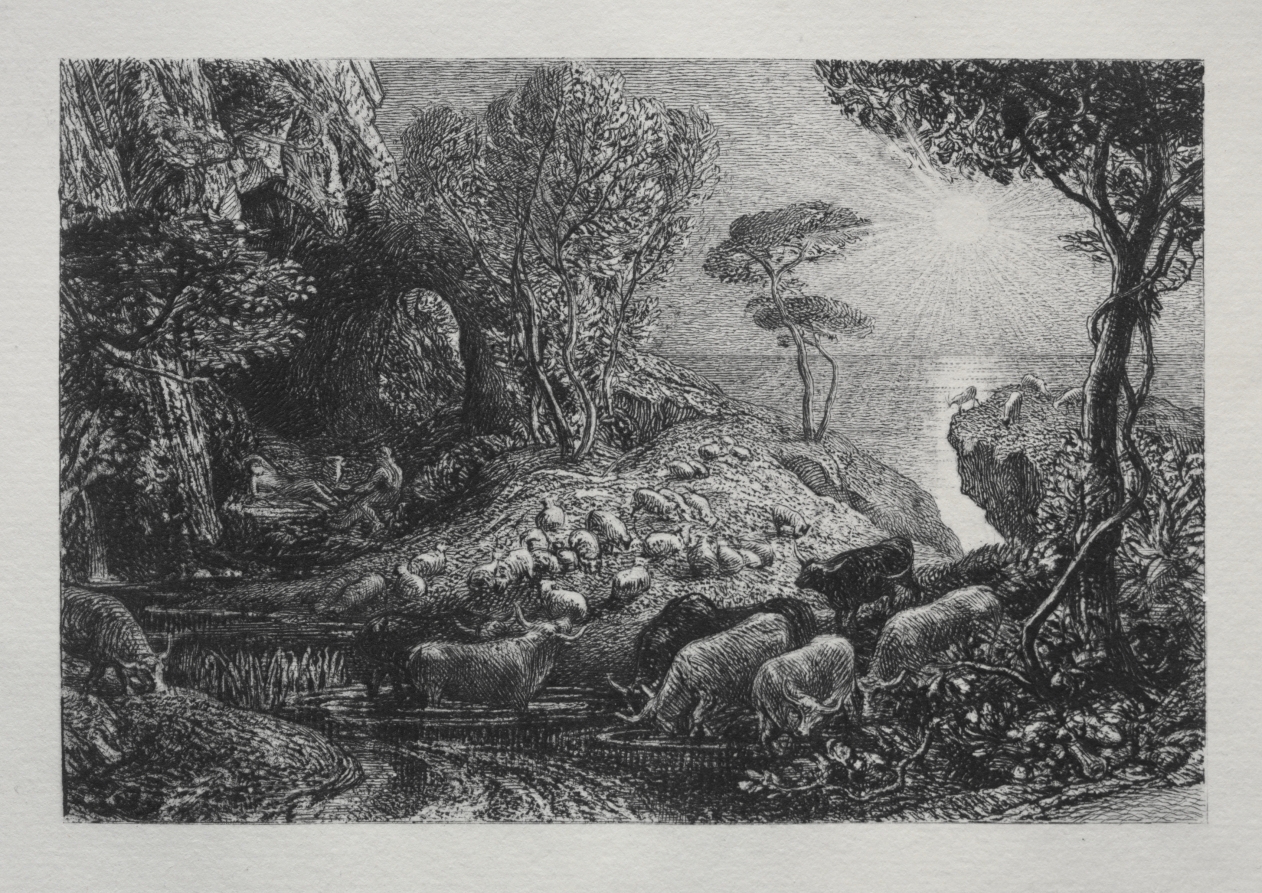
Moeris and Galatea, 1883
His etchings, many of which were produced in relatively modest editions, appear at auction with enough regularity to reward patient attention, and they are held in major collections including the British Museum, the Victoria and Albert Museum, and the Yale Center for British Art. Watercolors and gouaches from his mature period, such as The Golden Hour of 1865, demonstrate his mastery of a slow, luminous light that owes much to his study of Claude and Turner while remaining unmistakably personal. Works on paper from the Shoreham years, when they appear, are among the most coveted objects in British art and are priced accordingly, having passed through major sales at Christie's and Sotheby's London to find homes in institutional and private collections of the highest seriousness. What draws collectors again and again is not rarity alone but emotional truth: Palmer's work rewards sustained looking in a way that few artists of any period can match.
In the broader context of art history, Palmer occupies a position of remarkable influence. The Ancients, his circle at Shoreham, included Edward Calvert and George Richmond, both of whom shared his debt to Blake and his rejection of industrial modernity. Palmer's legacy runs forward through the English pastoral tradition, touching the Neo Romantic artists of the 1940s, among them Graham Sutherland and John Piper, who rediscovered the Shoreham works and found in them a template for a spiritually charged engagement with the British landscape. There are also clear lines connecting Palmer to the American visionary tradition, and his influence on twentieth century printmaking has been acknowledged by artists working on both sides of the Atlantic.
His friendship and debt to his father in law John Linnell, himself a significant figure in British landscape painting, placed him at the center of a network of Romantic era art that continues to generate scholarly and curatorial attention. Samuel Palmer matters today for reasons that go beyond connoisseurship or market positioning. In an era of pervasive anxiety about the natural world, his painting asks us to look at a field, a moon, a tree in blossom and feel the full weight of what might be lost. His art is not nostalgic in the pejorative sense.
It is urgent. It insists that beauty is not decoration but necessity, that the luminous and the sacred are not separate from ordinary life but woven through it, visible to anyone willing to slow down and truly see. To collect Palmer is to inherit that vision, and to carry it forward into a world that needs it more than ever.
Explore books about Samuel Palmer