Ryan McGinness
Ryan McGinness Turns Every Symbol Into Poetry
Artist Spotlight · The Collection Editorial
“I am interested in the way that symbols and signs accumulate meaning over time and across different contexts.”
Ryan McGinness, studio interview
In the spring of 2023, the art world was reminded once again of Ryan McGinness's singular ability to hold two worlds in perfect tension when his large scale paintings commanded serious attention at auction and in gallery presentations across New York and Los Angeles. His canvases, dense with interlocking symbols and radiating color fields, looked as vital and urgent as anything being made by artists half his age. For a painter who has been building one of the most coherent and ambitious bodies of work in American contemporary art since the late 1990s, that vitality is not accidental. It is the product of a rigorous, deeply considered practice that has only grown richer with time.
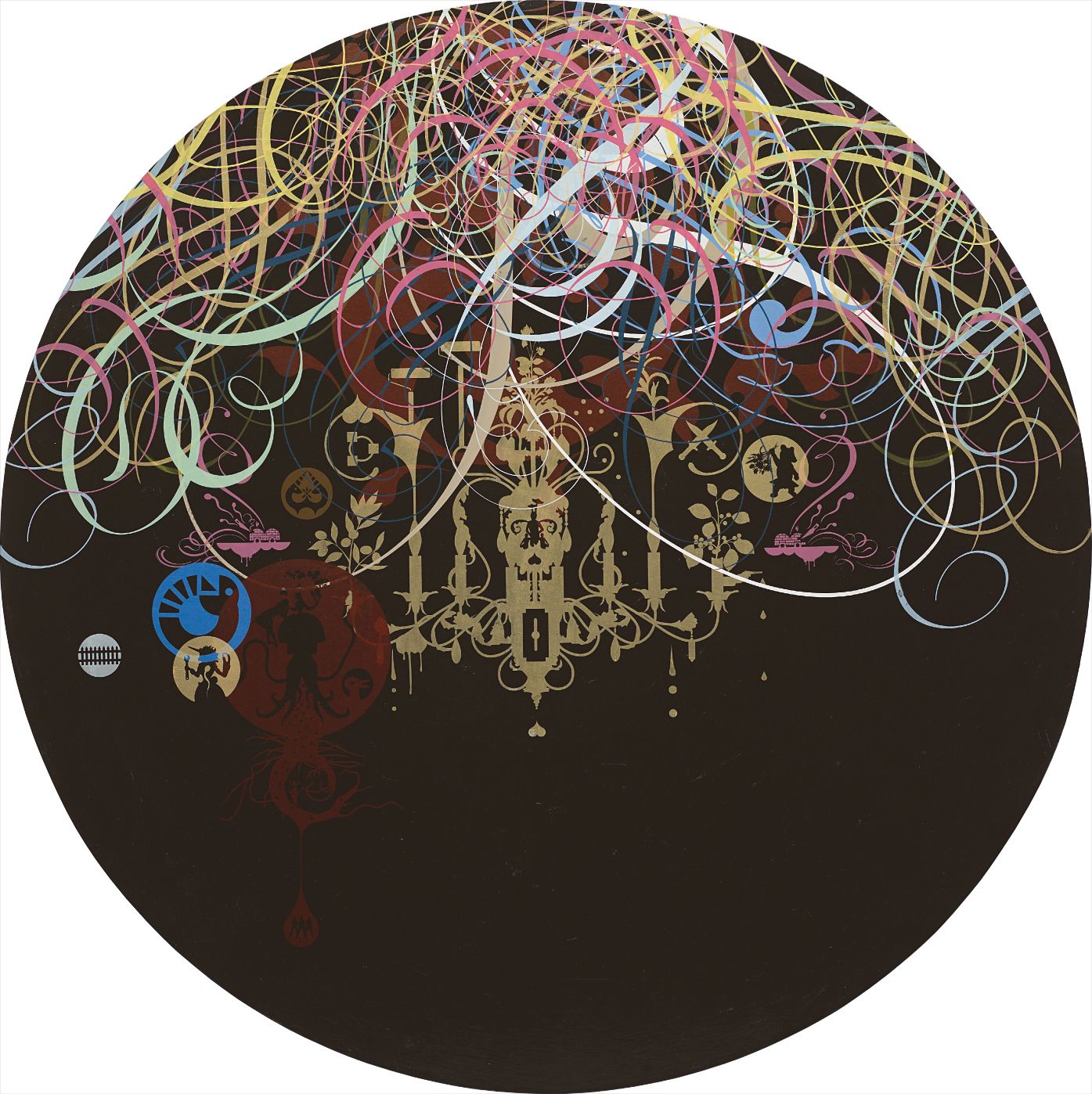
Ryan McGinness
May I Have a Large Cup of Coffee?
Ryan McGinness was born in 1972 in Virginia Beach, Virginia, a city shaped by military culture, surf and skate subcultures, and the particular restless energy of the American coast. That environment left its mark. The visual language of skateboarding, with its hunger for bold graphics, irreverent iconography, and the democratization of design, entered McGinness's sensibility early and never really left. He went on to study at Carnegie Mellon University in Pittsburgh, where he received a BFA and developed the foundational understanding of graphic design, communication theory, and fine art history that would later allow him to move between those disciplines with unusual ease and authority.
After graduating, McGinness relocated to New York City in the early 1990s, arriving at a moment when the boundaries between commercial culture and fine art were being aggressively tested. He worked in design and branding, gaining fluency in the visual grammar of logos, corporate identity, and consumer communication. Rather than treating that experience as something separate from his art practice, he recognized it as the very subject matter he wanted to explore. By the late 1990s, he had begun developing the language that would become his signature: intricate, layered compositions built from hundreds of symbols, signs, and invented iconography, rendered with the precision of a commercial illustrator and the ambition of a painter thinking about Jasper Johns, Andy Warhol, and the full sweep of twentieth century American art.
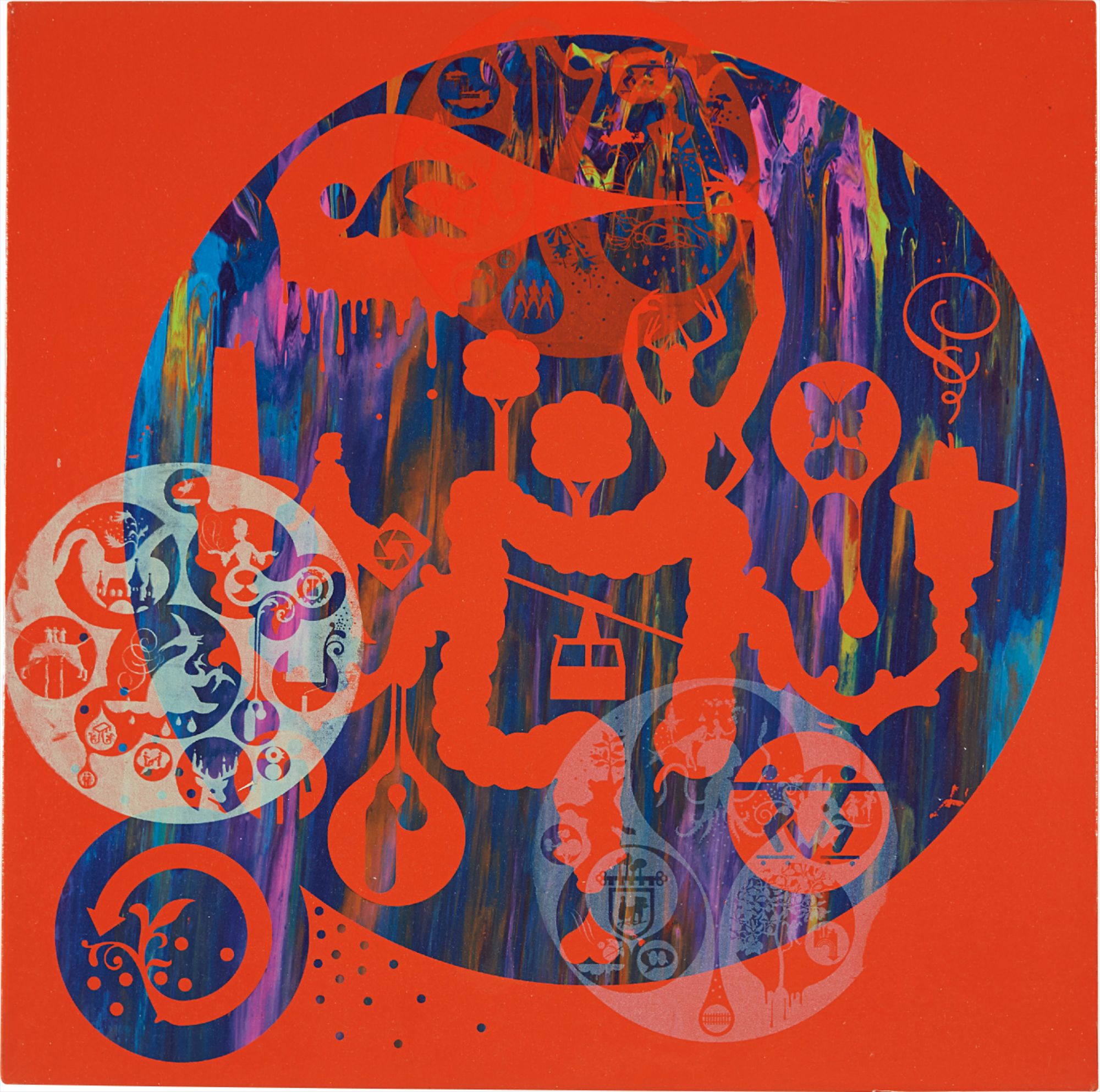
Ryan McGinness
The Greatest Good for the Greatest Number
The breakthrough came with exhibitions that positioned McGinness not as a designer making art, but as a serious painter engaging with the history of image making. His shows at Kid Robot and later at prominent galleries including Steve Lazarides and Zero in Milan helped establish an international audience that understood his work as something genuinely new. He was not simply quoting commercial culture the way earlier Pop artists had done. He was fluent in it, had worked inside it, and was now using that fluency to ask harder questions about how images accumulate meaning, how symbols function across different contexts, and what happens when the visual noise of contemporary life is organized into something approaching beauty.
Works from this period, including paintings on wood panel using acrylic and urethane enamel, demonstrated his technical range and his commitment to the physicality of the painted surface. Among his most celebrated works, pieces like "The Greatest Good for the Greatest Number" and "The Need for Enemies" illustrate the philosophical ambition that runs beneath the dazzling surface of his compositions. The titles are not decorative; they invite the viewer to consider the relationship between collective ideology and individual symbol systems. "May I Have a Large Cup of Coffee?
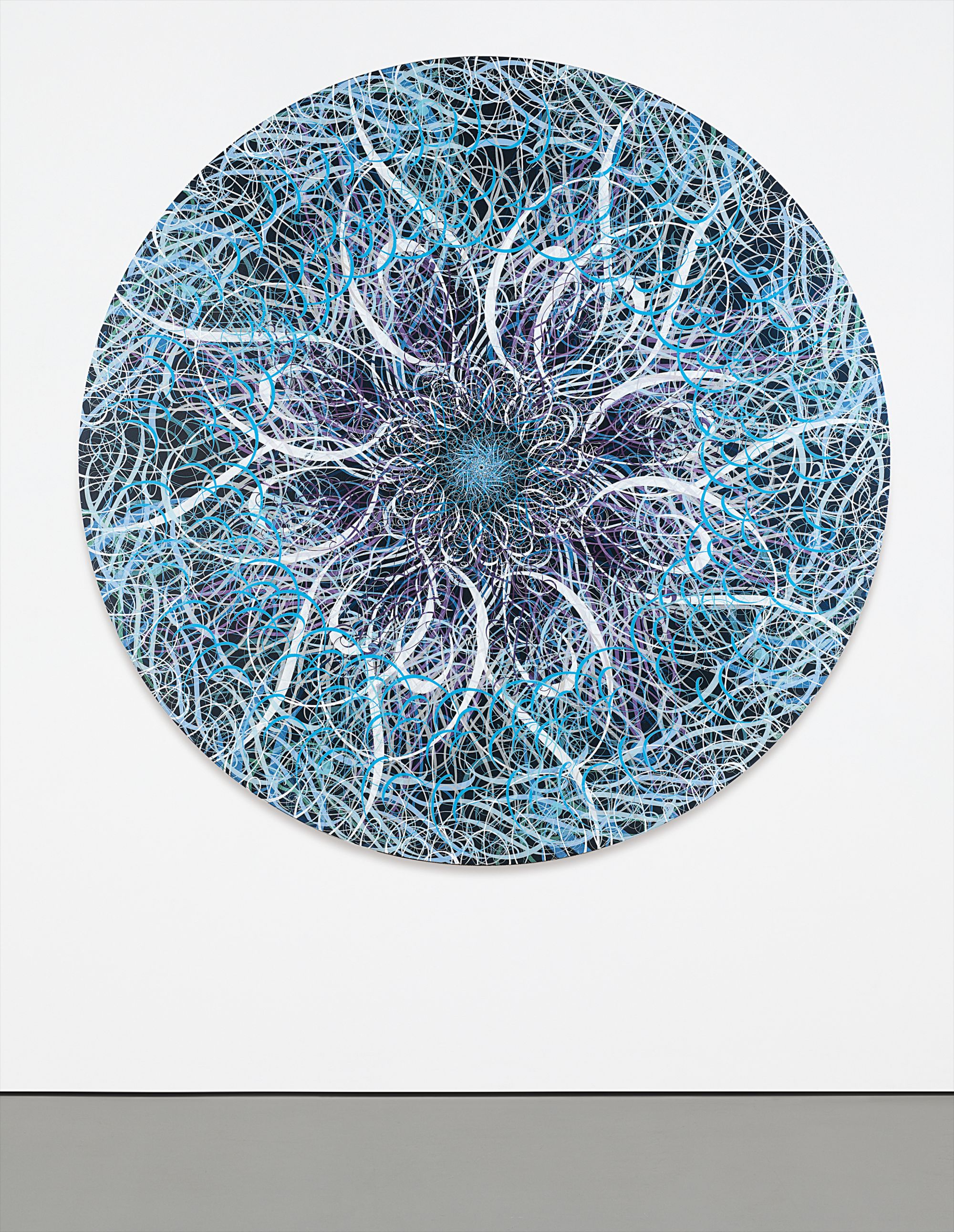
Ryan McGinness
diameter 71 5/8 in. (182 cm.)
" operates differently, deploying wit and scale together in a way that feels genuinely Warholian without being derivative. His large circular canvases, some exceeding 71 inches in diameter, create an almost cosmological sense of order and chaos coexisting. Works like "Cosmos Sensation Mix" and "Another Forrest" from 2006 show how deeply he thinks about the relationship between natural systems and human sign making. His printmaking practice, including screenprints produced with exceptional technical refinement, extends his ideas into editions that allow a broader range of collectors to engage with his vocabulary.
For collectors, McGinness represents an opportunity that is increasingly rare: a mid career American artist with a fully formed and instantly recognizable visual language, an institutional exhibition history, and a market that has demonstrated consistent depth and seriousness. His works on wood panel and canvas hold strong, and his prints, produced with the care and precision he brings to all his work, have attracted collectors who appreciate both accessibility and quality. What to look for is specificity of title and complexity of composition. The works in which his philosophical interests are most legible, where the density of symbol and the scale of ambition reinforce each other, represent his practice at its most powerful.
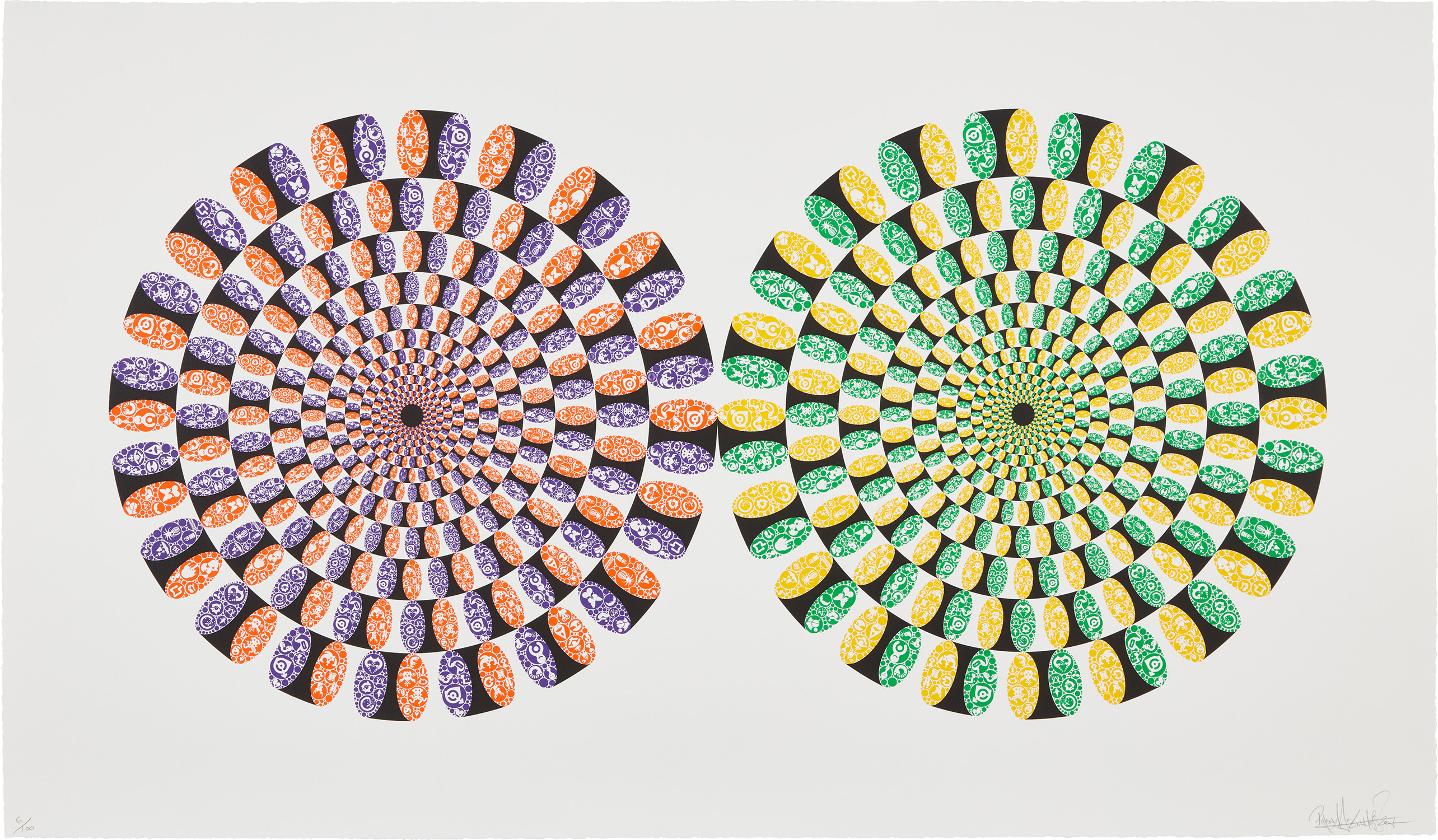
Ryan McGinness
Double Recursive Combs, Boustrophedonic
Collectors already holding his work have found it to be among the most conversation generating pieces in any collection, the kind of art that rewards extended looking and reveals new details over time. McGinness occupies a distinct position within the broader landscape of artists who have drawn on street culture, graphic design, and commercial visual language. He shares certain concerns with artists like Keith Haring, whose symbol based visual systems also operated across the fine art and popular culture divide, and with designers turned artists like Ed Fella. His engagement with seriality and the accumulation of meaning through repetition connects him to the Conceptual and Pop traditions, while his technical refinement and surface attention align him with a generation of painters deeply committed to craft.
Among his contemporaries working at the intersection of graphic sensibility and fine art painting, he stands as one of the most intellectually rigorous and visually consistent voices. The legacy of Ryan McGinness is still being written, which is one of the most exciting things about collecting his work now. He has already produced a body of paintings, prints, and installations that hold their own against the best work of his generation. His insistence on taking commercial visual culture seriously, not mocking it or simply appropriating it but genuinely analyzing and transforming it, feels more relevant with each passing year as the world fills with more images, more symbols, and more urgent questions about what they mean and who controls them.
For any collection aspiring to document the most serious visual thinking of the early twenty first century, McGinness is not a peripheral figure. He is essential.
Explore books about Ryan McGinness
Ryan McGinness: Paintings
Ryan McGinness
Ryan McGinness: 2002-2007
Ryan McGinness, various contributors
Ryan McGinness: Untitled
Ryan McGinness, Larry Gagosian
Ryan McGinness: Pure Color
Ryan McGinness
Ryan McGinness: Recent Paintings
Ryan McGinness, Peter Halley