Rudolf Bonnet
Rudolf Bonnet, The Soul of Bali
Artist Spotlight · The Collection Editorial
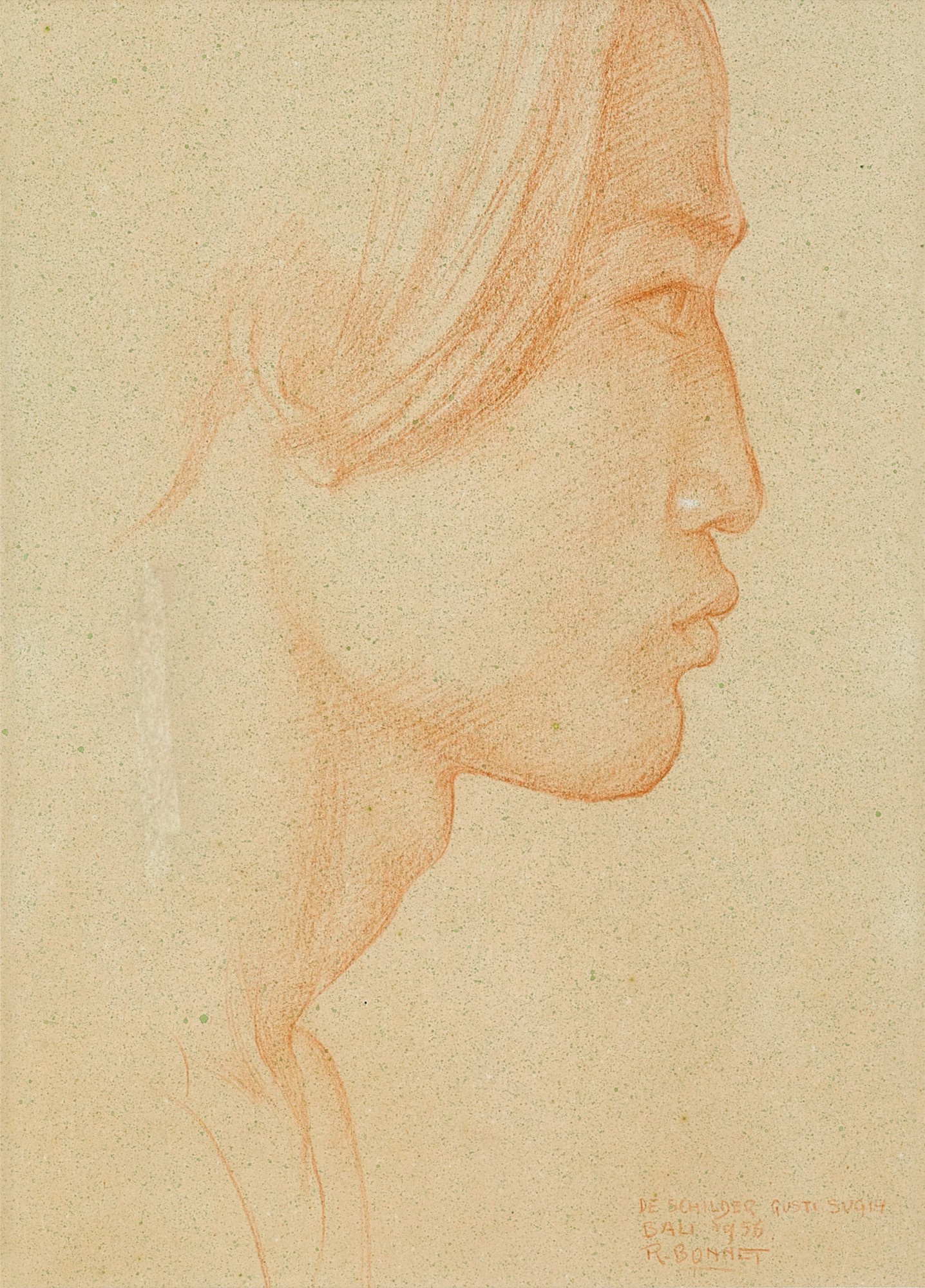
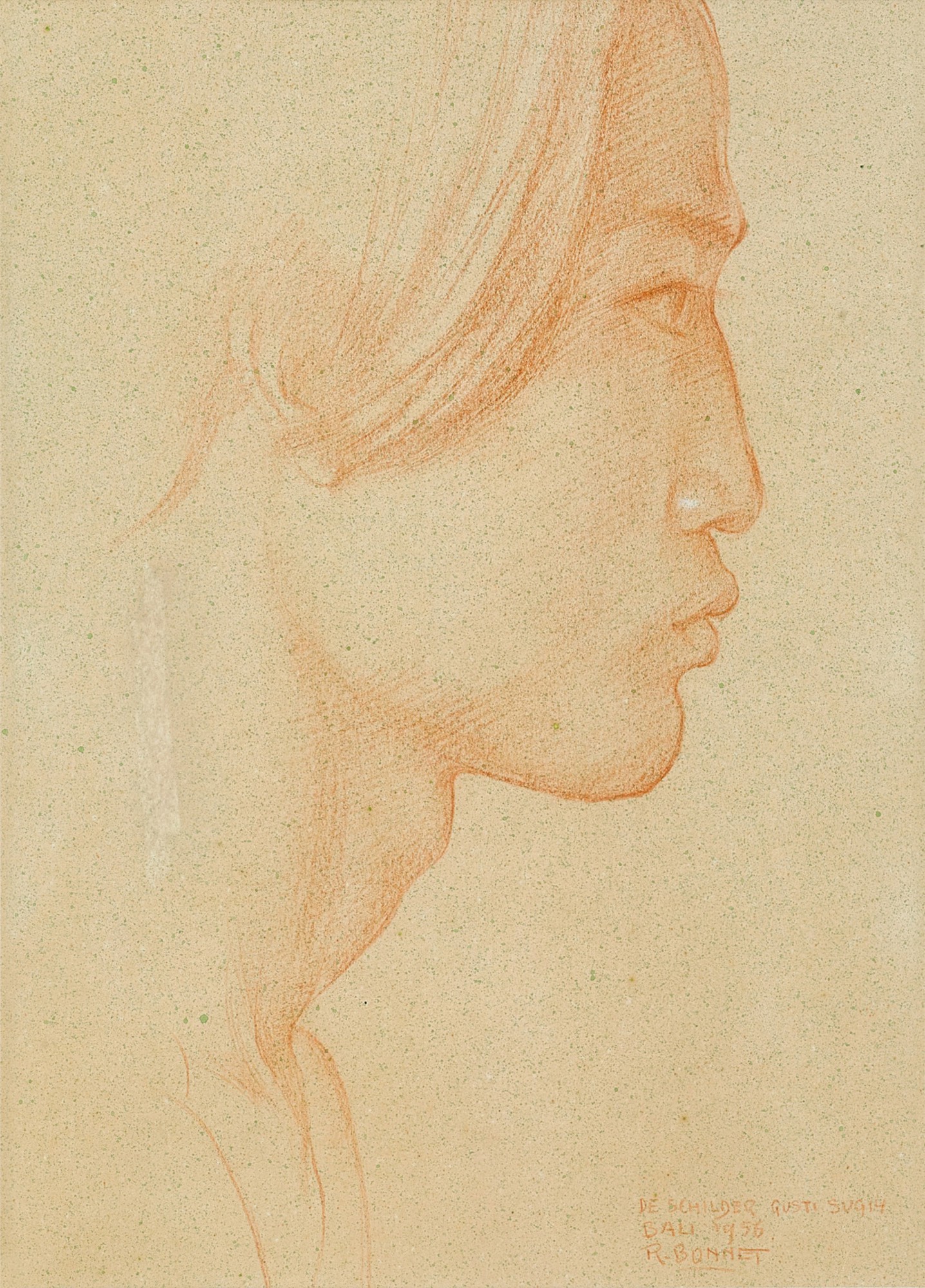
There is a moment, standing before Rudolf Bonnet's red chalk portrait of the painter Gusti Sugih, when the distance between cultures collapses entirely. The sitter gazes back with quiet dignity, rendered with a sensitivity that speaks not of a Western artist studying an exotic subject but of two artists in genuine conversation. That quality of mutual regard, of deep and earned intimacy, is what has brought renewed attention to Bonnet's work among collectors and scholars alike, as institutions across Asia and Europe reconsider the full complexity of twentieth century cross cultural artistic exchange. His drawings and paintings feel, in this moment, urgently alive.
Rudolf Bonnet
De Schilder Gusti Sugih (The Painter Gusti Sugih) 畫家古斯提·蘇吉肖像
Rudolf Bonnet was born in Amsterdam in 1895, into a city that was still absorbing the radical energies of Post Impressionism and the early stirrings of modernism. He trained at the Rijksacademie van Beeldende Kunsten in Amsterdam, where he absorbed the rigorous figurative tradition that would anchor his practice for life. Like many European artists of his generation, he was drawn southward, spending formative years in Italy, particularly in Florence and Rome, where he studied the Old Masters and refined his command of draughtsmanship. These Italian years gave Bonnet a reverence for the human figure as the supreme subject of art, a conviction he would carry with him for the rest of his life and across the world.
Bonnet arrived in Bali for the first time in 1929, and what began as a journey of artistic curiosity became a lifelong commitment. He settled in Ubud, in the highlands of the island, and what he found there was a living culture of artistic practice unlike anything he had encountered in Europe. Balinese men and women made art not as a profession separated from daily life but as a natural extension of spiritual and communal existence. Bonnet was transfixed.
Rudolf Bonnet
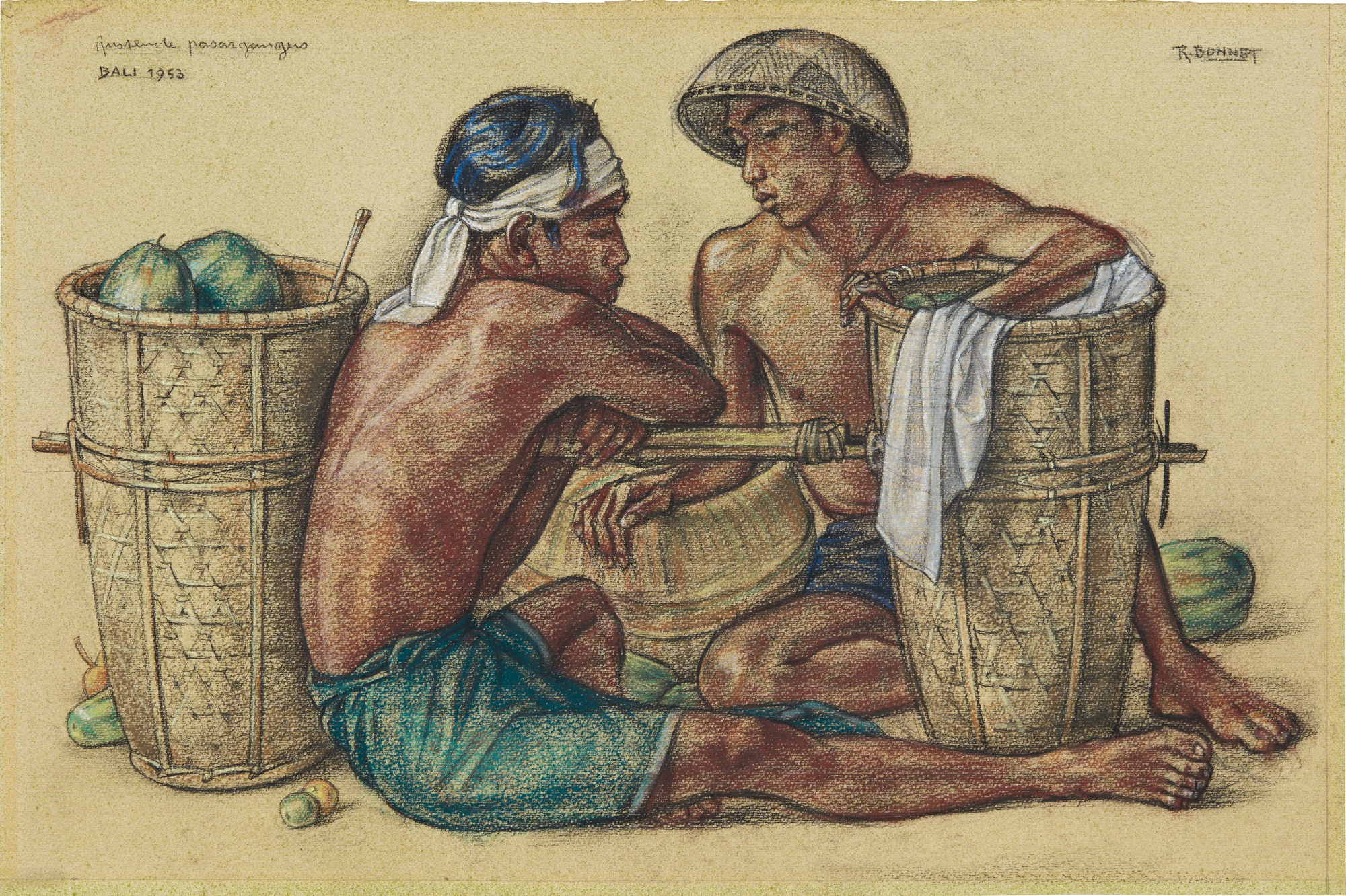
Rudolf Bonnet 魯道夫·邦尼 | Resting Market Vendors, Bali 歇息中的峇里市場攤販, 1953
He began drawing and painting the people around him with the focused attention of an artist who has finally found his true subject, and over the following decades his figurative work reached a sustained level of accomplishment that few of his contemporaries could match. The founding of the Pita Maha cooperative in 1936 stands as the defining institutional act of Bonnet's life. Together with the German artist and musician Walter Spies and the enlightened Balinese aristocrat Tjokorda Gde Agung Sukawati, Bonnet helped create an organisation that supported Balinese artists, standardised quality, and opened pathways to international exhibition and sale. Pita Maha, which translates roughly as great vitality or sublime spirit, was genuinely collaborative in its ambitions.
Bonnet brought technical knowledge and a network of connections in the Western art world, while the Balinese artists brought a living iconographic tradition of extraordinary richness. The cooperative nurtured figures who would go on to define modern Balinese painting, and Bonnet's role as mentor and advocate was as significant as his role as an artist. The works Bonnet made during his Balinese decades are marked by a quality that is difficult to name precisely but easy to feel. His charcoal and pastel drawing Resting Market Vendors, Bali, made in 1953, exemplifies the approach.
The figures are at ease, caught in an unguarded moment of rest, and Bonnet renders them with neither the romanticising distance of the colonial gaze nor the flattening abstraction of pure formalism. They are simply people, observed with love and skill. His red chalk drawings in particular demonstrate a command of tone and line that places him in a tradition running from the Renaissance through to the great portrait draughtsmen of the nineteenth century, while the subjects themselves are entirely his own. The warmth of red chalk as a medium seems almost chosen for its resonance with Balinese skin tones, and in works like the portrait of Gusti Sugih the technical and the personal become inseparable.
Bonnet's life in Bali was not without disruption. The Japanese occupation during the Second World War saw him interned, and the political upheavals of Indonesian independence brought periods of uncertainty and forced departure. He was eventually expelled from Indonesia in 1958 during a period of heightened nationalism, a painful separation from the place that had become his true home. He returned to the Netherlands, and later spent time in Italy, but he came back to Bali in 1972, spending his final years there and dying in Ubud in 1978.
The Neka Art Museum in Ubud holds a significant collection of his works and honours his legacy as one of the central figures in the story of Balinese modernism. For collectors, Bonnet's drawings represent an exceptional opportunity to acquire works of genuine art historical significance at a level of the market that still rewards careful looking. His works on paper, particularly the red chalk and charcoal drawings, are where his mastery is most consistently evident, and they have the additional virtue of being intimate objects, works that reward close attention in a domestic setting. Collectors who are drawn to the intersection of Western and non Western artistic traditions, or who follow the growing scholarly and institutional interest in the art of Southeast Asia, will find in Bonnet an artist whose importance is well established but whose market has not yet reflected the full measure of his achievement.
Related figures worth understanding alongside Bonnet include Walter Spies, whose work in Bali overlapped significantly with his own, as well as the broader network of early twentieth century artists who worked in Southeast Asia and the Pacific, from Paul Gauguin's earlier Polynesian sojourn to the later work of Donald Friend in Bali during the 1960s. The legacy of Rudolf Bonnet is ultimately inseparable from the living tradition of Balinese art that he helped sustain and elevate. The artists he mentored through Pita Maha went on to train successive generations, and the organisation he co founded in 1936 played a genuine role in ensuring that Balinese artistic culture did not simply become a curiosity for tourists but developed on its own terms, in dialogue with but not dominated by Western influence. In an era when the politics of cultural exchange are examined with increasing rigour, Bonnet's story is a nuanced and instructive one.
He was not a figure without the assumptions of his time, but he was an artist of rare empathy, and the works he left behind make the case for his place in art history with quiet, enduring force.
Explore books about Rudolf Bonnet
Rudolf Bonnet: Life and Work
A. A. M. Djelantik
Rudolf Bonnet and Balinese Art
Claire Holt
The Paintings of Rudolf Bonnet
Edi Sedyawati
Rudolf Bonnet: A Pioneer of Modern Balinese Art
Astri Wright
Bonnet in Bali: The Artist and the Island
Made Wianta