Rubens Santoro
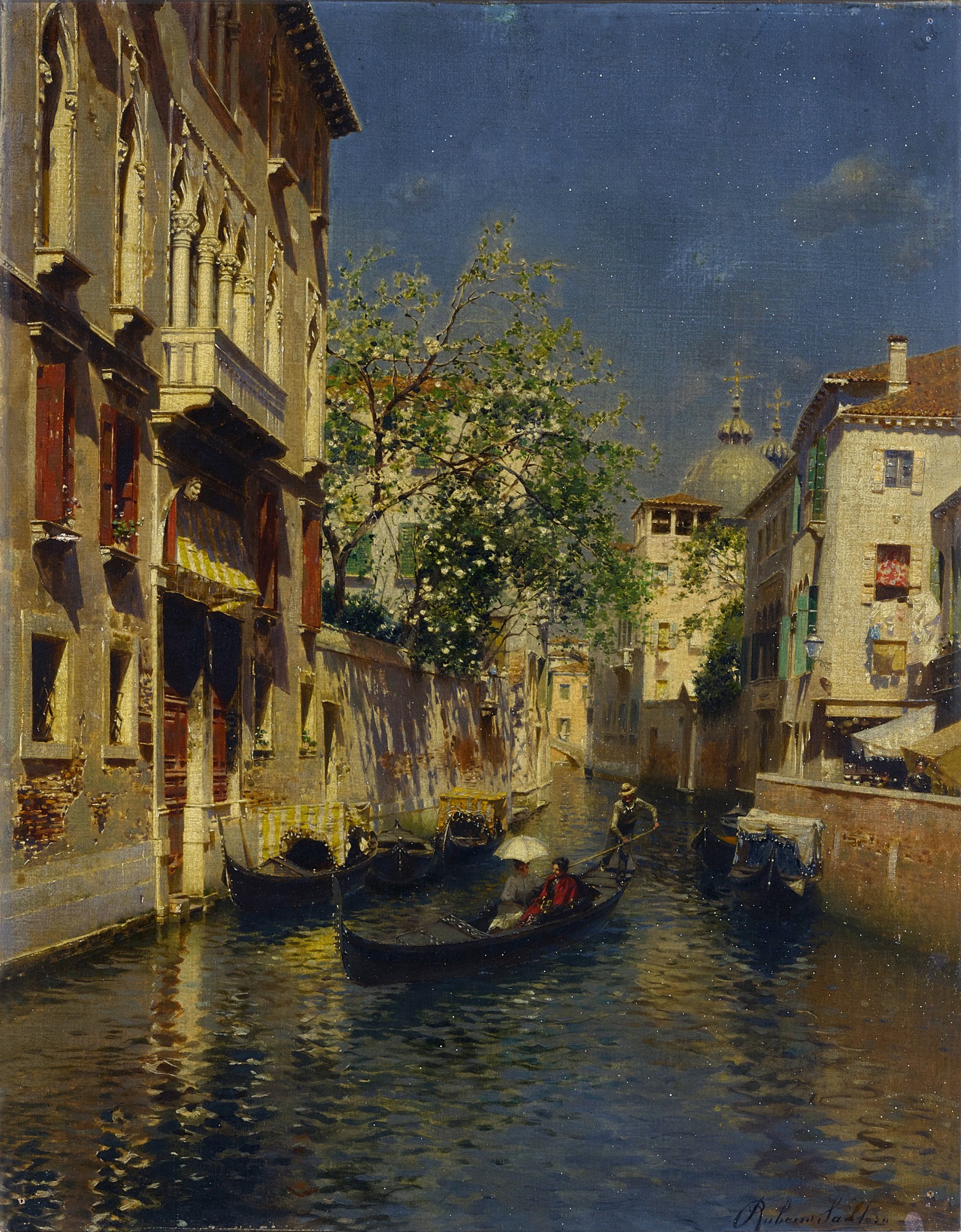
Rubens Santoro, Master of Liquid Light
Artist Spotlight · The Collection Editorial
There is a moment, familiar to anyone who has stood at the edge of a Venetian canal in the late afternoon, when the water seems to become something other than water. It flickers, shifts, and holds the sky inside itself like a mirror that refuses to stay still. No painter of the nineteenth or early twentieth century captured that moment with more fidelity, more feeling, or more quiet brilliance than Rubens Santoro. Born in 1859 and active across a career that stretched remarkably into 1942, Santoro spent decades perfecting a vision of Italy so luminous and so alive that his canvases continue to stop auction room bidders cold more than a century after they were painted.
Rubens Santoro
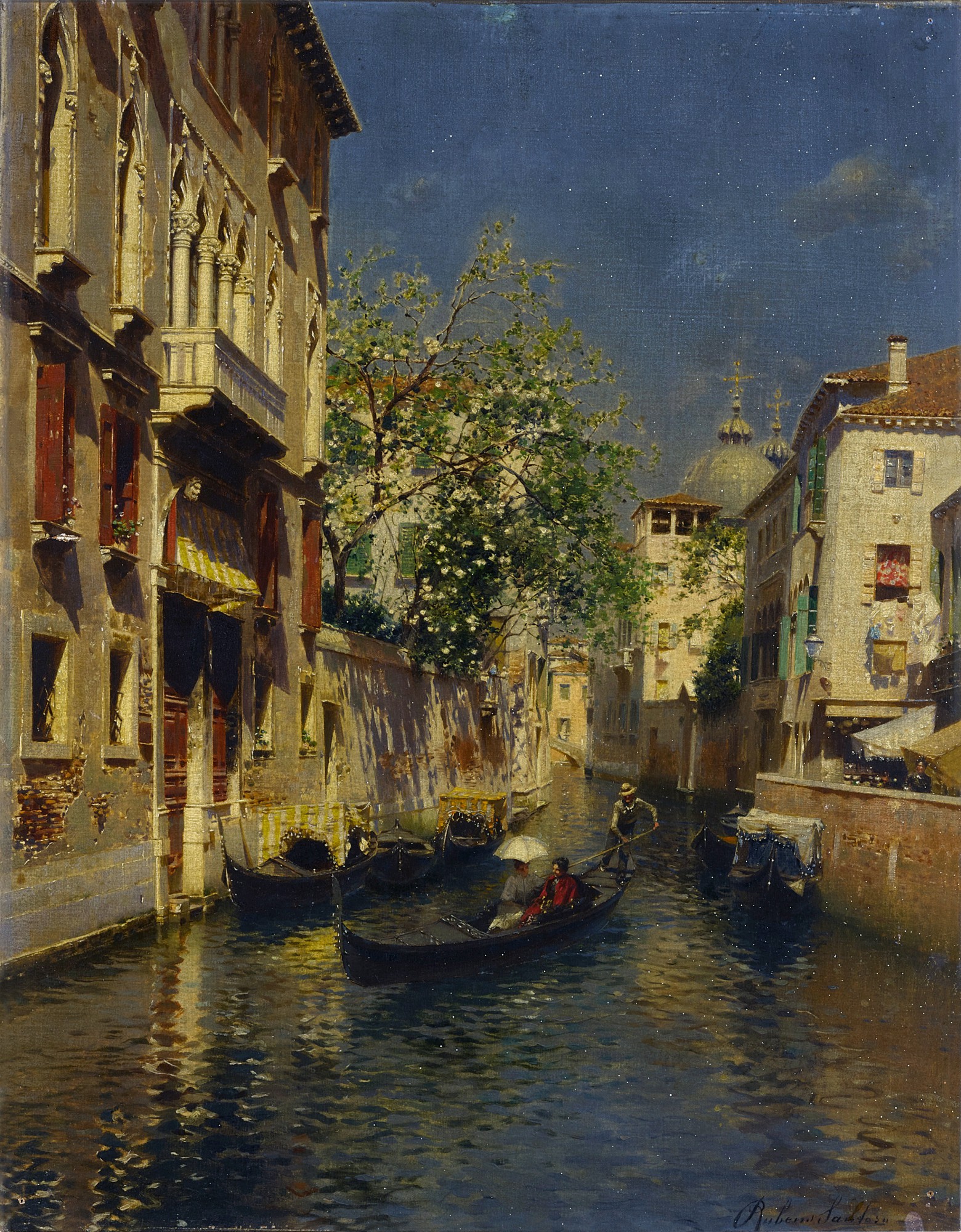
Venetian Canal
Santoro was born in Mongrassano, a small town in Calabria in the deep south of Italy, and his origins in that sun scorched, intensely colourful landscape left a permanent mark on his sensibility. He came of age artistically at the Naples Academy of Fine Arts, one of the most distinguished institutions in southern Europe during the latter half of the nineteenth century. Naples at that time was a city wrestling with its own modernity, still absorbing the upheavals of Italian unification, and the Academy reflected a culture that prized technical mastery and a close observation of the visible world. For Santoro, this was formative in every sense.
He absorbed the discipline of realism not as a constraint but as a tool, a means of getting closer to the truth of what light actually does to a surface, a wall, a stretch of moving water. The move toward Venice was both inevitable and transformative. Venice had drawn painters for centuries, and by the time Santoro arrived it had become a kind of proving ground for anyone serious about the interplay of light and architecture and reflection. What set Santoro apart from the many competent vedutisti working in his era was the intimacy of his approach.
Rubens Santoro
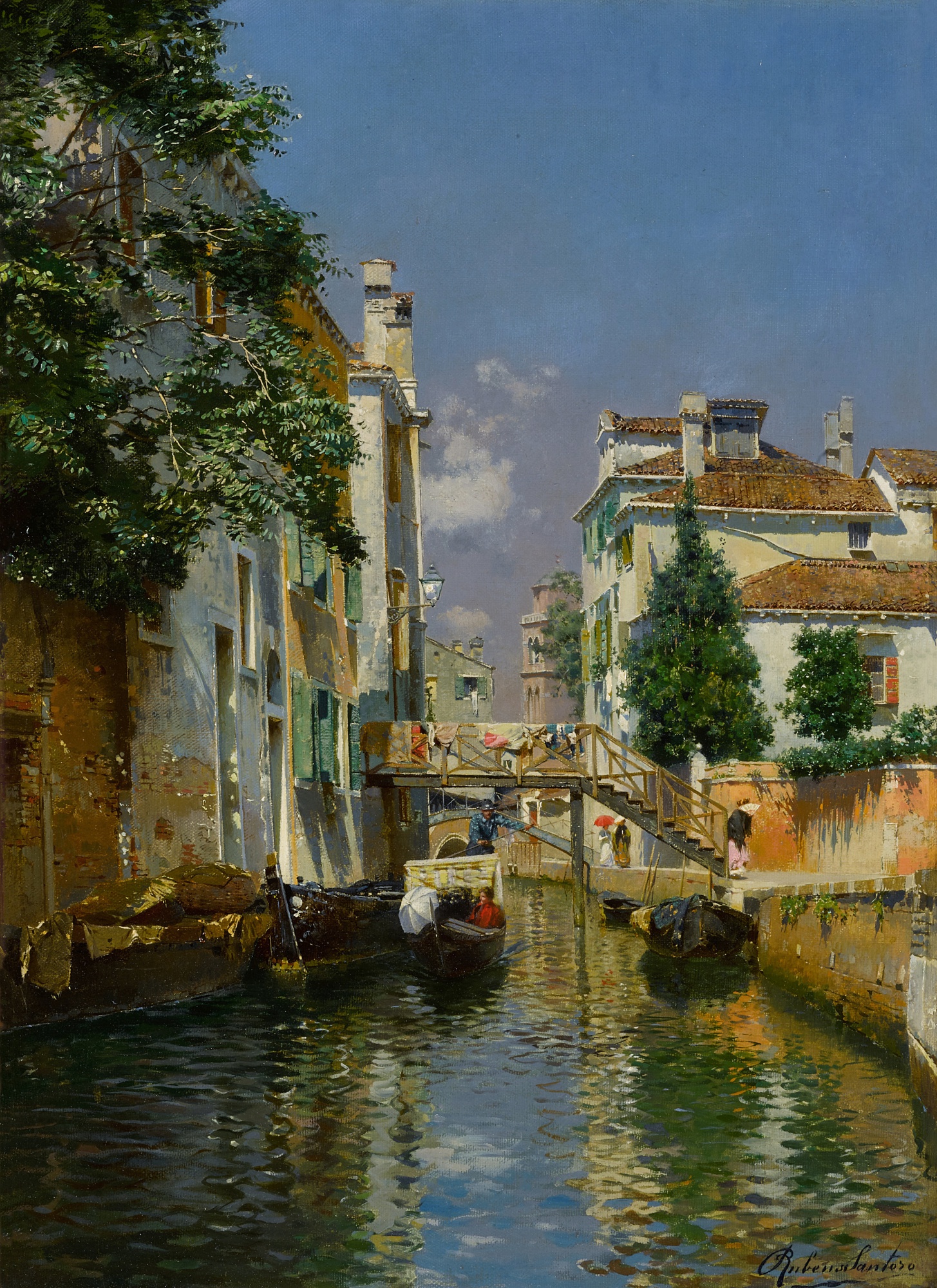
Venetian Backwater with the Campanile of San Geremia church
Where others painted Venice from a distance, composing grand views for an export market hungry for souvenirs, Santoro pressed closer. He sought out the backwaters, the narrow rio, the quiet fondamenta where gondoliers rested and laundry hung above still water. His palette was warm without being saccharine, his brushwork confident but never showy. He understood that the real drama of Venice was not in its famous monuments but in the way ordinary life unfolded against an extraordinary backdrop.
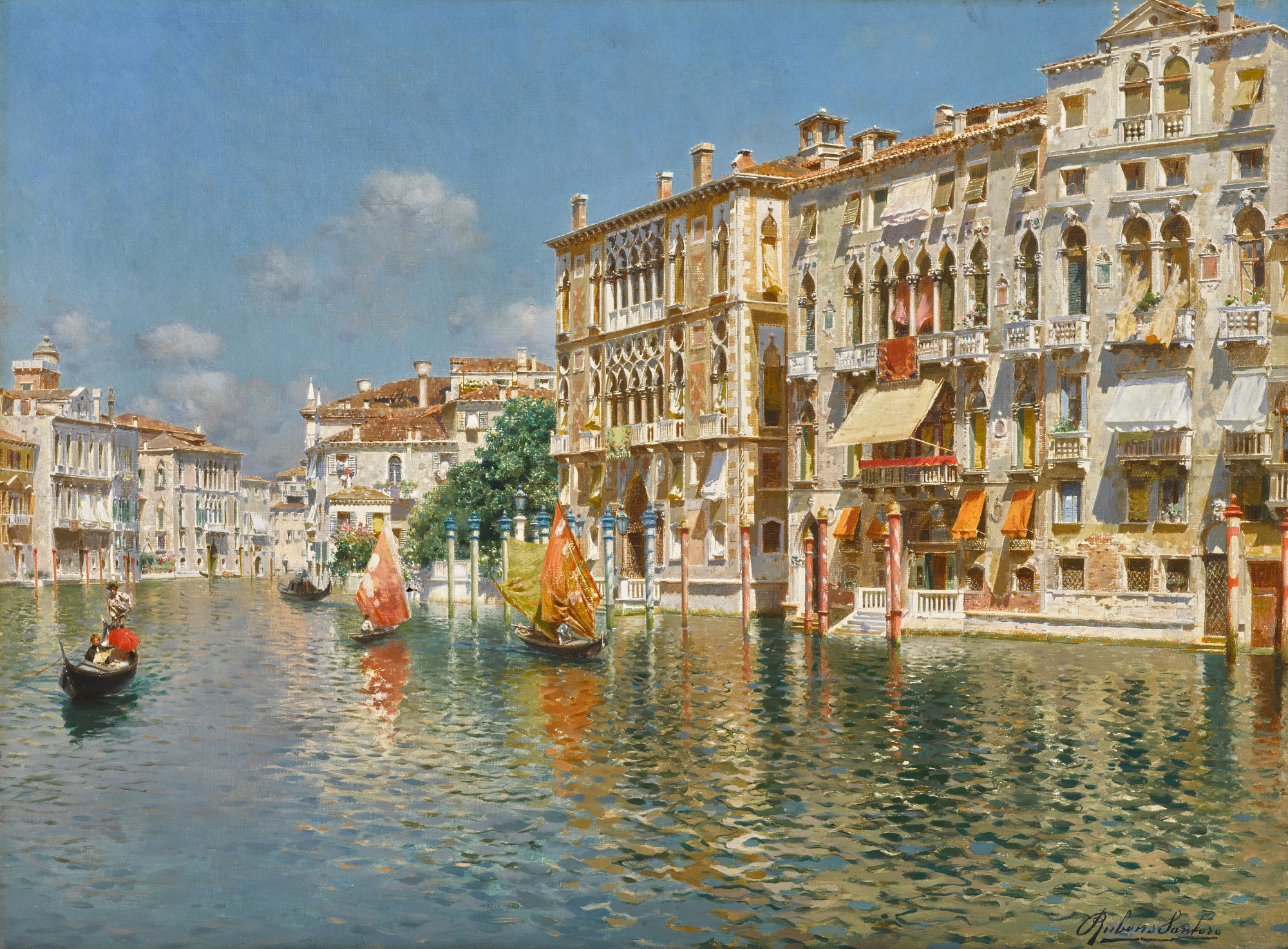
His signature works from the Venetian period represent some of the finest plein air realism produced by any Italian painter of his generation. "Venetian Canal" demonstrates his extraordinary ability to render the fractured geometry of reflections without losing the sense of depth and volume beneath the surface. "Venetian Backwater with the Campanile of San Geremia Church" is perhaps even more revealing, showing how Santoro could anchor a composition with a recognizable architectural detail while allowing the surrounding atmosphere to breathe and shimmer. "The Grand Canal, Venice" takes on one of the most painted subjects in Western art history and succeeds by virtue of Santoro's unfailing instinct for the precise quality of light at a specific hour.
Rubens Santoro
The Grand Canal, Venice
These are not decorative exercises. They are concentrated acts of observation, each one the result of sustained looking and a technical command that makes the difficulty invisible. Santoro worked at a moment when Italian painting was navigating between the influence of French Impressionism and its own deeply rooted traditions of academic realism. He was a contemporary of artists like Francesco Netti and Vincenzo Irolli, and his work shares with them a commitment to the observed scene, to figures in natural light, and to the particular chromatic richness of the Italian south.
But Santoro was also paying attention to what was happening further north in Europe. The luminism of the Dutch masters, filtered through his Neapolitan training and his direct engagement with the Venetian environment, gave his work a quality that transcends easy categorization. He is neither strictly academic nor fully Impressionist, but occupies a rich and productive space between those positions, which is precisely what makes him so rewarding to study and to collect. From a market perspective, Santoro's reputation has remained remarkably steady across generations of collecting.
His works appear regularly at Sotheby's, Christie's, and Bonhams, and they consistently attract serious attention from both institutional buyers and private collectors with a refined taste for nineteenth century European painting. The auction record for his work reflects a market that understands quality and rewards it accordingly. Collectors are drawn to Santoro for several reasons. First, there is the sheer visual pleasure of the work, the sense that a canvas by Santoro genuinely brightens a room.
Second, there is the art historical substance behind that pleasure, the knowledge that these paintings were made by a serious artist working at the height of his powers within a distinguished tradition. Third, and perhaps most importantly for the long term collector, there is the scarcity of top quality examples. Santoro was prolific, but works of the calibre of his finest Venetian scenes do not come to market often, and when they do, they tend to move quickly. What to look for when considering a work by Santoro is above all the quality of the light.
His best canvases have a glow that is difficult to describe but immediately recognizable, a sense that the paint itself is somehow luminous rather than merely coloured. The handling of water is the key indicator of quality. In the finest examples, reflections are broken just enough to suggest movement without dissolving into abstraction, and the relationship between the surface of the water and the sky above it feels physically true. Condition matters greatly with Santoro, as the subtlety of his tonal transitions can be compromised by old varnish or heavy cleaning.
Works with clear provenance and good exhibition history are naturally to be preferred. Rubens Santoro matters today not because the art world has recently rediscovered him, though there is every reason to believe that serious scholarly attention to his career is long overdue, but because the qualities his work embodies are enduringly relevant. He was a painter who looked hard at the world, who found in the specific textures of light on water in a particular Italian city a subject worthy of a lifetime of sustained attention. In an era when so much art announces itself loudly, Santoro's canvases offer something rarer and more nourishing.
They invite you to slow down, to look again, and to find in that second looking something you missed the first time. For collectors who value that quality of attention, there are few better places to begin.