Roy DeCarava
Roy DeCarava: Light Found in Darkness
Artist Spotlight · The Collection Editorial
“I want to photograph light, not the absence of it.”
Roy DeCarava
There is a moment in the Museum of Modern Art's permanent collection galleries when visitors stop mid stride. It happens in front of a Roy DeCarava photograph, almost without exception. The image may depict a man ascending subway stairs, or a hallway in Harlem suffused with shadow, or a musician caught in a private reverie, but the effect is the same: a sudden, quiet arrest of attention. DeCarava's photographs do not announce themselves.
Roy DeCarava
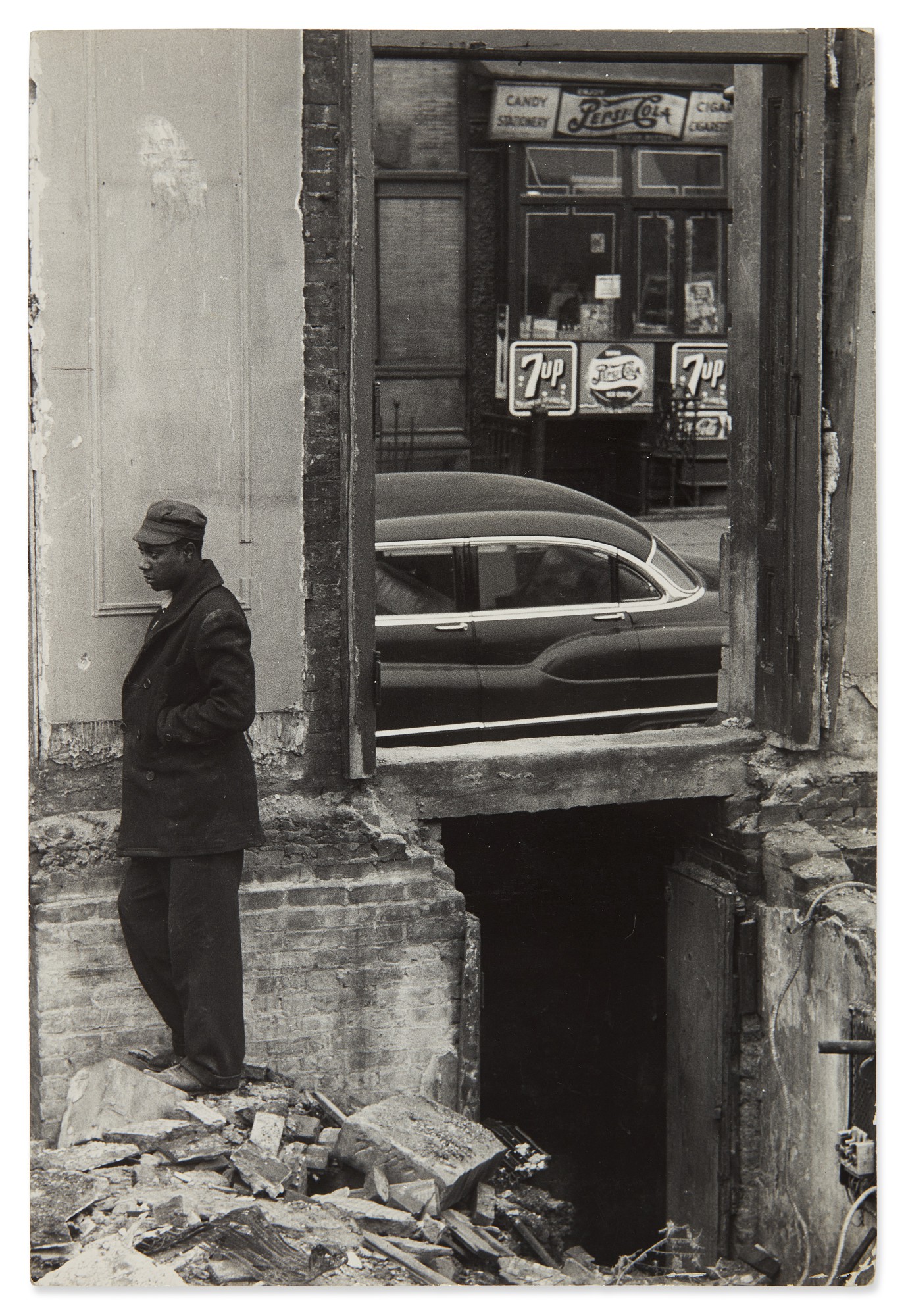
Man Standing Outside of a Building
They invite you in, slowly, the way your eyes adjust when you step from a bright street into a cool, dark room, and once adjusted, you begin to see everything. Roy Rudolph DeCarava was born in Harlem in 1919, the son of a Jamaican immigrant mother who raised him largely on her own. Growing up in the neighborhood that would become the defining subject of his life's work, DeCarava came of age during a period of extraordinary cultural vitality and grinding economic hardship. He studied at the Harlem Community Art Center and later at the Cooper Union and the George Washington Carver Art School, training first as a painter and printmaker.
Photography came to him almost sideways, as a practical tool for reference sketches, but it seized him with a force that painting never quite matched. By the late 1940s, the camera had become his primary instrument, and Harlem his inexhaustible subject. DeCarava's early photographic practice unfolded during a pivotal era in American cultural life. He was photographing Harlem in the late 1940s and into the 1950s, a period when the neighborhood's jazz clubs and stoops and tenement hallways pulsed with a life that mainstream American media either ignored or caricatured.
Roy DeCarava
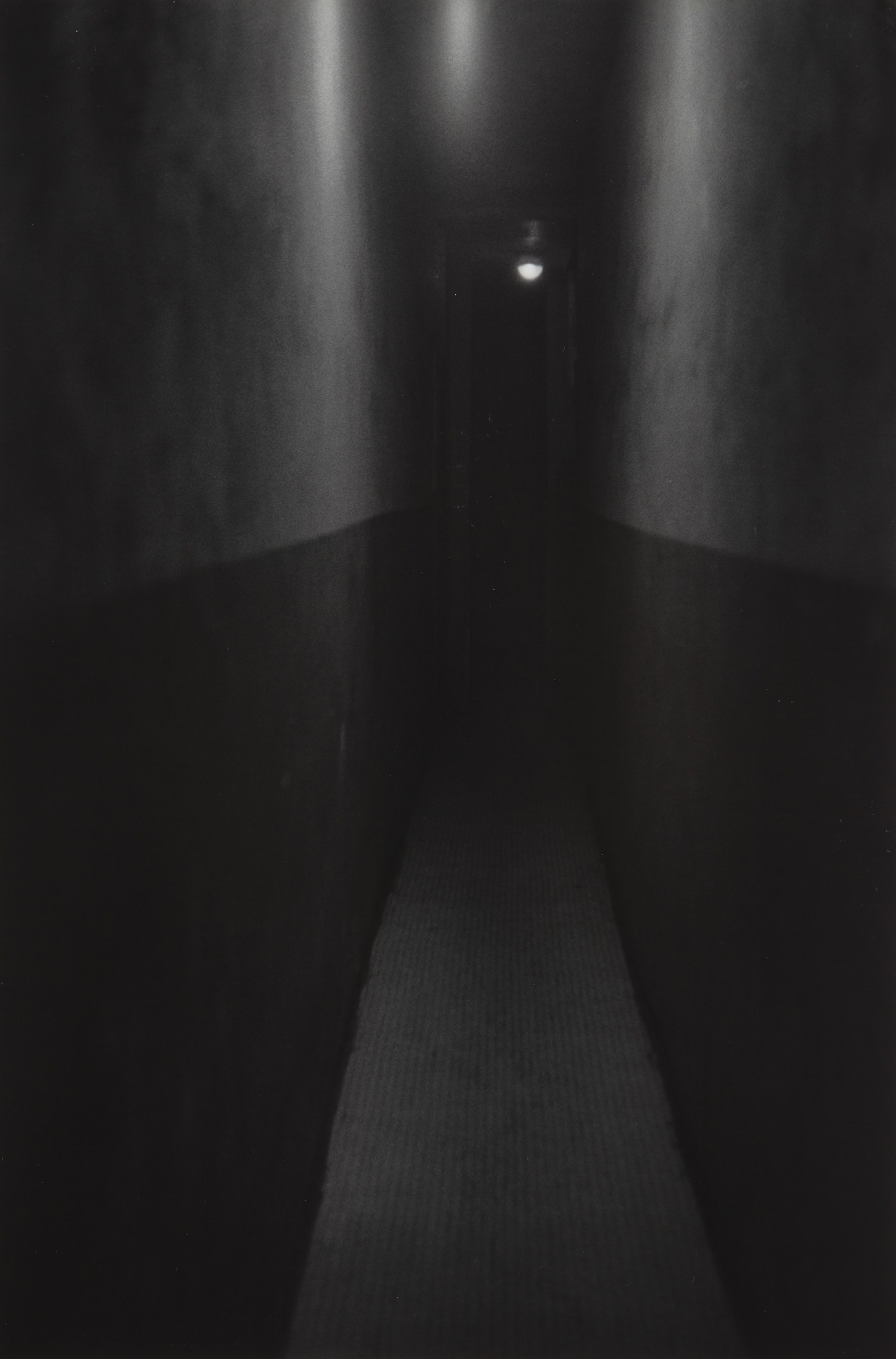
Hallway, New York
DeCarava was after something more truthful and more interior. His 1952 Guggenheim Fellowship, the first ever awarded to an African American photographer, was a watershed moment, both for his career and for the broader recognition of Black artistic practice within American institutions. The fellowship allowed him to work with sustained focus, producing the body of photographs that would form the basis of his landmark 1955 collaboration with the poet Langston Hughes, "The Sweet Flypaper of Life." That book, part fiction, part documentary meditation, presented Harlem not as a problem to be solved but as a place of profound, irreducible humanity.
“I want a creative expression, the kind that will tell what I feel and what I see.”
Guggenheim Fellowship Application, 1952
What distinguishes DeCarava's photographs from nearly all of his contemporaries is his radical commitment to darkness as a formal and ethical choice. Where the photojournalistic tradition of the era favored sharp contrast and legible detail, DeCarava pushed his prints toward deep shadow, allowing his subjects to emerge from near black tones with a luminous, almost underwater quality. This was not accident or technical limitation. It was a deliberate insistence that Black subjects be rendered with the same tonal complexity and psychological depth that the history of Western painting had long reserved for other bodies.
Roy DeCarava
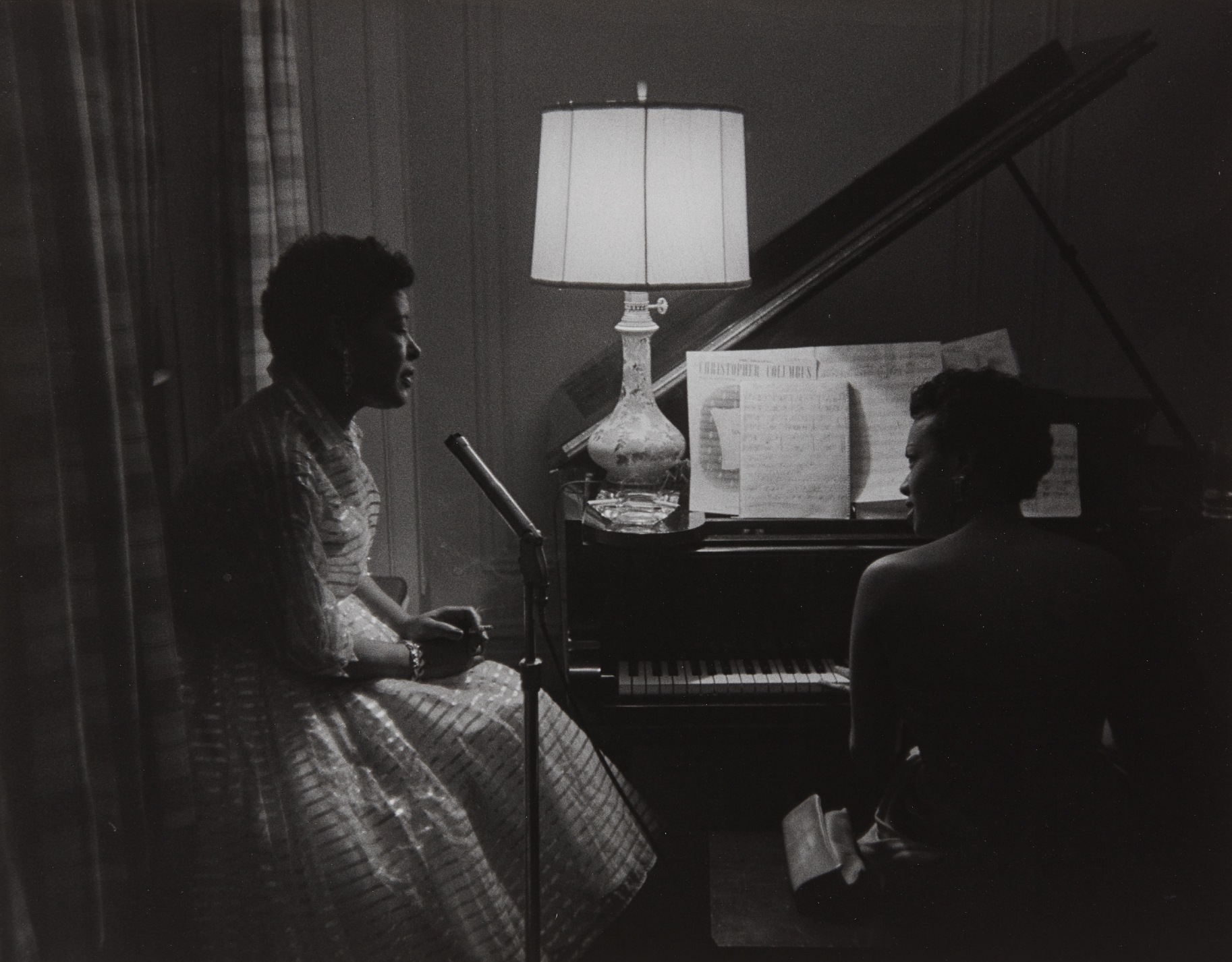
Billie Holiday and Hazel Scott at a Party
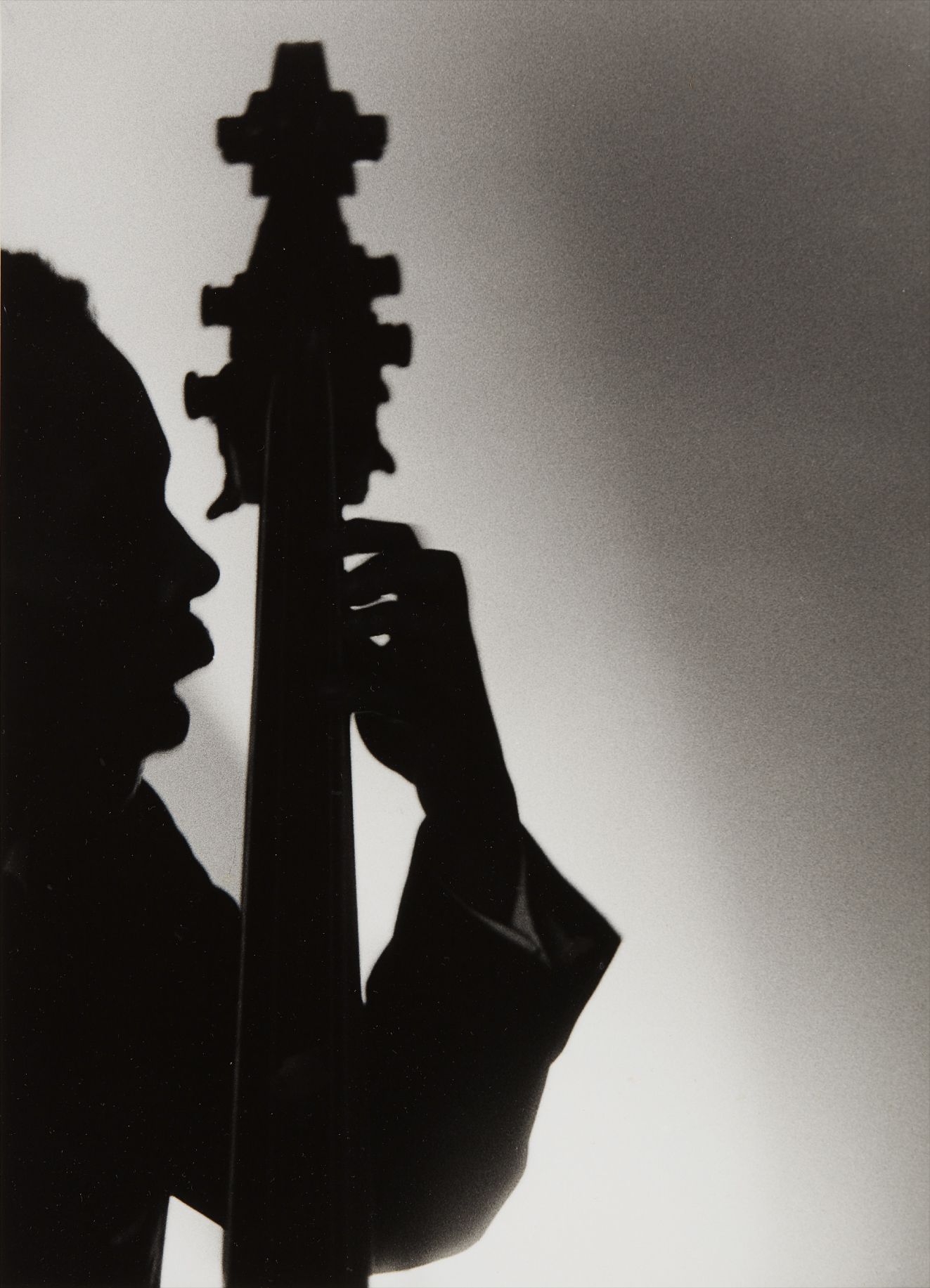
Works such as "Hallway, New York" demonstrate this with extraordinary economy: a corridor dissolves into layers of shadow, and what remains feels less like documentation than like memory itself made visible. Similarly, "Man Coming Up Subway Stairs" transforms a purely mundane transit moment into something approaching secular grace, the figure ascending as if emerging from the underworld into ordinary urban light. The portraits DeCarava made of musicians are among the most celebrated works in the history of jazz photography. His image of Billie Holiday, and his studies of figures such as Coltrane, Duke Ellington, and Langston Hughes, were never conceived as promotional materials or journalistic dispatches.
They were acts of intimate witness. "Billie Holiday and Hazel Scott at a Party," one of the works available through The Collection, captures two of the most formidable women in American music in a moment that feels genuinely unguarded, the power and the vulnerability coexisting in the same frame. DeCarava opened a gallery in his home at 44th Street in 1955, known as A Photographer's Gallery, which was among the first spaces in New York dedicated exclusively to photography as fine art, another signal of his understanding that the medium deserved institutional seriousness long before the market agreed. From a collecting perspective, DeCarava's market has grown significantly in stature over the past two decades, reflecting both a broader institutional reappraisal of his contribution and increased demand for works that sit at the intersection of photography, civil rights history, and American modernism.
Roy DeCarava
George Morrow
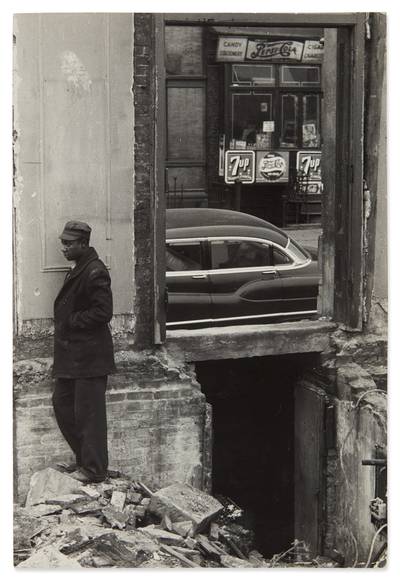
His prints, particularly the gelatin silver prints he made in later years from his classic negatives, are held in the permanent collections of the Museum of Modern Art, the Metropolitan Museum of Art, the Art Institute of Chicago, and the Smithsonian American Art Museum, among others. For private collectors, the appeal lies in the extraordinary range of his subject matter and the consistency of his aesthetic vision across decades of work. Works on paper with studio stamps and archival notations, such as the circa 1952 "Man Standing Outside of a Building" with its handwritten studio markings and crossed out addresses, carry additional documentary and provenance interest, connecting the physical object to the material circumstances of DeCarava's working life. Within art history, DeCarava belongs to a lineage of photographers who understood their medium as capable of moral as well as aesthetic argument.
His work invites comparison to that of Gordon Parks, who was documenting Black American life for Life magazine during the same years but with a different formal sensibility, and to Lisette Model, whose influence on street photography shaped the generation that came of age in postwar New York. DeCarava was also a decisive influence on younger photographers including Dawoud Bey, who has spoken openly about DeCarava's importance to his own practice, and Carrie Mae Weems, whose use of intimacy and shadow owes something to the tradition DeCarava established. He taught for many years at Hunter College, where his impact on successive generations of image makers was profound and lasting. Roy DeCarava died in New York in 2009 at the age of 89, having lived long enough to see his work receive the institutional recognition it had always merited.
The International Center of Photography awarded him its Infinity Award for Master of Photography in 2001. In the years since his death, the conversation around his work has only deepened, shaped by renewed attention to the history of Black artistic expression in America and by a collecting culture increasingly attentive to figures who worked with integrity and independence outside the commercial mainstream. His photographs remain what they always were: generous, precise, and alive with the belief that ordinary life, seen with enough patience and enough love, is endlessly worth looking at.
Explore books about Roy DeCarava
Roy DeCarava: A Lifetime of Photography
Sherry Turner DeCarava, Deborah Willis
The Sweet Flypaper of Life
Roy DeCarava, Langston Hughes
Roy DeCarava: Photographs
Roy DeCarava
Roy DeCarava: Notes of Grace
Deborah Willis, Cheryl Finley