Roger Brown
Roger Brown's America, Gloriously Reimagined
Artist Spotlight · The Collection Editorial
There are moments in art history when a single painting stops you cold, not because it is beautiful in any conventional sense, but because it tells a truth you had not quite found words for. Roger Brown spent his entire career manufacturing those moments. When the Art Institute of Chicago mounted a major retrospective of his work in 1987, visitors encountered something rare: an artist who had built an entirely self contained visual universe, one that was unmistakably American, mordantly funny, deeply felt, and unlike anything produced by his contemporaries. Decades later, his paintings continue to command serious attention from institutions and private collectors alike, and the conversation around Chicago Imagism as one of the most vital and underappreciated movements in postwar American art has never been more alive.
Roger Brown
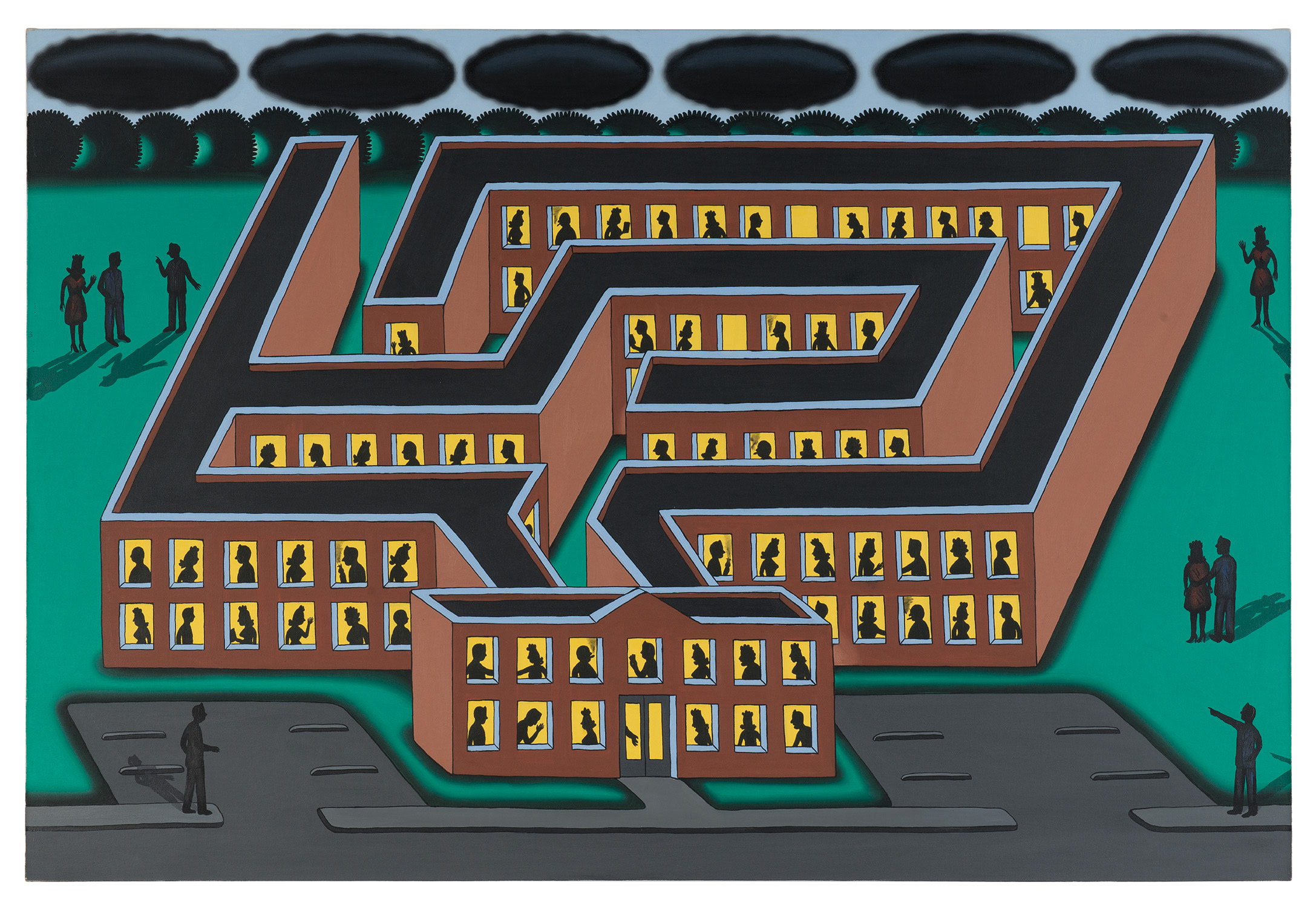
Looking for a Leveraged Buyout, 1988
Roger Brown was born in Hamilton, Alabama in 1941, and the American South left a permanent imprint on his imagination. The flattened spaces, the theatrical light, the vernacular architecture of small towns and roadside America all found their way into his canvases. He arrived in Chicago in the 1960s to study at the School of the Art Institute of Chicago, where he encountered a cohort of painters who were collectively and quietly staging a revolt against the dominant orthodoxies of Abstract Expressionism and Minimalism. Under the influence of teachers like Whitney Halstead and Don Baum, who famously organized the exhibitions that would come to define the Imagist sensibility, Brown found permission to pursue figuration, narrative, and symbolic content at a time when much of the New York establishment considered such interests retrograde.
What distinguished Brown from the outset was the confidence and originality of his visual language. While his fellow Imagists, artists such as Ed Paschke, Jim Nutt, and Gladys Nilsson, pursued their own distinctive paths through the figure, Brown developed a grammar of silhouette and pattern that was entirely his own. His figures are almost always rendered as dark, anonymous shapes, stripped of individual identity, placed against landscapes and cityscapes that pulse with decorative energy. The sky in a Roger Brown painting is never simply a sky: it is a field of rolling clouds, repeated waves, or stacked horizontal bands of color that give the entire composition the feel of a stage set, a world observed from a careful and slightly ironic distance.
Roger Brown
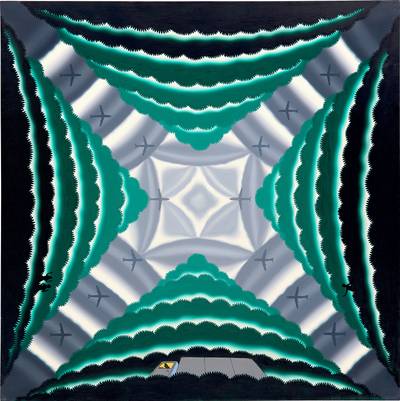
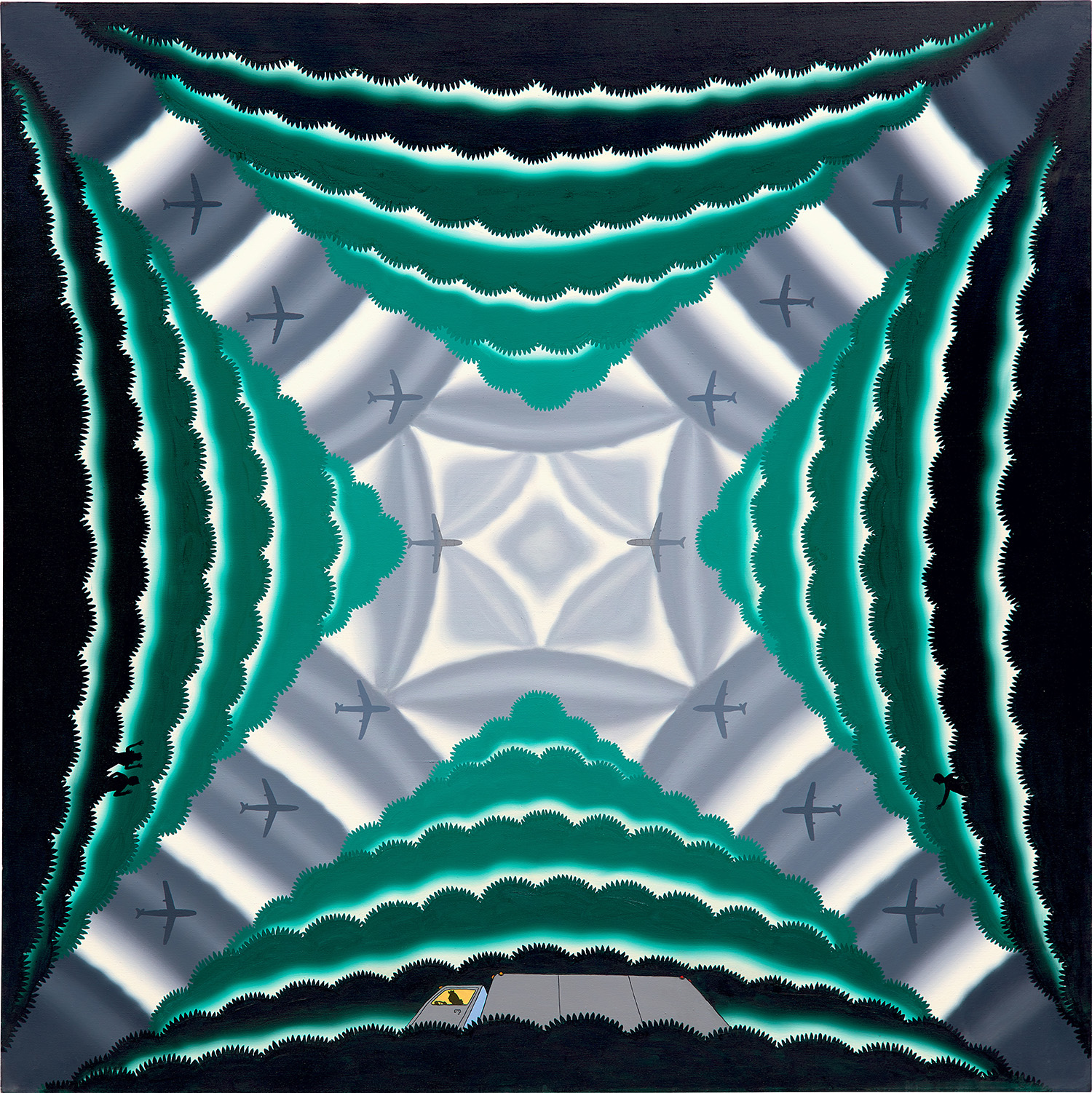
Flying in Formation, 1979
This formal decision carried enormous emotional weight, suggesting both the isolation of modern life and the comedy of the human condition. The works themselves form a remarkable catalogue of American anxieties and ambitions. "Tract Town" from 1973 is an early masterpiece of the genre, presenting a suburban development as a grid of identical houses beneath a luminous, patterned sky, the repetition both comic and quietly devastating. "Flying in Formation" from 1979 deploys Brown's silhouetted figures against an aerial perspective that transforms movement into choreography, collective human action rendered as something between a military exercise and a ballet.
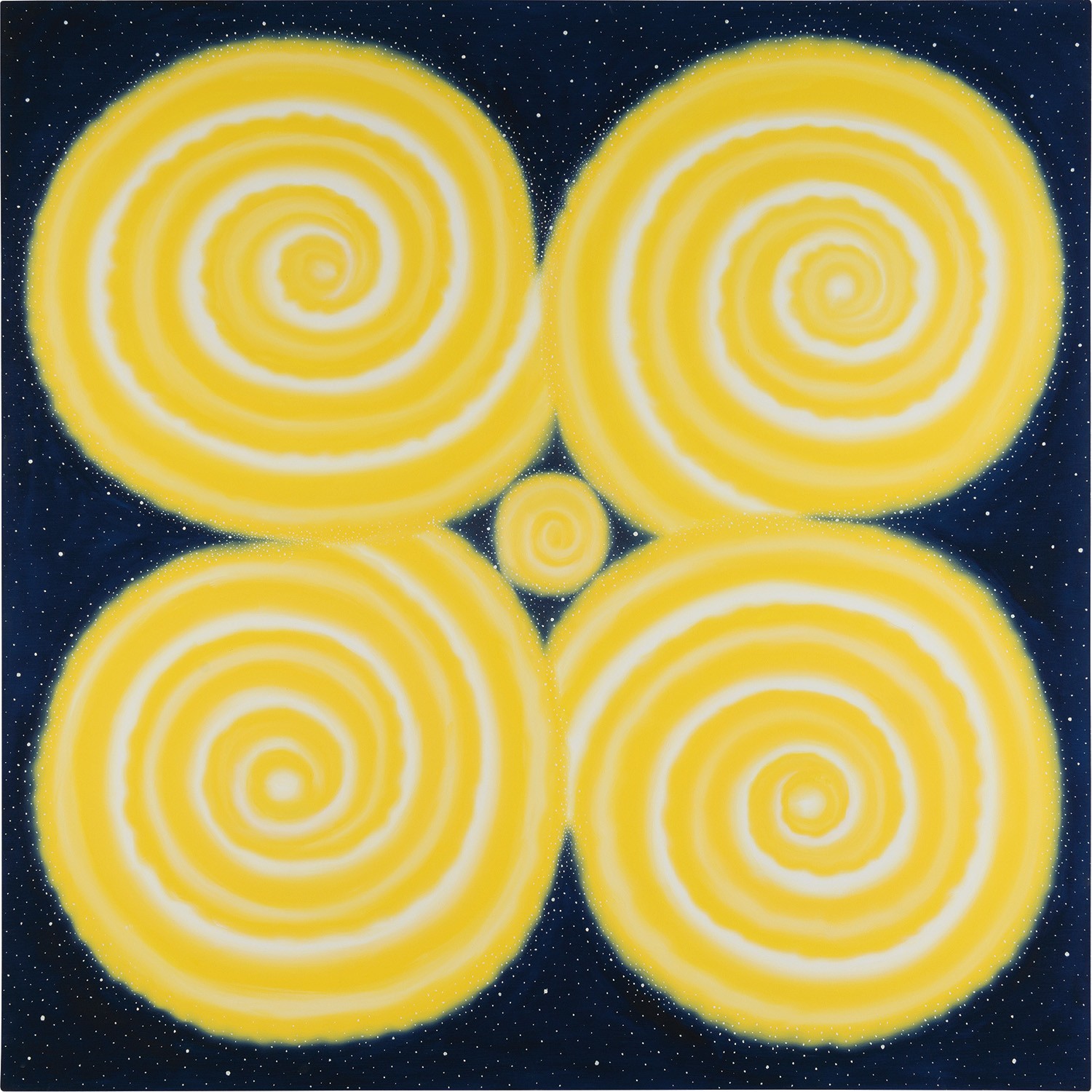
"Jonestown" from 1980 confronts one of the defining tragedies of the late 1970s with a gravity and formal restraint that makes its impact all the more lasting. Then there are works like "Looking for a Leveraged Buyout" from 1988 and "The Big Bang" from 1989, in which Brown turns his eye toward the economics and metaphysics of the Reagan era with the knowing precision of a cultural satirist who has read his history carefully. Each of these paintings rewards sustained looking: the surface pleasure of the pattern and color gives way to layers of meaning that accumulate slowly. Brown was also a prolific collector and an engaged citizen of the art world.
Roger Brown
The Big Bang, 1989
His home in Chicago and his property in Kentuck Knob, Pennsylvania became expressions of his aesthetic philosophy, filled with folk art, architectural fragments, and objects that informed his practice directly. He had a deep and serious engagement with American vernacular culture: roadside signs, painted window displays, carnival imagery, and the visual language of evangelical Christianity all fed into his work. This was not appropriation for its own sake but genuine affection and intellectual curiosity, a desire to understand the full texture of the country he was depicting. From a collecting perspective, Roger Brown represents one of the most compelling opportunities in American postwar art.
His work remains relatively accessible compared to artists of comparable historical stature, and the trajectory of Chicago Imagism as a recognized movement has brought increasing institutional and critical support. Major museums including the Smithsonian American Art Museum hold significant examples of his work, and the Estate of Roger Brown, managed through the School of the Art Institute of Chicago, has been an important steward of his legacy. Collectors who have pursued Brown with seriousness tend to emphasize the range of his output: his paintings vary considerably in scale and subject, and finding a work that resonates personally is both the challenge and the pleasure of collecting him. Early works from the late 1960s and early 1970s show the formation of his visual ideas and carry significant art historical interest, while the politically engaged canvases of the 1980s represent his mature voice at full power.
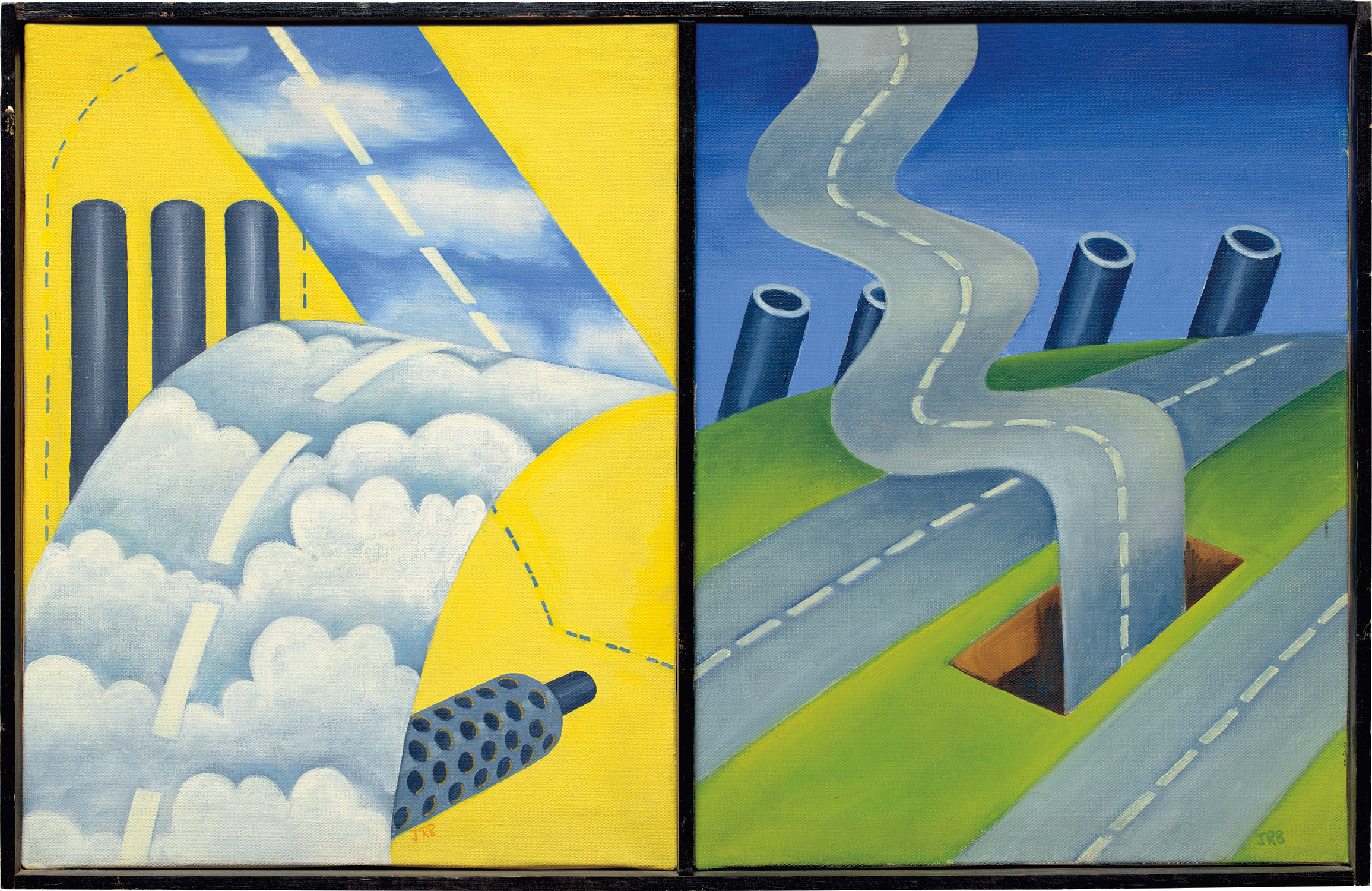
Roger Brown
Two works: (i-ii), 1967
To understand Brown fully, it helps to place him in the broader conversation about American figurative painting. He shares a commitment to vernacular sources and symbolic imagery with artists like Philip Guston, whose own return to figuration in the late 1960s sent shockwaves through the art world. There are affinities too with the Pop sensibility of artists like Joe Zucker and Neil Jenney, and with the folk art inflected practice of Howard Finster, though Brown always operated at a level of formal sophistication and intellectual intention that sets him apart from any simple category. He was, in the end, his own school.
Roger Brown died in 1997, and the loss was felt acutely by everyone who understood what he had built. But the work endures with remarkable vitality. In an era when art about politics, about American identity, about the comedy and tragedy of collective life feels urgently necessary, Brown's paintings speak with the authority of genuine vision. He saw his country clearly, loved it critically, and gave it back to us transformed into something we could actually look at and think about.
That is the definition of a lasting contribution, and it is why collectors and curators continue to return to his canvases with fresh eyes and real gratitude.
Explore books about Roger Brown