Rogelio Polesello
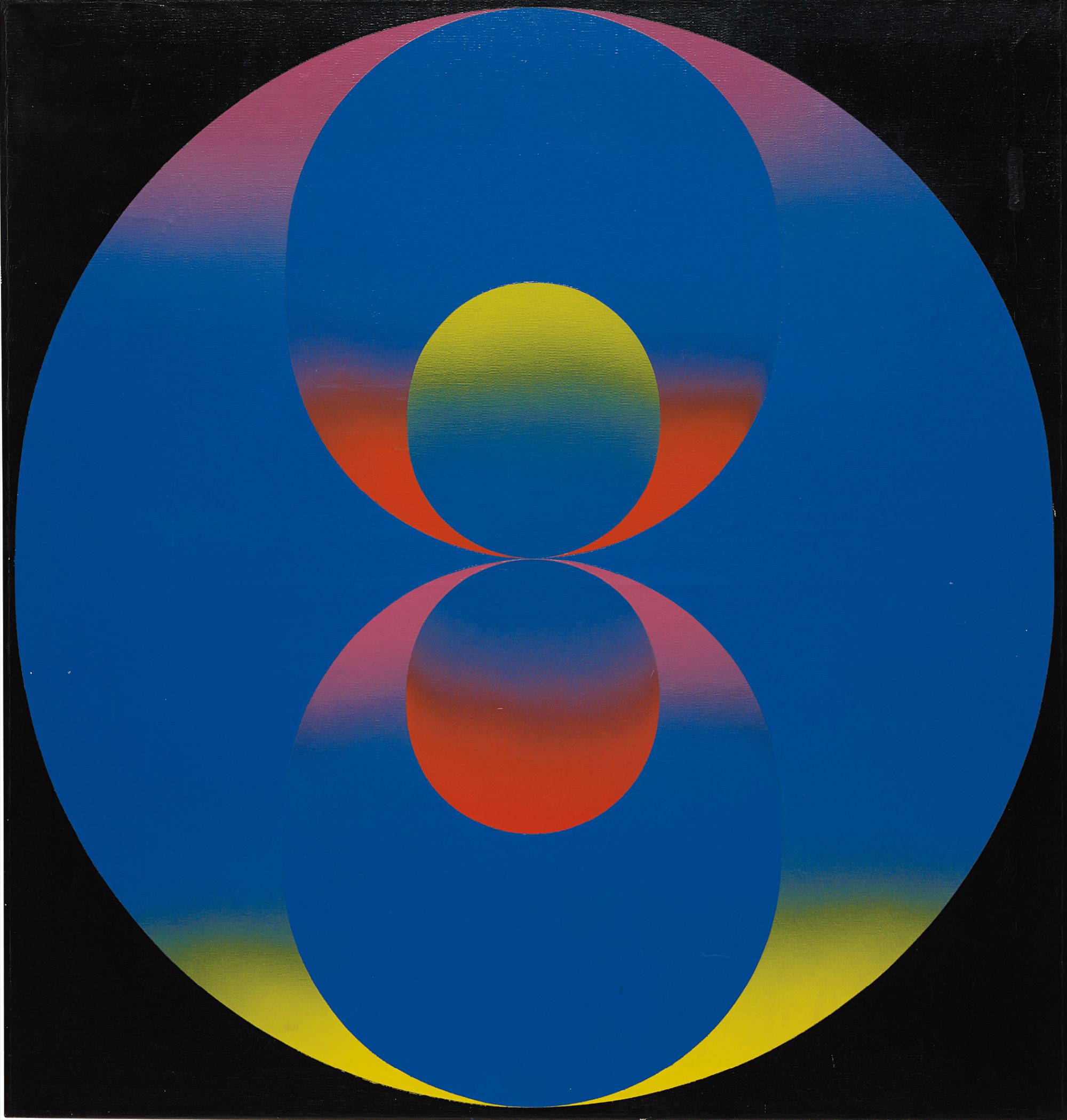
Rogelio Polesello: Vision in Vibrant Motion
Artist Spotlight · The Collection Editorial
Stand before one of Rogelio Polesello's canvases and something remarkable happens. The surface breathes. Circles advance and recede. Color pulses with a rhythm that feels almost biological.
Rogelio Polesello
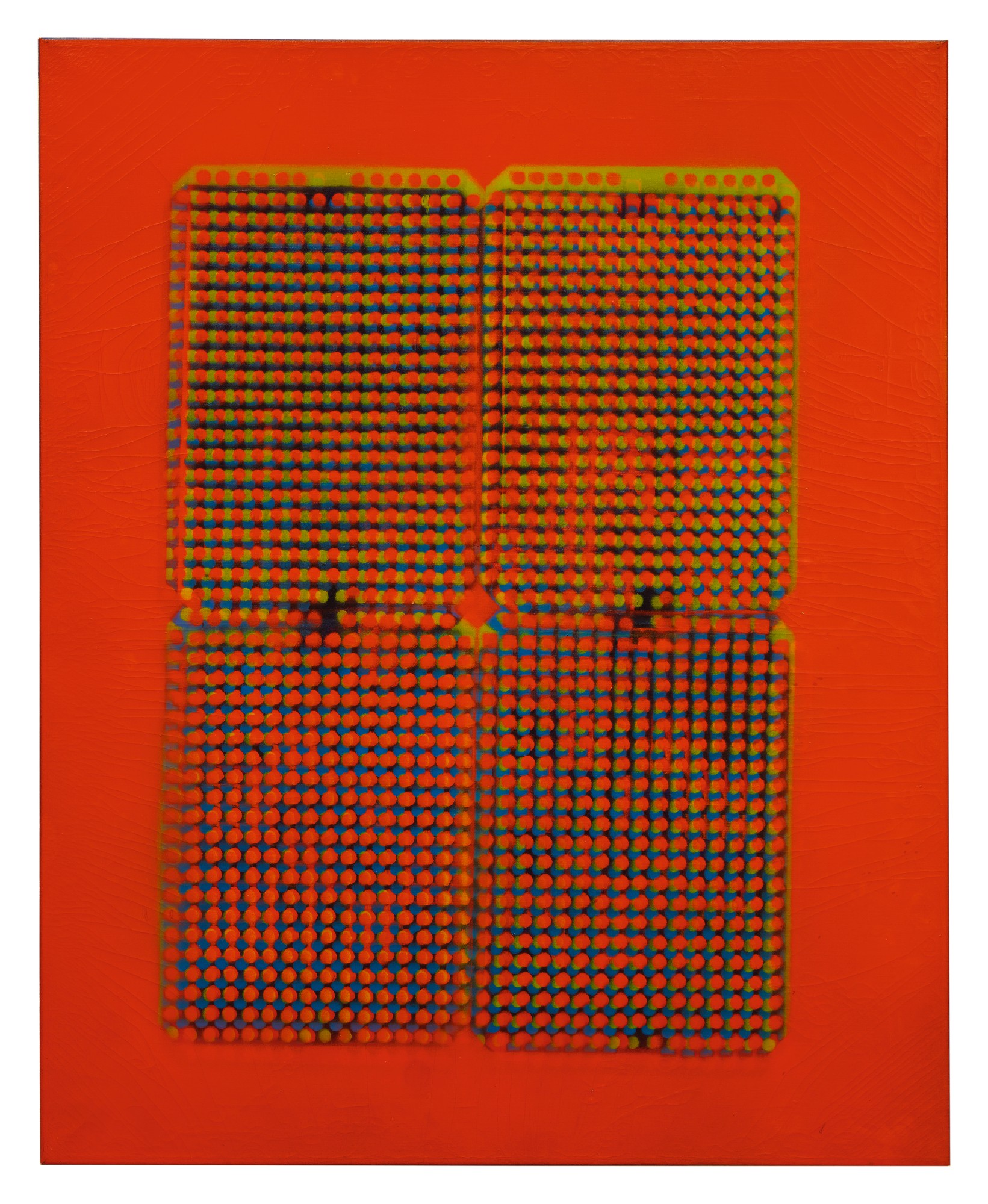
Naranja, 1966
It is not a trick, or rather, it is the most sophisticated kind of trick: a total command of visual perception rendered through acrylic and geometry. Polesello built a universe from the most elemental tools available to a painter, and the universe he built keeps expanding, decades after his brush last moved across the canvas. Polesello was born in Buenos Aires in 1939, arriving into a city already charged with modernist ambition. Argentina in the postwar decades was not a peripheral outpost of the art world but an active, sometimes ferocious participant in the international conversation about what painting could be and do.
The Instituto Di Tella, founded in Buenos Aires in 1958 and operating through the 1960s, became one of the most electrifying centers of avant garde experimentation in the entire Western Hemisphere. Polesello came of age as an artist in precisely this environment, studying at the Escuela Nacional de Bellas Artes in Buenos Aires and absorbing the twin currents of rigorous formal training and radical conceptual openness that defined the Argentine scene of his formative years. His early career placed him at the center of geometric abstraction at a moment when that movement was undergoing a fundamental transformation. The hard edged geometry that had defined constructivism and concrete art in the 1940s and 1950s was giving way to something more dynamic and more perceptually alive.
Rogelio Polesello
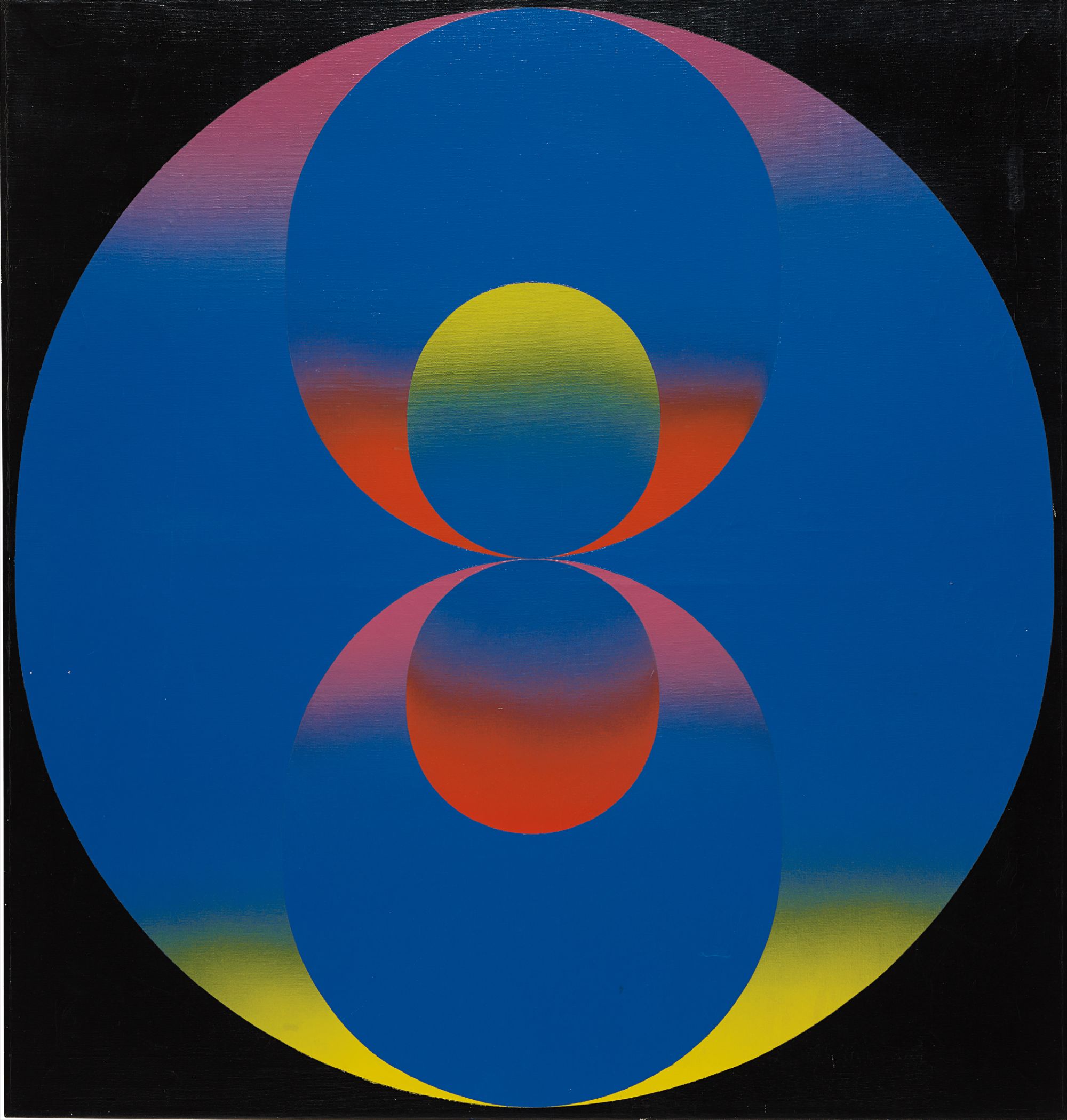
Círculos centrales
Artists across Europe and the Americas were discovering that precise geometric form, combined with strategic use of color and scale, could activate the eye in ways that conventional painting never had. Polesello embraced this discovery with a particular intensity. His work was never satisfied with stasis. Every composition reaches toward movement, toward the suggestion that the image exists in time as well as in space.
The year 1966 stands as a watershed moment in understanding Polesello's achievement. It was then that he completed Naranja, a work that crystallizes everything that makes his practice so compelling. Painted in acrylic on canvas, Naranja deploys its titular orange across a composition of radiating forms that seem to rotate before the eye. The color is not decorative but structural: it is the carrier of optical energy, the medium through which the painting performs its transformation from flat surface to living field.
Naranja demonstrates Polesello's mastery of the principles that would come to define Op Art internationally, but it does so with a warmth and sensuality that sets it apart from the cooler, more analytical work being produced in New York and London at the same moment. There is something deeply Argentine about that warmth, a chromatic generosity rooted in the particular light and visual culture of the Rio de la Plata. Circulos Centrales, another defining work from his acrylic on canvas practice, extends these investigations into the territory of pure concentricity. Rings of color emanate from a central point in a composition that is at once perfectly ordered and visually restless.
The work rewards extended looking: what first appears as a simple pattern gradually reveals itself as a precisely engineered perceptual event, with each ring calibrated in relation to its neighbors to produce a specific optical effect. Polesello was also a gifted graphic designer, and his work in that discipline informed his painting in productive ways. His command of the relationship between figure and ground, between positive and negative space, gave his canvases a graphic clarity that made them both immediately accessible and endlessly rich upon closer examination. Polesello exhibited internationally throughout his career, participating in exhibitions that placed Argentine geometric abstraction in dialogue with European kinetic art and North American Op Art.
His work was shown in venues across Latin America and Europe, and he earned recognition as one of the essential voices in the story of Latin American modernism. He is rightly grouped with artists such as Jesus Rafael Soto of Venezuela and Carlos Cruz Diez, also Venezuelan, both of whom were pursuing related investigations into optical phenomena and color perception at the same historical moment. The Argentine concrete art tradition, developed by artists including Tomas Maldonado and Gyula Kosice in the 1940s, provided Polesello with a rigorous intellectual foundation, while the international Op Art movement, exemplified by Victor Vasarely in France and Bridget Riley in Britain, offered a broader context for his explorations. Within this constellation, Polesello holds a distinctive place: his work is warmer in palette, more sensuous in its effects, and more deeply rooted in a specifically Latin American visual tradition than many of his international contemporaries.
For collectors, Polesello represents one of the genuinely significant opportunities available in the market for mid century Latin American modernism. His work has steadily attracted serious attention from institutions and private collectors who recognize that the story of Op Art and geometric abstraction has too often been told as a purely European and North American narrative. Collectors drawn to the work of Vasarely, Riley, or Frank Stella frequently find that Polesello's paintings offer a comparable level of intellectual rigor and visual power, along with a chromatic richness that is entirely his own. Works from the 1960s, the decade of Naranja and his most concentrated engagement with optical phenomena, are particularly prized.
When acquiring Polesello, collectors should attend closely to the quality of the color relationships: at his best, the interactions between hues are calibrated with a precision that produces optical effects no reproduction can fully convey. The works must be experienced in person, which is part of what makes owning one so rewarding. Polesello lived and worked in Buenos Aires until his death in 2014, remaining committed to his adopted city and to the tradition of rigorous, visually ambitious painting that had shaped him as a young artist. He left behind a body of work that grows more significant with each passing year, as scholars and curators continue to expand their understanding of the international dimensions of geometric abstraction and Op Art.
His paintings are not relics of a particular moment but active presences, works that continue to do exactly what they were designed to do: to make the eye move, to make the mind alert, to remind us that looking is not a passive act but an encounter. In an era when so much art demands explanation before it can be experienced, Polesello's canvases offer the rarer gift of immediate, visceral engagement followed by deeper and deeper layers of discovery. That is the mark of a genuine master, and it is why his work continues to find new admirers wherever it is shown.