Rodolfo Morales
Rodolfo Morales: Dreams Rooted in Oaxacan Soil
Artist Spotlight · The Collection Editorial
There is a moment, standing before a Rodolfo Morales canvas, when the boundary between memory and imagination simply dissolves. Women in elaborate Tehuana dress hover above cobblestone plazas. Horses materialize from clouds. A village orchestra plays to no one and everyone at once.
Rodolfo Morales
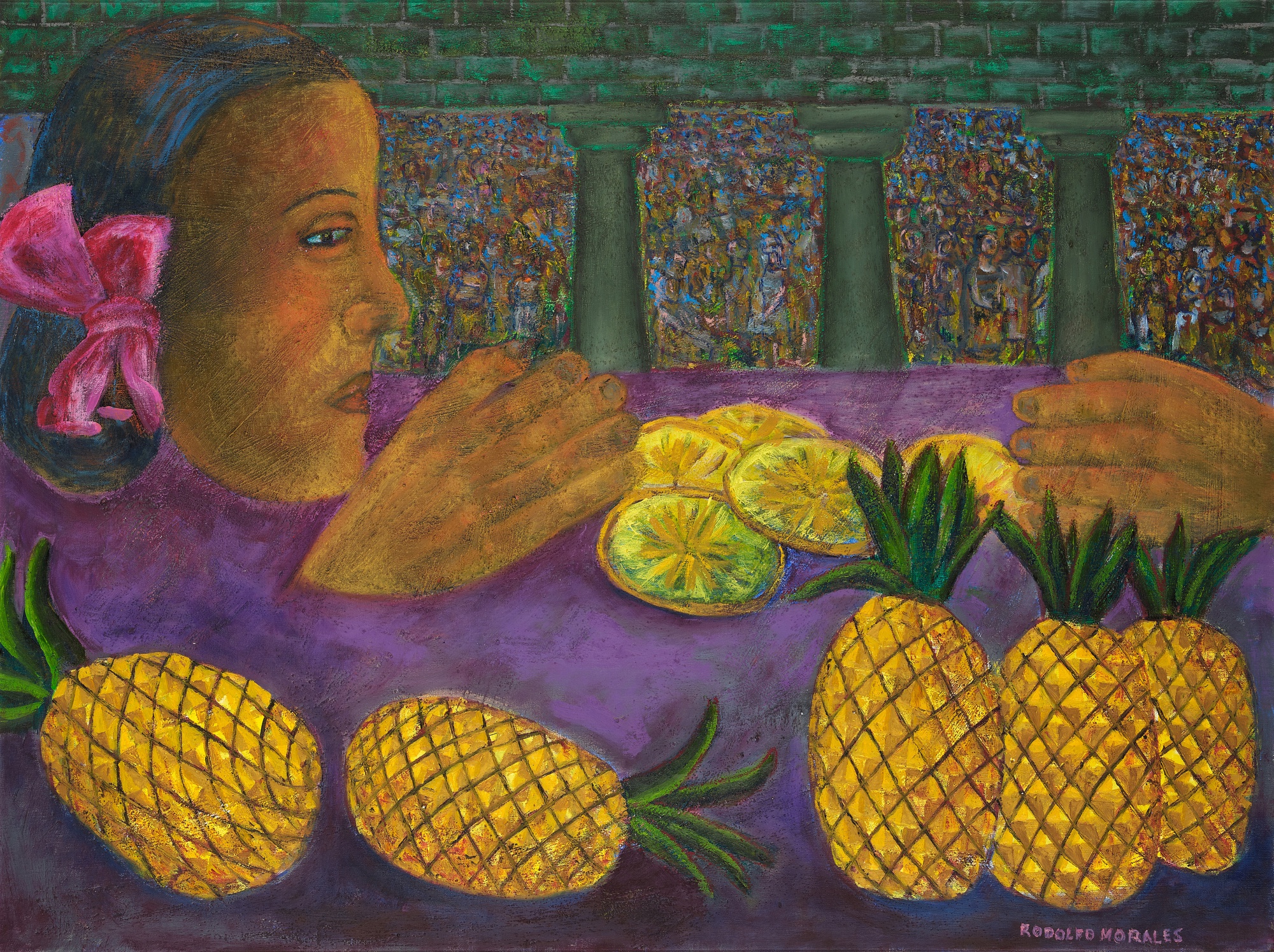
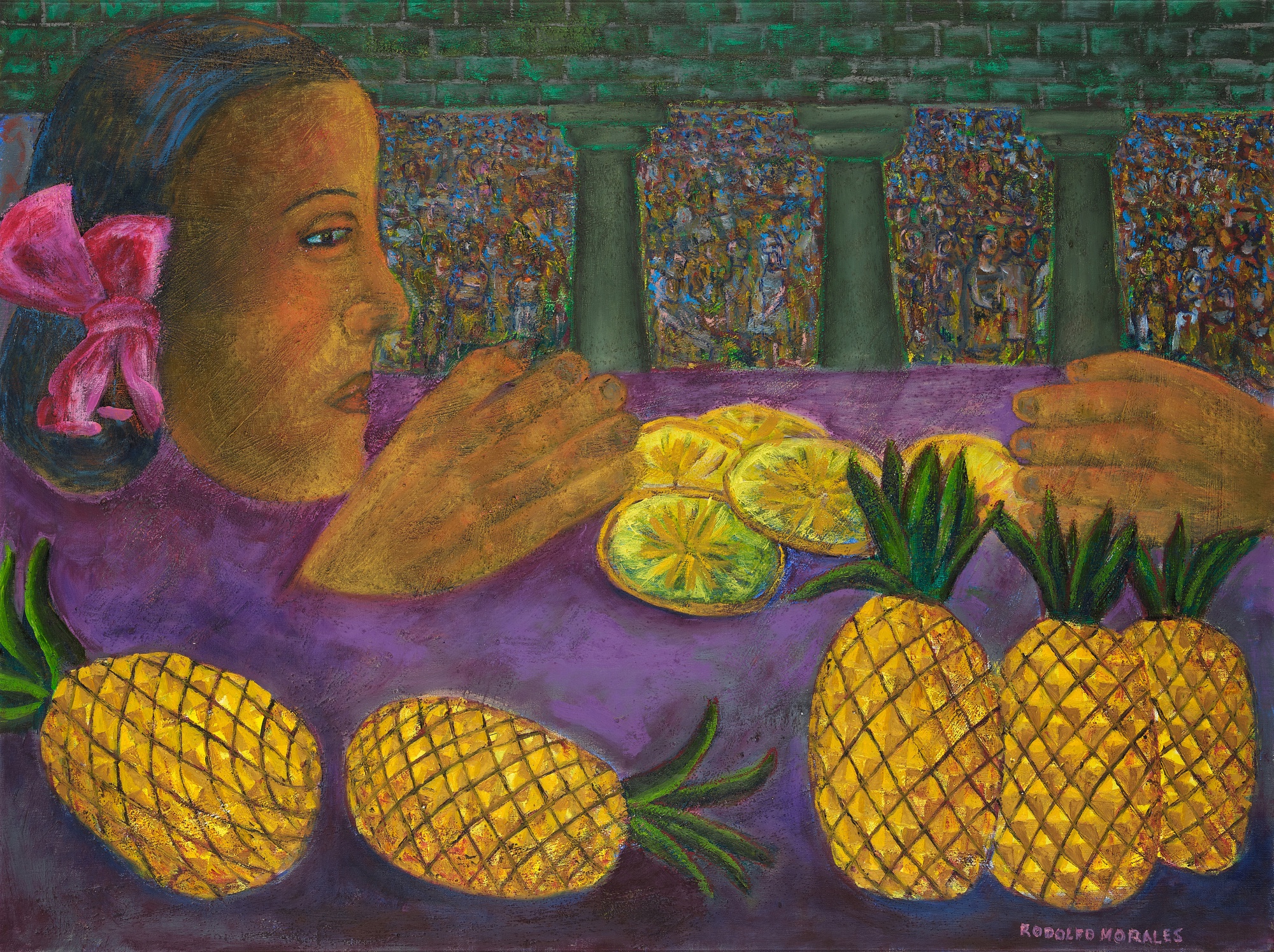
Muchacha con piñas, 1997
It is this quality, at once deeply local and genuinely universal, that has secured Morales a place among the most beloved Latin American painters of the twentieth century, and that continues to draw serious collectors to his work with undiminished enthusiasm. In recent years, major auction houses including Christie's and Sotheby's have seen sustained demand for his paintings, with works regularly achieving prices that reflect both his cultural significance and the relative scarcity of his finest compositions on the open market. Rodolfo Morales was born in 1925 in Ocotlán de Morelos, a small market town in the Central Valleys of Oaxaca, Mexico. Ocotlán sits in the Sierra Madre del Sur, a landscape of dry hills, flowering trees, and ancient Zapotec ceremonial life, and its atmosphere permeates every canvas Morales ever made.
He grew up surrounded by the visual richness of indigenous Zapotec culture: the embroidered textiles, the painted gourds, the elaborate costumes worn during festivals, and the particular quality of Oaxacan light that seems to flatten and intensify color simultaneously. These were not influences he encountered in a museum. They were the fabric of daily life, and he carried them with him always. Morales studied at the Escuela Nacional de Artes Plásticas in Mexico City, where he trained alongside a generation of artists grappling with the legacy of the great Mexican muralists.
Rodolfo Morales
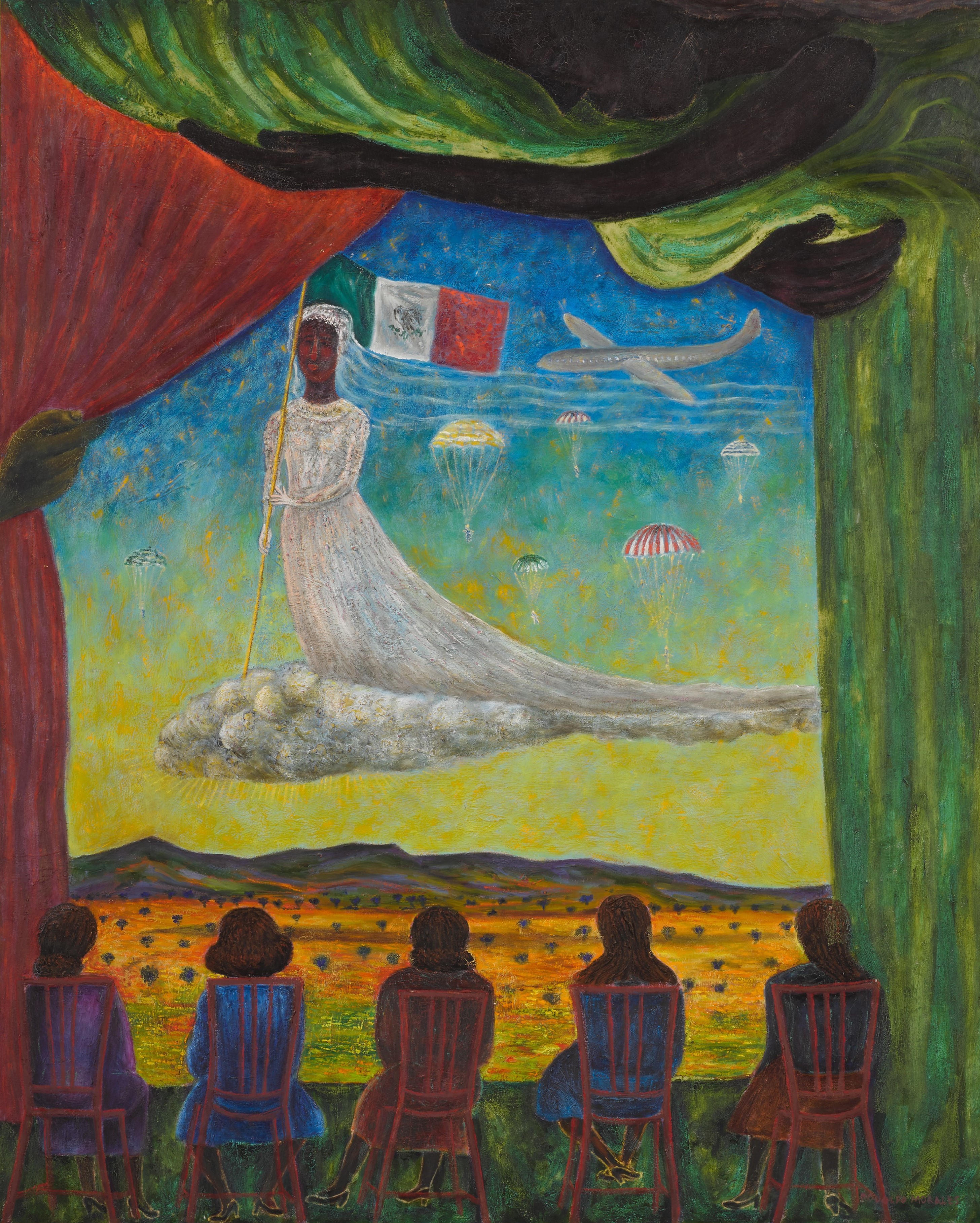
Sin título, 1990
Diego Rivera, José Clemente Orozco, and David Alfaro Siqueiros had defined a monumental, politically charged vision of Mexican identity, and the pressure to work within or against that tradition was considerable. Morales absorbed the commitment to Mexican subject matter but turned decisively away from the heroic and the propagandistic. His sensibility was quieter, stranger, more interior. He returned to Oaxaca not as a rejection of the wider art world but as an act of creative fidelity to the specific place and culture that had made him.
For decades, Morales taught art at the secondary school level in Mexico City, a fact that tends to astonish those who encounter it for the first time. He painted steadily throughout this period, developing his vocabulary of floating figures, fragmented architectural spaces, and luminous color, but he remained largely outside the commercial gallery circuit. It was not until the 1980s, when he was already in his mid fifties, that his work gained significant international recognition. The timing, coinciding with a broader surge of collector interest in Latin American art, was fortuitous, but the recognition was entirely deserved.
Rodolfo Morales
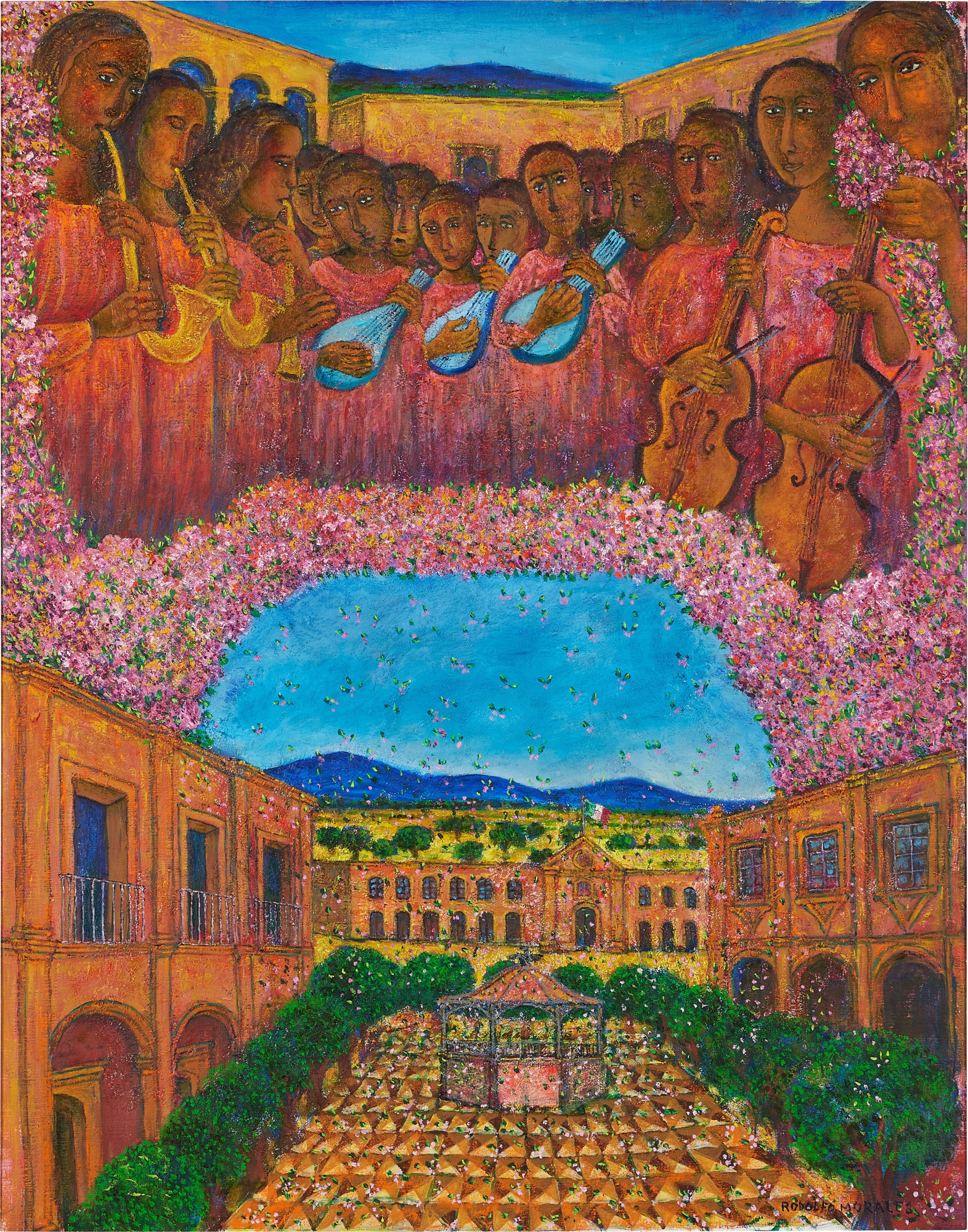
Orquesta de mi pueblo, 1997
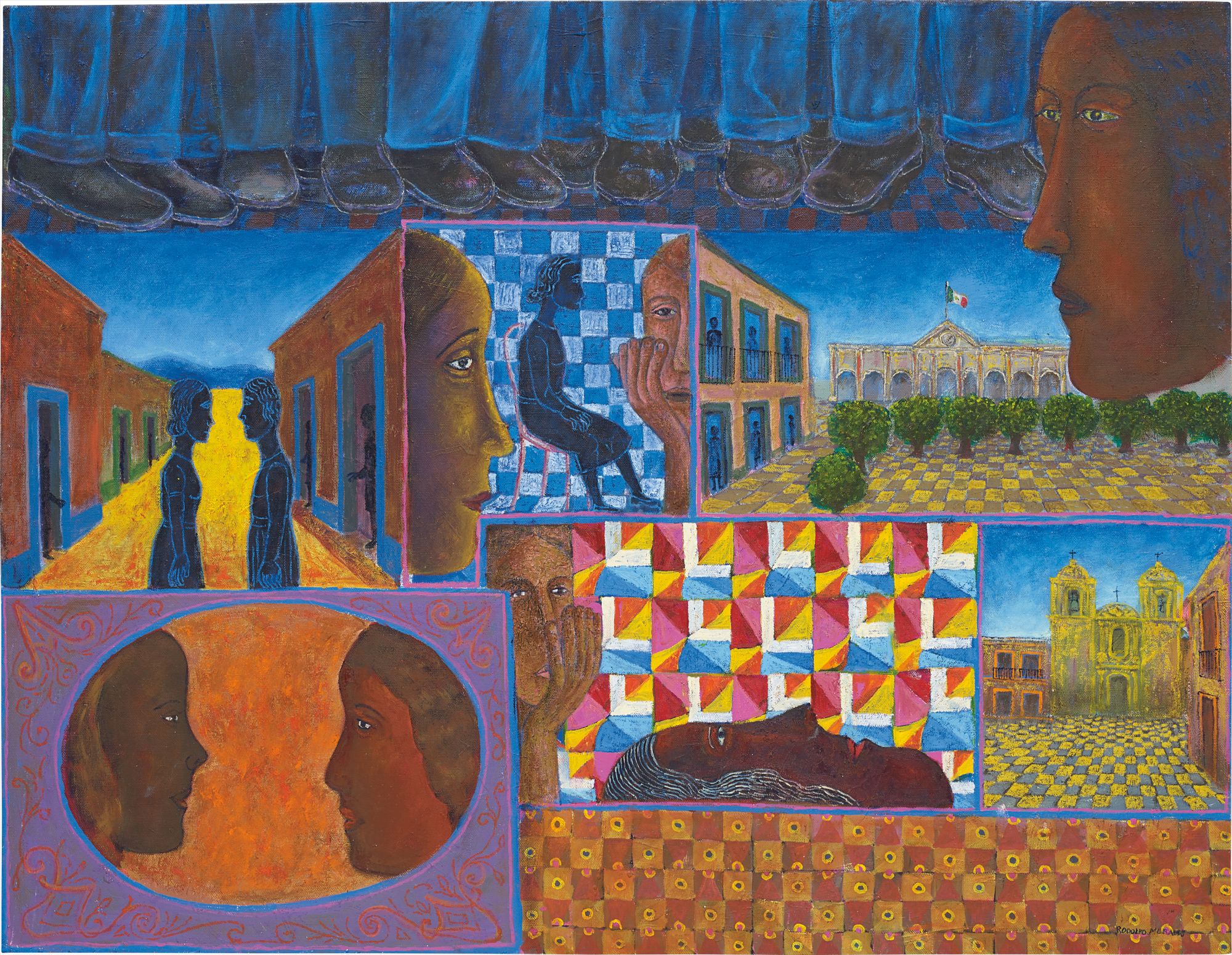
His canvases had been quietly perfecting themselves for decades. The paintings that define Morales at his peak are compositions of extraordinary formal intelligence disguised as folk whimsy. Works such as Orquesta de mi pueblo, from 1997, demonstrate how rigorously he organized his seemingly spontaneous imagery. Musicians, animals, and architectural fragments are arranged with the precision of a stage director who understands that apparent disorder requires careful choreography.
His oil and sand technique, visible in works like Muchacha con piñas from the same year, introduces a tactile dimension that anchors the dreamlike content in physical material reality. The sand, sourced from Oaxacan earth, functions almost as a signature of place: the ground itself insisting on its presence within the picture. His palette favored deep ochres, dusty roses, and the particular blue green that one associates with Oaxacan ceramics, and he handled these colors with a confidence that never tipped into decoration. For collectors, the appeal of Morales operates on several registers simultaneously.
Rodolfo Morales
n.d.
There is the biographical narrative, compelling in itself: a man who spent his working life as a schoolteacher and emerged in late middle age as one of Mexico's most celebrated painters. There is the philanthropic dimension, which adds a layer of meaning to the acquisition of his work. After achieving commercial success, Morales dedicated enormous resources to the restoration of historic churches and colonial buildings in Oaxaca through the Fundación Cultural Rodolfo Morales, turning his earnings into a sustained act of cultural preservation. Owning a Morales is, in a real sense, participating in that larger project.
And then there is simply the quality of the paintings themselves, which reward sustained looking in ways that more fashionable work sometimes does not. In terms of art historical context, Morales occupies a distinctive position between Mexican modernism and the international Surrealist tradition. He shares something with Frida Kahlo in his willingness to locate the personal and the mythological within the same pictorial space, and something with Francisco Toledo, the great Oaxacan master who was his contemporary and fellow champion of regional culture, in his commitment to indigenous visual languages. Internationally, his compositions invite comparison with Marc Chagall, whose floating figures and village memories they superficially resemble, though Morales's relationship to his source culture is far more direct and intimate than Chagall's nostalgic reconstruction.
Morales did not look back at a lost world. He painted the world he lived in, transformed by his particular gift for wonder. Rodolfo Morales died in Ocotlán de Morelos in 2001, the same town where he was born, having returned in his final years to the landscape that had always sustained his imagination. His legacy is threefold: the paintings themselves, which continue to circulate through major collections and auction rooms with undiminished vitality; the restored buildings of Oaxaca, which stand as monuments to his generosity; and a model of artistic practice grounded in cultural loyalty rather than metropolitan ambition.
At a moment when the art world increasingly values specificity, rootedness, and the ethics of cultural representation, his example feels not merely historical but urgently relevant. To collect Morales is to acquire a piece of Oaxacan light, Zapotec memory, and one man's extraordinarily disciplined capacity for joy.
Explore books about Rodolfo Morales
Rodolfo Morales: Una Retrospectiva
Instituto de Artes Contemporáneas
Rodolfo Morales: Pintor de Oaxaca
Francisco Toledo
The Art of Rodolfo Morales
Linda Forth
Morales: Visiones de México
Raúl Flores Prieto