Roby Dwi Antono
Roby Dwi Antono's Wide Eyes See Everything
Artist Spotlight · The Collection Editorial
In the closing months of 2023, a small oil painting of a girl clutching a crustacean's claw quietly made its way through the international contemporary art circuit and stopped collectors in their tracks. "Little Girl With Crustacean's Claw" is the kind of work that rewards a second and third look, its surface tension holding together the sweetness of childhood and something altogether stranger lurking just beneath. For Roby Dwi Antono, this tension is not accidental. It is the whole point, and it is why his name has become one of the most consistently discussed in Southeast Asian contemporary art over the past decade.
Roby Dwi Antono
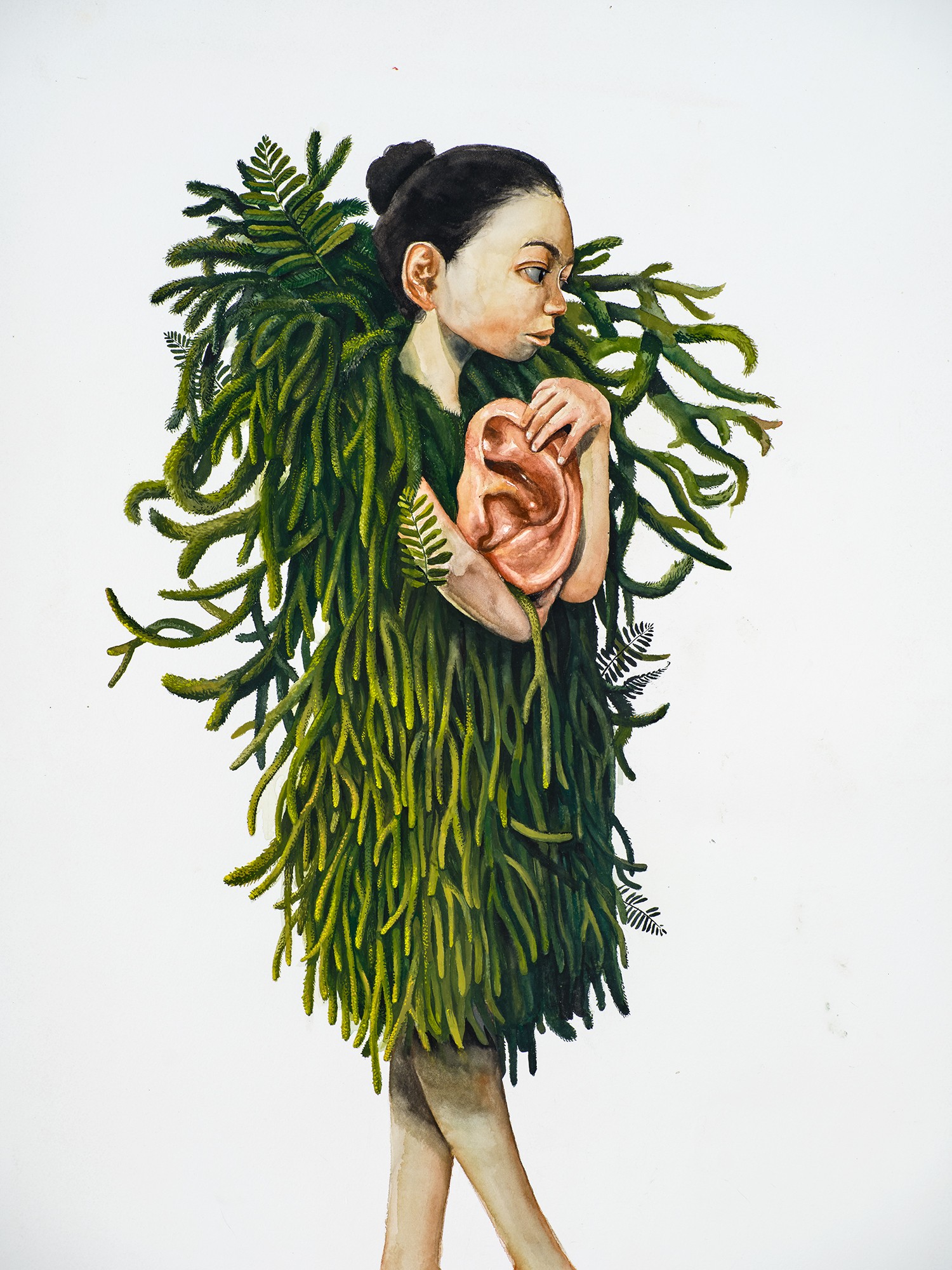
Ranum, 2014
Antono was born in 1990 in Solo, Central Java, a city with a rich cultural identity rooted in Javanese court tradition, batik craft, and a long history of wayang, the shadow puppet theatre that has shaped visual storytelling across the Indonesian archipelago for centuries. Growing up in this environment gave him an early and intuitive relationship with figures that carry symbolic weight, characters who exist simultaneously in the everyday world and in some other, more charged dimension. Solo is not Jakarta, and that distance from the Indonesian capital's commercial art scene arguably gave Antono the space to develop a visual language entirely his own before the market came knocking. His formation as an artist drew from sources that seem at first unlikely to coexist.
Japanese anime and manga, with their enormous luminous eyes and their emotional directness, were formative influences, as was the flattened graphic boldness of Western pop art. At the same time, Antono absorbed the symbolic richness of Indonesian visual culture, its love of ornament, its comfort with the spiritual and the mythological sitting alongside the domestic. The synthesis of these streams produced something that feels genuinely new: figurative painting that is immediately legible as a cultural hybrid yet belongs to no single tradition. This is a difficult balance to achieve and an even more difficult one to sustain across a career, but Antono has managed it.
Roby Dwi Antono
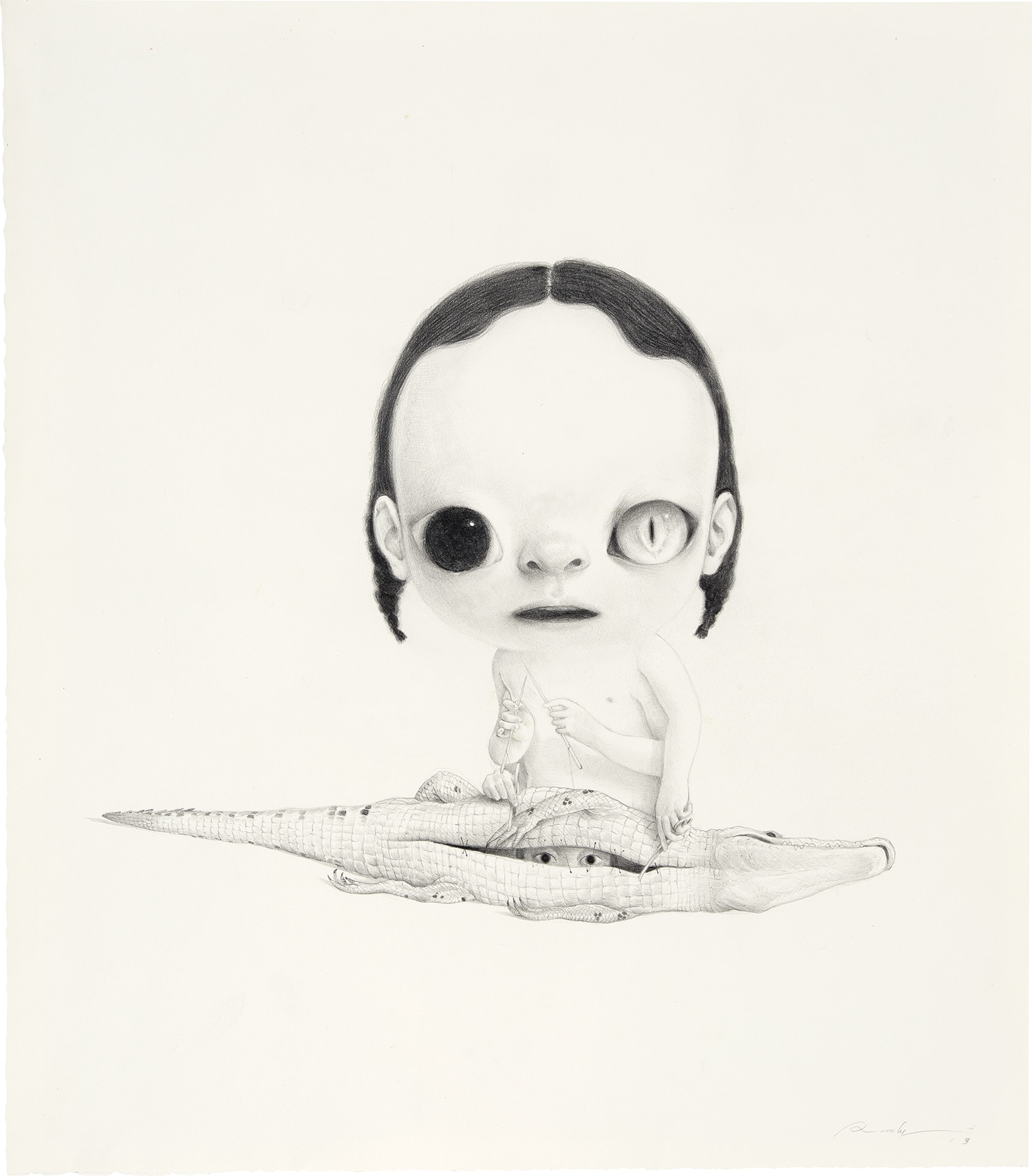
The Curious Creator, 2019
His early works on paper, including the watercolour "Ranum" from 2014, reveal a painter already in command of his central preoccupations. The figures he painted then, as now, tend toward the childlike, with oversized eyes that function less as anatomical features and more as emotional weather systems. These are not portraits of innocence so much as portraits of interiority, of the interior life that children are presumed not to have and that Antono insists on taking seriously. By the time he moved toward larger scale oil paintings around 2019 and 2020, that command had deepened considerably.
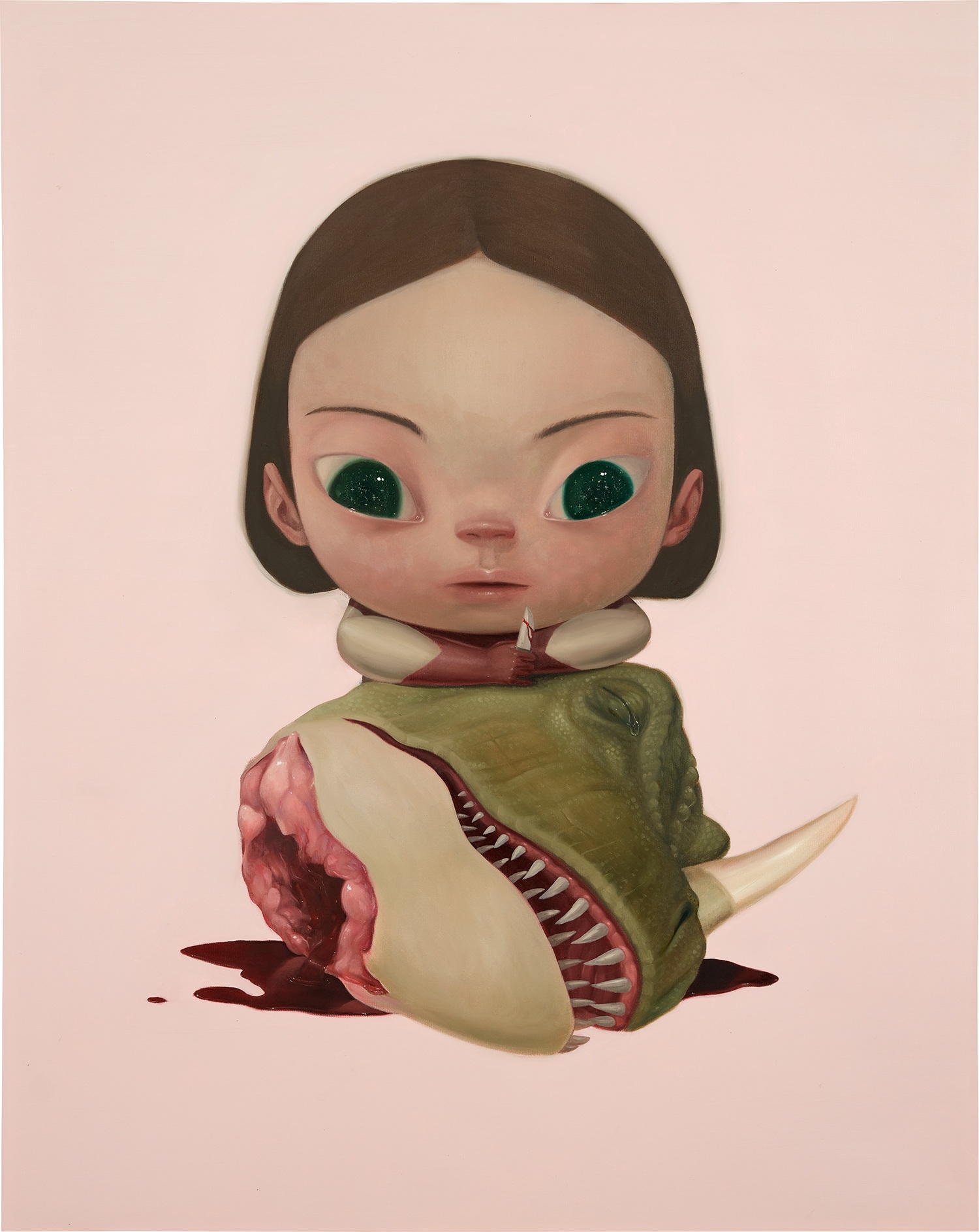
Works like "The Curious Creator" from 2019 and the pair of canvases "We Are There Together" and "Kira" from 2020 show a painter who has expanded his formal vocabulary without losing the intimacy that made the early works so arresting. The backgrounds grew more complex, the chromatic relationships more adventurous, and the figures more psychologically layered. 2020 was a particularly fertile year for Antono, and it is worth pausing on "Hayu," a work in charcoal and spray paint on canvas that signals his willingness to move across media and method. The incorporation of spray paint into a charcoal ground creates a surface that reads as both urban and ancient, immediate and considered.
Roby Dwi Antono
We Are There Together, 2020
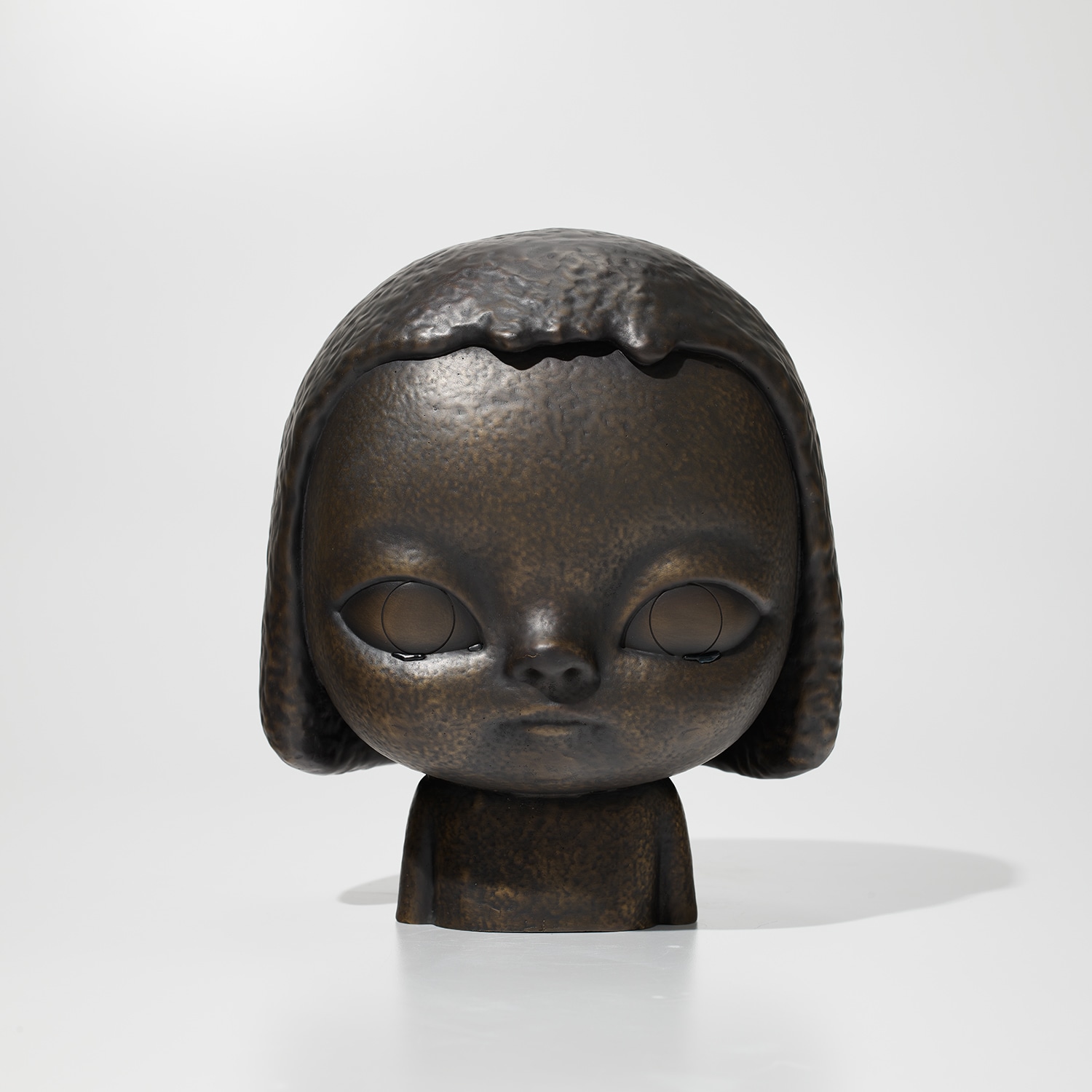
This material restlessness is characteristic of Antono's practice and distinguishes him from painters content to work within a single register. He has also worked in sculpture, most notably with "Asteria," a figure in fibre reinforced plastic with CNC acrylic eyes and a steel skeleton and base. The sculpture extends his painterly concerns into three dimensions with considerable authority, the CNC eyes giving the figure the same uncanny luminosity that his painted figures possess. More recently, works on galvanized steel plate, including "DIN" and "KIN" executed in spray paint, demonstrate an ongoing curiosity about surface and support that keeps his practice in productive motion.
For collectors, Antono's work presents a compelling proposition for several reasons. His command of multiple media means that entry points exist at various price levels, from works on paper through to major canvases and sculptural pieces. His institutional profile in Southeast Asia has grown steadily, with representation through Srisasanti Gallery, one of the leading galleries in Indonesia with strong connections to the regional and international market. Collectors who acquired his work in the early part of the last decade have seen that interest validated by growing critical and market attention.
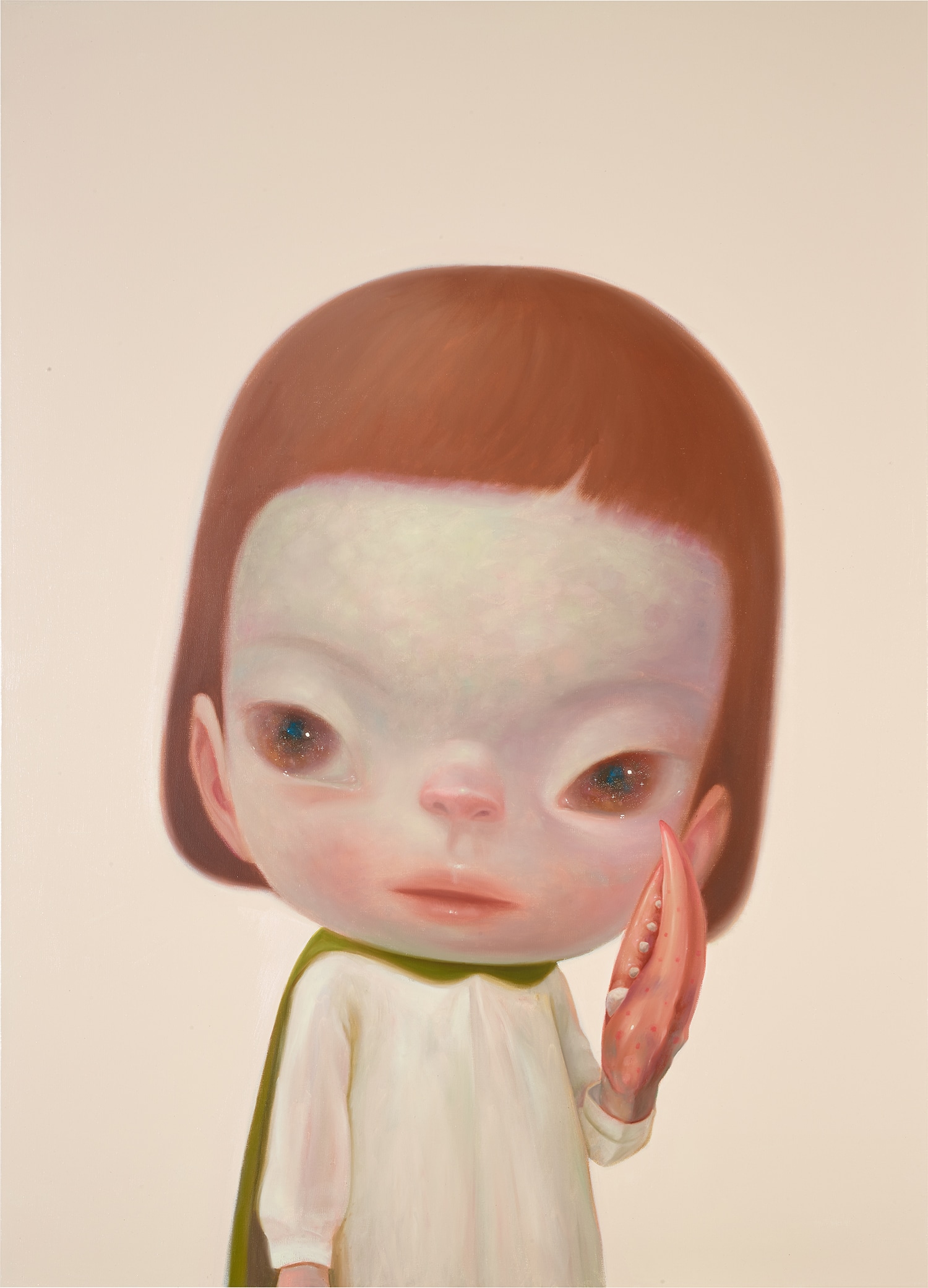
Roby Dwi Antono
Little Girl With Crustacean's Claw, 2023
The figurative tradition he works within is one that resonates strongly with collectors across Asia and increasingly with European and American buyers looking for contemporary painting that carries genuine cultural specificity rather than the generic internationalism that characterises much of what circulates at major fairs. Within the broader landscape of contemporary figurative painting, Antono occupies a distinct position. His work invites comparison with the Japanese Neo Pop tradition of artists like Yoshitomo Nara, whose similarly childlike figures carry a deceptive emotional weight, and with the surrealist figurative painting that has flourished across Southeast Asia in recent decades. He also sits meaningfully alongside a generation of Indonesian painters who have brought the country's visual culture into productive conversation with global contemporary art discourse, contributing to a broader reassessment of where significant painting is being made in the twenty first century.
His blend of the local and the cosmopolitan feels less like a strategic positioning than a genuine expression of how he sees the world. What ultimately makes Antono matter, beyond the formal accomplishment and the collecting opportunity, is the quality of attention his work asks of the viewer. Those wide, searching eyes that populate his canvases and sculptures are not passive objects of contemplation. They look back.
They ask questions about what it means to see and to be seen, about the relationship between the protected world of childhood and the complicated world that lies beyond it. In a moment when figurative painting has returned to the centre of critical and market attention, Antono is among the artists whose work gives that return genuine substance. He is, in the fullest sense, a painter worth watching.