Robin Rhode
Robin Rhode Draws the World Into Motion
Artist Spotlight · The Collection Editorial
When the Hayward Gallery in London presented Robin Rhode's work to its audiences, something remarkable happened in the room. Visitors found themselves leaning forward, trying to understand how a single South African artist had managed to make still photographs feel like held breath, like the instant before a body completes its leap. Rhode has spent more than two decades building one of the most genuinely original bodies of work in contemporary art, and the momentum around his practice shows no sign of slowing. Institutions across Europe, North America, and beyond have come to recognize him as an artist whose ideas are both intellectually rigorous and viscerally alive.
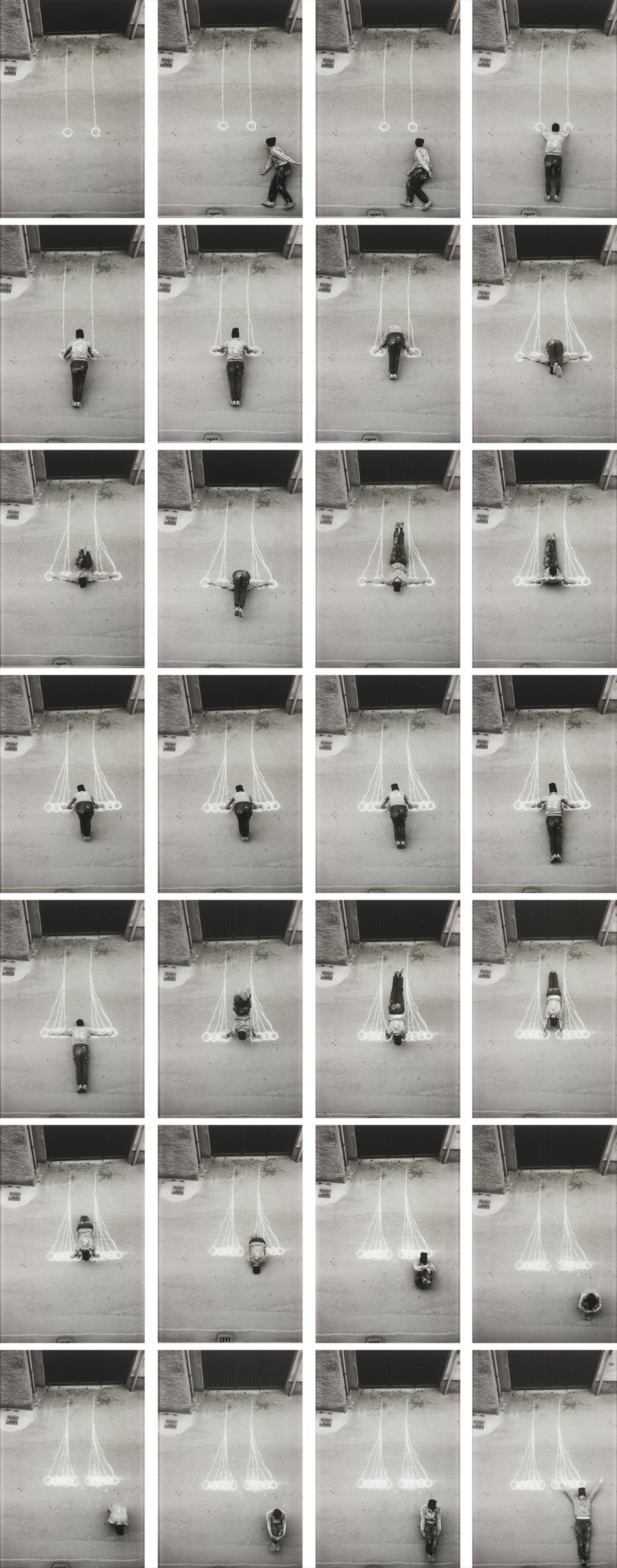
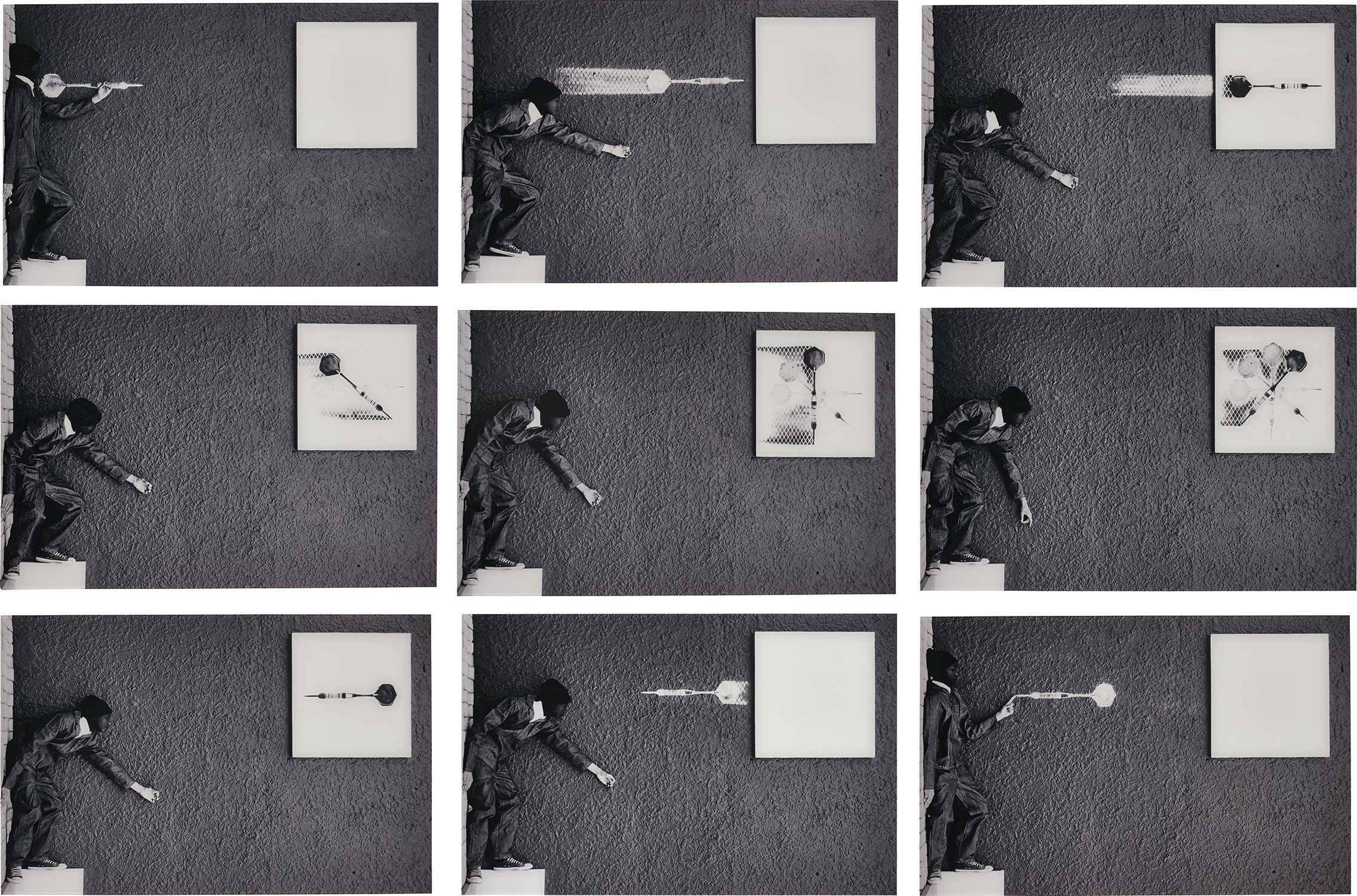
Robin Rhode
black and white photographs on Plexiglas, in 28 parts
Robin Rhode was born in Cape Town in 1976 and grew up in Johannesburg, a city whose street culture, energy, and social complexity would become the permanent grammar of his imagination. Johannesburg in the late apartheid and post apartheid years was a place of extraordinary creative ferment and real tension, where public space was contested, reclaimed, and reimagined daily. Rhode absorbed all of it. He studied at the Technikon Witwatersrand and the South African School of Film, Television and Dramatic Art, training that gave him a sophisticated understanding of image making, narrative sequencing, and the relationship between a body and the camera.
These are not incidental influences. They are the very architecture of how he thinks. By the early 2000s, Rhode had developed a practice that felt entirely new and yet rooted in traditions stretching from Duchamp to street graffiti to performance documentation. His method, at its core, involves drawing on walls with chalk or charcoal and then interacting physically with those drawings through movement and gesture, with the entire sequence captured in photographs taken in rapid succession.
Robin Rhode
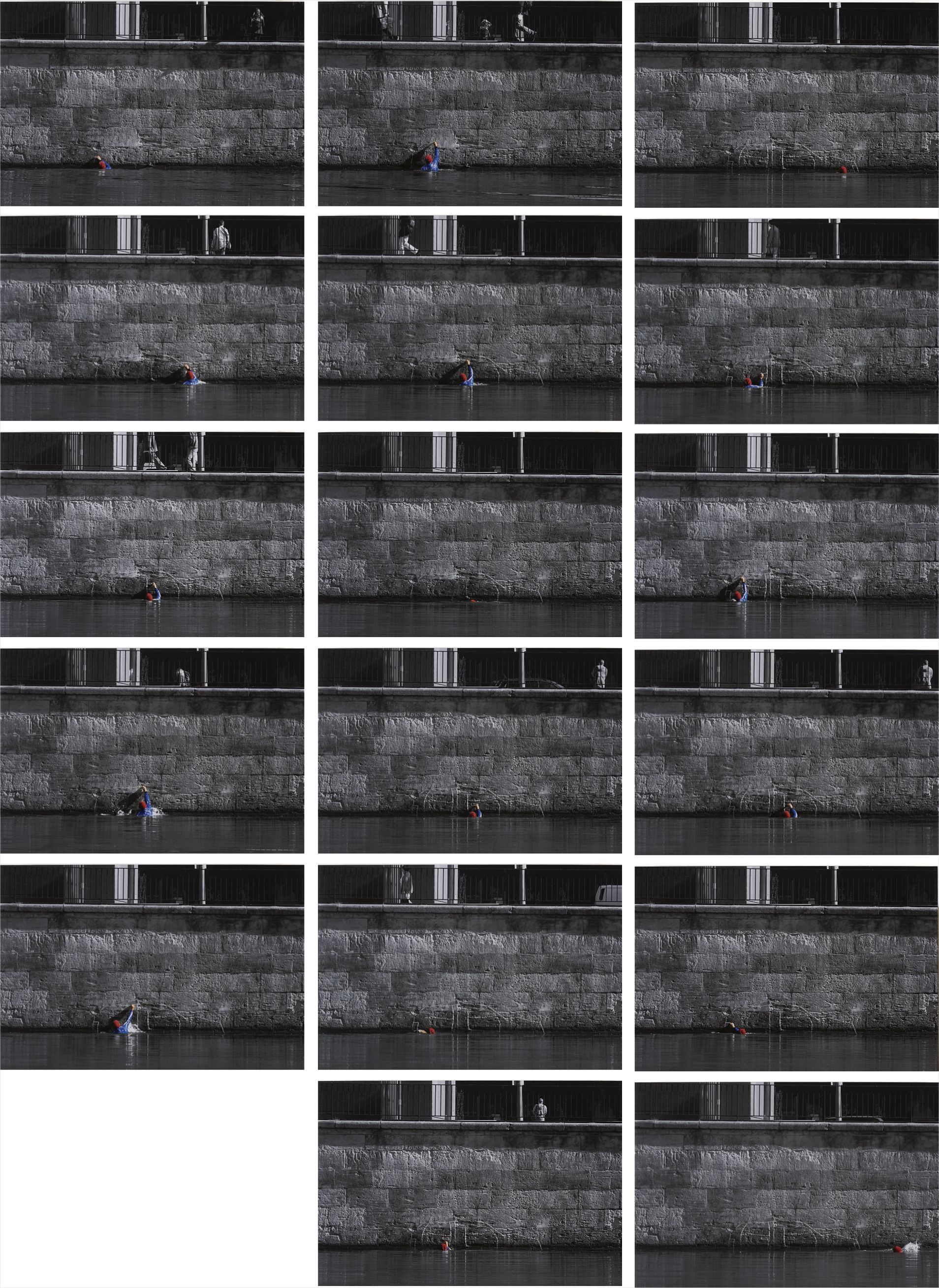
Automatic Drowning
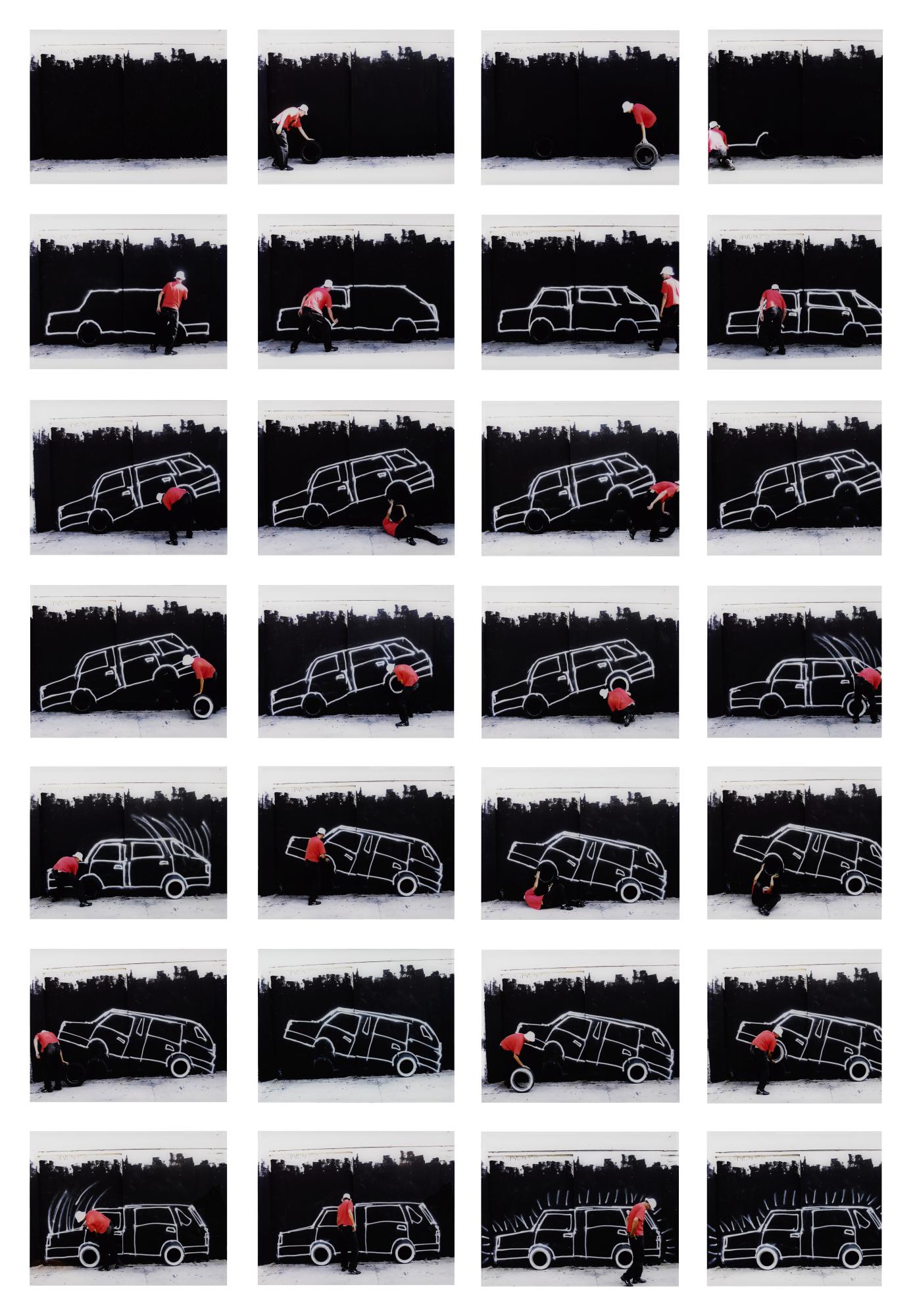
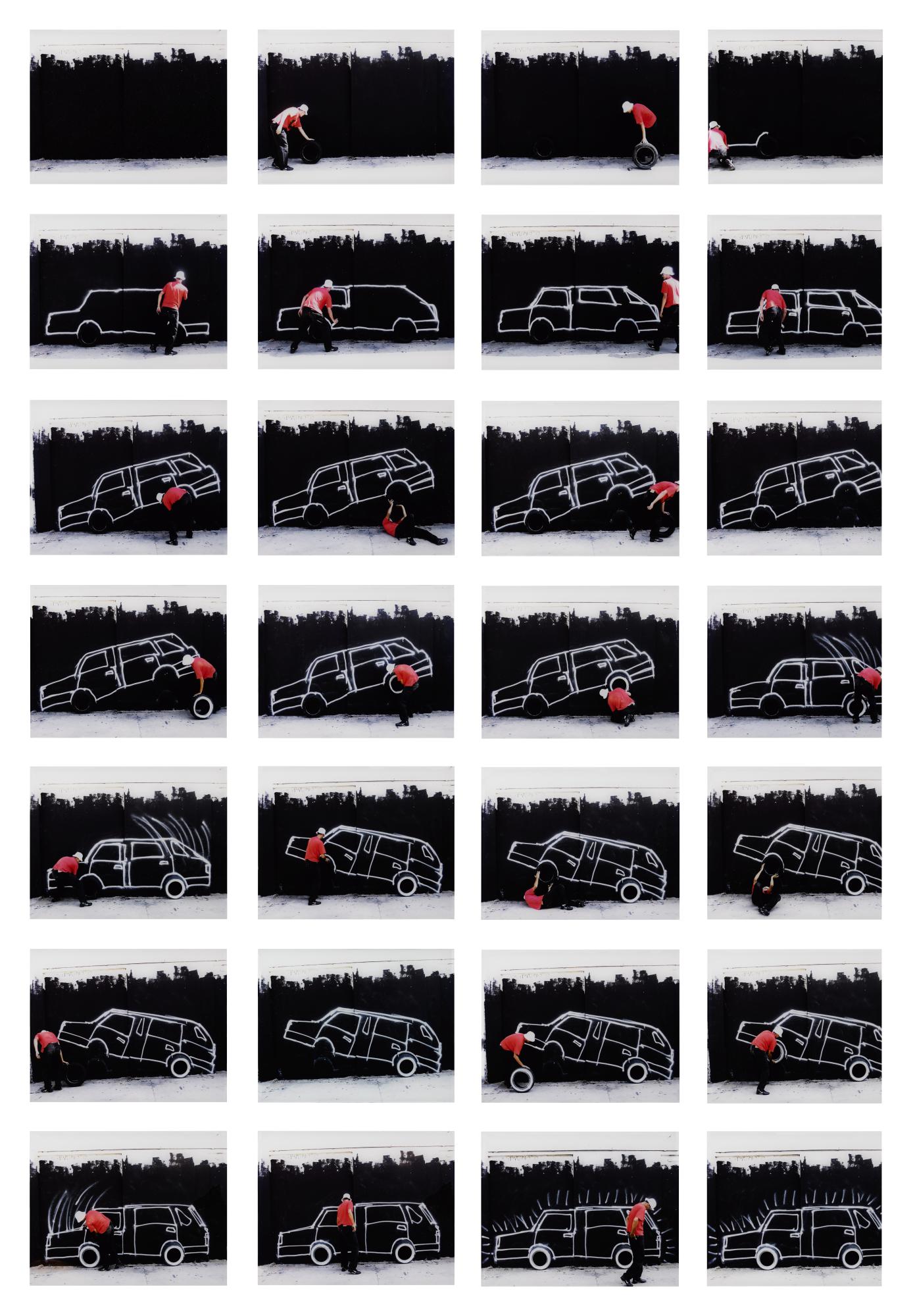
The wall becomes a stage, the drawing becomes a prop, and the artist becomes performer, animator, and subject all at once. Works like the celebrated series created around 2002 and 2003 established him internationally as an artist who had found a genuinely fresh language for thinking about desire, imagination, and the gap between what we draw and what we can touch. Among the works that define Rhode's achievement, several stand out with particular force. "White Walls" from 2002, presented as a grid of twenty eight chromogenic prints each mounted to Plexiglas and aluminum, captures the spirit of his early practice with wonderful economy.
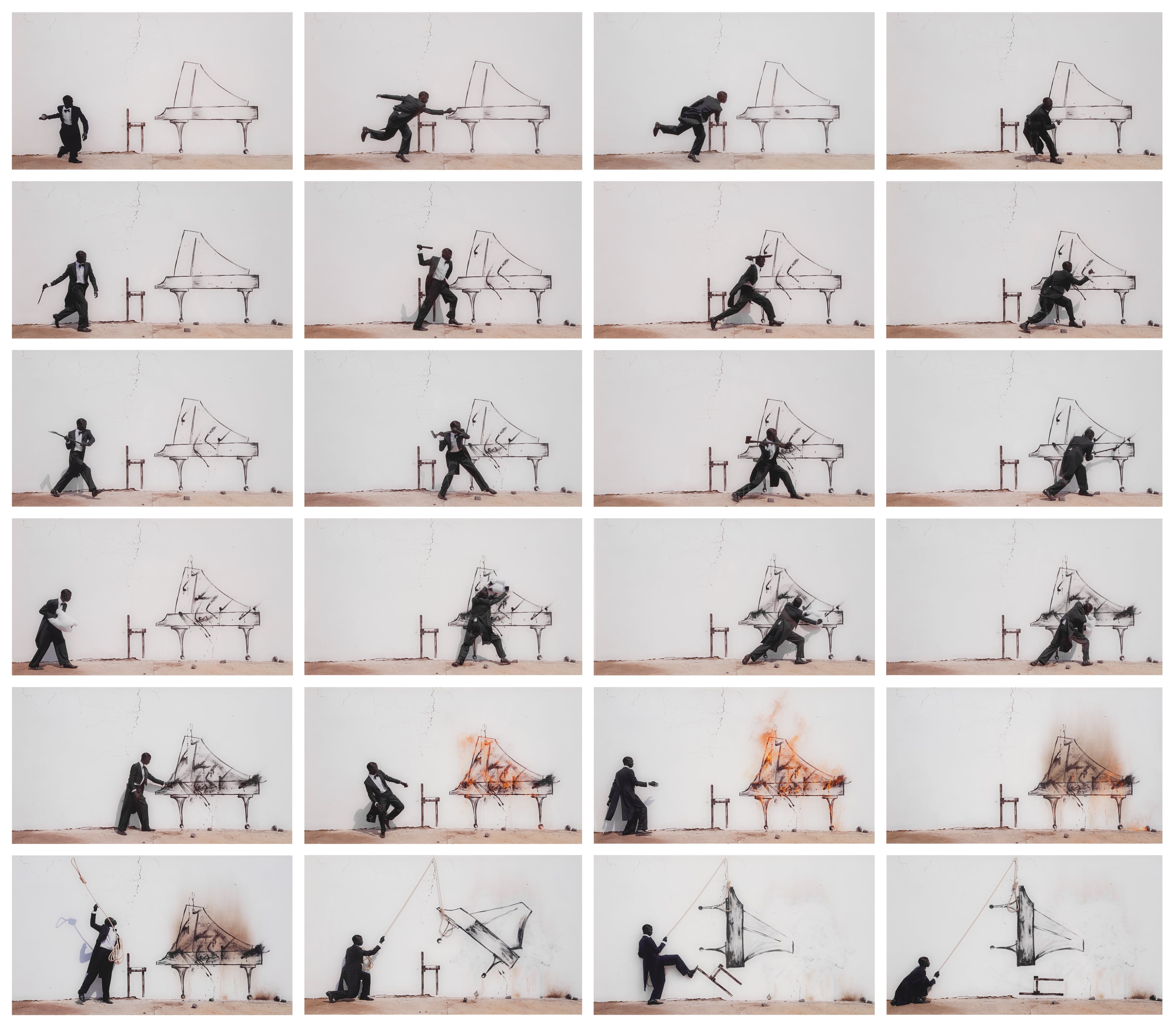
A figure interacts with a drawn bicycle, a drawn piano, a drawn basketball hoop, and the sequence of images turns what is essentially an absence into a vivid presence. "Board" from 2003 operates with similar logic, its eight part chromogenic print sequence unfolding like a storyboard for a film that exists only in the space between frames. "Motorbike," rendered across twenty eight colour coupler prints on aluminium, extends this sensibility into something more cinematic and propulsive. These multi part works reward close attention.
Robin Rhode
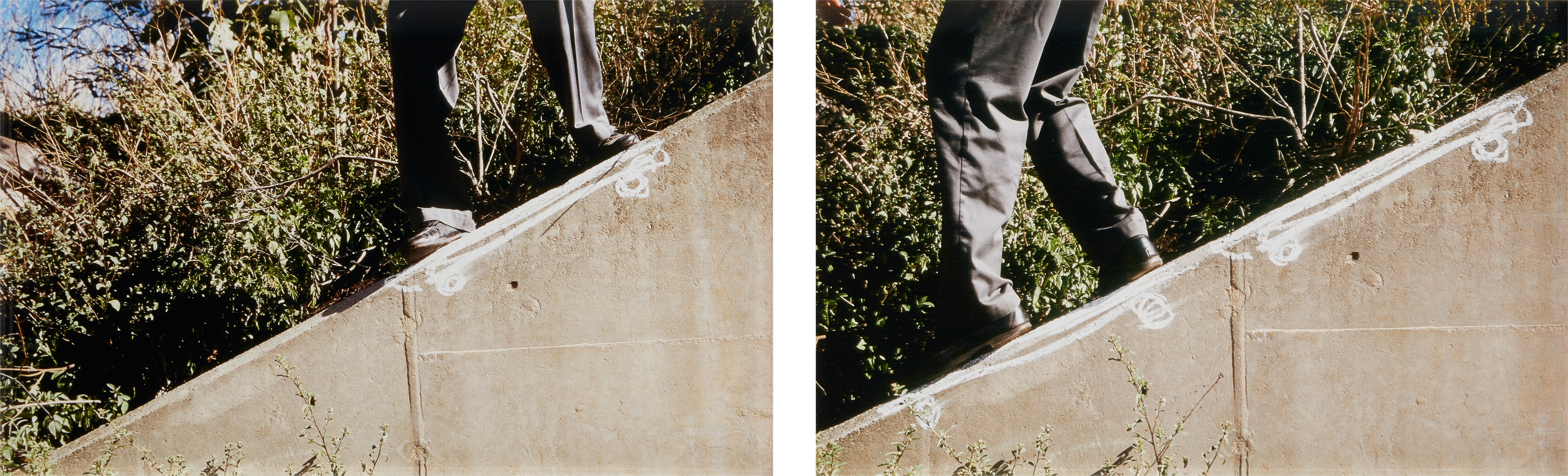
Descending a Bridge
Each individual print is beautiful on its own terms, but the full sequence is where the meaning lives, in the rhythm, the accumulation, and the final image of a body caught mid gesture. Rhode has also moved across media with confidence and curiosity. "Spade," executed in gold plated bronze, charred wood, and black pigment, demonstrates an appetite for sculpture that enriches rather than dilutes his photographic practice. The object carries the same symbolic freight as his wall drawings, turning an everyday implement into something ceremonial and weighted with meaning.
Works like "Piano Chair," "Throw Away," "Descending a Bridge," and "Automatic Drowning" show the range of emotional registers Rhode can occupy, from the playful to the meditative to the elegiac. His participation in the Venice Biennale and his exhibitions at institutions like the Wexner Center for the Arts in Columbus, Ohio, confirmed that his ideas translate powerfully across cultural contexts. For collectors, Rhode's work offers something genuinely rare: a practice that is both conceptually serious and genuinely pleasurable to live with. The multi part photographic works require wall space and a certain commitment, but they repay that commitment with daily discoveries.
Robin Rhode
White Walls
The sequencing means that different parts of a work catch the eye at different moments, so the piece is never quite the same twice. Early works from the 2002 and 2003 period, particularly those from editions held by distinguished galleries including the Perry Rubenstein Gallery, have proven to be among the most sought after examples of his output. Collectors drawn to artists who sit at the intersection of conceptual rigour and physical vitality often find Rhode an irresistible proposition. His editions are relatively limited, and works in strong condition with full documentation and original gallery labels carry a particular premium.
Rhode exists in productive dialogue with a broad range of art historical currents. His work echoes the performative documentation of Yoko Ono and early Vito Acconci, the urban attentiveness of Jean Michel Basquiat, and the conceptual wit of artists like Maurizio Cattelan. Within African contemporary art, he stands alongside figures such as William Kentridge, another Johannesburg artist who uses drawing and animation to explore history, memory, and the body, as a defining voice of his generation. Like Kentridge, Rhode transforms humble materials and modest gestures into works of genuine philosophical weight.
The street culture references in his practice connect him to a global conversation about urban space, visibility, and who gets to make marks in public, but Rhode's engagement with these themes is always specific, personal, and formally disciplined. What makes Robin Rhode matter so deeply right now is precisely his insistence on the imaginative power of drawn lines and moving bodies in an era saturated with digital spectacle. His walls are not screens. His chalk is not a cursor.
The figures in his photographs are not avatars. They are human beings in real space, reaching for things that are not there, and somehow making us feel the weight of that reaching. In a collecting landscape crowded with noise and novelty, Rhode's work offers something more lasting: the quiet conviction that imagination is a form of action, and that a mark on a wall can change the world around it.
Featured Works
Explore books about Robin Rhode