Roberto Fabelo
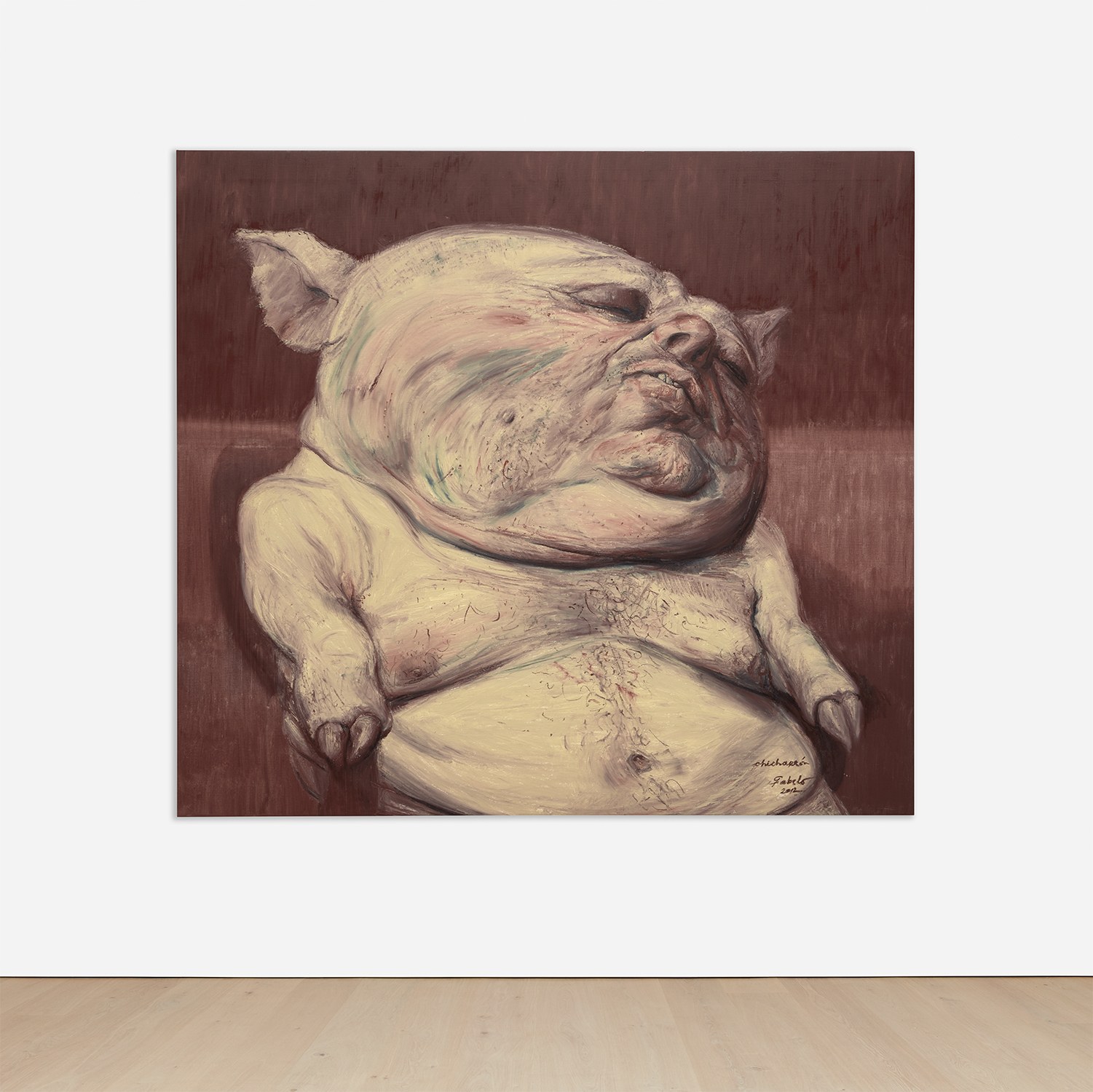
Roberto Fabelo's World of Magnificent Wonders
Artist Spotlight · The Collection Editorial
There are artists who paint the world as it is, and there are artists who paint the world as it dreams itself. Roberto Fabelo belongs irrevocably to the second category. The Havana art world has long understood this, but in recent years a widening international audience of collectors and curators has arrived at the same conclusion, drawn by the Cuban master's extraordinary ability to fuse technical virtuosity with an imagination that refuses all easy categories. His works appear in major Latin American art auctions and in private collections across Europe, the Americas, and beyond, and each time one surfaces in the market it is received with the quiet reverence normally reserved for old masters whose language took centuries to fully decode.
Roberto Fabelo
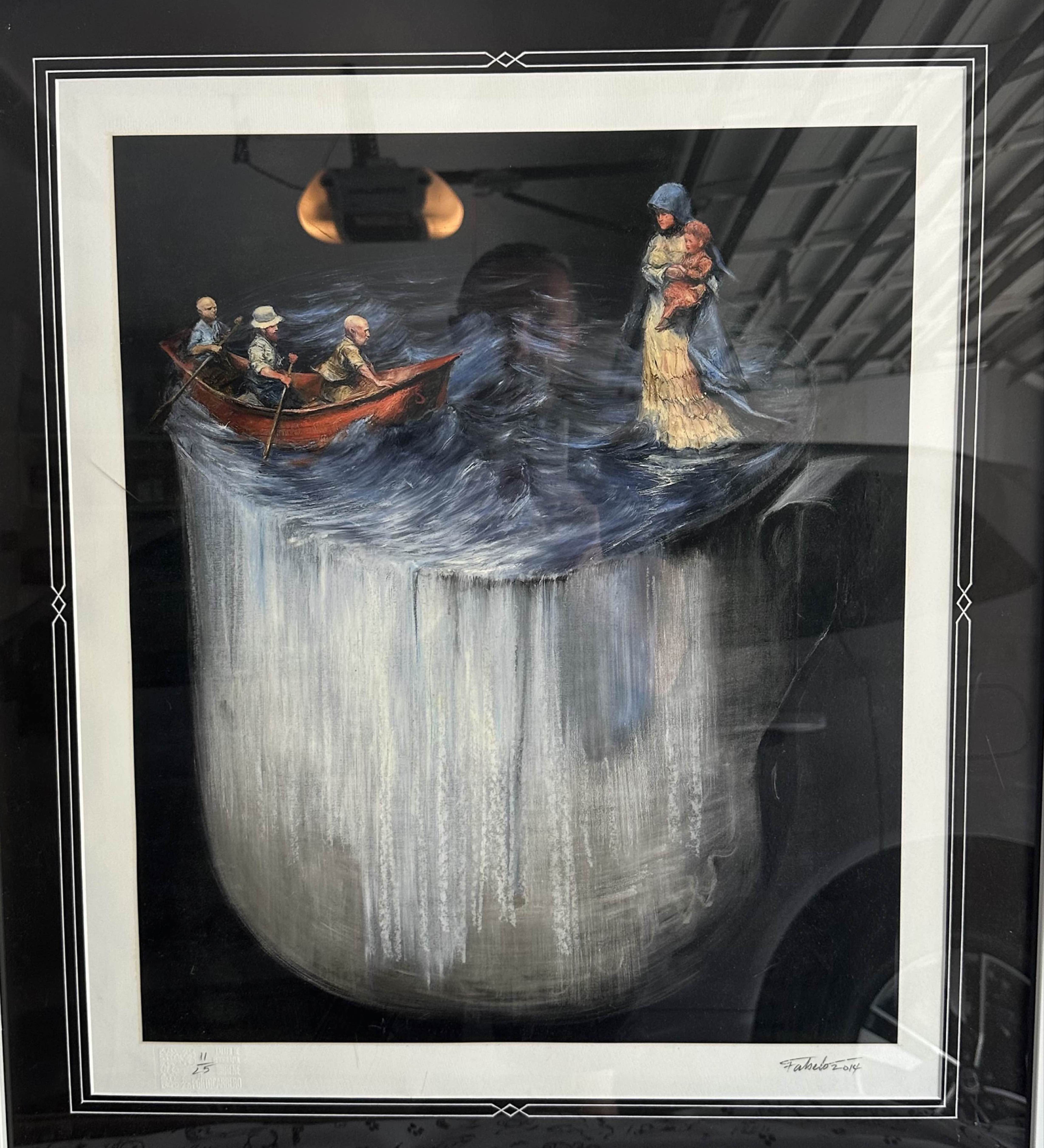
Perro voldador, 2014
Fabelo was born in 1950 in Cuba, and the island's particular cultural atmosphere shaped him in ways that feel inseparable from his art. Cuba in the second half of the twentieth century was a place of intense creative ferment, where European academic traditions, African spiritual heritage, and a fiercely independent political consciousness collided and recombined into something entirely its own. Fabelo came of age within this crucible, training with rigorous discipline in drawing and printmaking before expanding into painting and mixed media. The classical foundations are always visible in his work, in the sureness of a contour line, in the way a figure commands its surrounding space, in a sense of pictorial gravity that anchors even the most fantastical imagery.
But those foundations were always in service of something stranger and more urgent than mere technical display. His artistic development moved through several recognizable phases while maintaining a consistent obsession with the human figure as a site of transformation. Early works established his command of oil paint and his appetite for allegory, with figures caught in theatrical arrangements that suggest ritual, vulnerability, and a kind of tender absurdity. Over time, he incorporated printmaking with the same seriousness he brought to painting, and the lithograph became for him not a secondary medium but a primary one, capable of its own emotional register.
Roberto Fabelo
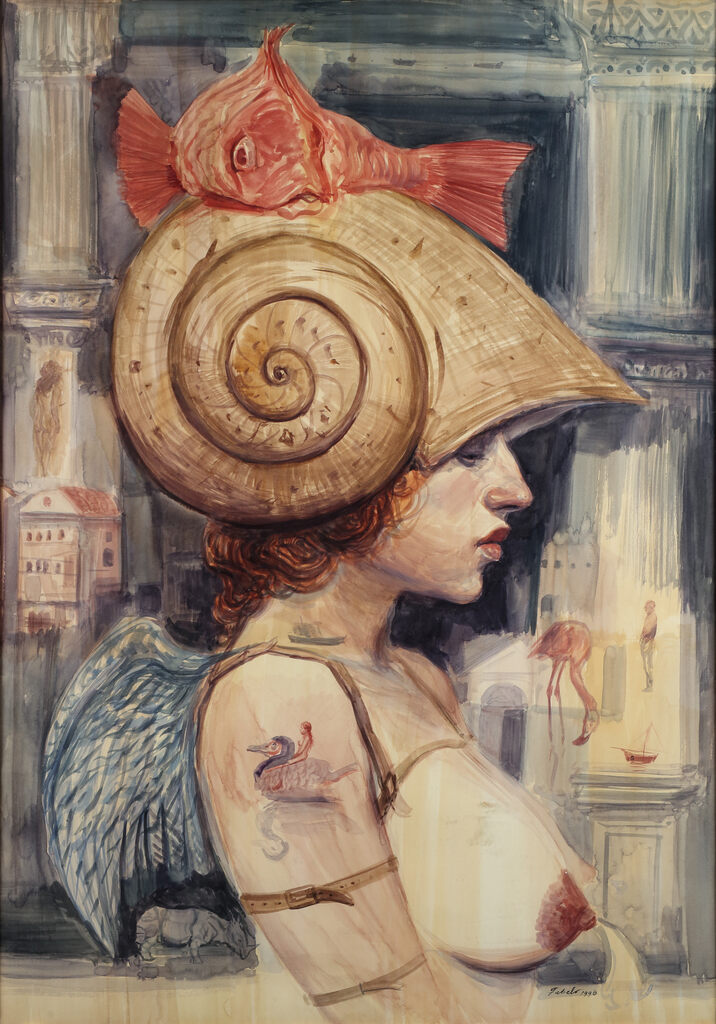
el gran pez rojo , 1996
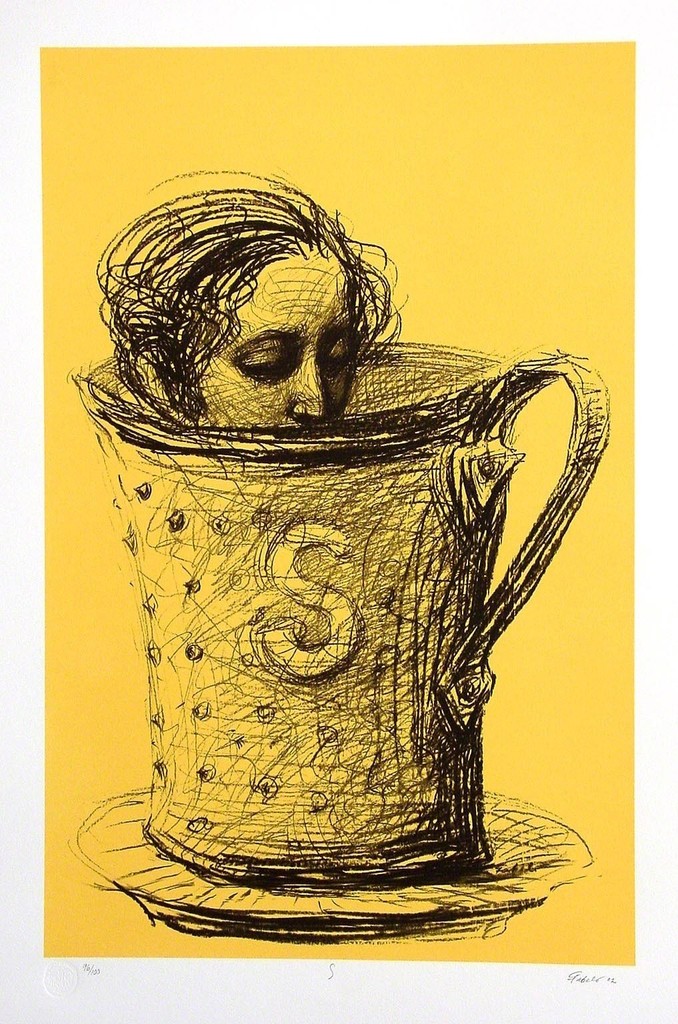
His surfaces grew more complex, introducing embroidered silk, fiber relief, and layered grounds that blur the boundary between painting and textile, between image and object. Looking carefully at the works available here, the range of Fabelo's invention becomes immediately apparent. In his 2014 lithograph titled Perro volador, numbered 11 of 15, a large ceramic cup becomes a churning sea. Three men row a small red wooden boat through dark, foam tipped waves that rise from the cup's rim while a woman in Victorian dress holds an infant and stands at the opposite edge, poised between storm and stability.
The palette is predominantly deep blue and silver grey, the handling loose but controlled, and the entire image balances on the knife edge between domestic metaphor and existential drama. A cup of something, tea or trouble, contains multitudes. The piece is intimate in scale but oceanic in ambition. Pájaro lindo from 2009 presents an entirely different materiality.
Roberto Fabelo
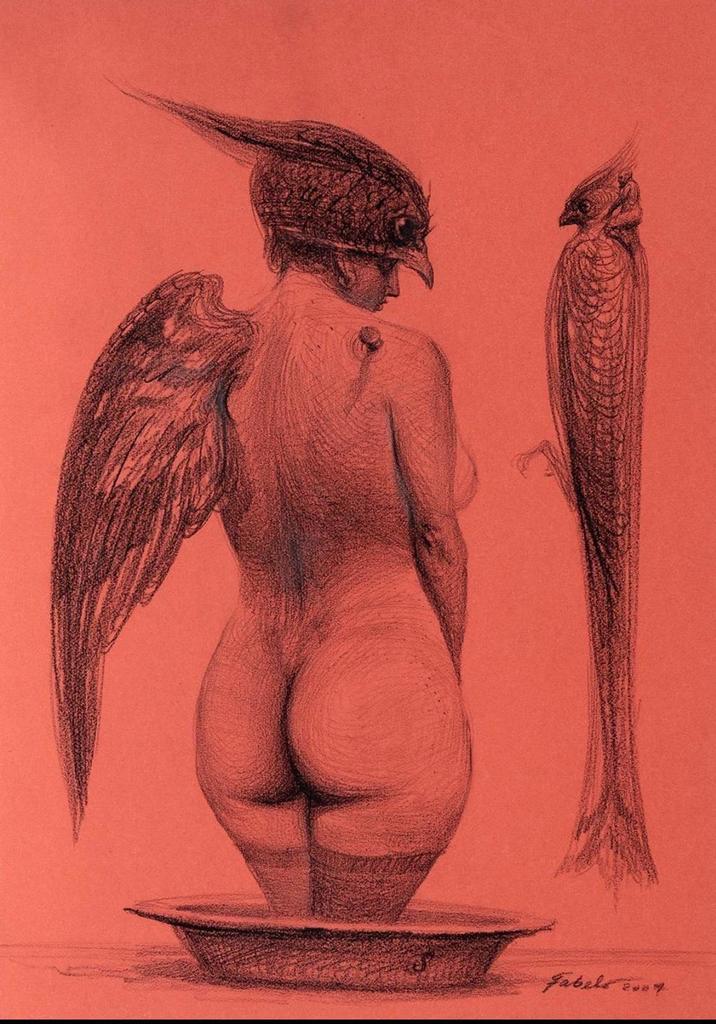
S/T, 2004
Executed in oil on fiber relief, it shows a nude figure crouched and turning inward, its head replaced by the vivid red head of a long billed bird. Flowering vines in green and pink trace patterns across the pale skin of the body, and the black background pushes the figure forward with theatrical force. This is Fabelo working in three dimensions as well as two, the raised relief surface giving the work a sculptural presence that photographs only partially capture. The hybridization of human and animal here is not grotesque in any reductive sense but something more like a meditation on the permeable boundaries of self, nature, and desire.
Two further works demonstrate his mastery of drawing on decorated grounds. Cautiva from 2013 and Ángel doméstico from 2008 both use embroidered or patterned silk as their substrate, allowing floral and vine motifs to weave through and across the figurative imagery. In Cautiva, a deep rose pink ground carries repeating small flowers and swirling white lines, while a female figure rendered in dark burgundy tones occupies the composition in profile, her silhouette dissolving at the edges into the pattern beneath. Ángel doméstico works similarly in warm terracotta and gold, a winged figure emerging from and merging with an ornamental lattice.
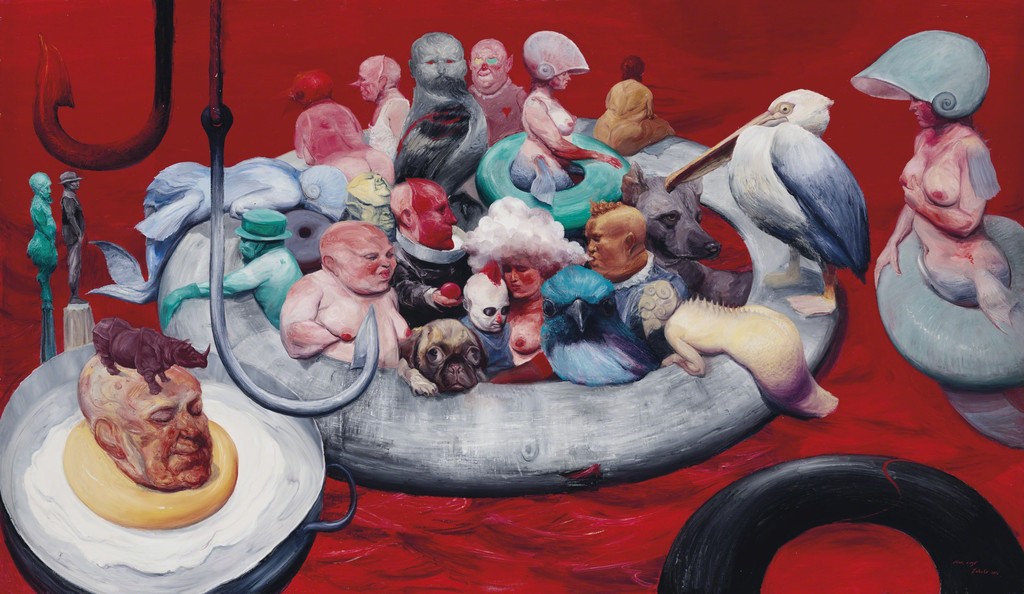
Roberto Fabelo
Mar rojo, 2015
These works feel at once ancient and completely contemporary, connecting to traditions of sacred image making while insisting on their own secular and psychological complexity. For collectors, Fabelo presents a genuinely compelling proposition. His technical range is exceptional, spanning intimate works on paper and in printmaking through large scale paintings and mixed media pieces that function almost as sculptural objects. Works on decorated silk and fiber relief are among his most distinctive contributions and among the most immediately arresting in person, where their material presence rewards close attention in ways that reproductions cannot fully convey.
Limited edition lithographs like Perro volador offer an accessible entry point into a body of work that spans decades and has only grown in critical and market stature over time. Collectors who have followed Latin American art seriously will recognize Fabelo as a peer of figures like Wifredo Lam and Kcho in terms of his importance to Cuban cultural history, though his sensibility is entirely his own. Within the broader arc of art history, Fabelo belongs to a tradition of fantastical figurative painting that runs from Northern European Renaissance imagery through Francisco Goya, into surrealism, and forward into the rich vein of Latin American artists who absorbed surrealism and made it answer to their own cultural questions. There is something in his work that recalls the transformative figures of Max Ernst and the psychic intensity of Remedios Varo, but the specific texture of Cuban experience gives his imagery a grounding that prevents it from floating into mere fantasy.
His hybrids feel necessary, his allegories feel earned. What makes Fabelo matter today, above and beyond his historical importance to Cuban art, is the way his work continues to speak to a world preoccupied with questions of identity, embodiment, and the fragility of human civilization. The tiny figures navigating a tempest inside a teacup, the body that becomes a garden, the angel domesticated into something vulnerable and interior: these are images for a moment that has rediscovered the value of depth, craft, and genuine imaginative ambition. To live with a Fabelo is to live with something that does not exhaust itself on first looking, or on hundredth looking.
That is a rare quality, and it is the foundation of a lasting legacy.
Featured Works
Explore books about Roberto Fabelo
Roberto Fabelo: Pintura, Dibujo, Escultura
Various authors
Roberto Fabelo: La Pasión por la Forma
Gerardo Mosquera
Fabelo: El Viaje Interior
Juan Martínez
Roberto Fabelo: Obra Completa 1975-2010
Ramón Espinosa
La Poética Visual de Roberto Fabelo
Iván de la Nuez