Robert Pruitt
Robert Pruitt Draws a New Universe
Artist Spotlight · The Collection Editorial
Something unmistakable is happening around Robert Pruitt's work. Over the past several years, major institutions from the Museum of Fine Arts Houston to the Studio Museum in Harlem have turned their walls over to his monumental figures, and the critical conversation surrounding his practice has reached a new intensity. Collectors who encountered his drawings a decade ago as quiet revelations are now watching those same works anchor serious collections alongside names like Kara Walker and Kerry James Marshall. Pruitt is not an emerging voice.
Robert Pruitt
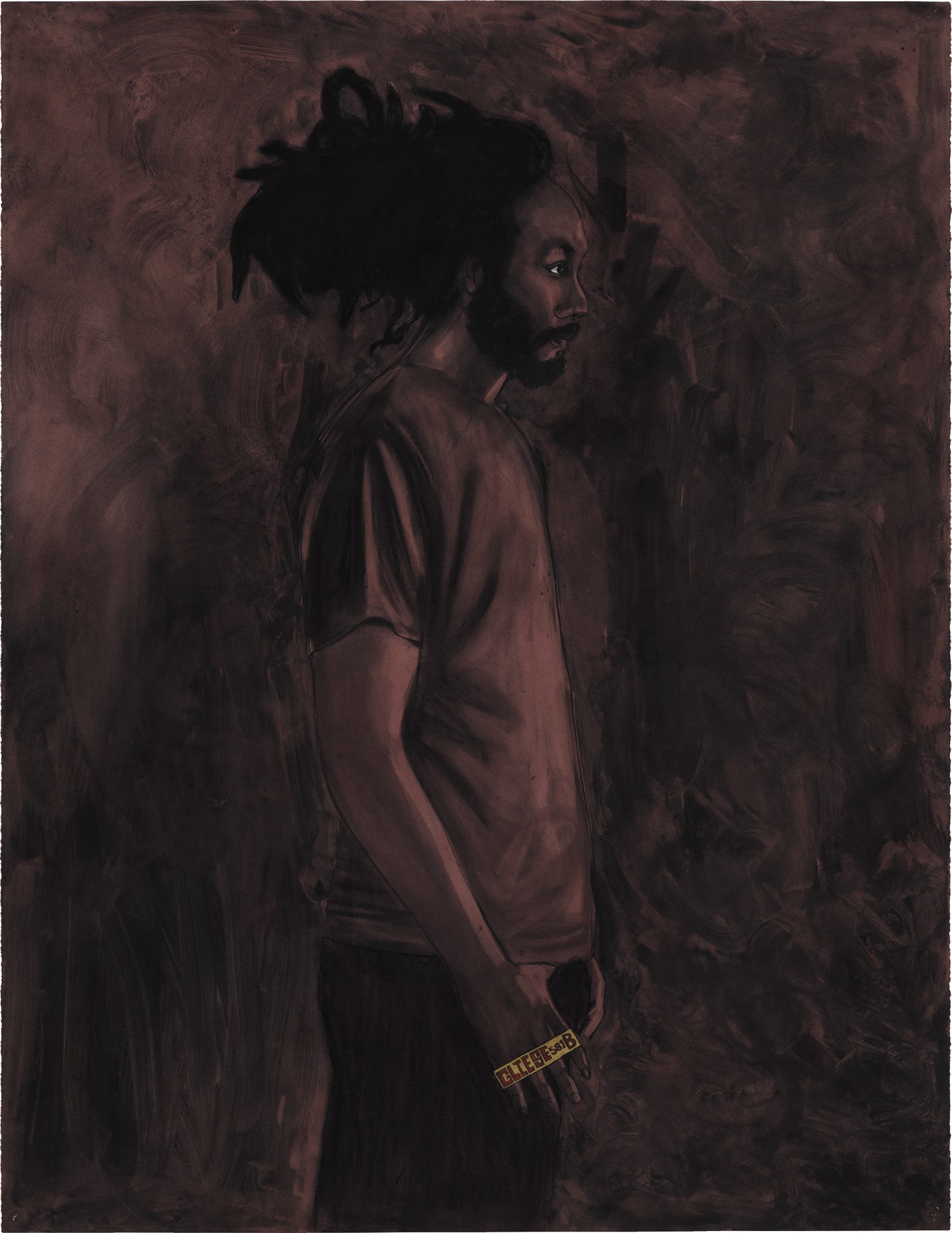
Brother Going to Gleise, 2011
He is a fully formed artist whose moment has simply, and rightfully, arrived. Pruitt was born in 1975 and came of age in Houston, Texas, a city whose cultural DNA is far more layered than its popular reputation suggests. Houston's Black cultural life, its historic Third Ward neighborhood, its music scenes, and its particular relationship to both Southern tradition and futurist ambition all left deep marks on the artist's imagination. He studied at Texas Southern University, a historically Black institution that gave him grounding in a tradition of African American art making that stretched back through generations, and later pursued graduate work at the University of Houston, where his ideas about scale, materiality, and identity began to crystallize into a coherent and urgent practice.
The influences that feed Pruitt's work are genuinely wide ranging, and the miracle of his draftsmanship is that he holds them all in balance without strain. Afrofuturism, the genre and philosophy that imagines Black life liberated from historical trauma and projected into speculative futures, runs through everything he makes. So does hip hop culture, not as decoration but as a living epistemology, a way of knowing and signifying the world. West African spiritual traditions, the aesthetics of science fiction, the history of portraiture, and the visual language of protest art all find their way into his compositions.
Robert Pruitt
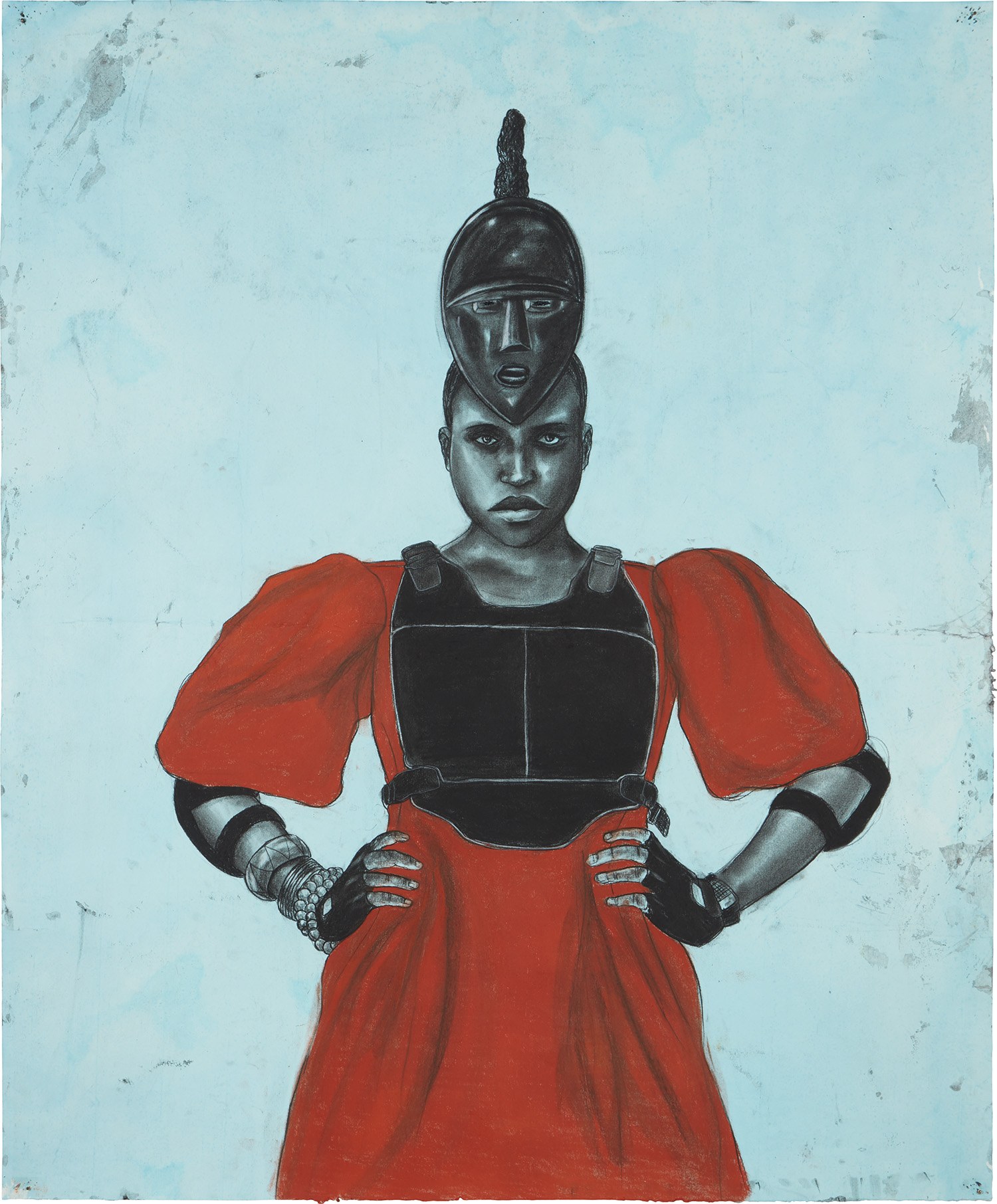
Fantastic Sagas: Soldier, 2013
He absorbs these streams and channels them through an extraordinary hand. Pruitt works primarily in Conté crayon and charcoal on hand dyed paper, and the choice of medium is worth pausing over. These are materials associated with study, with the preparatory gesture, with the moment before the finished thing. In Pruitt's hands they become the finished thing, fully realized and emotionally complete.
The hand dyed paper introduces color as atmosphere rather than illustration, warm golds and deep ochres and bruised violets that feel ancient and cosmic at the same time. His figures inhabit these fields with a quiet authority that recalls the devotional mood of medieval painting while pointing unmistakably toward imagined futures. Gold leaf appears in key works, elevating his subjects to the status of icons without irony or overstatement. Two works that collectors and curators consistently return to are "Brother Going to Gleise" from 2011 and "Fantastic Sagas: Soldier" from 2013.
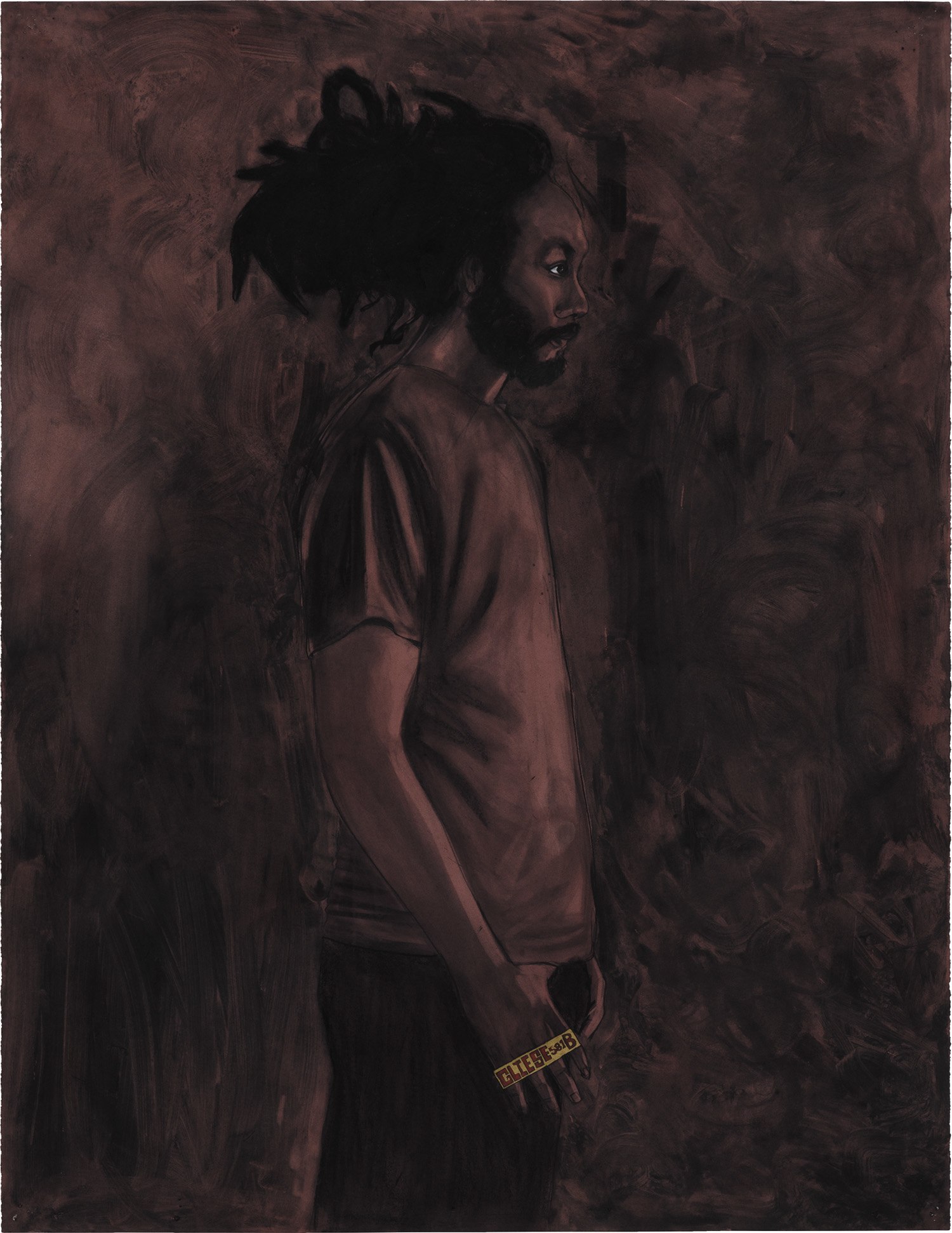
"Brother Going to Gleise" places a Black male figure within a cosmological field, reaching toward a distant star system, and the piece captures in a single image the twin currents of longing and possibility that define Afrofuturist thought. The Conté and charcoal work with gold leaf on hand dyed paper gives the figure a luminous presence that feels both intimate and monumental. "Fantastic Sagas: Soldier" is technically remarkable as a double sided work, a choice that insists viewers move around it and encounter it as an object in space rather than a flat image on a wall. Both works demonstrate Pruitt's ability to honor the specific weight of Black male experience while opening that experience outward into something universal and mythic.
For collectors, Pruitt's work represents a genuinely rare proposition: an artist who operates at the intersection of critical importance and aesthetic pleasure, whose works are as rewarding to live with as they are to think about. His drawings reward sustained looking in a way that photography based work sometimes does not. Every session in front of a Pruitt reveals new marks, new spatial decisions, new evidence of the thinking hand at work. The market for his work has grown steadily and with conviction, driven not by speculative momentum but by genuine institutional endorsement and collector devotion.
Works from his earlier periods, particularly those produced in the late 2000s and early 2010s, are now sought with real urgency by collectors who recognize that the supply of serious examples is finite. Pruitt's place in the broader landscape of contemporary drawing and Black figurative art is secure and distinguished. He belongs to a generation of artists that includes Titus Kaphar, Toyin Ojih Odutola, and Dario Robleto, makers who take the figure seriously as a site of historical reckoning and imaginative possibility. His work is in conversation with the legacy of Charles White, the great draftsman of Black American life, and with the speculative vision of artists like Jean Michel Basquiat, though Pruitt's cosmological quietude is distinctly his own.
The Studio Museum in Harlem's long engagement with artists of his generation provides important context, as does the thriving Houston art ecosystem that continues to produce artists of international significance. What finally makes Pruitt matter, beyond the beauty of any single work, is his insistence on the full dimensionality of his subjects. His figures are not symbols or arguments. They are people, endowed with interiority and aspiration and spiritual depth, placed within histories and futures that are entirely their own.
At a moment when the art world continues to grapple with questions of whose stories get told and with what care, Pruitt offers an answer that feels both ancient and necessary. To own a work by Robert Pruitt is to accept an invitation into a vision of humanity that is expansive, generous, and genuinely beautiful.