Robert Nava
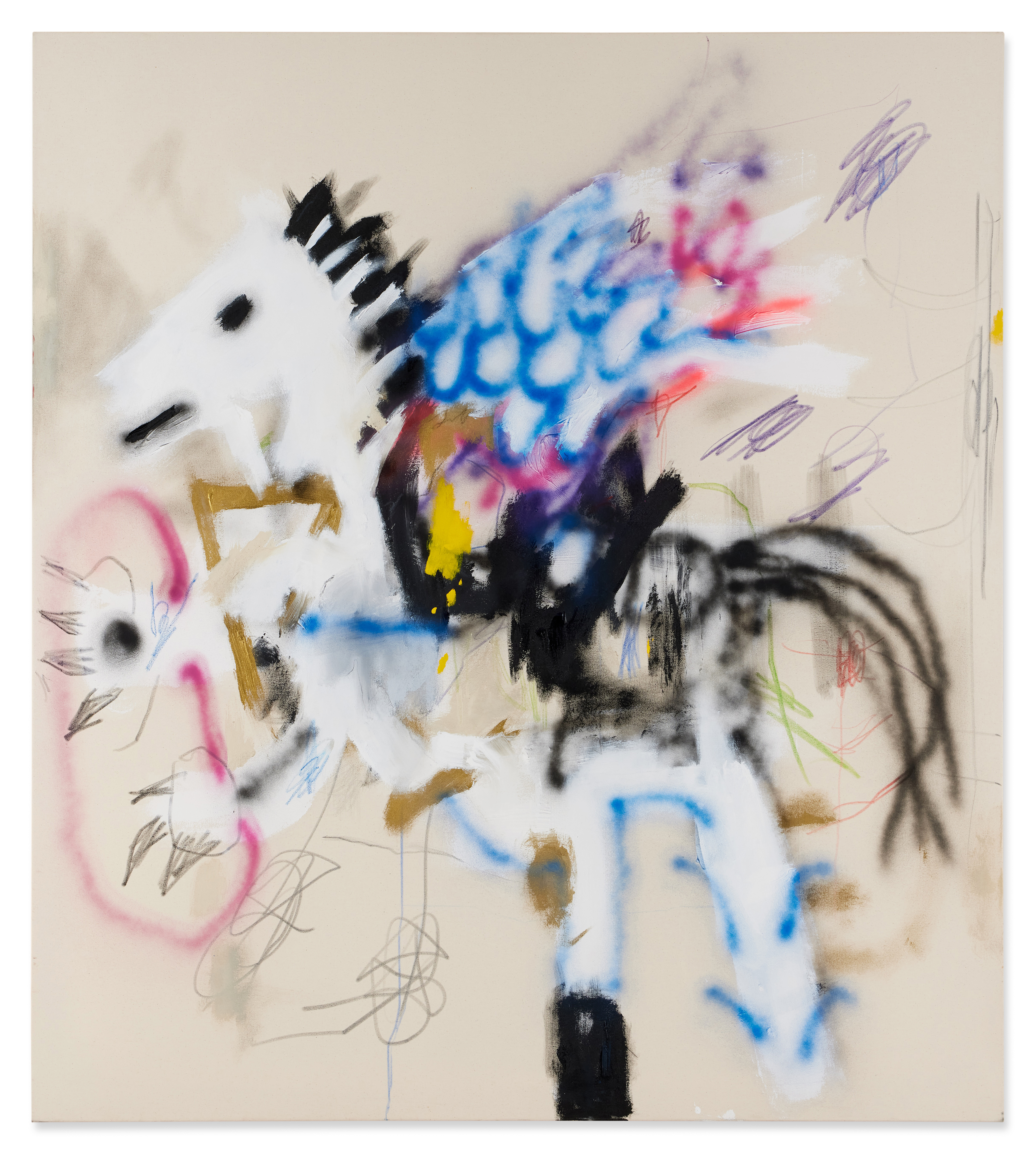
Robert Nava: Monsters, Myths, and Pure Magic
Artist Spotlight · The Collection Editorial
Something shifted in the contemporary art world around 2018 and 2019, and collectors who were paying close attention know exactly when they first felt it. Robert Nava's paintings began appearing at auction with increasing frequency, and the rooms went electric. Works that had been acquired modestly by early believers started commanding prices that reflected what those believers already understood: that Nava was conjuring something genuinely rare, a visual language both completely his own and somehow ancient, as if it had always existed and he was simply the first person to remember it clearly enough to paint it. Nava was born in 1985 in Aurora, Illinois, a city in the suburban sprawl west of Chicago that carries its own particular texture of American working life.
Robert Nava
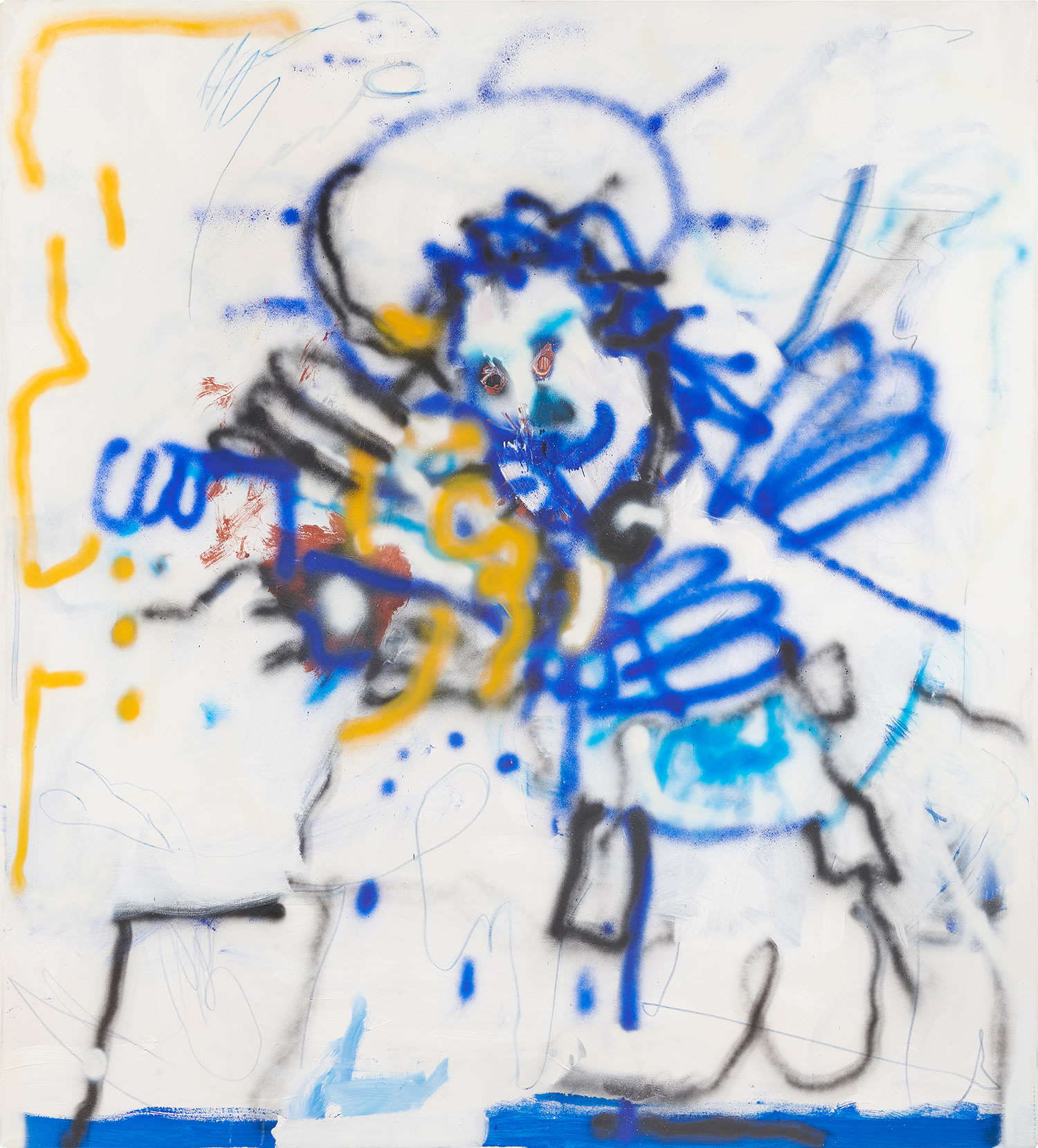
Maybe Metatron, 2017
Growing up in that landscape, somewhere between the urban energy of Chicago and the open flatness of the Midwest, gave him an outsider's hunger and an insider's practicality. He went on to earn his MFA from Yale University, one of the most rigorously competitive graduate programs in the country, and the combination of that raw midwestern formation with the intellectual intensity of New Haven proved to be exactly the kind of productive friction that forges a serious painter. Yale gave him the tools and the critical framework. Aurora gave him something that no program can teach.
What emerged from that formation is a practice built on contradiction and held together by conviction. Nava's paintings feature mythological creatures, monsters, celestial beings, and supernatural figures rendered in a visual register that borrows from children's drawings, cave paintings, and graffiti in equal measure. The line is loose, sometimes wobbly, seemingly naive at first glance. But spend more than thirty seconds with one of his canvases and the sophistication becomes undeniable.
Robert Nava
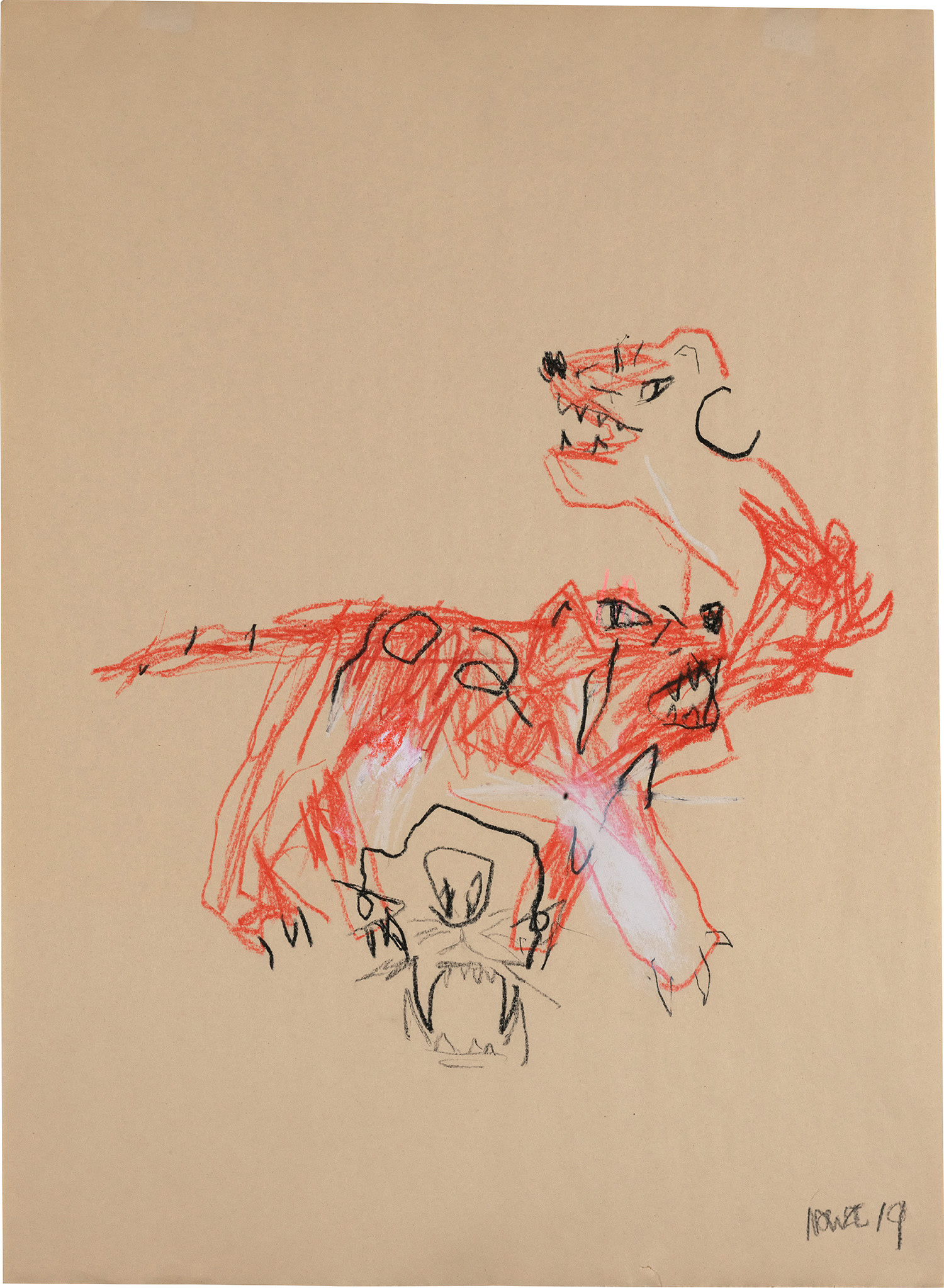
Mind Inside Mind Tiger, 2019
Every mark is placed with intention. The figures pulse with a strange interiority, as if the painter knows something about them that the viewer is only beginning to sense. This is not outsider art, though it flirts with that tradition respectfully. It is the work of a highly trained painter who has chosen to strip away everything that does not serve the image.
The works in Nava's early and mid period, spanning roughly 2015 through 2020, represent some of the most thrilling moments in his output. "Green Dress" from 2015 shows the seeds of what was coming, a directness of handling and a willingness to let the canvas breathe. By 2017, works like "Son Of Godzilla" and "Forklift" demonstrated his expanding confidence with scale and material. "Son Of Godzilla" combines acrylic and spray paint in a way that feels simultaneously urban and mythic, the creature neither threatening nor benign but simply present, enormous and alive.
Robert Nava
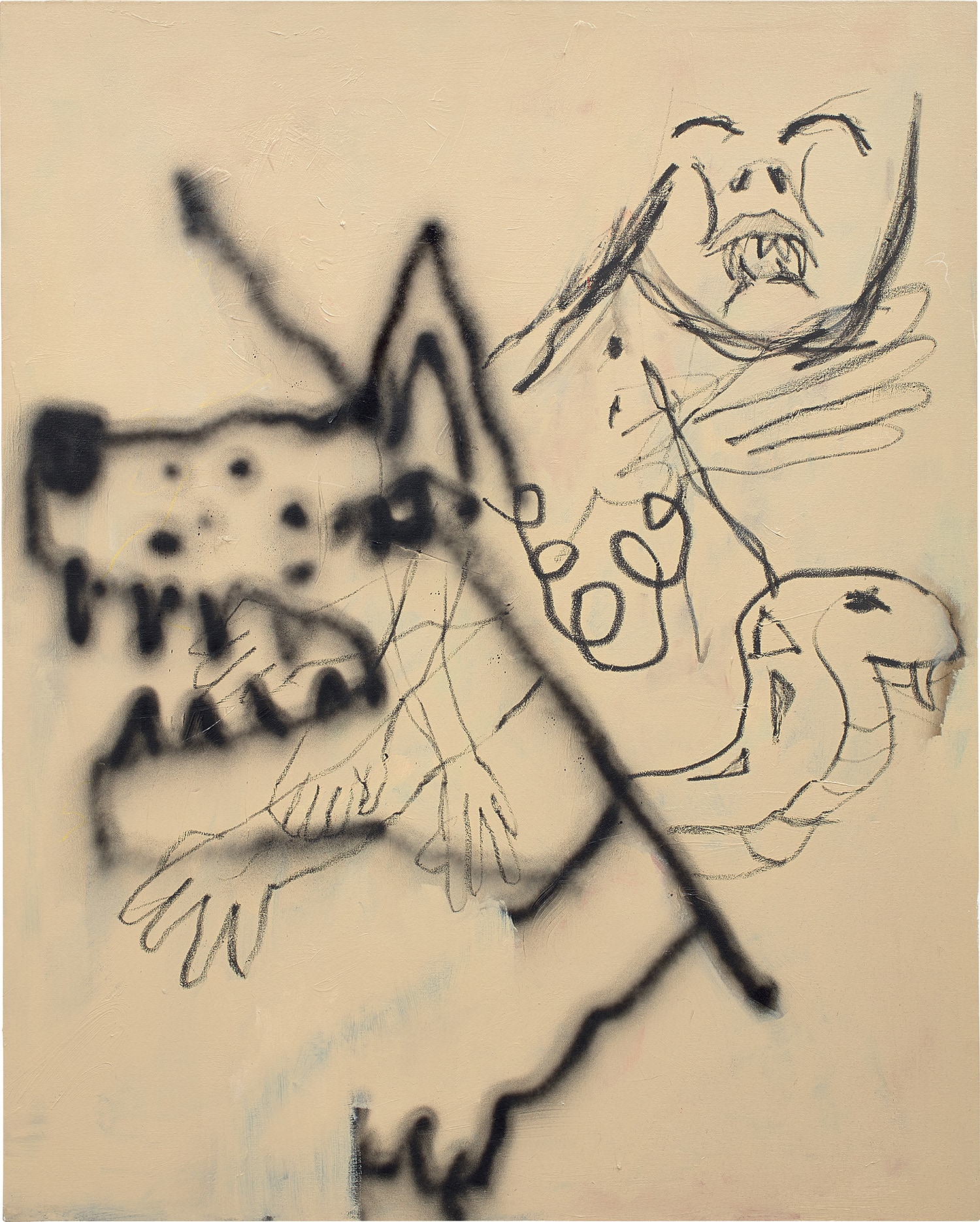
Vision Probably Rabies, 2019
"Maybe Metatron" from the same year, made with acrylic, colored pencil, and grease pencil on canvas, brings Nava's obsession with supernatural hierarchy into sharp focus. Metatron, the celestial scribe of Judaic tradition, becomes in Nava's hands something tender and slightly terrifying, a figure that hovers at the edge of comprehension. "Pegasus" from 2018 is among his most celebrated works, the winged horse transformed into something that feels genuinely sacred rather than merely decorative. The grease pencil and acrylic combination that Nava favors creates a surface that is simultaneously luminous and gritty, and in "Pegasus" that tension reaches a kind of resolution.
"Boiler Room" from 2018 and "Vision Probably Rabies" from 2019 show Nava moving fluidly between industrial imagery and the uncanny, finding equivalence between the two. The titles themselves are part of the work. There is humor in "Vision Probably Rabies" but also a genuine strangeness, as if the painting is diagnosing something real about the experience of vision itself. "Mind Inside Mind Tiger" from 2019, made with crayon, grease pencil, and pencil on paper, is an important work precisely because of its intimacy.
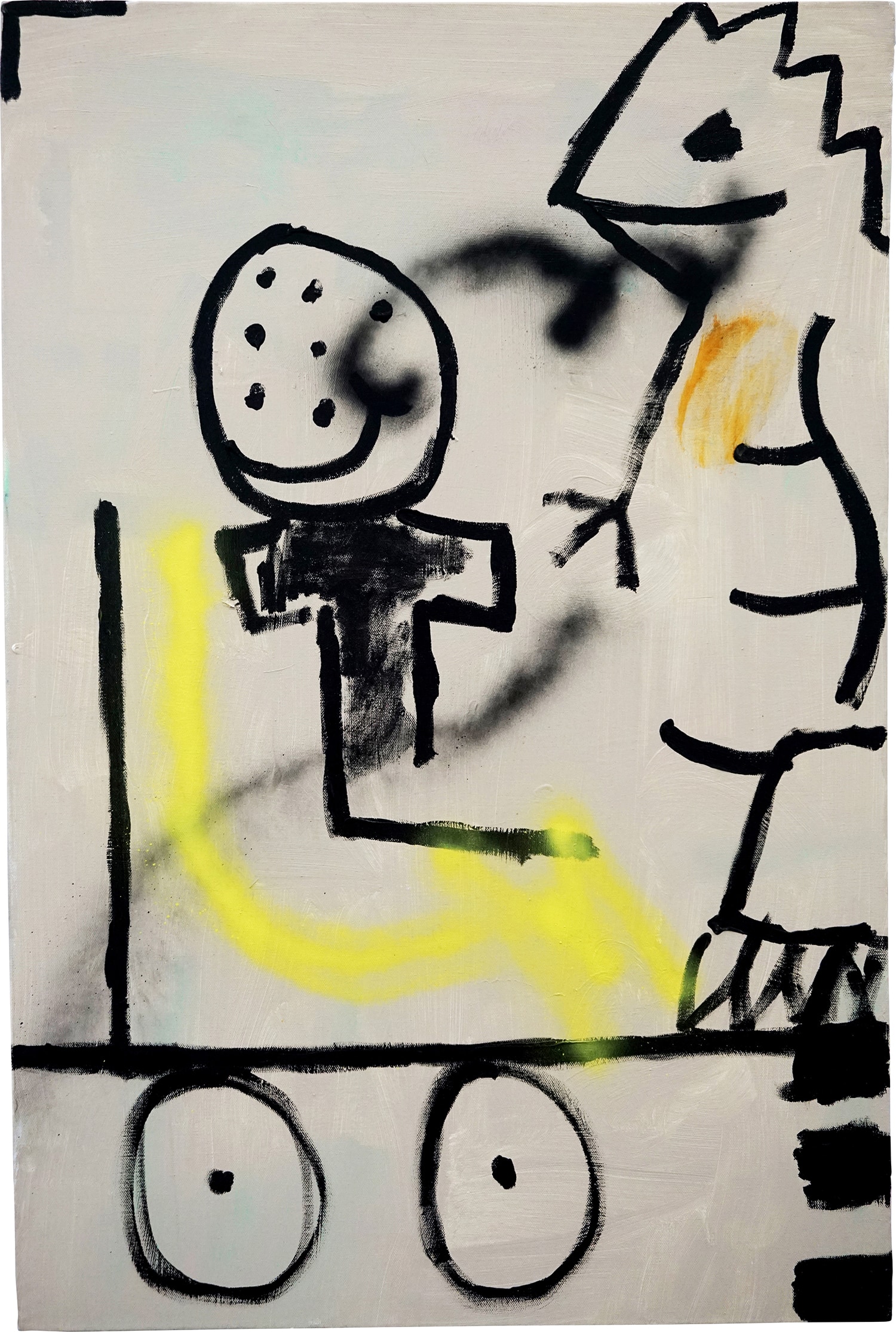
Robert Nava
Son Of Godzilla, 2017
Paper works by painters who are primarily known for large canvases often reveal something the bigger paintings keep private, and this piece does exactly that. The tiger is layered, recursive, a mind contemplating its own ferocity. By 2020, "Sylvia (87 Sylvia)" shows Nava naming his figures with a quiet tenderness that elevates them from creatures to characters. For collectors, Nava represents one of the most compelling opportunities of his generation.
His prices at Christie's, Sotheby's, and Phillips have risen steadily and reflect genuine institutional as well as private demand. The early works, particularly those from 2015 through 2018, have proven to be strong performers and are increasingly held by committed long term collectors who understand that Nava is building a body of work with real art historical coherence. When acquiring a Nava, the material combination matters enormously. His use of grease pencil alongside acrylic or spray paint is not incidental but structural, and works where multiple media interact most dynamically tend to be the strongest.
Scale is also worth considering. His large canvases make extraordinary statements, but the works on paper carry a rawness that is entirely their own and represent exceptional value for collectors building a thoughtful practice. Nava's closest peers and kindred spirits within contemporary painting include artists who share his commitment to figuration as a form of genuine inquiry rather than mere revival. His work resonates with the energetic mythology of the broader movement sometimes called the return to painting, and collectors who admire him often find themselves drawn to artists working at the intersection of the primal and the conceptual.
His Yale training connects him to a lineage of rigorous American painters, while his subject matter links him to an older tradition of artists who have understood that monsters and angels are not metaphors but realities, forces that painting exists precisely to make visible. What makes Robert Nava genuinely important, beyond the market and the exhibitions, is the seriousness with which he treats the imagination as a subject worthy of sustained attention. In a moment when contemporary painting is asked constantly to justify its existence against other media, Nava paints as if the question were never asked, as if painting were simply the most natural way to communicate with whatever forces populate the margins of the visible world. That confidence is not arrogance.
It reads, in person, as something closer to devotion. His creatures are not illustrations of ideas. They are the ideas themselves, fully alive on canvas, waiting for the right room and the right viewer to understand them completely.