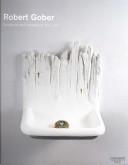
Robert Gober
Robert Gober: Sculptor of the Sacred Everyday
Artist Spotlight · The Collection Editorial
“I wanted to make something that felt like it had always existed, that you had always known.”
Robert Gober, interview with Lynne Cooke, 1993
In the autumn of 2014, the Haus der Kunst in Munich presented a sprawling retrospective of Robert Gober's work, a show that traveled to the Museum of Modern Art in New York in 2014 and 2015 and reminded a generation of younger artists and collectors just how singular this sculptor's vision truly is. The exhibition, titled simply 'The Works of Robert Gober,' filled room after room with uncanny domestic objects, immersive environments, and handmade wallpapers that unsettled and moved visitors in equal measure. Critics wrote of leaving the galleries feeling as though they had passed through something closer to a dream than an exhibition, and the art world was reminded once again that Gober occupies a place in American sculpture that belongs entirely to himself. Robert Gober was born in 1954 in Wallingford, Connecticut, into a Catholic family, and the imagery of that upbringing, its rituals, its symbolism, its particular relationship to the body and to guilt, would prove to be among the most generative forces of his artistic life.
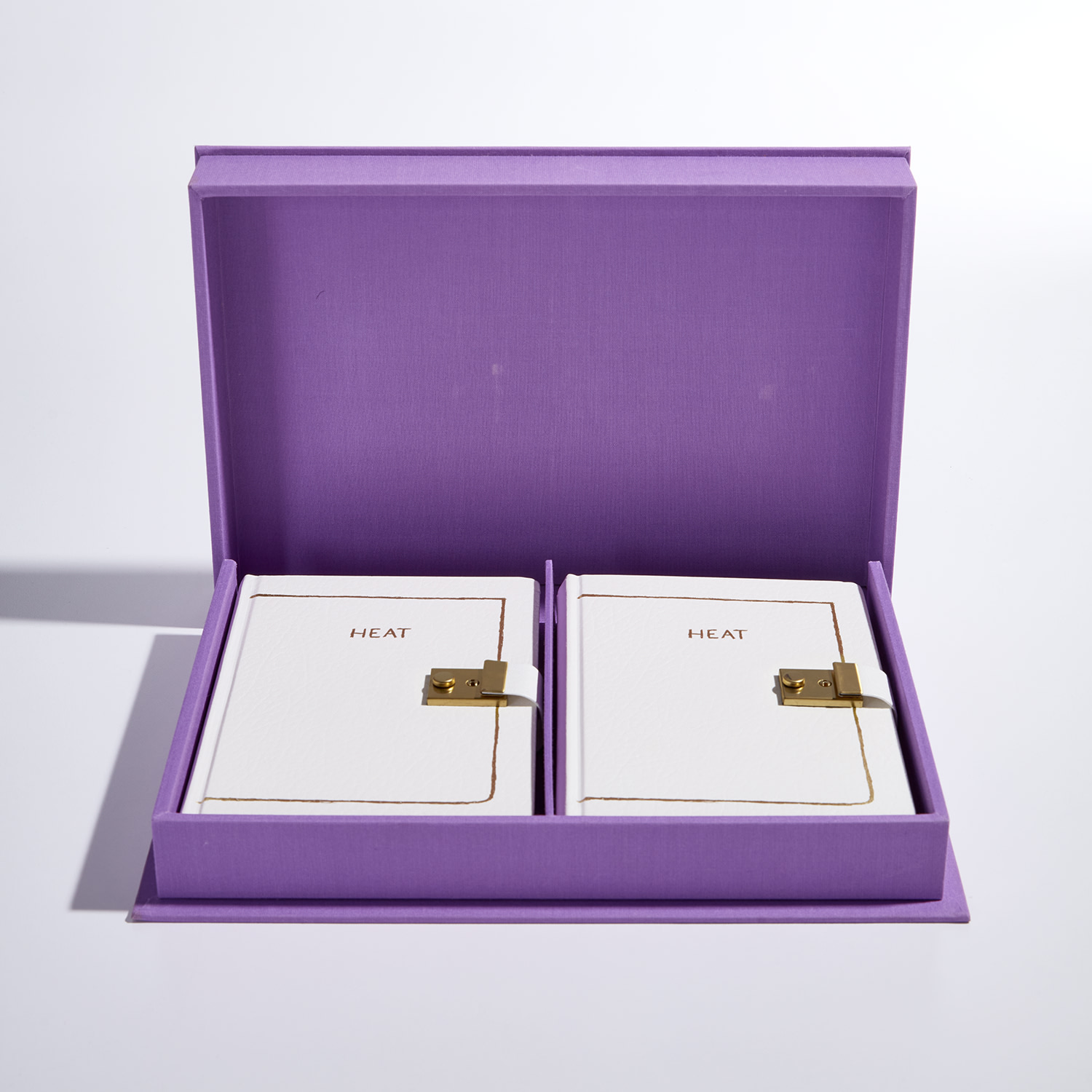
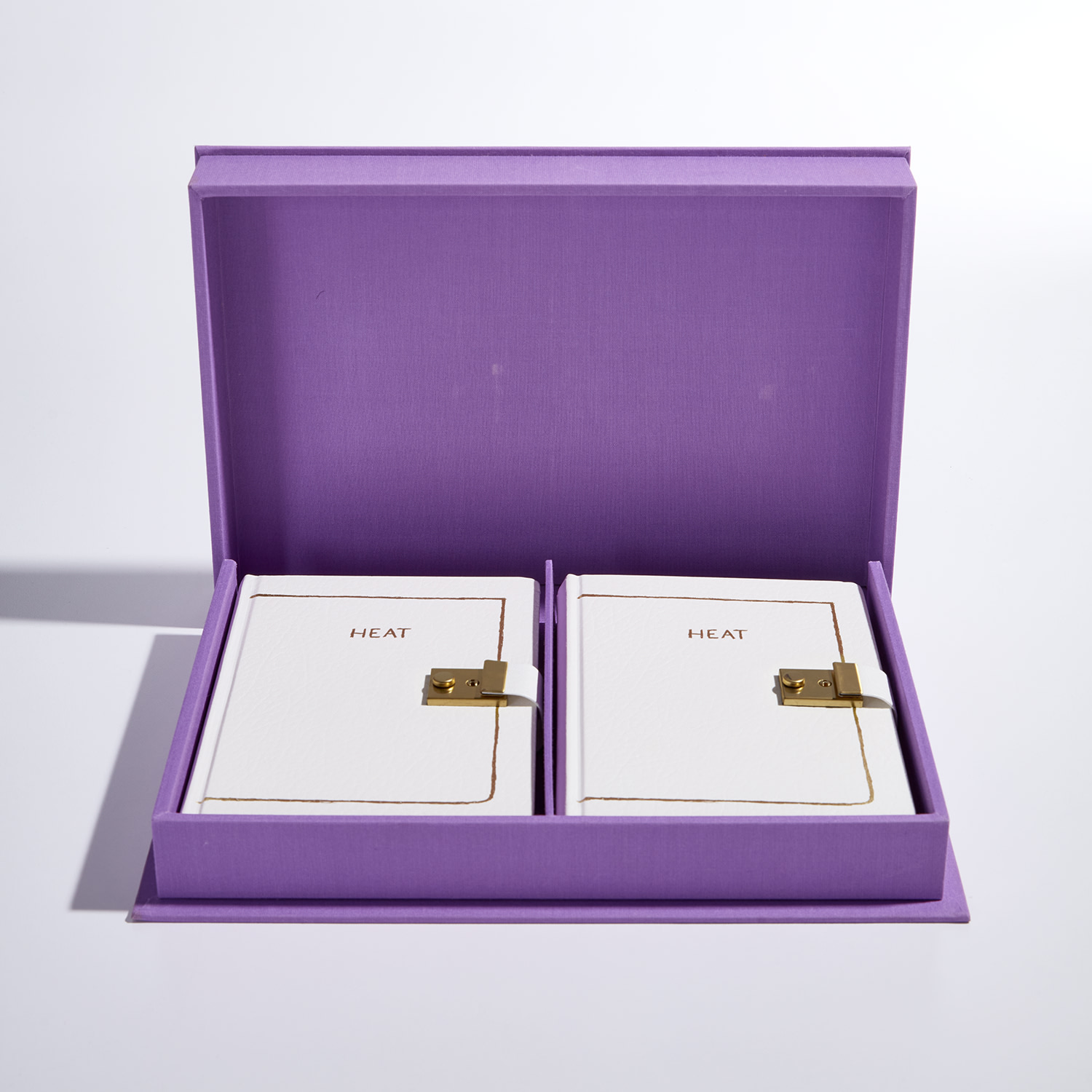
Robert Gober
Heat
He studied at Middlebury College in Vermont and later attended the Tyler School of Art in Rome, absorbing the weight of European religious iconography before returning to the United States. He arrived in New York City in the late 1970s, settling in Lower Manhattan at a moment of extraordinary creative ferment, when artists were redefining what objects, images, and spaces could mean and do. Gober's early years in New York placed him at the center of a scene that included artists such as Felix Gonzalez Torres, Sherrie Levine, and Christopher Wool, figures who were questioning the foundations of representation and the authority of the readymade. He worked for a time as a carpenter and art handler, and this intimacy with craft and with the physical life of objects never left his practice.
By the mid 1980s he had begun exhibiting with the Paula Cooper Gallery, which remains his primary gallery to this day, and his first mature sculptures, among them the handmade sinks cast in plaster and painted with meticulous care, announced the arrival of a genuinely new sensibility in American art. Those early sinks, including the work known as 'The Floating Sink' from 1986, are among the most discussed objects in late twentieth century sculpture. They are recognizable yet wrong, familiar yet charged with an unplaceable unease. Gober fabricated them entirely by hand, refusing to cast from existing plumbing fixtures, which gave each one a quality of being both more and less than the thing it resembled.
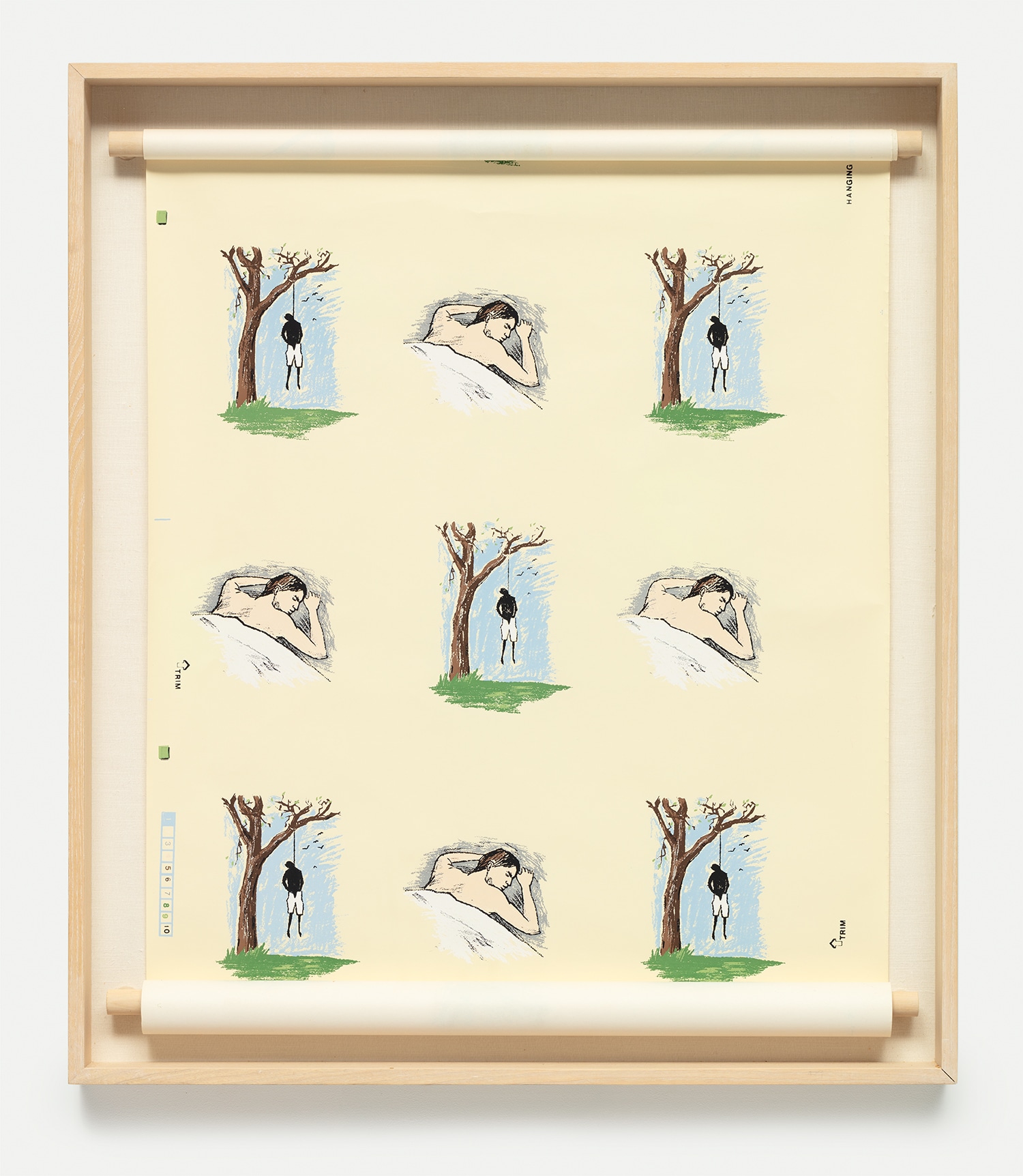
Robert Gober
Hanging Man/Sleeping Man
Around the same period he began producing his wallpapers, including the 'Hanging Man / Sleeping Man' screenprint in colors that appears as a full roll, a repeating pattern of two male figures, one suspended and one at rest, cycling across the wall in a rhythm that is simultaneously decorative and deeply charged. The 'Male and Female Genital Wallpaper' from 1989 continued this investigation, layering the erotic and the domestic in ways that were controversial and courageous at a moment when the AIDS crisis was reshaping every conversation about bodies, desire, and mortality. The works on paper and in print that Gober has produced alongside his sculptures are essential to understanding the full reach of his practice. His 'Rat Bait' from 1992, cast plaster with casein and silkscreen ink, brings together the handmade and the printed in a way that collapses the distance between object and image.
His contribution to publications such as 'Heat,' signed and issued through the Library Fellows of the Whitney Museum of American Art, and his 'Brokeback Mountain' print, signed and numbered in pencil and published by The Grenfell Press in New York, demonstrate his sustained engagement with the worlds of artists' books and limited edition publishing. These works are not secondary to his sculpture but are part of a continuous inquiry into how meaning accumulates across different forms and surfaces. For collectors, Gober's work presents a rare combination of intellectual rigor and emotional accessibility. His prints, wallpapers, and multiples offer points of entry into a practice whose major sculptural works have long since entered the permanent collections of institutions including the Museum of Modern Art, the Whitney Museum of American Art, and the Art Institute of Chicago.
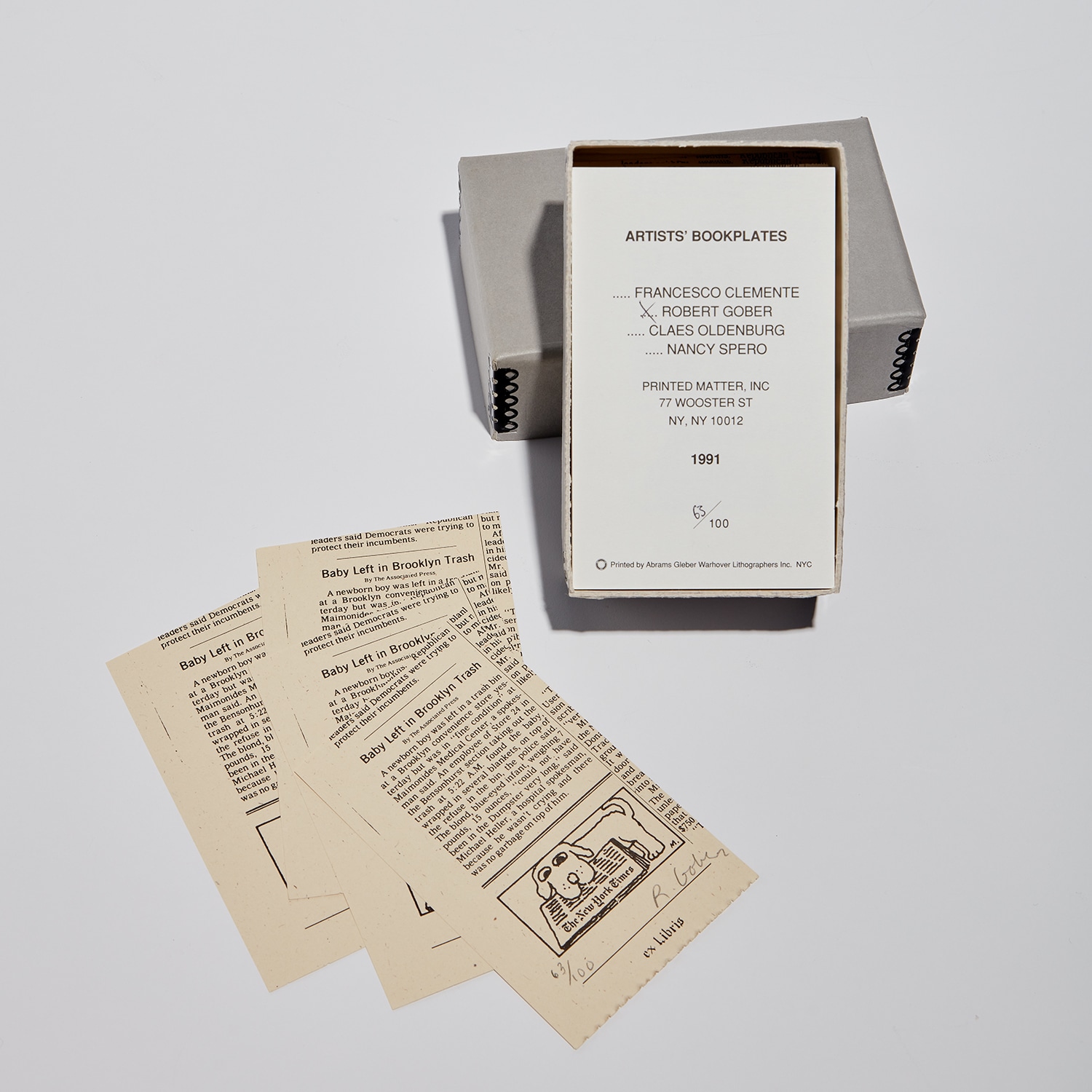
Robert Gober
Artists' Bookplates
Works on paper and edition prints, including the 'Hanging Man / Sleeping Man' wallpaper, the photolithograph dated 1992 to 1996, and the pair of signed works dated 1993 to 1994 and published by the artist in an edition of 75, reward close attention and represent significant moments in the documented history of his output. The 'Artists' Bookplates' published by Printed Matter, Inc. in New York, signed and numbered 63 out of 100, is a fine example of the kind of intimate, carefully considered multiple that Gober has produced throughout his career and that tends to find committed homes with collectors who value the full range of an artist's thinking. In art historical terms, Gober belongs to a generation that absorbed the lessons of Minimalism and Conceptualism and then turned them toward something warmer and more psychologically complex.
His debt to artists like Bruce Nauman, whose investigations of the body and its discontents opened so many doors, is evident, as is his dialogue with the surrealist tradition, particularly the uncanny domesticity found in the work of Meret Oppenheim. Yet Gober's Catholicism, his queerness, his political conscience during the AIDS crisis, and his extraordinary commitment to the handmade give his work a texture and a moral seriousness that are entirely his own. He is, in the best sense, an artist who cannot be mistaken for anyone else. Gober's legacy grows more secure with each passing decade, not because the art world has caught up with him but because his central concerns, the fragility of the body, the strangeness of the domestic, the persistence of grief and faith and desire, have only become more urgently felt.
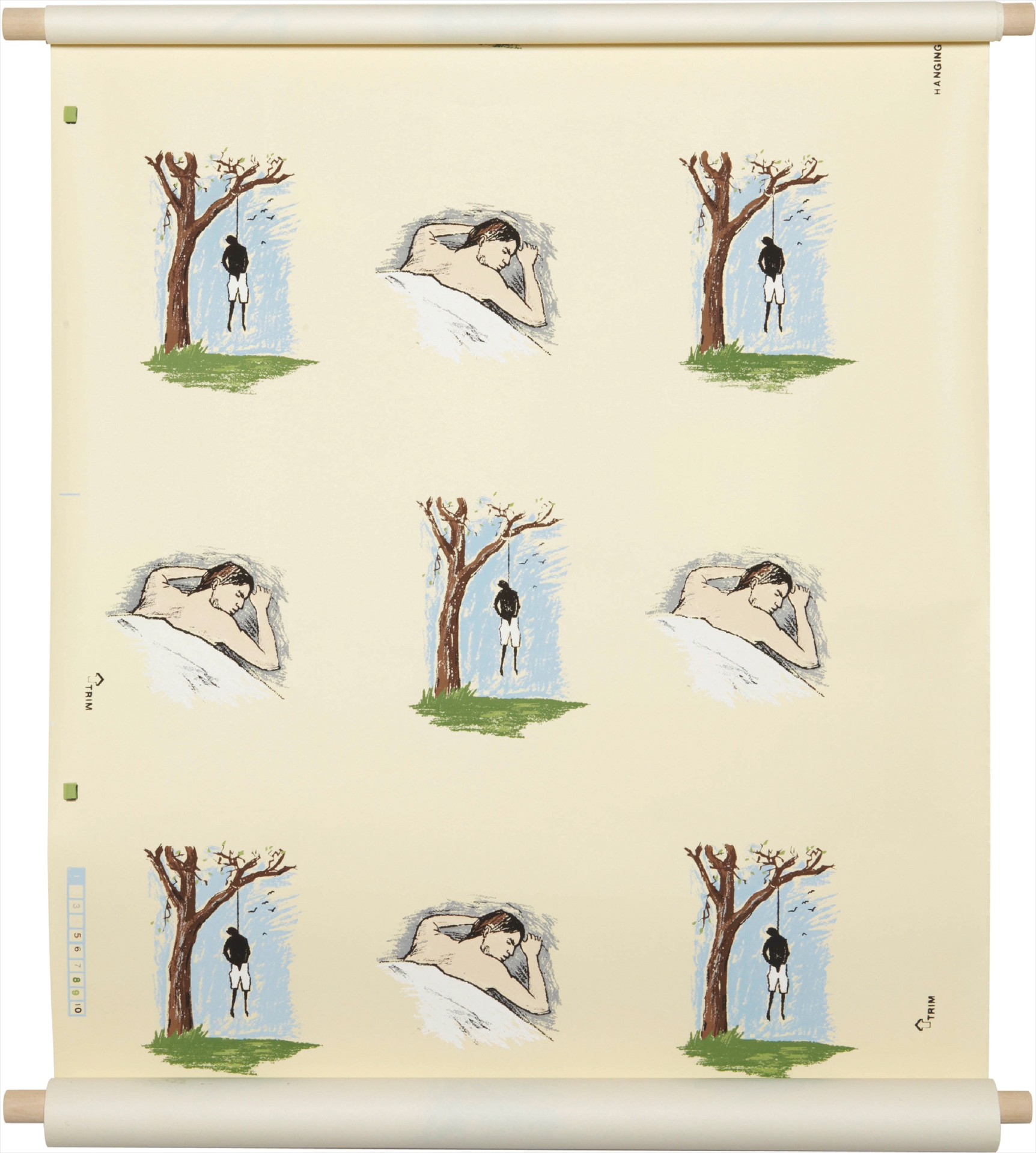
Robert Gober
Hanging Man / Sleeping Man
His work insists that sculpture can be a form of testimony, that a handmade object carries within it the entire weight of the hands that made it and the world those hands inhabited. For anyone who encounters his work in depth, whether in a museum retrospective or through the quiet presence of a print or a multiple, the experience is one of recognition: here is an artist who has looked at the world with exceptional honesty and made that honesty beautiful.
Explore books about Robert Gober