Robert Frederick Blum
Robert Blum, America's Most Enchanting Wandering Eye
Artist Spotlight · The Collection Editorial
There is a particular kind of artist who transforms travel into a visual language so personal and so precise that the world begins to look different through their eyes. Robert Frederick Blum was exactly that kind of artist. Born in Cincinnati in 1857, he spent the better part of his short but luminous career moving between continents, absorbing influences with a curiosity that never curdled into imitation. Today, with renewed collector appetite for the Aesthetic Movement and a growing appreciation for American artists who bridged the gap between Western academic tradition and East Asian visual culture, Blum feels not like a footnote to the Gilded Age but like one of its most sophisticated and undervalued voices.
Robert Frederick Blum
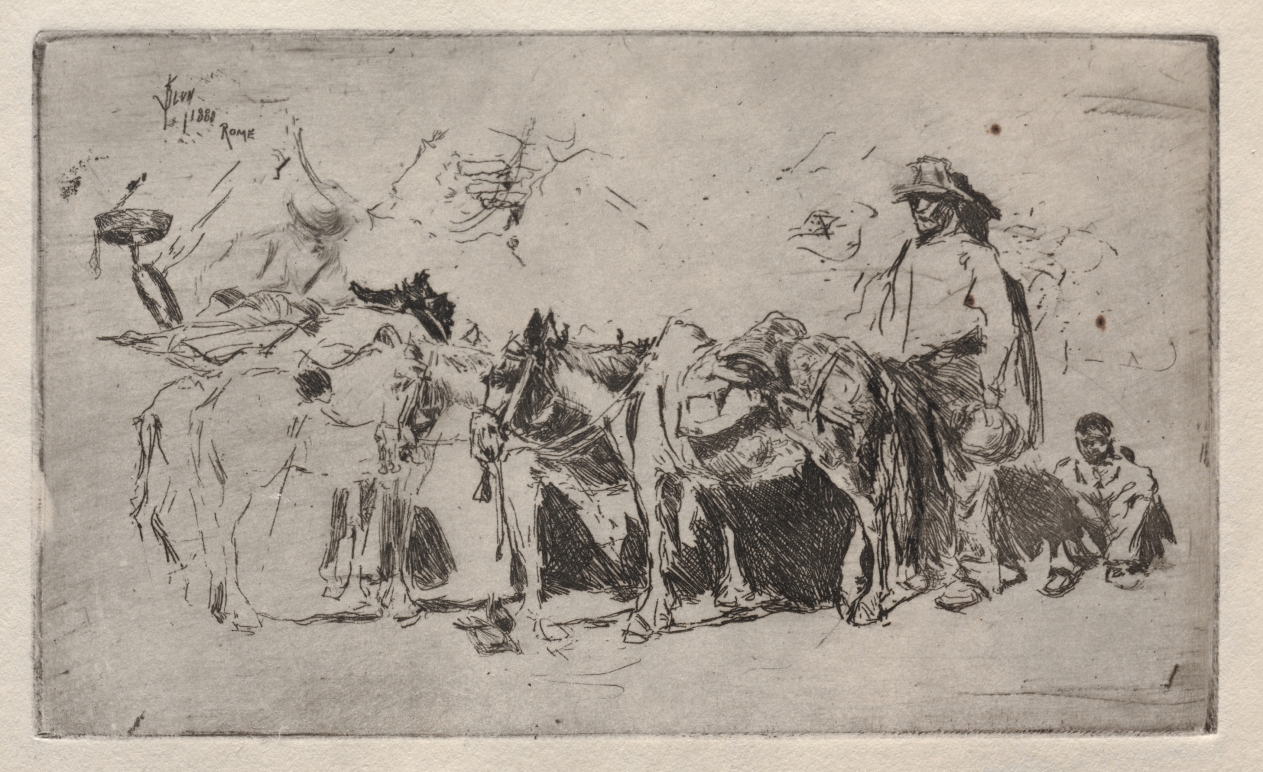
Men and Donkeys, Rome, 1880
Cincinnati in the mid nineteenth century was not the most obvious launching pad for an artist of international ambitions, but it proved surprisingly fertile ground. The city had a thriving decorative arts community, and Blum absorbed its ethos of craft, beauty, and applied skill from an early age. He studied at the McMicken School of Design in Cincinnati before making his way to Philadelphia, where he enrolled at the Pennsylvania Academy of the Fine Arts. There he encountered the rigorous draughtsmanship that would underpin everything he made, and there too he began to absorb the influence of artists who were looking outward, beyond the American landscape tradition, toward Europe and beyond.
It was in Philadelphia that Blum first encountered the work of James McNeill Whistler, a meeting of sensibilities that would prove decisive. Whistler's devotion to tone, atmosphere, and the decorative arrangement of form opened a door for the young Blum that never quite closed. The two artists shared a reverence for Japanese aesthetics at a time when Japonisme was reshaping the visual imagination of the Western world. But where Whistler distilled japonisme into an almost ethereal quietude, Blum brought to it a journalist's hunger for the specific and the observed.
Robert Frederick Blum
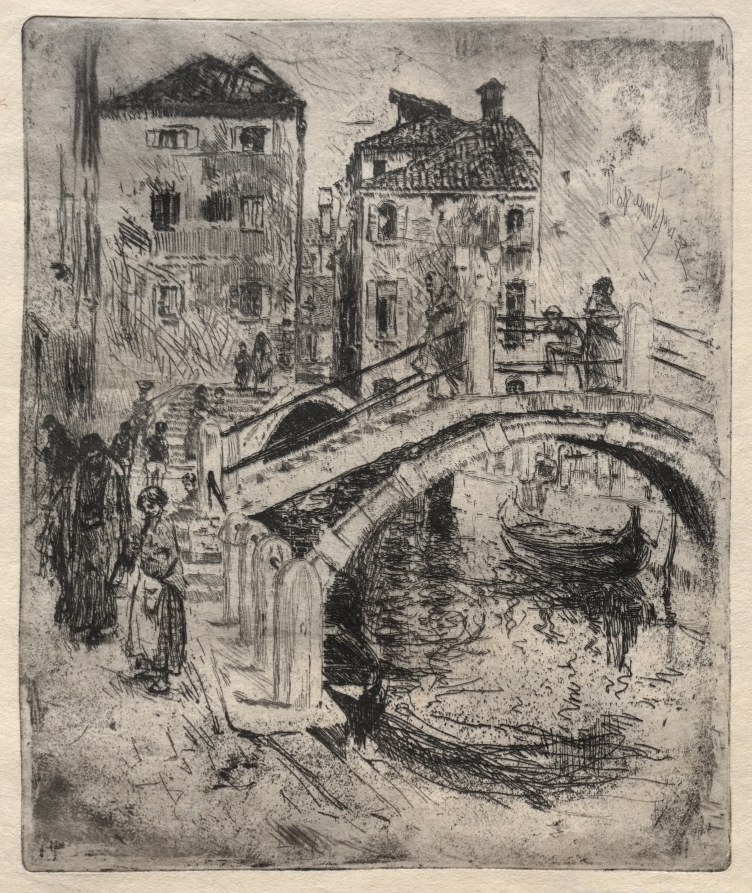
Venetian Canal and Bridges, 1886
His lines were never vague; they recorded, they celebrated, they delighted in the particular. Blum's European travels in the late 1870s and into the 1880s gave his practice its characteristic rhythm. He worked in Venice, in Rome, and across the continent, producing etchings that capture the texture of daily life with an intimacy rarely seen in the academic productions of his contemporaries. "Venetian Canal and Bridges," created in 1886, is a superb example of his European period: the composition balances the architectural solidity of Venice with an almost liquid sense of movement, the lines precise yet never stiff.
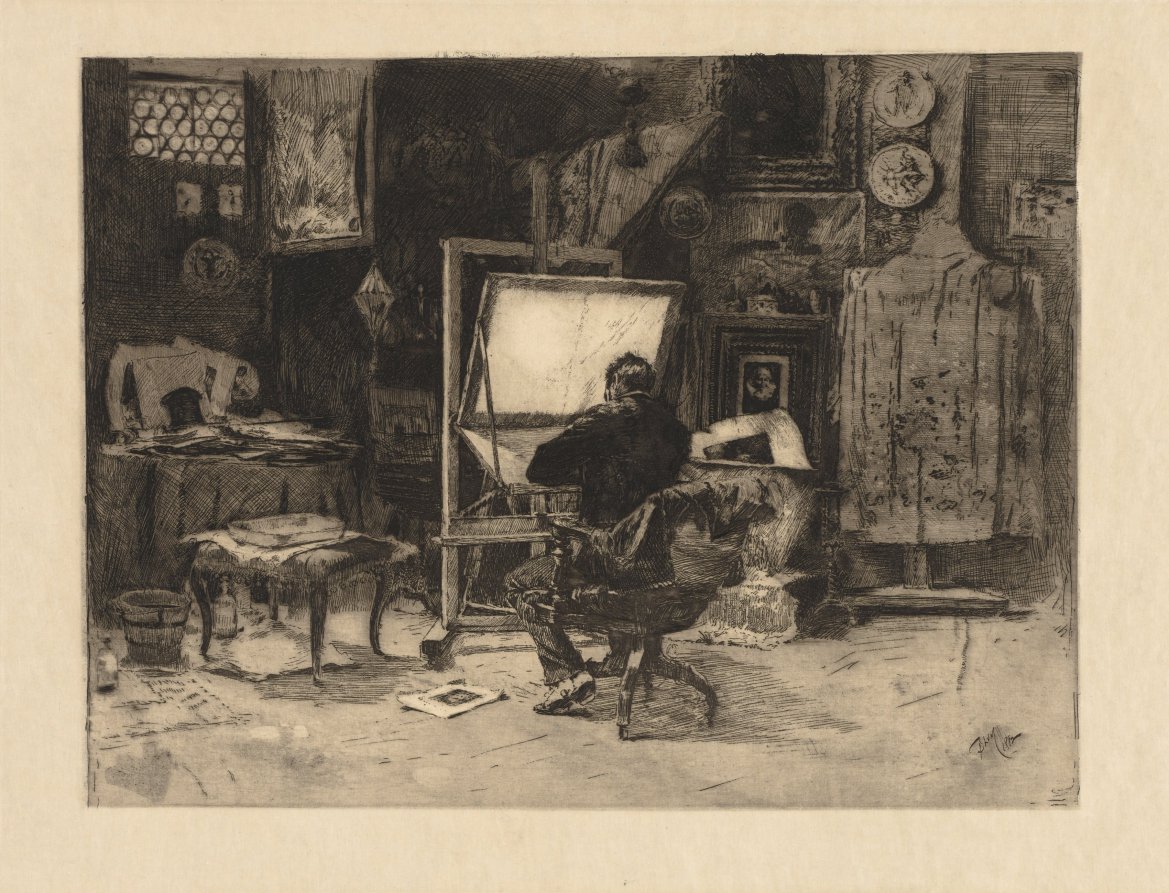
"Men and Donkeys, Rome" from 1880 demonstrates his gift for placing figures within landscape in a way that feels observed rather than arranged, casual in the best possible sense. These are not grand history paintings; they are acts of looking, and they reward the viewer who slows down to look back. His etching practice deserves particular emphasis because it is through prints that Blum's draftsmanship reveals itself most nakedly. "The Etcher" from 1882 is a quietly self referential work, a meditation on the act of making that manages to be both technically masterful and surprisingly tender.
Robert Frederick Blum
The Etcher, 1882
"Girl Reading" from 1883 belongs to a tradition of intimate domestic scenes that connects Blum to Mary Cassatt and Berthe Morisot, though his approach is distinctly his own, warmer in its particularity and lighter in touch. "Souvenir of Coney Island" from 1880 is a delightful outlier in his body of work, capturing the energy and democratic chaos of American leisure with the same attentive eye he brought to European subjects. It is a work that reminds us how genuinely curious Blum was about the world immediately around him, not just the world across the ocean. The Japanese influence in Blum's work deserves its own moment.
His "Profile Head of a Japanese Girl" from 1879 is an early indication of a fascination that would deepen considerably when he traveled to Japan in 1890 alongside the writer Lafcadio Hearn. The trip was commissioned as an illustration assignment, and Blum documented Japanese street life and ceremony with a respectful attentiveness that set him apart from artists who approached Asian subjects with condescension or exoticism. The resulting works, including large scale paintings of Japanese market scenes, brought him considerable recognition during his lifetime. He did not merely look at Japan; he listened to it, and the work shows.
Robert Frederick Blum
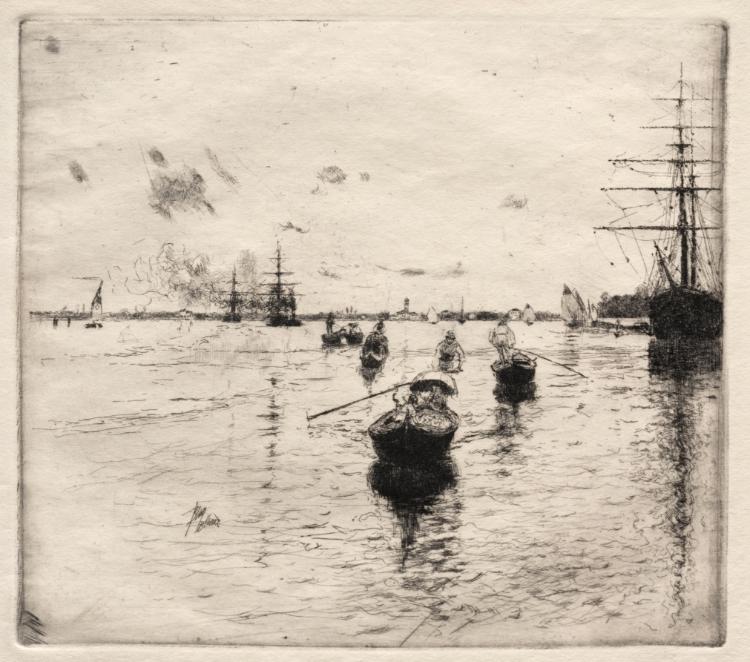
Lagoon with Steamers and Gondolas, 1885
For collectors, Blum occupies an exceptionally interesting position in the current market. He is well documented, institutionally respected, and represented in the collections of major American museums including the Metropolitan Museum of Art and the Brooklyn Museum. Yet he has not yet achieved the auction premiums of his closest peers, which means that acquiring a Blum print or painting today carries the dual pleasure of owning a genuinely beautiful object and holding a work whose market recognition still has room to grow. Collectors drawn to Whistler, to William Merritt Chase, to Frank Duveneck, or to the broader world of Gilded Age American art will find in Blum a natural companion.
His etchings in particular offer an accessible entry point into a body of work that rewards close and repeated attention. Within the broader sweep of American art history, Blum sits at a crossroads that feels increasingly significant. He was neither a pure academician nor a radical modernist; he was something more interesting, an artist who used the tools of tradition to pursue a genuinely cosmopolitan vision. The Aesthetic Movement to which he belonged insisted that beauty was not a luxury but a necessity, that the decorative and the serious need not be opposites.
That argument feels freshly relevant in a contemporary art world that has been slowly and steadily reclaiming the value of craft, surface, and the pleasures of the made thing. Blum understood something that took the art world decades to rediscover: that delight is a form of intelligence. He died in 1901 at just forty three years old, leaving behind a body of work that spans continents and disciplines, from intimate etchings of Roman streets to sweeping paintings of Japanese ceremony. The brevity of his life makes the richness of his output all the more remarkable.
To collect Robert Frederick Blum is to participate in a quiet ongoing act of recognition, acknowledging an artist whose eye was wide open, whose hand was sure, and whose sense of beauty was large enough to encompass the whole world.
Explore books about Robert Frederick Blum
Robert Frederick Blum: A Study
Kenneth McConkey
Robert Frederick Blum (1857-1901): American Painter and Illustrator
Smithsonian American Art Museum
The American Renaissance in Painting and Sculpture
George William Sheldon
American Drawings and Watercolors in the Metropolitan Museum of Art
Catherine Roach Ellis
Blum and His Circle: American Artists in Venice
Michael Quick