Richard Zommer
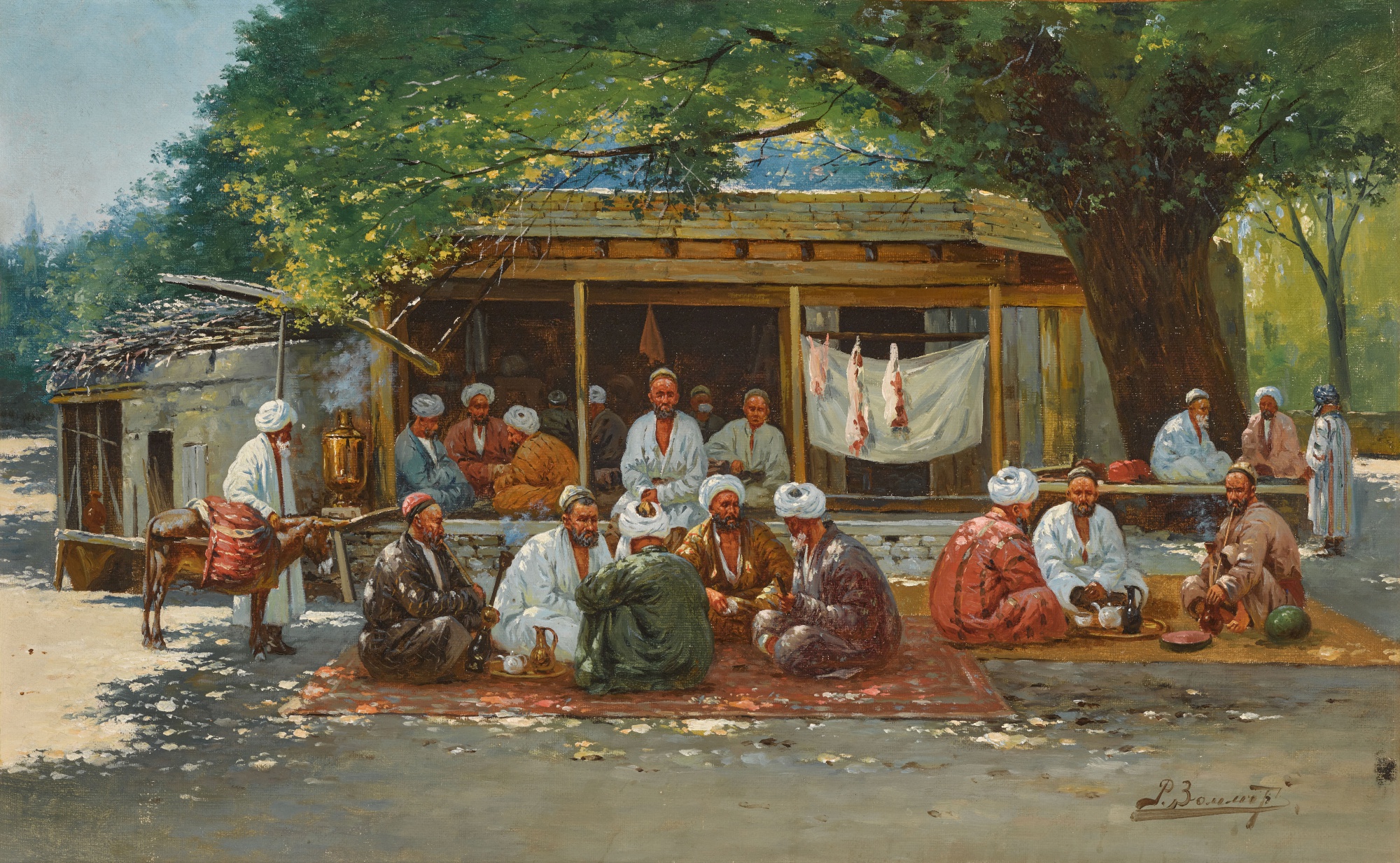
Richard Zommer: The East in Radiant Light
Artist Spotlight · The Collection Editorial
There is a moment, standing before a Zommer canvas, when the dust of a Central Asian market seems to rise from the paint itself. The light is golden and specific, the figures absorbed in their own lives, the architecture warm with age. Richard Karlovich Zommer spent decades pursuing exactly this quality of truth, traveling deep into Turkestan at a time when very few European painters had looked so carefully, or so lovingly, at the world beyond the Caspian. His paintings remain among the most compelling records we have of a vanished Central Asia, and collecting circles in Europe and Russia have been rediscovering their depth and ambition with considerable enthusiasm in recent years.
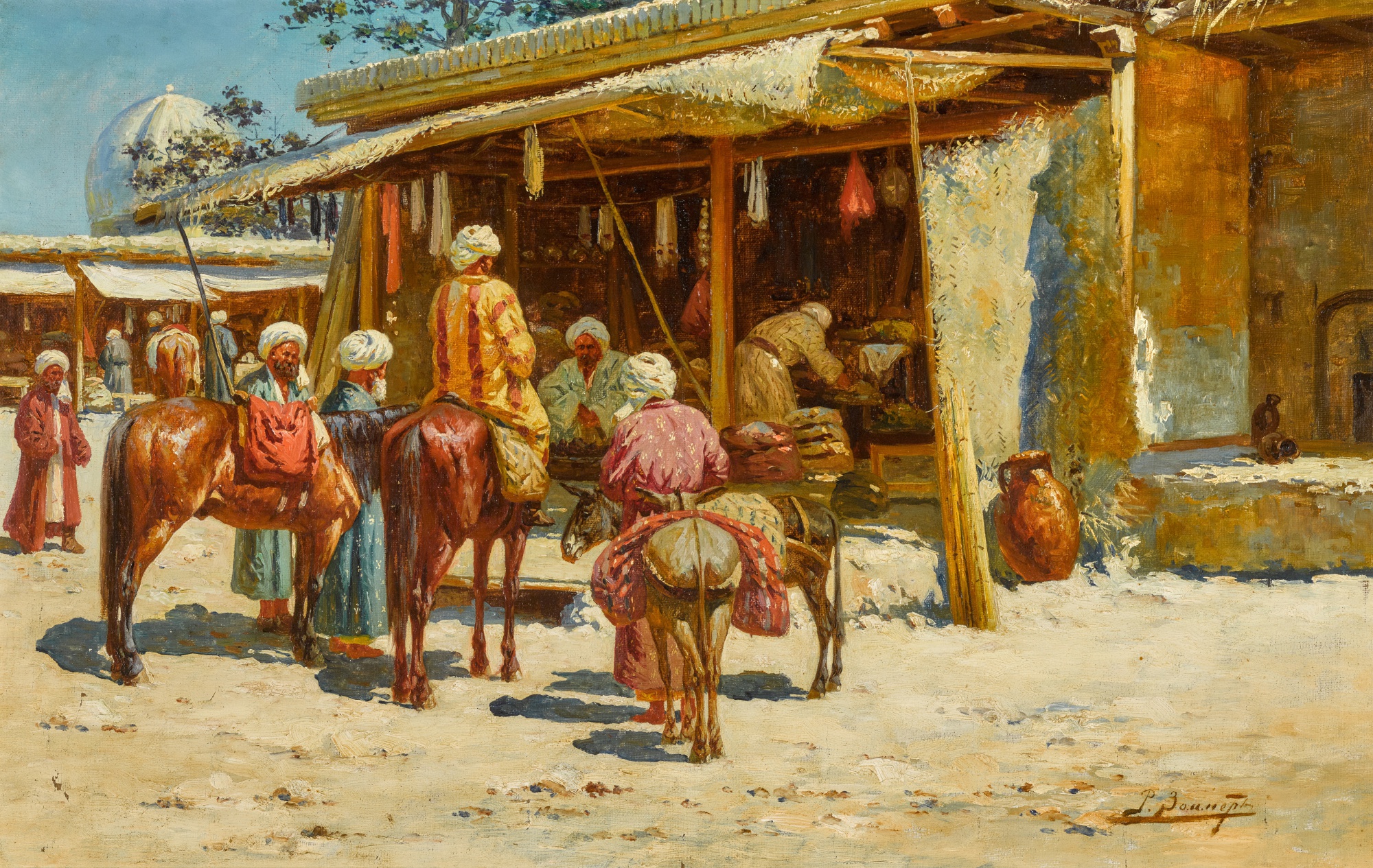
Richard Zommer
Market in Tashkent
Zommer was born in 1866 into the Russian German community that had long been part of the cultural fabric of the Russian Empire. This dual identity proved formative. He carried the rigorous academic traditions of German painting into spaces where Russian imperial curiosity was opening new geographic and artistic frontiers. He pursued his formal training at the Imperial Academy of Arts in St.
Petersburg, one of the great institutions of nineteenth century artistic education, whose alumni shaped the visual language of an entire era. The Academy instilled in him a command of composition, a facility with natural light, and a dedication to observed reality that would anchor everything he made afterward. What set Zommer apart from his contemporaries was the seriousness with which he approached Central Asia not as a fantasy but as a living world deserving of close attention. He traveled through Turkestan repeatedly, spending extended periods in the region and building a body of firsthand knowledge that gave his paintings their remarkable ethnographic weight.
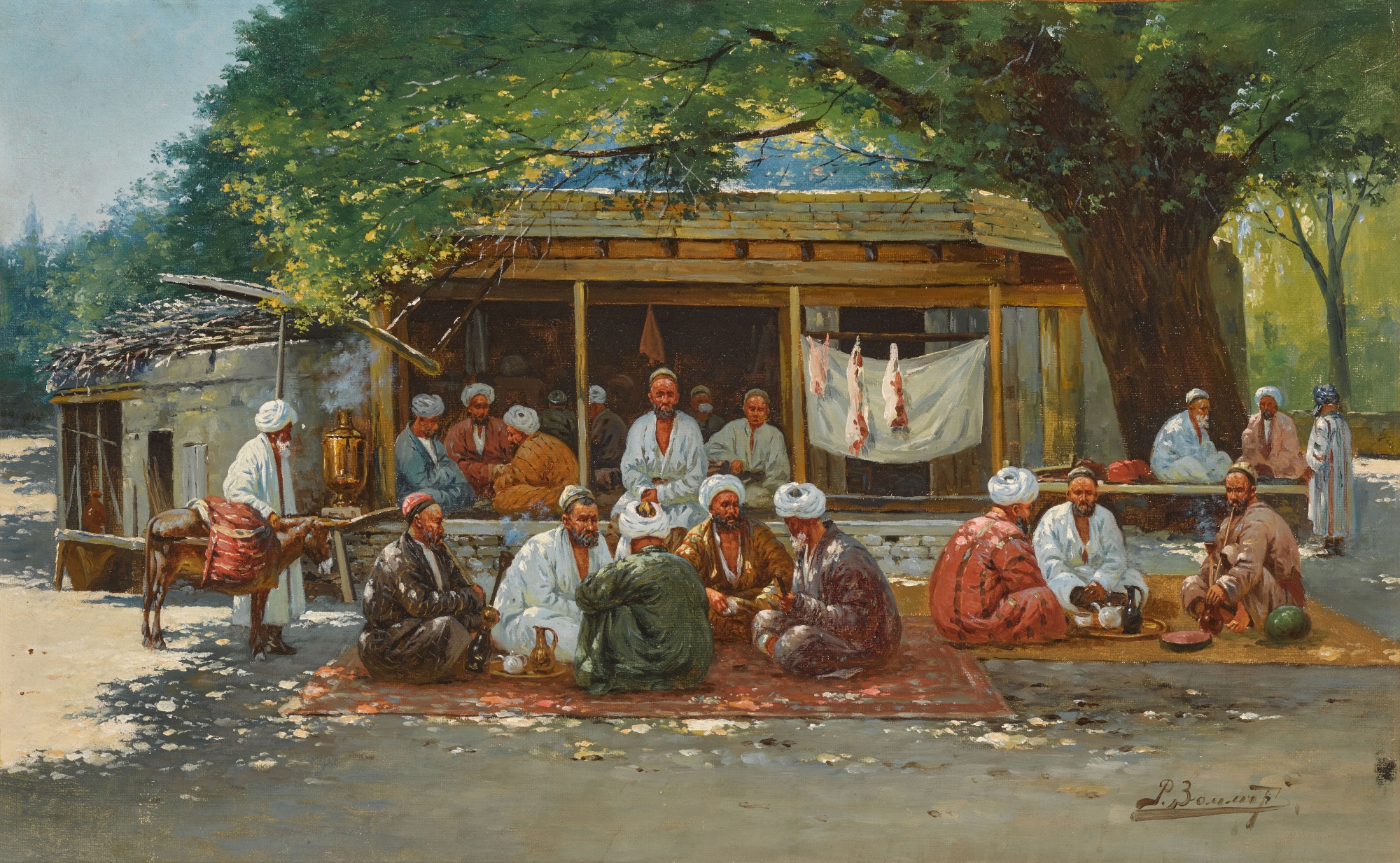
Richard Zommer
Chaikhana
Where other Orientalist painters of the era were content to work from imagination or from studio props assembled in Paris or St. Petersburg, Zommer went to the source. He documented the architecture of Tashkent, the rhythms of market life in Samarkand, the particular way light falls across a desert steppe in the late afternoon. His practice was as much about listening and watching as it was about painting.
The paintings that emerged from these journeys are among the most accomplished examples of Russian Orientalism ever produced. Market in Tashkent is perhaps his most celebrated single achievement, a work of extraordinary compositional confidence in which figures, goods, shadow, and blazing light are held in perfect tension. The painting rewards close looking: every face is individuated, every textile rendered with care, and the spatial depth achieved through nothing more than the masterly handling of atmosphere and tone. Chaikhana, his depiction of a traditional Central Asian teahouse, carries a different mood entirely, quieter and more contemplative, the men gathered in unhurried conversation beneath a canopy of shade.
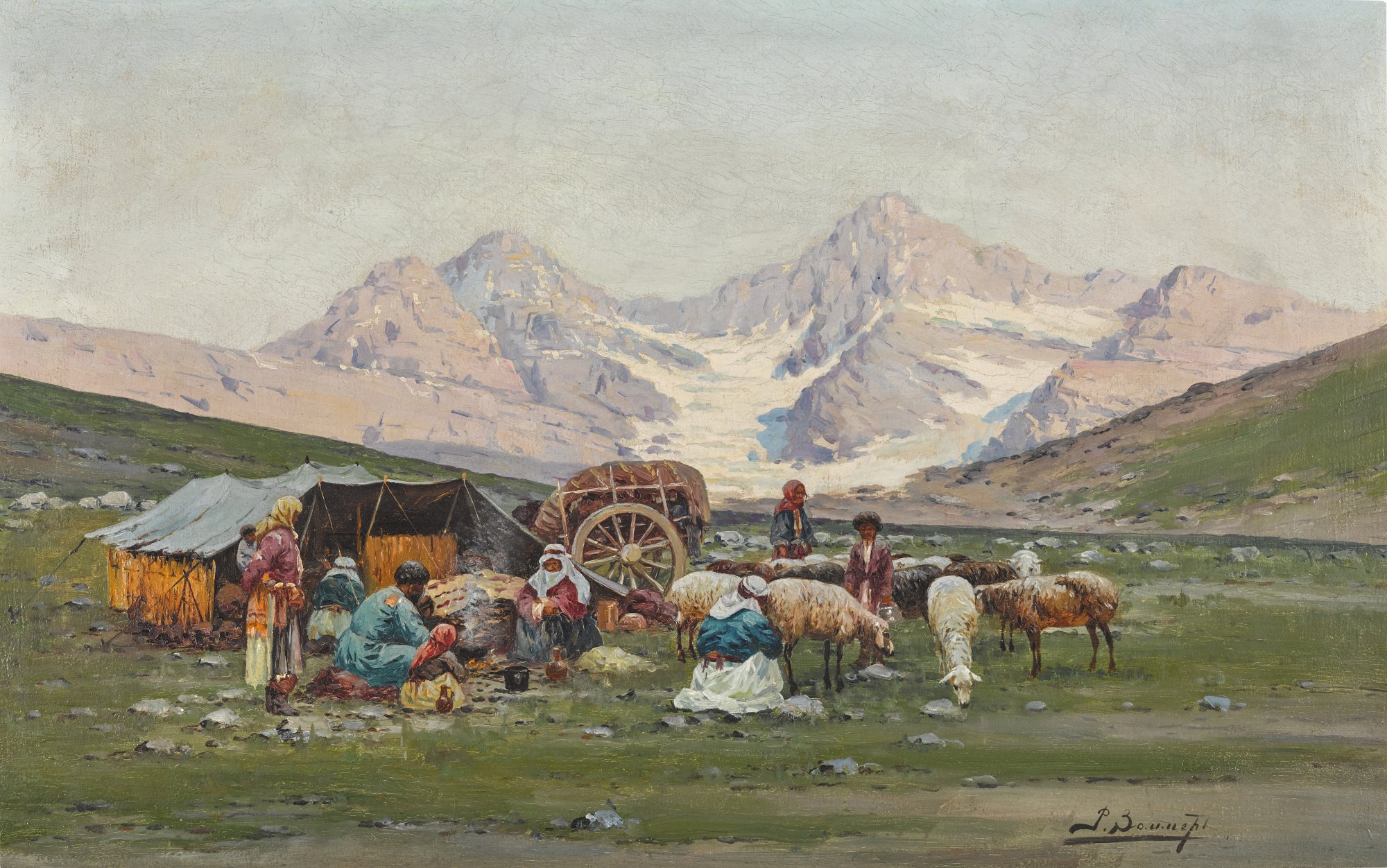
Richard Zommer
Camp in the Caucasus
These are not exotic spectacles assembled for a Western gaze. They are portraits of a society at ease with itself. Camp in the Caucasus and Camel Drivers in the Steppes extend his vision outward into the landscape, where Zommer proves equally at home. His handling of open terrain is assured and poetic.
The steppes in his work are not empty but full of a vast breathing stillness, and the camel drivers who move through them seem to belong to the land as completely as the horizon itself. At the Well is another quietly powerful work, the kind of painting that builds in memory long after you have left the room. A single encounter at a water source becomes a meditation on time, labor, and the textures of daily existence in a world very different from the one his buyers inhabited. For collectors, Zommer represents a compelling intersection of aesthetic quality and historical significance.
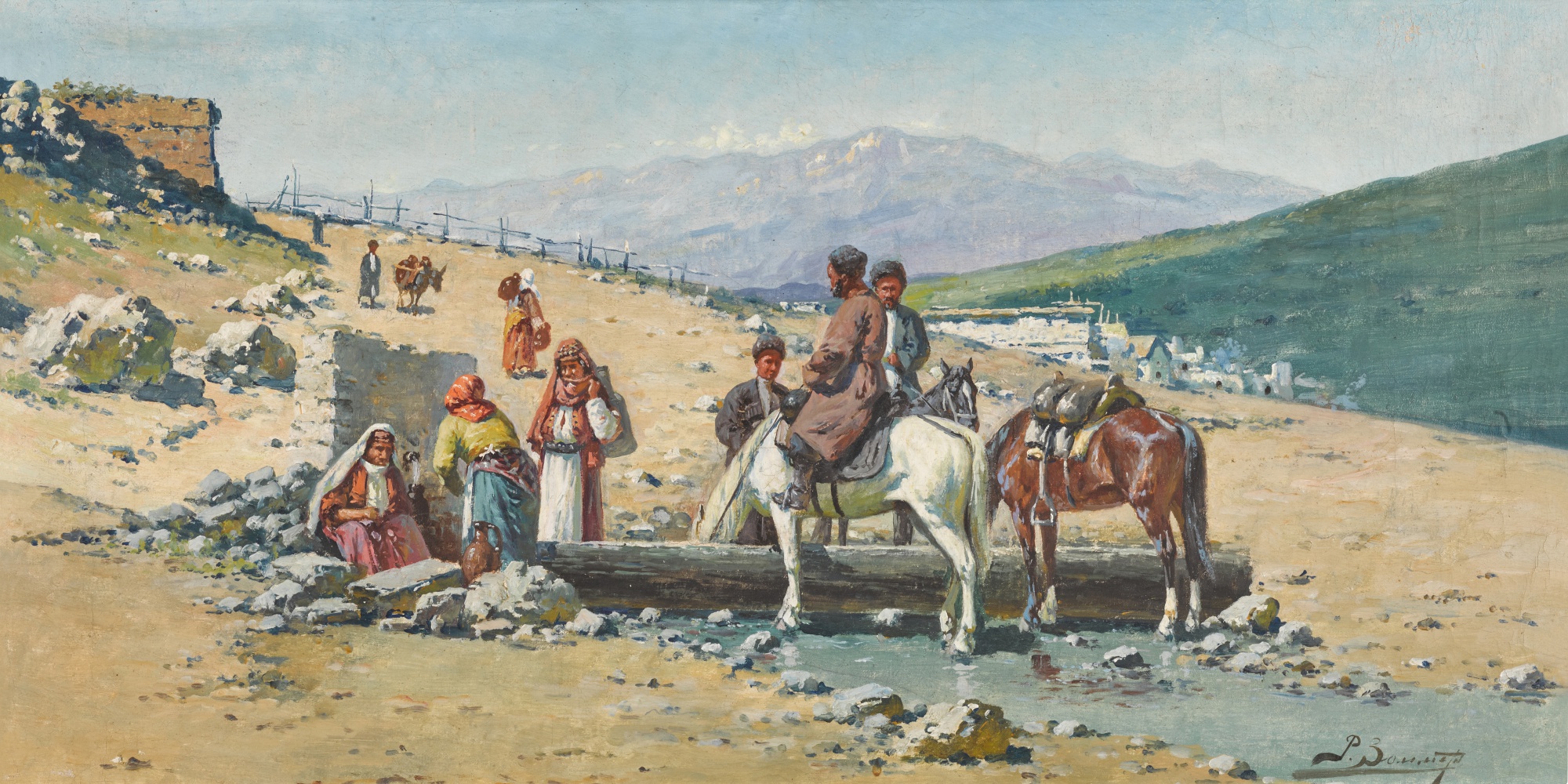
Richard Zommer
At the Well
His works appear regularly at major auction houses in London, Vienna, and Moscow, where they have demonstrated consistent collector interest and a market that reflects the growing appreciation for Russian imperial period painting beyond the canonical names. The best Zommer paintings share several qualities worth knowing: a luminous handling of natural light, compositions that balance human presence against architectural or landscape depth, and a surface quality in the oil paint that rewards close examination. Works on canvas and on prepared canvasboard both feature in his output, and the canvasboard works in particular can offer collectors an accessible entry point into his practice without sacrificing the quality of his observation. Zommer occupies a specific and important position within the broader tradition of Orientalist painting, a tradition that also includes the Russian master Vasily Vereshchagin, whose documentary seriousness offers one parallel, as well as the French Orientalists such as Jean Léon Gérôme and Eugène Fromentin, whose polished academicism influenced the entire field.
But Zommer is neither purely French in his sensibility nor purely Russian. His German academic grounding gives his work a particular solidity and restraint that distinguishes it from the more theatrical impulses of the Parisian school. He sits at a productive crossroads, and that position makes him genuinely singular within art history. The question of legacy is one that each generation answers differently, and ours is answering it in Zommer's favor.
As scholarly and curatorial attention turns toward the complexities of how European and Russian painters engaged with Central Asia during the imperial period, Zommer's paintings have acquired new layers of significance. They are not simply beautiful objects, though they are certainly that. They are also documents of a world that changed almost beyond recognition in the century following his journeys, and they carry within them a quality of genuine regard for the people and places they depict. To collect Zommer is to hold a piece of that regard, to be the custodian of a vision that was precise, passionate, and humane.